

Hastelloy C276 is a high-performance nickel-molybdenum-chromium alloy known for its exceptional corrosion resistance in harsh chemical environments. The ASTM standards define the chemical composition, mechanical properties, dimensions, and testing requirements to ensure consistent quality and reliability for industrial applications.
Overview of Hastelloy C276
Hastelloy C276 is widely used in chemical processing, pollution control, marine, and aerospace industries due to its excellent resistance to oxidizing and reducing media, including strong acids and chloride-containing solutions.
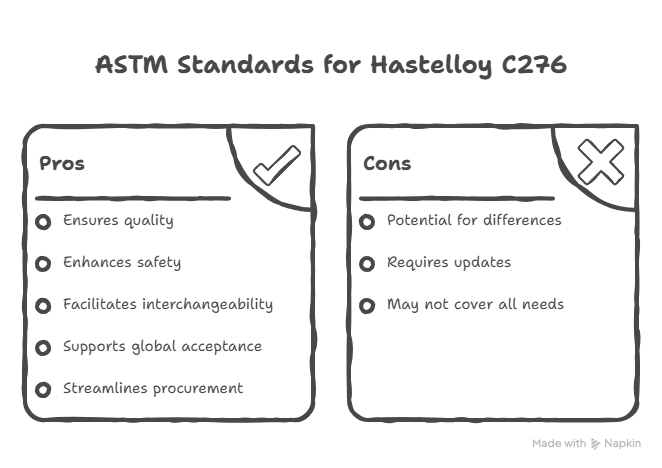
Importance of ASTM Standards
ASTM standards provide uniform specifications for the manufacturing, testing, and quality assurance of Hastelloy C276. Compliance ensures material reliability, interchangeability, and safety in critical applications.
Chemical Composition Standards (ASTM B574 / B574M)
The chemical composition of Hastelloy C276 is strictly defined to maintain corrosion resistance and mechanical properties. Typical composition ranges are:
| Element | Percentage (%) |
|---|---|
| Nickel (Ni) | 57 min |
| Chromium (Cr) | 15.5 – 17.5 |
| Molybdenum (Mo) | 15 – 17 |
| Iron (Fe) | 4 max |
| Cobalt (Co) | 5 max |
| Copper (Cu) | 0.5 max |
| Carbon (C) | 0.01 max |
| Manganese (Mn) | 1 max |
| Silicon (Si) | 0.08 – 0.5 |
Mechanical Properties Standards
ASTM standards define the mechanical requirements for Hastelloy C276, including tensile strength, yield strength, elongation, and hardness. For example:
Tensile Strength
Minimum ultimate tensile strength: 80 ksi (550 MPa)
Yield Strength
Minimum yield strength: 30 ksi (205 MPa)
Elongation
Minimum elongation: 40% in 2 inches
Hardness
Rockwell B: Max 95 HRB
Corrosion Resistance Standards
Hastelloy C276 is evaluated according to ASTM procedures for resistance to oxidizing and reducing chemicals. This includes nitric acid, hydrochloric acid, sulfuric acid, and chloride-containing solutions.
Dimensional and Tolerance Standards
ASTM standards define dimensions, tolerances, and surface finishes for rods, bars, sheets, plates, and tubes to ensure consistency for fabrication and assembly.
Product Forms
Bars and Rods
Hastelloy C276 bars are available in various diameters with precise tolerances for machining or forging.
Plates and Sheets
Used in corrosion-resistant tanks, reactors, and piping. Thickness and width are controlled under ASTM standards.
Tubes and Pipes
ASTM defines dimensions, wall thickness, and allowable variations for tubing used in chemical processing.
Heat Treatment and Delivery Conditions
Hastelloy C276 is typically solution-annealed to enhance corrosion resistance. ASTM standards specify solution annealing temperatures (1149 – 1177°C) and quenching procedures.
Inspection and Testing Requirements
Hardness Testing
Rockwell or Brinell hardness testing ensures material consistency.
Tensile and Elongation Testing
Ensures that bars, sheets, and tubes meet mechanical specifications.
Non-Destructive Testing (NDT)
Optional methods include ultrasonic or dye-penetrant inspection to detect internal defects.
ASTM Standards and UNS Number Correspondence
Hastelloy C276 corresponds to UNS N10276. ASTM B574/B574M outlines the chemical, mechanical, and dimensional specifications for various forms.
Comparison with Other International Standards
ISO and EN standards may have slightly different tolerances and chemical limits. ASTM ensures broad acceptance in North America and globally recognized processes.
Industry Applications and Standard Relevance
Compliance with ASTM standards ensures suitability for chemical reactors, heat exchangers, piping in chloride-rich environments, marine equipment, and other critical components.
Impact on Procurement and Supplier Selection
Purchasing materials certified to ASTM standards guarantees quality and reduces risk. Suppliers must provide test certificates and compliance documentation.
ASTM Standard Updates and Revisions
ASTM regularly updates B574/B574M to reflect new research, alloy variations, and safety requirements. Engineers and buyers must verify the current version before procurement.
Frequently Asked Questions (FAQ)
What is the ASTM standard for Hastelloy C276?
The main ASTM standard is B574 / B574M, which defines chemical composition, mechanical properties, and delivery conditions.
What is the UNS number for Hastelloy C276?
UNS N10276 corresponds to Hastelloy C276 and is commonly referenced alongside ASTM B574.
Can ASTM C276 standards be applied globally?
Yes, ASTM standards are internationally recognized, but ISO or EN standards may have slight differences in dimensions and tolerances.


 English
  Korean
  Japanese
  Arabic
  Spanish
  German
  Portuguese
  French
  Russian
  Italian