

Monel is a nickel-copper alloy known for its exceptional corrosion resistance, especially in marine and chemical environments. Unlike many other nickel-based alloys, Monel relies primarily on its high nickel and copper content rather than chromium or molybdenum. Understanding the chemical composition of Monel metal is essential for selecting the correct grade for industrial applications.
Introduction to Monel Alloy
Monel is a solid-solution strengthened nickel-copper alloy family widely used in marine engineering, chemical processing, oil and gas, and heat exchangers. The alloy structure consists mainly of a single-phase Ni-Cu matrix, providing uniform corrosion resistance and excellent mechanical properties.
Overview of Monel Chemical Composition
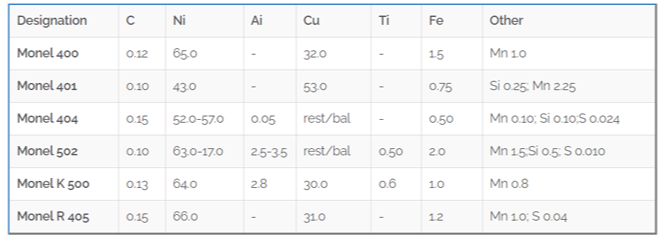
Monel typically contains more than 63% nickel and 28–34% copper, with controlled amounts of iron, manganese, carbon, silicon, and trace elements. The exact composition varies depending on the specific grade, such as Monel 400 or Monel K500.
Nickel (Ni) Content and Its Dominant Role
Nickel is the primary element in Monel, typically ≥63%. It provides:
- Excellent resistance to corrosion
- Strong resistance to chloride stress corrosion cracking
- Good mechanical strength across a wide temperature range
- Outstanding toughness at low temperatures
The high nickel content is the key factor behind Monel’s durability in seawater environments.
Copper (Cu) Content and Corrosion Contribution
Copper typically ranges from 28% to 34%. It enhances:
- Resistance to seawater and brine
- Performance in hydrofluoric acid
- Resistance in alkaline solutions
The Ni-Cu solid solution ensures uniform corrosion resistance without galvanic separation.
Iron (Fe) Control Range
Iron content is usually limited to ≤2.5%. Iron contributes to structural stability but must be controlled to avoid compromising corrosion resistance.
Manganese (Mn) and Its Effect on Strength and Workability
Manganese is typically ≤2.0%. It improves hot workability and helps control sulfur content, contributing to better processing performance.
Carbon (C) Content and Limitation Standards
Carbon is generally limited to ≤0.3%. Excess carbon may lead to carbide formation, which can negatively impact corrosion resistance and weldability.
Silicon (Si) and Its Function
Silicon content is usually ≤0.5%. It acts as a deoxidizer during melting and contributes slightly to strength improvement.
Control of Sulfur (S) and Trace Elements
Sulfur and other trace elements are strictly controlled at very low levels to prevent hot cracking and maintain weldability. Tight impurity control ensures consistent mechanical and corrosion performance.
Composition Range of Monel 400
- Nickel (including cobalt): ≥63%
- Copper: 28–34%
- Iron: ≤2.5%
- Manganese: ≤2.0%
- Carbon: ≤0.3%
- Silicon: ≤0.5%
Monel 400 is a solid-solution alloy without precipitation strengthening elements.
Composition Differences in Monel K500 (Aluminum and Titanium Strengthening)
Monel K500 has a similar Ni-Cu base composition but includes:
- Aluminum (Al): 2.3–3.15%
- Titanium (Ti): 0.35–0.85%
These additions enable precipitation hardening, significantly increasing tensile and yield strength while maintaining corrosion resistance similar to Monel 400.
Effect of Composition on Seawater Corrosion Resistance
The high nickel and copper content makes Monel highly resistant to flowing seawater, marine atmospheres, and chloride environments. Controlled impurity levels help prevent pitting and stress corrosion cracking.
Effect of Composition on Mechanical Properties
Nickel provides toughness and strength, while copper contributes to ductility. In K500, aluminum and titanium form intermetallic precipitates during aging, dramatically increasing hardness and strength.
Standards and UNS Grade Correspondence
- UNS N04400 – Monel 400
- UNS N05500 – Monel K500
- ASTM B127 – Plate/Sheet
- ASTM B164 – Bar/Rod
- ASTM B165 – Seamless Pipe/Tube
Comparison with Other Nickel-Based Alloy Compositions
Compared with nickel-chromium alloys like Inconel (focused on high-temperature oxidation resistance) or nickel-molybdenum alloys like Hastelloy (optimized for extreme chemical corrosion), Monel’s composition is simpler but highly effective in marine and hydrofluoric acid environments.
Effect of Composition Control on Weldability
Low carbon and low sulfur content improve weldability and reduce the risk of hot cracking. However, due to work-hardening tendencies, controlled heat input and appropriate filler materials are recommended during welding.
Frequently Asked Questions (FAQ)
What is the main element in Monel?
Nickel is the primary element, typically over 63%.
Why does Monel not contain chromium like other nickel alloys?
Monel relies on its Ni-Cu solid solution for corrosion resistance rather than chromium oxide film formation.
Does Monel K500 have the same composition as Monel 400?
No. K500 contains aluminum and titanium for precipitation hardening.
Is Monel suitable for chloride environments?
Yes. Its high nickel content provides excellent resistance to chloride stress corrosion cracking.


 English
  Korean
  Japanese
  Arabic
  Spanish
  German
  Portuguese
  French
  Russian
  Italian