

Hastelloy C-22 chemical composition is the foundation of its exceptional corrosion resistance and mechanical reliability in aggressive industrial environments. As a nickel-chromium-molybdenum-tungsten alloy, Hastelloy C-22 is specifically engineered to resist pitting, crevice corrosion, and stress corrosion cracking in highly corrosive media. Understanding the precise chemical balance of this alloy helps engineers, procurement managers, and material specialists select the right material for demanding chemical, marine, and pollution-control applications.
Introduction to Hastelloy C-22 Material
Hastelloy C-22 is a versatile nickel-based alloy belonging to the C-series family. It was developed to provide superior resistance to localized corrosion compared with earlier alloys such as C-276. The alloy performs exceptionally well in oxidizing and reducing environments and maintains structural integrity across a wide temperature range.
Its advanced composition allows it to resist chloride-induced pitting, crevice corrosion, and stress corrosion cracking, making it ideal for chemical processing equipment, flue gas desulfurization systems, marine components, and pharmaceutical reactors.
Hastelloy C-22 Chemical Composition Overview
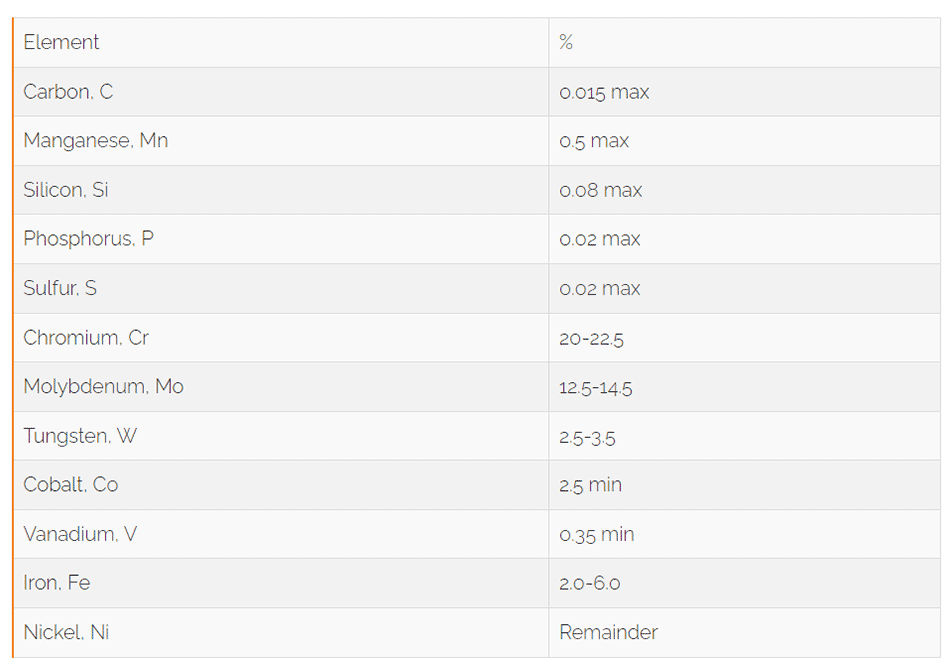
The typical chemical composition of Hastelloy C-22 (UNS N06022) in weight percentage is as follows:
- Nickel (Ni): Balance (~56% minimum)
- Chromium (Cr): 20.0 – 22.5%
- Molybdenum (Mo): 12.5 – 14.5%
- Tungsten (W): 2.5 – 3.5%
- Iron (Fe): 2.0 – 6.0%
- Cobalt (Co): ≤ 2.5%
- Carbon (C): ≤ 0.015%
- Silicon (Si): ≤ 0.08%
- Manganese (Mn): ≤ 0.5%
- Phosphorus (P): ≤ 0.02%
- Sulfur (S): ≤ 0.02%
- Vanadium (V): ≤ 0.35%
This optimized combination ensures high corrosion resistance while maintaining good mechanical strength and fabrication performance.
Nickel (Ni) Content and Its Function
Matrix Stability
Nickel forms the primary matrix of Hastelloy C-22. With a minimum content of approximately 56%, nickel ensures structural stability and resistance to stress corrosion cracking, especially in chloride-containing environments.
Resistance to Reducing Environments
Nickel enhances performance in reducing acids such as hydrochloric and sulfuric acid, where many stainless steels fail.
Chromium (Cr) and Its Influence on Corrosion Resistance
Oxidation Resistance
Chromium content between 20% and 22.5% forms a protective passive chromium oxide layer on the surface, improving resistance to oxidizing media.
Improved Pitting Resistance
Higher chromium content compared to C-276 significantly enhances resistance to localized corrosion in chloride environments.
Molybdenum (Mo) Contribution to Pitting and Crevice Corrosion Resistance
Localized Corrosion Protection
Molybdenum at 12.5–14.5% greatly increases resistance to pitting and crevice corrosion, particularly in seawater and chemical process streams.
Solid-Solution Strengthening
Mo also strengthens the alloy by distorting the lattice structure, contributing to higher tensile strength without precipitation hardening.
Tungsten (W) and Alloy Stability Enhancement
Synergistic Effect with Molybdenum
Tungsten works together with molybdenum to further enhance resistance to localized corrosion.
Microstructural Stability
It improves resistance to grain boundary precipitation and increases long-term thermal stability.
Iron (Fe) and Minor Element Influence
Cost and Structural Balance
Iron content is controlled between 2% and 6% to maintain cost efficiency while preserving corrosion resistance.
Cobalt and Vanadium
These minor elements are limited to prevent adverse phase formation and maintain corrosion performance.
Carbon (C), Silicon (Si), Manganese (Mn) Control Limits
Low Carbon Advantage
Carbon is strictly limited (≤0.015%) to prevent carbide precipitation, which could reduce corrosion resistance at grain boundaries.
Silicon and Manganese Role
These elements assist in deoxidation during melting but are tightly controlled to avoid embrittlement.
Relationship Between Chemical Composition and Corrosion Resistance
The combined high levels of chromium, molybdenum, and tungsten give Hastelloy C-22 superior resistance to pitting, crevice corrosion, and stress corrosion cracking. Compared to earlier C-series alloys, its optimized chemistry significantly improves performance in mixed acid environments.
Relationship Between Chemical Composition and Mechanical Properties
The alloy’s solid-solution strengthening elements (Mo and W) enhance tensile strength and yield strength while preserving ductility. Typical mechanical properties (solution annealed condition) include:
- Tensile Strength: ≥ 690 MPa
- Yield Strength (0.2% offset): ≥ 283 MPa
- Elongation: ≥ 40%
- Hardness: Approx. 88 HRB
Low carbon content ensures good weldability and reduces susceptibility to intergranular corrosion.
Comparison with Hastelloy C-276 Composition
- C-22 contains higher chromium content.
- C-22 has lower iron content.
- C-22 offers improved pitting resistance equivalent number (PREN).
- C-276 contains slightly lower chromium and similar molybdenum.
As a result, C-22 generally provides better resistance to localized corrosion and improved overall corrosion performance.
Standards and Grade Equivalents (UNS & ASTM)
- UNS: N06022
- ASTM B574 – Bars
- ASTM B575 – Plate, Sheet, Strip
- ASTM B619 / B622 – Pipe and Tube
- EN/DIN: 2.4602
These standards define strict chemical composition limits and mechanical property requirements.
Effect of Composition Control on Weldability
Low carbon and controlled impurity levels minimize carbide precipitation during welding, reducing the risk of intergranular corrosion and hot cracking. Hastelloy C-22 is considered highly weldable using common processes such as TIG and MIG.
Composition Tolerance Under Different Standards
Different ASTM and EN standards may allow slight variations within defined composition ranges. However, the critical elements (Cr, Mo, W) remain tightly controlled to ensure consistent corrosion performance across global supply chains.
Frequently Asked Questions (FAQ)
What is the chemical composition of Hastelloy C-22?
Hastelloy C-22 contains nickel as the base element, with 20–22.5% chromium, 12.5–14.5% molybdenum, and 2.5–3.5% tungsten, along with controlled minor elements.
Why does Hastelloy C-22 have better corrosion resistance than C-276?
Because it has higher chromium content and optimized molybdenum-tungsten balance, improving resistance to pitting and crevice corrosion.
Is low carbon important in Hastelloy C-22?
Yes, low carbon reduces carbide precipitation, improving weldability and preventing intergranular corrosion.


 English
  Korean
  Japanese
  Arabic
  Spanish
  German
  Portuguese
  French
  Russian
  Italian