

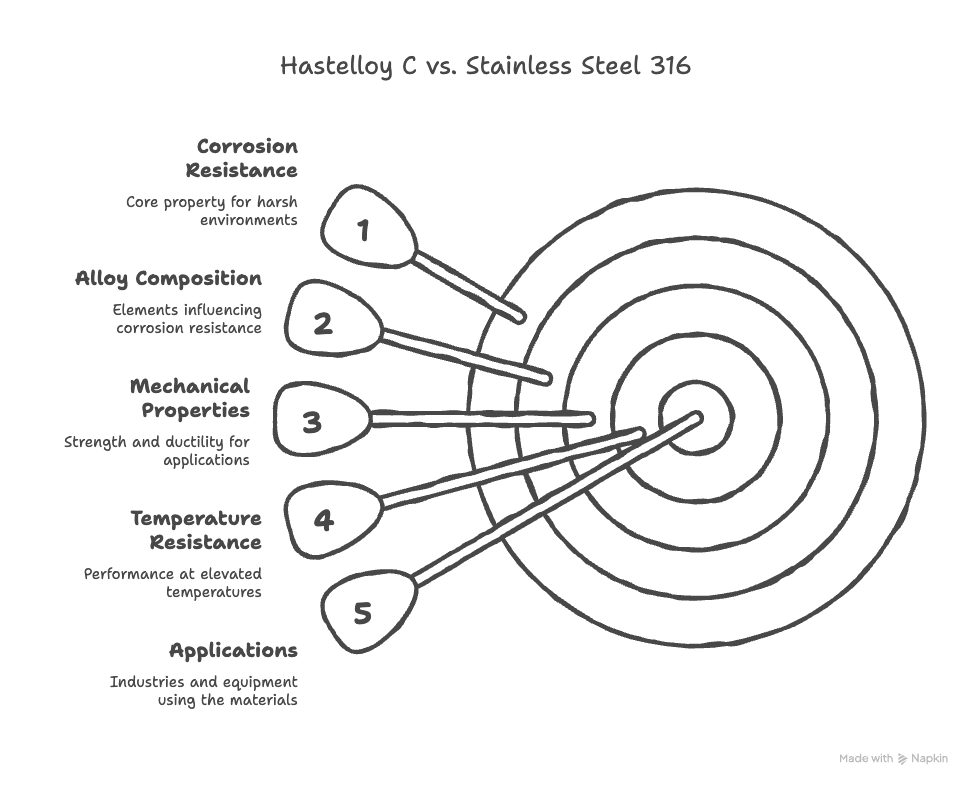
Hastelloy C and Stainless Steel 316 are widely used materials in corrosive and high-demand industrial environments, but they differ greatly in alloy composition, performance limits, and cost. Stainless Steel 316 is an austenitic chromium-nickel-molybdenum steel known for good general corrosion resistance and affordability, while Hastelloy C is a high-performance nickel-chromium-molybdenum alloy designed for extreme chemical corrosion conditions. Understanding the differences between Hastelloy C and 316 stainless steel is essential for selecting the correct material for chemical processing, oil and gas, marine, and industrial equipment.
Alloy Classification and Design Philosophy
Stainless Steel 316 is an austenitic stainless steel alloyed with chromium, nickel, and molybdenum. It is designed for good overall corrosion resistance, especially in chloride environments.
Hastelloy C refers to a family of nickel-based alloys (such as C276 and C22) engineered to withstand severe corrosion from strong acids, mixed chemicals, and high-temperature corrosive media.
Chemical Composition Comparison
| Element | Stainless Steel 316 | Hastelloy C (Typical) |
|---|---|---|
| Nickel (Ni) | 10 – 14% | Balance |
| Chromium (Cr) | 16 – 18% | 14 – 22% |
| Molybdenum (Mo) | 2 – 3% | 15 – 17% |
| Iron (Fe) | Balance | 4 – 7% |
| Copper (Cu) | — | ≤ 2% |
| Tungsten (W) | — | Up to 4.5% |
The significantly higher nickel and molybdenum content in Hastelloy C provides superior corrosion resistance compared to 316 stainless steel.
Corrosion Resistance Performance
Stainless Steel 316 performs well in mildly corrosive environments, including seawater exposure, food processing, and general chemical handling. However, it is vulnerable to pitting and crevice corrosion in high-chloride or strongly acidic conditions.
Hastelloy C offers outstanding resistance to sulfuric acid, hydrochloric acid, wet chlorine gas, and mixed corrosive environments. It resists pitting, crevice corrosion, and stress corrosion cracking far better than 316.
Mechanical Properties
Stainless Steel 316 provides good ductility, toughness, and moderate strength at room temperature and elevated temperatures.
Hastelloy C maintains stable mechanical properties even in severe corrosion conditions and at moderately high temperatures.
| Property | 316 Stainless Steel | Hastelloy C |
|---|---|---|
| Room Temperature Strength | Moderate | Moderate to High |
| Ductility | Excellent | Good |
| Creep Resistance | Limited | Better |
Temperature Resistance
Stainless Steel 316 is typically suitable for continuous service up to about 425–450°C, depending on the environment.
Hastelloy C can operate in corrosive environments at similar or slightly higher temperatures, where chemical stability is more critical than pure heat resistance.
Fabrication and Weldability
316 Stainless Steel is easy to fabricate, weld, and machine using standard stainless steel practices, making it cost-effective for large-scale fabrication.
Hastelloy C also offers excellent weldability but requires specialized machining techniques due to rapid work hardening and higher tool wear.
Cost Comparison
Stainless Steel 316 is significantly less expensive and widely available, making it suitable for cost-sensitive applications.
Hastelloy C is substantially more expensive due to high nickel and molybdenum content and complex manufacturing processes.
| Material | Typical Relative Cost |
|---|---|
| Stainless Steel 316 | Low |
| Hastelloy C | High (2–4× 316) |
Typical Applications
Stainless Steel 316 Applications:
Food processing equipment, pharmaceutical systems, marine hardware, heat exchangers, piping, and general industrial components.
Hastelloy C Applications:
Chemical reactors, acid processing equipment, flue gas desulfurization systems, oil and gas sour service components, and pollution control equipment.
How to Choose Between Hastelloy C and 316 Stainless Steel
Choose 316 Stainless Steel if: the environment is mildly corrosive, cost is a major concern, and standard fabrication is required.
Choose Hastelloy C if: the application involves strong acids, mixed corrosive media, or severe localized corrosion risks.
Related Questions
Is Hastelloy C better than 316 stainless steel?
Yes, Hastelloy C offers far superior corrosion resistance, especially in aggressive chemical environments.
Why is Hastelloy C more expensive than 316?
Because of its high nickel and molybdenum content and advanced corrosion-resistant alloy design.
Can 316 stainless steel replace Hastelloy C?
Only in mild environments; it is not suitable for severe acidic or mixed corrosion conditions.


 English
  Korean
  Japanese
  Arabic
  Spanish
  German
  Portuguese
  French
  Russian
  Italian