

Hastelloy and Inconel are two of the most widely used high-performance alloys in the industry, known for their excellent high-temperature strength and corrosion resistance. In this article, we compare these two alloys in terms of their chemical composition, mechanical properties, and application areas to help you choose the best material for your needs.
Hastelloy and Inconel Alloy Introduction
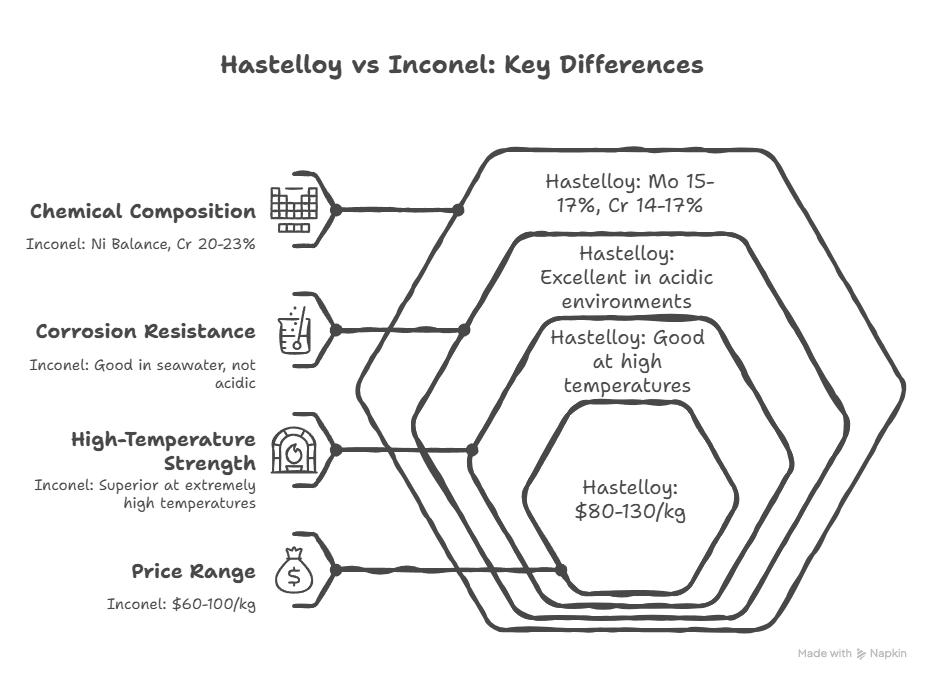
Both Hastelloy and Inconel belong to the family of nickel-based superalloys, but they are designed with different goals in mind. Hastelloy is primarily engineered for outstanding resistance to corrosion, especially in harsh chemical environments, while Inconel is focused on high-temperature strength and oxidation resistance. Both materials are widely used in aerospace, chemical, and petrochemical industries.
Chemical Composition Comparison
Hastelloy
Hastelloy alloys typically contain a higher percentage of molybdenum and chromium, contributing to their excellent resistance to reducing acids, chlorides, and other aggressive environments.
Inconel
Inconel alloys, on the other hand, are characterized by a higher nickel content, making them particularly suited for high-temperature applications. Inconel 625, for example, includes significant amounts of molybdenum and niobium for enhanced strength and oxidation resistance at elevated temperatures.
| Element | Hastelloy (e.g., C276) | Inconel (e.g., 625) |
|---|---|---|
| Nickel (Ni) | Balance | Balance |
| Chromium (Cr) | 14 – 17% | 20 – 23% |
| Molybdenum (Mo) | 15 – 17% | 8 – 10% |
| Tungsten (W) | 0% | 3 – 4% |
| Cobalt (Co) | 2 – 4% | 0% |
Strengthening Mechanism Differences
Hastelloy
Hastelloy is typically strengthened through a combination of solid solution strengthening and age hardening mechanisms. Its primary strength comes from the elements such as molybdenum and tungsten, which form carbides and solid solutions to enhance its resistance to corrosion.
Inconel
Inconel alloys are primarily strengthened through solid solution strengthening. Inconel 718, for example, is strengthened by the formation of gamma prime (γ′) phase, which significantly improves its strength and resistance to thermal creep deformation.
Corrosion Resistance Comparison
Hastelloy
Hastelloy alloys excel in corrosive environments, particularly in acidic conditions, and are often chosen for applications in chemical processing, such as in the production of sulfuric acid. Their resistance to chloride-induced stress corrosion cracking is particularly notable.
Inconel
Inconel alloys are primarily known for their excellent oxidation and high-temperature corrosion resistance. They are widely used in aerospace, gas turbines, and industrial heat exchangers where high-temperature oxidation resistance is a top priority.
High-Temperature Strength Comparison
Hastelloy
Hastelloy alloys maintain excellent strength at high temperatures but are generally not designed to withstand as high temperatures as Inconel. They are often used in environments where corrosion resistance is more critical than extreme heat resistance.
Inconel
Inconel alloys are known for their superior performance at extremely high temperatures (up to 1,000°C or higher), making them ideal for applications like turbine blades and other high-stress, high-temperature environments.
Weldability and Machinability Comparison
Hastelloy
Hastelloy alloys are known for their challenging welding and machining properties due to their high nickel content. Special techniques and equipment are often needed to ensure quality welding and machining.
Inconel
Inconel alloys are similarly challenging to weld and machine, though Inconel 625, for example, is slightly easier to weld than some other Inconel grades. Both Hastelloy and Inconel require specialized processes to prevent cracking during welding.
Mechanical Properties Comparison
| Property | Hastelloy (e.g., C276) | Inconel (e.g., 625) |
|---|---|---|
| Tensile Strength | 80 – 100 ksi | 100 – 130 ksi |
| Yield Strength | 40 – 60 ksi | 50 – 80 ksi |
| Elongation | 30 – 50% | 30 – 50% |
Applications Comparison
Hastelloy
Hastelloy alloys are typically used in chemical and petrochemical applications, such as reactors, heat exchangers, and pollution control equipment, due to their superior resistance to acidic corrosion.
Inconel
Inconel alloys are primarily used in high-temperature applications, such as in gas turbines, jet engines, and exhaust systems, where both high strength and resistance to oxidation are critical.
Cost and Price Comparison
Hastelloy
Hastelloy tends to be more expensive than Inconel due to its specialized corrosion resistance, particularly for harsh chemical environments. Prices for Hastelloy C276, for example, are generally higher compared to Inconel 625.
Inconel
Inconel alloys are typically less expensive than Hastelloy alloys, as they are more commonly used for high-temperature rather than corrosion-resistant applications. However, high-performance grades like Inconel 718 can be similarly priced to some Hastelloy grades.
Market Positioning
Hastelloy
Hastelloy is marketed as a high-end, specialty alloy primarily used in the chemical processing industry, where its corrosion resistance is unmatched. It is also used in more niche applications, such as nuclear reactors and pollution control equipment.
Inconel
Inconel is widely marketed for high-temperature applications and is more commonly used across industries such as aerospace, automotive, and power generation. It is often selected for parts that must perform under extreme heat and mechanical stress.
Typical Alloy Comparison (Hastelloy C276 vs Inconel 625)
| Alloy | Price Range (USD/kg) | Application |
|---|---|---|
| Hastelloy C276 | 80 – 130 | Chemical processing, pollution control |
| Inconel 625 | 60 – 100 | High-temperature applications, gas turbines |
Corrosion Resistance Case Studies
In Acidic Environments
Hastelloy C276 excels in acidic environments, particularly in sulfuric acid, hydrochloric acid, and other aggressive chemicals, while Inconel is generally not suitable for such conditions.
In Seawater Environments
Both Hastelloy C276 and Inconel 625 exhibit excellent resistance to seawater corrosion, but Hastelloy tends to outperform in more aggressive chloride environments.
Material Selection Tips
When selecting between Hastelloy and Inconel, consider:
- For high-temperature strength and oxidation resistance, choose Inconel.
- For applications requiring high resistance to chemical attack, particularly in acidic or chloride-rich environments, choose Hastelloy.
Frequently Asked Questions (FAQ)
What is the primary difference between Hastelloy and Inconel?
Hastelloy is known for its excellent corrosion resistance, while Inconel excels in high-temperature strength and oxidation resistance.
Which alloy is better for high-temperature environments?
Inconel alloys are better suited for high-temperature applications, especially in gas turbines, jet engines, and exhaust systems.
Which alloy performs better in acidic environments?
Hastelloy is superior in acidic environments, particularly for applications involving sulfuric and hydrochloric acids.


 English
  Korean
  Japanese
  Arabic
  Spanish
  German
  Portuguese
  French
  Russian
  Italian