

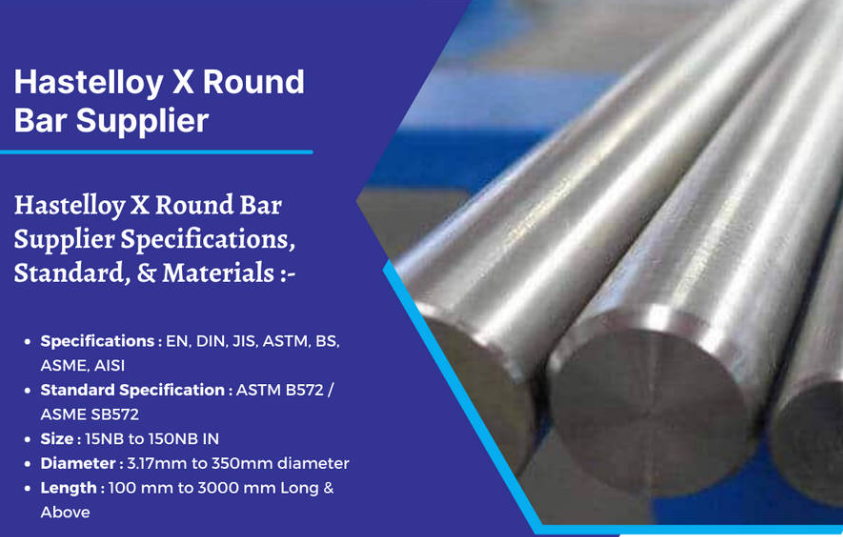
Hastelloy X round bar is a high-performance nickel-based superalloy product widely used in high-temperature and corrosive environments. Known for its outstanding oxidation resistance, excellent fabricability, and strong high-temperature strength, Hastelloy X round bar is commonly applied in gas turbines, aerospace components, industrial furnaces, and petrochemical processing equipment. This article provides a comprehensive technical overview covering chemical composition, mechanical properties, heat treatment, processing characteristics, standards, and typical applications.
Introduction to Hastelloy X Material
Hastelloy X is a solid-solution strengthened nickel-chromium-iron-molybdenum alloy designed for exceptional strength and oxidation resistance at elevated temperatures. Unlike precipitation-hardened alloys, Hastelloy X maintains good ductility and formability while offering reliable performance up to approximately 1200°C (2190°F) in oxidizing atmospheres.
The balanced composition of nickel, chromium, molybdenum, and iron allows this alloy to perform well in both high-temperature and moderately corrosive environments, making it a versatile material choice.
Hastelloy X Round Bar Product Overview
Product Forms
Hastelloy X round bar is available in hot-rolled, forged, peeled, centerless ground, and bright-drawn conditions. The surface finish and dimensional tolerance depend on the manufacturing process and customer requirements.
Supply Conditions
- Solution annealed
- Hot finished
- Cold drawn
- Forged and machined
Round bars can be supplied in straight lengths, cut-to-size pieces, or customized machining blanks.
Chemical Composition Analysis
The typical chemical composition of Hastelloy X (weight %) is as follows:
- Nickel (Ni): Balance (~47–52%)
- Chromium (Cr): 20.5–23.0%
- Iron (Fe): 17.0–20.0%
- Molybdenum (Mo): 8.0–10.0%
- Cobalt (Co): 0.5–2.5%
- Tungsten (W): 0.2–1.0%
- Carbon (C): 0.05–0.15%
- Manganese (Mn): ≤1.0%
- Silicon (Si): ≤1.0%
- Phosphorus (P): ≤0.04%
- Sulfur (S): ≤0.03%
Chromium enhances oxidation resistance, molybdenum strengthens the alloy through solid-solution strengthening, and iron improves structural stability and cost efficiency.
Mechanical Properties Parameters
At Room Temperature (Solution Annealed)
- Tensile Strength: ≥ 690 MPa
- Yield Strength (0.2% offset): ≥ 275 MPa
- Elongation: ≥ 30%
- Hardness: Approx. 85 HRB (varies with processing)
Elevated Temperature Performance
Hastelloy X retains significant strength at elevated temperatures, making it suitable for long-term high-heat exposure applications.
Physical Properties
- Density: Approx. 8.22 g/cm³
- Melting Range: 1260–1355°C
- Thermal Conductivity (at 20°C): ~9.1 W/m·K
- Coefficient of Thermal Expansion: 12.8 µm/m·°C (20–100°C)
These physical characteristics contribute to thermal stability and predictable expansion behavior during temperature cycling.
High-Temperature Strength Performance
Strength Retention
Hastelloy X round bar maintains excellent tensile and yield strength at temperatures up to 870–980°C. This makes it suitable for combustion chambers and turbine components.
Thermal Stability
The alloy resists grain growth and maintains structural integrity under prolonged high-temperature exposure.
Oxidation Resistance
With over 20% chromium content, Hastelloy X forms a stable chromium oxide layer that protects against oxidation in air up to approximately 1200°C. This makes it ideal for furnace parts and high-temperature ducting systems.
Corrosion Resistance
Resistance to Industrial Atmospheres
Hastelloy X shows good resistance to carburizing and nitriding environments.
Moderate Corrosion Resistance
While not as corrosion-resistant as some Hastelloy C-series alloys, it performs reliably in many petrochemical and gas-processing environments.
Creep and Fatigue Resistance
Creep Strength
Hastelloy X demonstrates strong resistance to creep deformation at elevated temperatures, making it suitable for long-term stress exposure.
Fatigue Performance
The alloy exhibits good resistance to thermal fatigue and cyclic loading, especially in turbine applications.
Heat Treatment Process
Solution Annealing
Typically performed at 1175–1205°C followed by rapid cooling to optimize mechanical properties and restore ductility.
Stress Relieving
Optional stress relief may be applied depending on fabrication requirements.
Machinability and Weldability
Machining Performance
Hastelloy X can be machined using rigid tooling and proper cutting speeds. Work hardening characteristics require sharp tools and adequate lubrication.
Weldability
The alloy has excellent weldability using TIG, MIG, and other common welding processes without significant cracking risks.
Common Sizes and Tolerances
- Diameter Range: 6 mm – 500 mm
- Length: 1000 mm – 6000 mm (customized available)
- Tolerance: h9, h11, or per ASTM specifications
- Surface: Black, peeled, polished, bright
Custom diameters and precision machining blanks are available upon request.
Standards and Grade Equivalents
- UNS: N06002
- ASTM B572 – Bars and Forgings
- ASTM B435 – Plate and Sheet
- DIN/EN: 2.4665
Compliance with these standards ensures consistent chemical composition and mechanical performance.
Main Application Fields
- Gas turbine components
- Combustion chambers
- Industrial furnace parts
- Petrochemical equipment
- Aerospace exhaust systems
- Heat exchangers and ducting
Its combination of high-temperature strength and oxidation resistance makes Hastelloy X round bar especially suitable for structural components exposed to extreme heat.
Frequently Asked Questions (FAQ)
What is Hastelloy X round bar used for?
It is mainly used in gas turbines, combustion chambers, furnace components, and high-temperature structural parts.
Is Hastelloy X suitable for high-temperature applications?
Yes, it maintains strength and oxidation resistance up to approximately 1200°C in oxidizing environments.
What standards cover Hastelloy X round bar?
Common standards include ASTM B572, UNS N06002, and EN 2.4665, which define chemical and mechanical requirements.


 English
  Korean
  Japanese
  Arabic
  Spanish
  German
  Portuguese
  French
  Russian
  Italian