

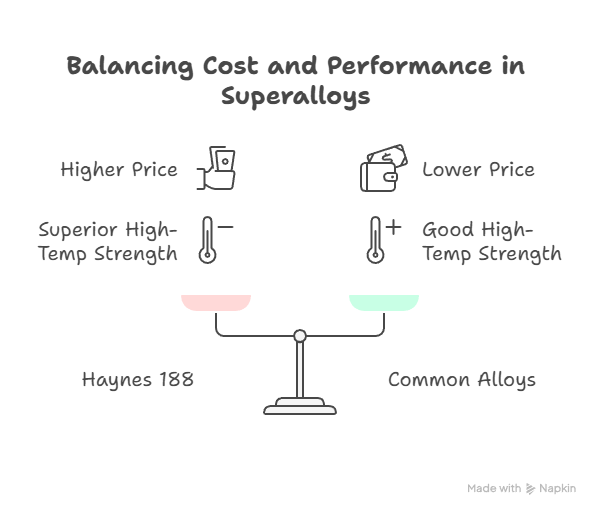
Haynes 188 is a high-performance cobalt-based superalloy known for exceptional strength, corrosion resistance, and wear resistance at elevated temperatures. It is widely used in aerospace, gas turbines, chemical processing, and other demanding industrial environments. Because Haynes 188 contains costly elements like cobalt, chromium, and tungsten, its price per kilogram is generally higher than many other alloys. The cost of Haynes 188 can vary significantly based on product form (e.g., bar, sheet, tube, wire), quantity ordered, supplier, and market fluctuations in raw materials.
Factors Affecting Haynes 188 Price
The final cost of Haynes 188 material depends on several key influences:
| Factor | How It Affects Price |
|---|---|
| Product Form | Bars, tubes, and wire can differ in processing difficulty and yield, affecting cost. |
| Dimensions | Larger cross-sections and longer lengths use more material and are priced higher. |
| Quantity | Bulk orders typically reduce per-kg prices; small quantities often cost more. |
| Certifications | Material test reports (MTR), heat treatment, and traceability add to cost. |
| Market Metal Prices | Cobalt, chromium, and tungsten prices fluctuate and directly influence alloy cost. |
| Supplier Location | Shipping, duties, and logistics can increase the delivered price. |
Typical Price Range for Haynes 188
While specific supplier quotes are always needed for exact pricing, typical market price ranges for Haynes 188 material (as guidance) are roughly:
| Product Form | Approx. Price (USD/kg) | Notes |
|---|---|---|
| Round Bar / Rod | $80 – $180+ | Depends on diameter and length |
| Sheet / Plate | $90 – $200+ | Thicker plates trend toward the high end |
| Seamless Tube | $100 – $220+ | Smaller OD and thin walls usually cost more |
| Wire / Strip | $120 – $260+ | Fine gauges and precision stock cost more |
Note: These ranges are indicative based on typical market behavior; **actual prices from factories and distributors may vary** with order size, lead time, and certification requirements. Always request a tailored quotation.
Why Haynes 188 Prices Are Higher
The cost of Haynes 188 is generally elevated compared to common stainless steels or nickel alloys due to:
- Cobalt Content: Cobalt is expensive and volatile in pricing.
- Complex Alloying: Chromium, tungsten, iron, and other elements add strength and resistance, increasing material cost.
- Specialized Manufacturing: Precision forging, rolling, or extrusion of superalloys requires advanced processes.
- Certifications and Testing: High-performance sectors often demand full traceability and mechanical testing.
How to Get Accurate Haynes 188 Pricing
To obtain precise pricing, you should prepare the following information when requesting quotes:
| Specification | Why It Matters |
|---|---|
| Alloy Form (bar, tube, sheet) | Affects processing cost and yield |
| Dimensions | Material usage directly affects cost |
| Quantity | Bulk orders often reduce unit cost |
| Certification Level | ASTM/AMS/ISO requirements add cost |
| Delivery Terms | FOB vs. DDP or expedited shipping impacts price |
Haynes 188 Material Supplied by Ncalloys
Ncalloys supplies Haynes 188 in a wide range of product forms including bars, tubes, plates, and precision wire. All material is fully certified, with quality documentation and traceability suitable for aerospace, chemical processing, and power generation applications. Custom sizes and heat treatment services are available on request.
Manufacturer: Ncalloys
Contact Email: [email protected]
Related Questions
1. What industries use Haynes 188?
Haynes 188 is commonly used in aerospace gas turbines, heat-treating fixtures, chemical processing equipment, and high-temperature industrial components due to its strength and oxidation resistance.
2. Can Haynes 188 withstand high temperatures?
Yes, Haynes 188 retains high strength and corrosion resistance at elevated temperatures, making it ideal for applications up to and beyond 1100°C in many cases.
3. How does Haynes 188 compare to other superalloys in price?
Due to its cobalt base and complex alloying, Haynes 188 generally costs more per kilogram than many nickel-based alloys like Inconel 625 or Hastelloy C276, but it offers superior high-temperature strength in many environments.


 English
  Korean
  Japanese
  Arabic
  Spanish
  German
  Portuguese
  French
  Russian
  Italian