

Haynes 188 and Haynes 25 (also known as L605) are both cobalt-based superalloys designed for high-temperature applications, particularly in aerospace and gas turbine environments. While they share similar base elements, Haynes 188 is a more advanced alloy with improved oxidation resistance and thermal stability at extreme temperatures. Understanding the differences between these two materials is essential for selecting the right alloy for demanding service conditions.
Introduction to Haynes 188 and Haynes 25 (L605)
Haynes 25 (UNS R30605) is a traditional cobalt-based alloy widely used for its excellent high-temperature strength and corrosion resistance. Haynes 188 (UNS R30188) is a newer development designed to enhance oxidation resistance and long-term stability in oxidizing environments above 1000°C.
Development Background and Application Positioning
| Alloy | Development Focus | Typical Positioning |
|---|---|---|
| Haynes 25 (L605) | General high-temperature strength | Classic cobalt-based alloy |
| Haynes 188 | Improved oxidation resistance | Advanced high-temp applications |
Chemical Composition Comparison (Co, Ni, Cr, W)
| Element | Haynes 188 (%) | Haynes 25 (L605) (%) |
|---|---|---|
| Cobalt (Co) | Balance | Balance |
| Nickel (Ni) | ~22 | ~10 |
| Chromium (Cr) | ~22 | ~20 |
| Tungsten (W) | ~14 | ~15 |
Alloy Design Philosophy Differences
Haynes 25 is designed as a versatile cobalt-based alloy focusing on strength and corrosion resistance. Haynes 188 incorporates higher nickel content and optimized chromium levels to improve oxidation resistance and thermal stability at extreme temperatures.
Strengthening Mechanism Comparison
| Alloy | Strengthening Mechanism |
|---|---|
| Haynes 25 | Solid solution strengthening (Co-Cr-W system) |
| Haynes 188 | Enhanced solid solution strengthening with improved stability |
High-Temperature Strength and Stress Rupture Performance
Both alloys offer excellent high-temperature strength, but Haynes 188 demonstrates better strength retention at temperatures above 900°C, especially in long-term exposure conditions.
Creep Resistance Comparison
| Alloy | Creep Resistance |
|---|---|
| Haynes 25 | Good |
| Haynes 188 | Very good (improved long-term stability) |
Thermal Stability (Long-Term Service Performance)
Haynes 188 exhibits superior microstructural stability during prolonged high-temperature exposure, making it more suitable for components subjected to continuous service.
Oxidation Resistance (Above 1000°C)
| Alloy | Oxidation Resistance |
|---|---|
| Haynes 25 | Good up to ~980°C |
| Haynes 188 | Excellent above 1000°C |
Sulfidation and Hot Corrosion Resistance
Haynes 188 provides improved resistance to sulfidation and hot corrosion due to its optimized chromium and nickel content, making it more reliable in aggressive combustion environments.
Machining and Formability Comparison
| Property | Haynes 188 | Haynes 25 |
|---|---|---|
| Machinability | Difficult | Moderate |
| Formability | Good | Good |
Welding Performance Comparison
Both alloys have good weldability, but Haynes 188 generally shows better weld stability and resistance to cracking in high-temperature welded structures.
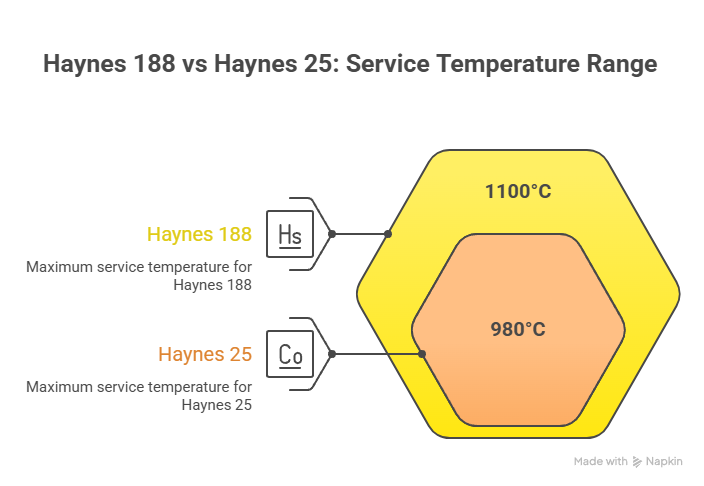
Service Temperature Range Comparison
| Alloy | Max Service Temperature |
|---|---|
| Haynes 25 | ~980°C |
| Haynes 188 | ~1100°C |
Aerospace Engine Applications Comparison
- Haynes 25: Combustion chambers, afterburner components
- Haynes 188: Combustor liners, transition ducts, hot gas components
Improvements of Haynes 188 over Haynes 25
- Better oxidation resistance at extreme temperatures
- Improved long-term thermal stability
- Enhanced performance in aggressive combustion environments
Cost and Market Price Differences
| Alloy | Price Level | Reason |
|---|---|---|
| Haynes 25 | High | Traditional cobalt alloy |
| Haynes 188 | Higher | Advanced composition and performance |
When to Choose Haynes 188
- Operating temperatures above 1000°C
- Oxidizing or combustion environments
- Long-term thermal exposure conditions
When to Choose Haynes 25 (L605)
- Moderate high-temperature applications
- Cost-sensitive projects
- General aerospace and industrial use
Frequently Asked Questions (FAQ)
Is Haynes 188 better than Haynes 25?
For high-temperature oxidation resistance and long-term stability, Haynes 188 is generally superior.
Which alloy is more cost-effective?
Haynes 25 is usually more cost-effective for less demanding applications.
Can Haynes 25 replace Haynes 188?
Only in lower temperature environments where oxidation resistance is less critical.
Are both alloys suitable for aerospace applications?
Yes, both are widely used in aerospace, but Haynes 188 is preferred for more extreme conditions.


 English
  Korean
  Japanese
  Arabic
  Spanish
  German
  Portuguese
  French
  Russian
  Italian