

Haynes 25 is a high-performance nickel-based superalloy that is widely used in industries where high temperature, corrosion resistance, and mechanical strength are crucial. Its excellent properties make it suitable for use in aerospace, power generation, and chemical processing industries. This article will provide a detailed look at Haynes 25’s chemical composition, its high-temperature performance, corrosion resistance, and mechanical properties. Additionally, we will compare Haynes 25 to other alloys such as Inconel 625, Hastelloy C-276, and Alloy 800H, exploring the similarities and differences between them. We will also cover its applications in critical industries and provide insights into its welding performance and heat treatment effects.
Overview of Haynes 25 Alloy
Haynes 25 is a nickel-chromium-based alloy that is specifically designed to offer excellent performance in extreme environments. The alloy combines high strength with excellent resistance to high-temperature oxidation and corrosion, making it suitable for applications where both thermal and mechanical performance are critical. It is often used in industries such as aerospace, power generation, and chemical processing, where components are exposed to high temperatures, corrosive environments, and mechanical stress.
The composition of Haynes 25 includes a high concentration of nickel and chromium, with smaller amounts of molybdenum, iron, and other trace elements that contribute to its high strength and resistance to oxidation and corrosion at elevated temperatures.
The Major Chemical Composition of Haynes 25
The main components of Haynes 25 alloy include:
| Element | Composition (%) | Role in Alloy |
|---|---|---|
| Nickel (Ni) | Balance | Provides high-temperature strength, corrosion resistance, and overall stability. |
| Chromium (Cr) | 20-25% | Improves oxidation resistance by forming a stable oxide layer at high temperatures. |
| Molybdenum (Mo) | 8-10% | Enhances resistance to corrosion and improves strength at high temperatures. |
| Iron (Fe) | 2-5% | Contributes to the alloy’s overall strength and stability. |
| Tungsten (W) | 1-3% | Increases high-temperature strength and enhances resistance to thermal degradation. |
| Cobalt (Co) | 0.5-1% | Improves high-temperature stability and resistance to embrittlement. |
High-Temperature Performance of Haynes 25
Haynes 25 is known for its outstanding high-temperature performance. The alloy retains its mechanical properties at temperatures up to 1100°C (2012°F), making it ideal for use in high-stress, high-heat applications such as turbine engines and combustion chambers. The combination of nickel and chromium provides excellent resistance to thermal expansion and creep, ensuring that the alloy maintains its strength and integrity in extreme environments.
Additionally, Haynes 25 exhibits exceptional resistance to thermal cycling, making it suitable for applications where rapid temperature fluctuations are common, such as in aerospace engines and gas turbines.
Corrosion Resistance of Haynes 25
Haynes 25 is highly resistant to oxidation and other forms of corrosion at elevated temperatures, thanks to the high chromium content. The chromium in the alloy forms a protective oxide layer on the surface that prevents further oxidation and protects the material from the damaging effects of high-temperature exposure. This makes Haynes 25 an excellent choice for applications in environments with high levels of oxygen, sulfur, or other corrosive gases.
In addition to oxidation resistance, Haynes 25 also exhibits resistance to carburization, sulfidation, and other forms of corrosion commonly encountered in high-temperature environments.
Mechanical Properties of Haynes 25
Haynes 25 exhibits excellent mechanical properties, including high tensile strength, hardness, and creep resistance. The alloy maintains its strength even at elevated temperatures, which is critical for applications where components are exposed to mechanical stress over extended periods. Additionally, Haynes 25 demonstrates excellent resistance to deformation under both high temperatures and high stress.
The material’s strength and resistance to creep make it ideal for use in high-stress applications, such as turbine blades, heat exchangers, and other critical components in the aerospace and power generation industries.
Applications of Haynes 25 in Aerospace and Energy Industries
Haynes 25 is widely used in industries where high temperature, strength, and corrosion resistance are essential. Some of its most common applications include:
- Turbine blades and vanes in gas turbines
- Combustion chambers and nozzles
- Heat exchangers and furnace components
- Gas and steam turbine components
- Welding electrodes and welding parts in high-temperature applications
These applications benefit from Haynes 25’s combination of high strength, resistance to high-temperature oxidation, and long-term stability under extreme conditions.
Comparison of Haynes 25 with Other Alloys
Haynes 25 vs. Inconel 625
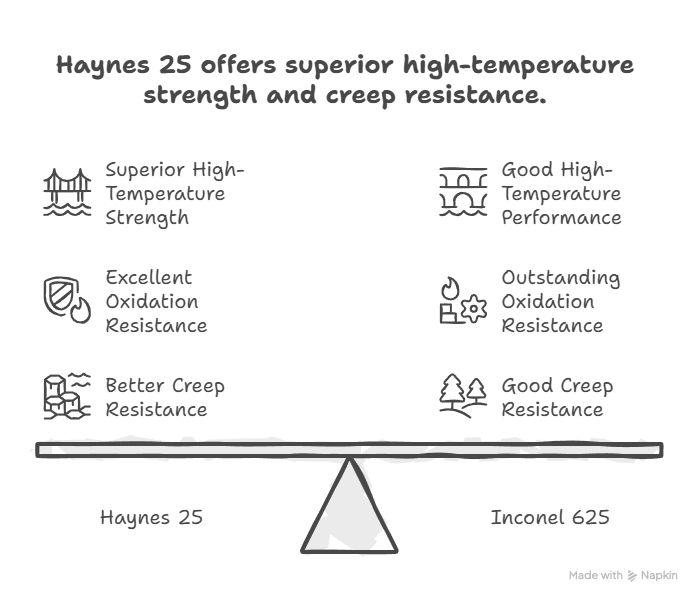
Inconel 625 is another high-performance nickel-based superalloy with excellent high-temperature performance. Both alloys offer outstanding resistance to oxidation and corrosion, but there are differences in their composition and performance. While both alloys are used in similar applications, Haynes 25 generally offers better high-temperature strength and oxidation resistance compared to Inconel 625, making it more suitable for applications in gas turbines and other high-stress environments.
Haynes 25 vs. Hastelloy C-276
Hastelloy C-276 is a corrosion-resistant alloy that performs well in extreme environments. While both Haynes 25 and Hastelloy C-276 offer excellent corrosion resistance, Haynes 25 has superior high-temperature strength and creep resistance, making it a better choice for high-temperature applications such as turbine engines and power generation components.
Haynes 25 vs. Alloy 800H
Alloy 800H is a heat-resistant alloy commonly used in industrial applications. While it shares similarities with Haynes 25 in terms of corrosion resistance and high-temperature performance, Haynes 25 offers superior creep resistance and mechanical strength at higher temperatures, making it more suitable for high-performance aerospace and power generation applications.
Welding Performance of Haynes 25
Haynes 25 has excellent weldability, making it suitable for a wide range of welding techniques, including TIG, MIG, and electron beam welding. The alloy’s composition helps it maintain its mechanical properties and oxidation resistance during the welding process. However, it is important to control the welding parameters carefully to avoid issues such as cracking or excessive oxidation.
Post-weld heat treatment may be required to restore the alloy’s strength and oxidation resistance, depending on the welding process and the specific application.
Heat Treatment and Strengthening Effects
Haynes 25 benefits from a heat treatment process that enhances its mechanical properties. The alloy undergoes solution heat treatment followed by aging to optimize its strength and resistance to creep. This heat treatment process improves the material’s microstructure, ensuring that it performs reliably under high-stress, high-temperature conditions.
Other Equivalent Alloys (e.g., Alloy 625)
Alloy 625 is another high-performance nickel-based superalloy that is often compared to Haynes 25. While both alloys offer similar levels of oxidation and corrosion resistance, Haynes 25 typically offers better high-temperature strength, creep resistance, and overall mechanical properties. Alloy 625 is often chosen for applications where resistance to aggressive chemicals is more critical, while Haynes 25 is preferred for applications with high thermal and mechanical demands.
Common Applications and Industry Case Studies
Haynes 25 is used in a variety of critical applications, such as:
- Aerospace: turbine blades, combustion chambers
- Energy: gas turbine components, steam turbine components
- Chemical processing: heat exchangers, furnace components
These industries rely on Haynes 25’s unique combination of high-temperature strength, oxidation resistance, and mechanical stability for mission-critical components that operate in extreme environments.
Performance of Haynes 25 in Extreme Environments
Haynes 25 performs exceptionally well in extreme environments, such as high-temperature applications in gas turbines and aerospace engines. The alloy’s ability to maintain its strength and resist oxidation and corrosion at elevated temperatures ensures that it can perform reliably in harsh conditions over extended periods.
Common Questions about Haynes 25
What is the primary use of Haynes 25 alloy?
Haynes 25 is primarily used in high-temperature applications, including turbine blades, combustion chambers, and heat exchangers in aerospace and power generation industries.
How does Haynes 25 compare to Inconel 625?
While both alloys offer excellent resistance to oxidation and corrosion, Haynes 25 provides better high-temperature strength and creep resistance, making it more suitable for high-performance applications.
Can Haynes 25 be welded easily?
Yes, Haynes 25 has excellent weldability, and it can be welded using standard techniques such as TIG and MIG welding. Proper welding procedures and post-weld heat treatment are important for optimal performance.


 English
  Korean
  Japanese
  Arabic
  Spanish
  German
  Portuguese
  French
  Russian
  Italian