

High Nickel Alloy 625 welded pipes are among the most trusted materials in industries that demand extreme strength, corrosion resistance, and thermal stability. As one of the most advanced materials in the nickel alloy family, Alloy 625—also known as Inconel 625—has become a standard choice for chemical processing, marine engineering, aerospace, and energy sectors. A professional high nickel alloy 625 welded pipe factory integrates high-quality raw materials, precise welding technology, and rigorous inspection procedures to ensure consistent performance in the most demanding environments.
Understanding Alloy 625 Composition and Properties
Alloy 625 is primarily composed of nickel, chromium, and molybdenum, offering exceptional resistance to oxidation and carburization. Its outstanding mechanical strength comes from solid solution strengthening, without the need for precipitation-hardening treatments. The alloy remains stable even under severe thermal cycling and exposure to oxidizing environments.
| Element | Typical Composition (%) | Role in Alloy 625 |
|---|---|---|
| Nickel (Ni) | 58.0 min | Provides corrosion resistance and toughness |
| Chromium (Cr) | 20.0 – 23.0 | Improves oxidation and scaling resistance |
| Molybdenum (Mo) | 8.0 – 10.0 | Enhances pitting and crevice corrosion resistance |
| Niobium (Nb) | 3.15 – 4.15 | Increases strength through solid solution hardening |
| Iron (Fe) | 5.0 max | Supports structural integrity |
| Carbon (C) | 0.10 max | Maintains ductility |
Manufacturing Process in a High Nickel Alloy 625 Welded Pipe Factory
A high nickel alloy 625 welded pipe factory follows an advanced process that ensures dimensional accuracy, metallurgical integrity, and surface finish. Each stage—from raw material preparation to final inspection—is tightly controlled to maintain international quality standards.
| Stage | Process Description | Key Quality Focus |
|---|---|---|
| 1. Raw Material Selection | Procure certified nickel alloy 625 strips or plates | Chemical composition verification |
| 2. Edge Preparation | Trim and bevel edges for precise welding | Uniform edge geometry |
| 3. Welding | Use TIG, MIG, or plasma arc welding techniques | Full penetration and defect-free weld |
| 4. Heat Treatment | Solution annealing to relieve stress | Enhanced microstructure uniformity |
| 5. Straightening | Mechanical alignment and tolerance correction | Dimensional accuracy |
| 6. Non-Destructive Testing (NDT) | Perform ultrasonic and radiographic inspections | Weld integrity verification |
| 7. Surface Finishing | Polish or pickle to remove oxidation | Smooth and clean surface |
| 8. Final Inspection | Hydrostatic testing and dimension checks | Compliance with ASTM B705/B704 standards |
Applications of Alloy 625 Welded Pipes
The versatility of Alloy 625 welded pipes makes them indispensable across several industries. They withstand harsh chemical environments, resist chloride-induced stress corrosion cracking, and maintain strength under high pressure and temperature. Below are key applications where these pipes excel.
| Industry | Application | Benefits |
|---|---|---|
| Chemical Processing | Heat exchangers, scrubbers, reactors | Excellent resistance to acid corrosion |
| Marine Engineering | Seawater piping systems, offshore platforms | Superior chloride ion resistance |
| Aerospace | Exhaust ducts, turbine shrouds | High strength-to-weight ratio |
| Power Generation | Boiler tubes, condensers | Oxidation resistance up to 980°C |
| Oil & Gas | Sour gas pipelines, riser systems | Resistance to sulfide stress cracking |
Key Benefits of Choosing a Reliable Alloy 625 Welded Pipe Factory
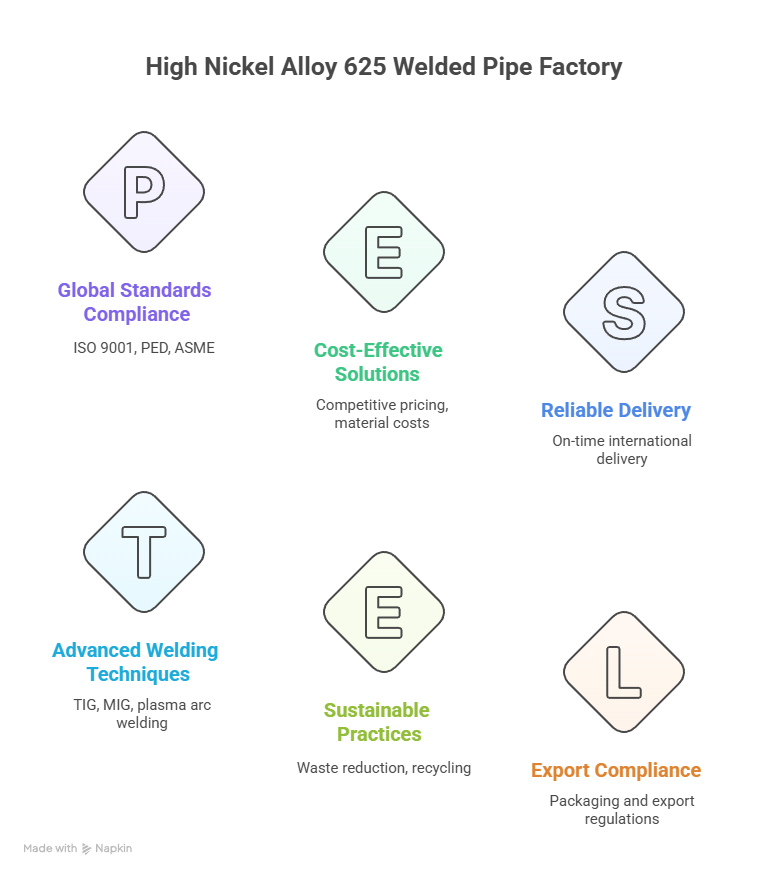
When selecting a high nickel alloy 625 welded pipe factory, customers prioritize consistent product quality, traceability, and reliable delivery. A certified manufacturer typically operates under ISO 9001, PED, and ASME standards, ensuring that every pipe meets global expectations.
| Feature | Factory Advantage | Customer Benefit |
|---|---|---|
| Automated Welding Lines | Improved weld consistency and precision | Lower defect rate |
| In-House Testing Facilities | Ultrasonic, eddy current, and hydro tests | Guaranteed safety and performance |
| Material Traceability | Mill test certificates (MTC) for each batch | Full transparency |
| Customized Solutions | Pipe sizing and finishing per client specs | Flexible order options |
| Global Logistics Support | Packaging and export compliance | On-time international delivery |
Mechanical and Physical Properties of Alloy 625 Welded Pipes
Alloy 625 welded pipes exhibit high tensile and yield strength along with exceptional toughness. These characteristics remain stable across a wide temperature range, making the material ideal for both cryogenic and high-heat environments.
| Property | Unit | Typical Value |
|---|---|---|
| Tensile Strength | MPa | 827 – 930 |
| Yield Strength (0.2% Offset) | MPa | 414 – 517 |
| Elongation | % | ≥ 30 |
| Melting Range | °C | 1290 – 1350 |
| Density | g/cm³ | 8.44 |
| Thermal Conductivity (at 20°C) | W/m·K | 9.8 |
| Elastic Modulus | GPa | 207 |
Inspection and Quality Control Practices
Quality control in a high nickel alloy 625 welded pipe factory is non-negotiable. Advanced inspection procedures ensure that every pipe meets chemical, mechanical, and dimensional standards. Testing covers destructive and non-destructive techniques to guarantee reliability in end-use conditions.
| Test Type | Method | Purpose |
|---|---|---|
| Visual Inspection | Manual and automated camera systems | Detect surface defects |
| Ultrasonic Test | High-frequency sound waves | Identify internal flaws |
| Radiographic Test | X-ray or gamma ray imaging | Examine weld quality |
| Hydrostatic Test | Pressurized water testing | Verify pressure containment |
| Hardness Test | Brinell or Rockwell | Evaluate material hardness |
| Chemical Analysis | Spectrometer verification | Confirm alloy composition |
Packaging and Export Standards
To maintain pipe integrity during transportation, manufacturers follow strict packaging standards. Pipes are wrapped in waterproof plastic, capped at both ends, and placed in wooden crates. Each package includes full documentation such as material test reports, heat numbers, and batch traceability information.
| Packaging Method | Protection Level | Typical Use |
|---|---|---|
| Wooden Crates | High | Overseas export |
| Bundle with Steel Straps | Medium | Domestic transport |
| Plastic Wrapping | Corrosion prevention | Short-term storage |
| End Caps | Prevent contamination | All shipping |
Frequently Asked Questions (FAQ)
1. What is the temperature limit for Alloy 625 welded pipes?
Alloy 625 welded pipes can operate continuously up to approximately 980°C (1800°F) without losing mechanical integrity, making them suitable for high-temperature service in chemical and aerospace industries.
2. Are Alloy 625 welded pipes resistant to seawater corrosion?
Yes. Thanks to their high nickel, molybdenum, and chromium content, Alloy 625 welded pipes show outstanding resistance to pitting, crevice corrosion, and chloride-induced stress corrosion cracking, which makes them ideal for marine and offshore applications.
3. What standards are followed in manufacturing Alloy 625 welded pipes?
High nickel alloy 625 welded pipe factories typically produce according to ASTM B705/B704 and ASME SB705/SB704 standards, ensuring compliance with chemical composition, mechanical properties, and testing requirements.


 English
  Korean
  Japanese
  Arabic
  Spanish
  German
  Portuguese
  French
  Russian
  Italian