

Inconel 625 composition is the key factor behind its exceptional corrosion resistance, high strength, and outstanding performance in extreme environments. As a nickel-based superalloy, Inconel 625 is widely used in aerospace, marine engineering, oil and gas, and chemical processing industries. Understanding the precise chemical composition of Inconel 625 helps engineers, buyers, and manufacturers select the right material for demanding applications. This guide provides a comprehensive analysis of Inconel 625 chemical composition, the role of each element, relevant standards, and how composition directly influences mechanical properties and high-temperature performance.
Introduction to Inconel 625
Inconel 625 is a solid-solution strengthened nickel-chromium-molybdenum alloy known for its excellent resistance to pitting, crevice corrosion, oxidation, and high-temperature degradation. Unlike precipitation-hardened alloys, Inconel 625 derives its strength primarily from solid solution strengthening through molybdenum and niobium additions. This makes it highly versatile and easier to fabricate while still maintaining superior mechanical integrity.
The alloy performs exceptionally well in both cryogenic and elevated temperatures up to approximately 980°C (1800°F), making it a preferred choice for heat exchangers, exhaust systems, subsea components, and turbine parts.
Chemical Composition Overview
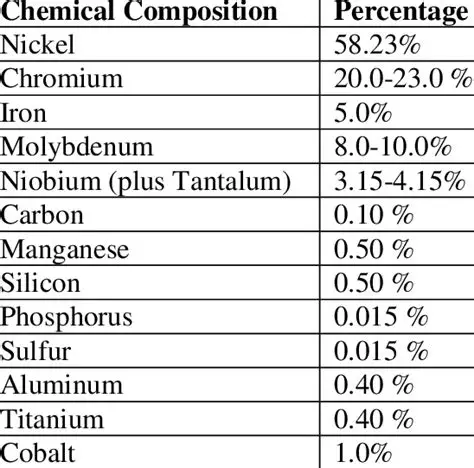
The standard chemical composition of Inconel 625 typically falls within the following ranges (weight percentage):
- Nickel (Ni): ≥ 58%
- Chromium (Cr): 20.0 – 23.0%
- Molybdenum (Mo): 8.0 – 10.0%
- Niobium (Nb) + Tantalum (Ta): 3.15 – 4.15%
- Iron (Fe): ≤ 5.0%
- Aluminum (Al): ≤ 0.40%
- Titanium (Ti): ≤ 0.40%
- Carbon (C): ≤ 0.10%
- Manganese (Mn): ≤ 0.50%
- Silicon (Si): ≤ 0.50%
- Phosphorus (P): ≤ 0.015%
- Sulfur (S): ≤ 0.015%
This carefully balanced composition is what gives Inconel 625 its remarkable combination of corrosion resistance, strength, and fabricability.
Nickel (Ni) Content and Its Function
Primary Matrix Element
Nickel is the base element of Inconel 625, comprising a minimum of 58% of the total composition. It forms the austenitic matrix structure, which provides excellent toughness, ductility, and resistance to thermal fatigue.
High-Temperature Stability
Nickel maintains structural stability at elevated temperatures and prevents phase transformation that could weaken the alloy. This ensures that Inconel 625 retains strength even under extreme heat exposure.
Corrosion Resistance Foundation
Nickel enhances resistance to chloride-induced stress corrosion cracking, making Inconel 625 ideal for marine and subsea environments.
Chromium (Cr) and Corrosion Resistance
Oxidation Protection
Chromium, typically between 20% and 23%, forms a protective chromium oxide layer on the surface. This passive film significantly improves oxidation resistance at high temperatures.
Resistance to Chemical Attack
Chromium enhances resistance to nitric acid, organic acids, and oxidizing environments. It is especially important in chemical processing plants where aggressive media are present.
Molybdenum (Mo) and Pitting & Crevice Resistance
Localized Corrosion Protection
Molybdenum content between 8% and 10% greatly improves resistance to pitting and crevice corrosion in chloride-containing environments.
Solid Solution Strengthening
Mo atoms distort the crystal lattice, increasing strength without the need for precipitation hardening. This strengthens the alloy while maintaining good weldability.
Niobium (Nb) Strengthening Mechanism
Solid Solution Strengthening
Niobium (3.15%–4.15%) is a critical strengthening element in Inconel 625. It enhances tensile strength and yield strength by reinforcing the nickel matrix.
Carbide Formation Control
Niobium helps control carbide precipitation, improving creep resistance and long-term stability under high temperatures.
Minor Elements (Fe, Al, Ti, C, Mn, Si) and Their Influence
Iron (Fe)
Iron is present in limited amounts (≤5%) and helps balance cost without significantly compromising corrosion resistance.
Aluminum (Al) and Titanium (Ti)
These elements contribute slightly to oxidation resistance and microstructural stability but are not primary strengthening elements in this alloy.
Carbon (C)
Carbon is controlled at low levels to prevent excessive carbide precipitation, which could reduce corrosion resistance.
Manganese (Mn) and Silicon (Si)
These elements assist in deoxidation during melting and improve manufacturability.
UNS & ASTM Specifications (e.g., UNS N06625)
Inconel 625 is commonly designated under UNS N06625. It is covered by multiple ASTM standards, including:
- ASTM B443 – Plate, Sheet, Strip
- ASTM B444 – Pipe and Tube
- ASTM B446 – Bar and Rod
- ASTM B564 – Forgings
These specifications define strict chemical composition limits to ensure consistent performance across different product forms.
Composition vs Mechanical Properties Relationship
The chemical composition directly determines mechanical performance. Due to solid solution strengthening from molybdenum and niobium, Inconel 625 typically offers:
- Tensile Strength: ~760–930 MPa
- Yield Strength: ~345–550 MPa
- Elongation: ≥30%
- Hardness: Approx. 200–240 HB
Higher Mo and Nb levels correlate with improved strength, while controlled carbon levels preserve ductility and corrosion resistance.
Composition vs High-Temperature Performance
The high nickel and chromium content ensures oxidation resistance up to 980°C. Molybdenum and niobium maintain structural integrity under thermal stress, making Inconel 625 suitable for exhaust ducts, turbine shrouds, and heat exchanger components.
Unlike precipitation-hardened alloys, Inconel 625 does not rely heavily on aging treatments, meaning its strength remains stable even after welding operations.
Comparison with Inconel 718 Composition
Although both are nickel-based superalloys, their compositions differ significantly:
- Inconel 625 relies on Mo and Nb for solid solution strengthening.
- Inconel 718 uses Nb, Al, and Ti for precipitation hardening.
- Inconel 625 generally contains higher molybdenum.
- Inconel 718 offers higher yield strength after aging treatment.
Inconel 625 provides superior corrosion resistance, while Inconel 718 typically delivers higher mechanical strength at elevated temperatures after heat treatment.
Frequently Asked Questions
What is the chemical composition of Inconel 625?
Inconel 625 contains a minimum of 58% nickel, 20–23% chromium, 8–10% molybdenum, and 3.15–4.15% niobium, along with small amounts of iron and minor elements.
Why does Inconel 625 contain molybdenum?
Molybdenum improves pitting and crevice corrosion resistance and strengthens the alloy through solid solution strengthening.
Is Inconel 625 stronger than Inconel 718?
Inconel 718 generally has higher yield strength after precipitation hardening, but Inconel 625 offers better corrosion resistance and easier weldability.


 English
  Korean
  Japanese
  Arabic
  Spanish
  German
  Portuguese
  French
  Russian
  Italian