

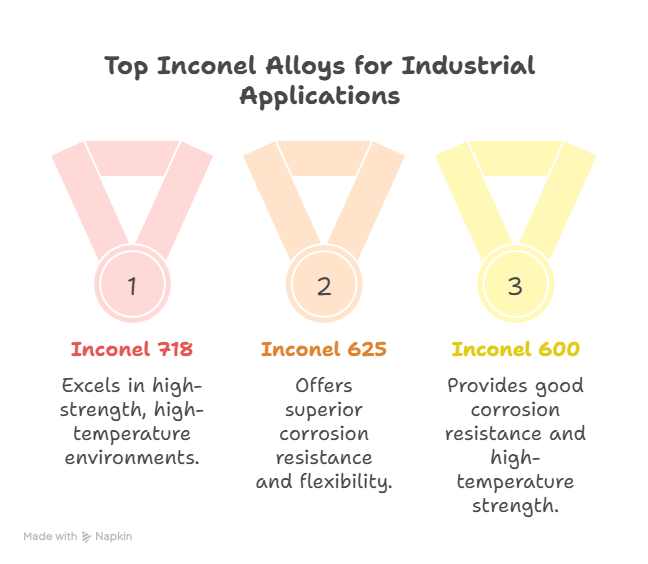
Inconel 625 and Inconel 718 are two of the most widely used nickel-based superalloys, both known for outstanding corrosion resistance and high-temperature performance. However, their mechanical behavior, strengthening mechanisms, cost, and ideal applications are different. Inconel 625 is a solid-solution-strengthened alloy offering superior corrosion resistance and exceptional flexibility, while Inconel 718 is a precipitation-hardened superalloy engineered for extremely high strength under elevated temperatures and long-term stress. This detailed comparison helps engineers, designers, and procurement specialists choose the best alloy for demanding industrial environments.
Chemical Composition Comparison
The chemical composition determines how both alloys behave under extreme conditions, including heat, corrosion, and mechanical load.
| Element | Inconel 625 | Inconel 718 |
|---|---|---|
| Nickel (Ni) | 58% min | 50–55% |
| Chromium (Cr) | 20–23% | 17–21% |
| Molybdenum (Mo) | 8–10% | 3% |
| Niobium + Tantalum (Nb+Ta) | 3.15–4.15% | 4.75–5.5% |
| Titanium (Ti) | — | 0.65–1.15% |
| Aluminum (Al) | — | 0.2–0.8% |
Strengthening Mechanism
Their strengthening principles are fundamentally different.
| Aspect | Inconel 625 | Inconel 718 |
|---|---|---|
| Strengthening Type | Solid-solution strengthening | Precipitation hardening |
| Main Strengthening Elements | Mo, Nb | γ” and γ’ precipitates |
| Heat Treatment | Not required | Required for maximum strength |
Mechanical Properties
Inconel 718 is significantly stronger than Inconel 625, especially at elevated temperatures.
| Property | Inconel 625 | Inconel 718 |
|---|---|---|
| Tensile Strength | ~760 MPa | ~1250 MPa |
| Yield Strength | ~340 MPa | ~1030 MPa |
| Hardness | Lower | Much higher |
| Fatigue Strength | Good | Excellent |
Temperature Resistance
Both alloys excel in high-temperature environments, but they operate best at different maximum temperature ranges.
| Temperature Factor | Inconel 625 | Inconel 718 |
|---|---|---|
| Max Operating Temperature | ~980°C | ~720°C (for long-term service) |
| Short-term Heat Resistance | Excellent | Very good |
| Creep Resistance | Higher at extreme heat | Limited above 650–700°C |
Corrosion Resistance
Inconel 625 is generally more corrosion-resistant, especially in seawater, chlorides, acids, and oxidizing environments.
| Environment | Inconel 625 Performance | Inconel 718 Performance |
|---|---|---|
| Seawater | Outstanding | Good |
| Acids (HCl, H2SO4) | Excellent | Moderate |
| Oxidation Resistance | High | High |
| Pitting/Crevice Corrosion | Superior | Moderate |
Machinability & Fabrication
Both alloys are considered difficult to machine, but 718 is more challenging due to precipitation hardening.
| Factor | Inconel 625 | Inconel 718 |
|---|---|---|
| Machinability | Difficult but better than 718 | Very difficult |
| Weldability | Excellent | Good but requires procedure control |
| Formability | Very good | Moderate |
Main Applications
The different performance profiles make each alloy suitable for specific industries.
| Industry | Inconel 625 Applications | Inconel 718 Applications |
|---|---|---|
| Aerospace | Exhaust ducts, bellows | Turbine discs, jet engine parts |
| Marine | Pumps, seawater piping | Fasteners, structural components |
| Chemical Processing | Acid tanks, heat exchangers | High-strength reactor components |
| Oil & Gas | Flexible risers, downhole tubing | High-pressure tools |
Cost Comparison
The price difference depends on the specific requirements of strength and heat treatment.
| Cost Aspect | Inconel 625 | Inconel 718 |
|---|---|---|
| Raw Material Cost | Higher (due to high Mo content) | Lower |
| Machining Cost | Lower | Higher |
| Heat Treatment Cost | None | Required |
Which Alloy Should You Choose?
Inconel 625 is ideal for severe corrosion environments and high temperatures close to 1000°C, while Inconel 718 is the better choice for applications requiring very high mechanical strength below 720°C.
| Need | Best Choice | Reason |
|---|---|---|
| Extreme corrosion resistance | Inconel 625 | Superior resistance to acids and chlorides |
| Maximum strength | Inconel 718 | Precipitation-hardening gives exceptional strength |
| High temperature above 800°C | Inconel 625 | Better creep resistance |
| Heavy load below 720°C | Inconel 718 | Engineered for long-term high-stress service |
Related Questions
1. Is Inconel 625 more corrosion-resistant than Inconel 718?
Yes, Inconel 625 has significantly better corrosion resistance, especially in seawater and acidic environments.
2. Which alloy is stronger, Inconel 625 or Inconel 718?
Inconel 718 is much stronger due to precipitation hardening, giving it over 1200 MPa tensile strength.
3. What is the main difference between Inconel 625 and 718?
The main difference is that 625 is optimized for corrosion resistance and high-temperature flexibility, while 718 is designed for extremely high mechanical strength at moderate-to-high temperatures.


 English
  Korean
  Japanese
  Arabic
  Spanish
  German
  Portuguese
  French
  Russian
  Italian