

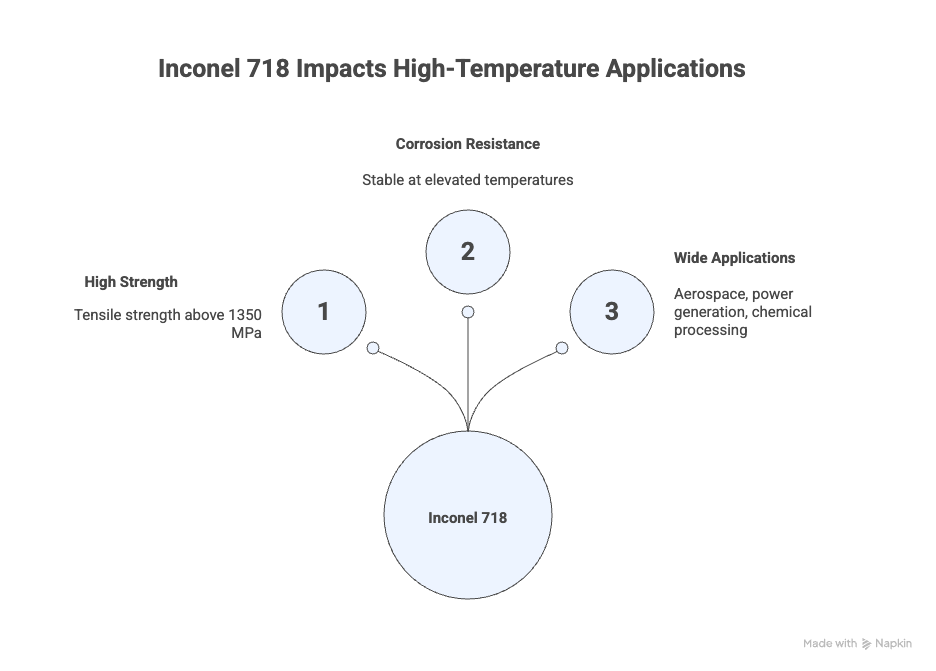
Inconel 718 is a high-performance nickel-chromium alloy widely recognized for its exceptional mechanical properties, corrosion resistance, and ability to retain strength at elevated temperatures. It is extensively used in aerospace, power generation, and chemical processing industries due to its superior performance under extreme conditions. This article provides an in-depth overview of the material properties of Inconel 718, including its chemical composition, mechanical characteristics, thermal behavior, and applications.
Chemical Composition
Inconel 718 is primarily composed of nickel (50–55%), chromium (17–21%), and iron (balance). Additional alloying elements such as niobium (4.75–5.5%), molybdenum (2.8–3.3%), titanium (0.65–1.15%), and aluminum (0.2–0.8%) play crucial roles in enhancing its strength and corrosion resistance. Minor amounts of cobalt, manganese, silicon, and carbon are also present to improve toughness, hardness, and overall metallurgical stability. The precise balance of these elements allows Inconel 718 to maintain high strength at both room and elevated temperatures.
Mechanical Properties
Inconel 718 exhibits remarkable mechanical properties that make it suitable for high-stress environments:
- Tensile Strength: Typically ranges from 1,240 MPa to 1,515 MPa after proper heat treatment.
- Yield Strength: Approximately 1,035 MPa to 1,240 MPa, ensuring structural integrity under heavy loads.
- Elongation: Around 12–20%, indicating good ductility and formability.
- Hardness: Rockwell B 90–100 or Rockwell C 35–40, depending on heat treatment and processing conditions.
- Fatigue Resistance: Exceptional resistance to cyclic stress, making it ideal for turbine blades, rocket engines, and high-performance components.
Thermal Properties
Inconel 718 maintains its strength and stability over a wide temperature range, making it suitable for high-temperature applications:
- Melting Point: Approximately 1,360–1,370°C.
- Operating Temperature: Can function effectively in environments up to 700°C without significant loss of strength.
- Thermal Conductivity: Low thermal conductivity (~11 W/m·K), which helps in reducing thermal fatigue.
- Coefficient of Thermal Expansion: Around 13.0 × 10⁻⁶ /°C, ensuring predictable expansion behavior in precision components.
Corrosion and Oxidation Resistance
One of the key advantages of Inconel 718 is its excellent corrosion resistance, particularly in oxidizing and mildly reducing environments. The chromium content forms a stable oxide layer that protects the underlying material from further oxidation. It also resists chloride-induced stress corrosion cracking and pitting, making it suitable for marine and chemical processing applications.
Heat Treatment and Processing
Inconel 718 achieves optimal properties through a combination of solution annealing and aging treatments. The alloy is first solution-treated at 980–1,020°C, followed by rapid cooling. Subsequent aging at 720°C for 8 hours, then 620°C for 8 hours, enhances the precipitation of strengthening phases such as gamma prime (γ’) and gamma double prime (γ”). These phases contribute significantly to the high tensile and yield strength of the alloy. Additionally, Inconel 718 can be fabricated using conventional methods such as forging, rolling, and machining, although its work-hardening tendency requires careful processing techniques.
Applications
Due to its unique combination of mechanical strength, corrosion resistance, and thermal stability, Inconel 718 is widely used in various demanding industries:
- Aerospace: Jet engine components, turbine blades, exhaust systems, and rocket motor cases.
- Power Generation: Gas turbines, nuclear reactors, and steam generators.
- Chemical Processing: Heat exchangers, pressure vessels, and piping systems exposed to corrosive environments.
- Marine: Subsea equipment, propeller shafts, and pumps for seawater applications.
Related Questions
What is the tensile strength of Inconel 718? Inconel 718 has a tensile strength typically ranging from 1,240 MPa to 1,515 MPa after proper heat treatment.
Can Inconel 718 resist corrosion? Yes, it exhibits excellent corrosion resistance, including resistance to oxidation, pitting, and chloride-induced stress corrosion cracking.
At what temperature can Inconel 718 be used? Inconel 718 can effectively operate in high-temperature environments up to approximately 700°C while maintaining its mechanical properties.


 English
  Korean
  Japanese
  Arabic
  Spanish
  German
  Portuguese
  French
  Russian
  Italian