

Inconel 718 is a high-performance superalloy that is widely used in industries such as aerospace, nuclear power, and turbine manufacturing. Known for its exceptional strength, corrosion resistance, and high-temperature performance, Inconel 718 has become an essential material in critical applications. This article will explore the key properties of Inconel 718, including its chemical composition, mechanical and physical properties, heat resistance, and applications in various industries. We will also compare Inconel 718 with other alloys and provide insights into how to select the best material for specific needs.
Chemical Composition of Inconel 718
Inconel 718 is primarily composed of nickel, making it a nickel-based superalloy. The exact chemical composition of Inconel 718 plays a significant role in its mechanical and thermal properties. The alloy contains:
- Nickel (Ni): Approximately 50-55%, providing the base for the alloy’s heat resistance and oxidation resistance.
- Chromium (Cr): 17-21%, contributing to its resistance to oxidation and corrosion in high-temperature environments.
- Iron (Fe): Around 18-21%, which serves as the alloy’s primary stabilizing element.
- Molybdenum (Mo): 2.8-3.3%, enhancing the alloy’s strength at high temperatures and its resistance to pitting and crevice corrosion.
- Aluminum (Al): 0.2-0.8%, which forms a solid solution and increases the alloy’s strength at elevated temperatures.
- Titanium (Ti): 0.65-1.15%, improving the alloy’s overall strength and heat resistance.
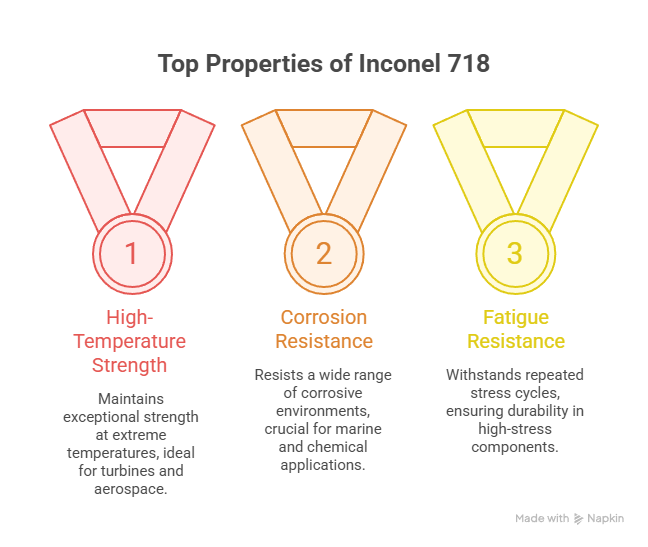
The precise combination of these elements gives Inconel 718 its unique properties, such as high-temperature strength, fatigue resistance, and excellent performance in harsh environments.
Mechanical Properties of Inconel 718
The mechanical properties of Inconel 718 make it a highly desirable material for applications that demand excellent strength and durability under extreme conditions. These properties are influenced by its chemical composition and heat treatment processes. Below are the key mechanical properties:
- Tensile Strength: Inconel 718 has a tensile strength of about 1,270 MPa at room temperature. At elevated temperatures, the tensile strength remains high, making it suitable for high-stress applications.
- Yield Strength: The yield strength of Inconel 718 is approximately 1,100 MPa at room temperature, and it maintains good yield strength even at high temperatures.
- Elongation: The elongation of Inconel 718 is about 15-30%, ensuring that the material can withstand deformation without cracking.
- Hardness: The hardness of Inconel 718 varies depending on the heat treatment process. After aging, it can achieve a hardness of up to 40 HRC, making it suitable for high-performance applications.
These mechanical properties make Inconel 718 an ideal choice for applications requiring materials that can withstand high loads, stresses, and temperatures.
Physical Properties of Inconel 718
Understanding the physical properties of Inconel 718 helps to better assess its behavior in various environments, particularly regarding heat and energy transfer. The key physical properties include:
- Density: The density of Inconel 718 is approximately 8.19 g/cm³. This density gives it a good balance between strength and weight, making it ideal for aerospace and turbine applications.
- Thermal Conductivity: Inconel 718 has a relatively low thermal conductivity of about 11.4 W/m·K at room temperature. This makes it a suitable material for high-temperature applications where heat resistance is essential.
- Melting Point: The melting point of Inconel 718 is around 1,300°C (2,372°F), which ensures its integrity at extremely high temperatures.
These physical characteristics, including low thermal conductivity and high melting point, make Inconel 718 suitable for applications requiring efficient heat management and resistance to thermal fatigue.
High-Temperature Resistance of Inconel 718
One of the standout features of Inconel 718 is its excellent high-temperature performance. This alloy is designed to maintain its strength and resist oxidation even at extreme temperatures. It is particularly suitable for use in gas turbines, jet engines, and other high-temperature environments, where materials must maintain their integrity under stress.
- Oxidation Resistance: Inconel 718 demonstrates excellent oxidation resistance, maintaining its properties even at temperatures as high as 700°C. This makes it ideal for use in environments where prolonged exposure to high temperatures could cause oxidation and material degradation.
- Heat Stability: The alloy’s ability to retain its mechanical properties at high temperatures makes it an excellent choice for turbine blades, exhaust systems, and similar applications.
Inconel 718 is particularly beneficial in applications where high thermal stability and resistance to oxidation are required, ensuring longevity and reliability in critical components.
Corrosion Resistance of Inconel 718
Inconel 718 is highly resistant to a wide variety of corrosive environments, making it suitable for applications in harsh chemical settings. Its resistance to both general corrosion and localized corrosion, such as pitting and crevice corrosion, is a key factor in its widespread use in industries like aerospace and marine engineering.
- Acid Resistance: Inconel 718 exhibits good resistance to sulfuric and hydrochloric acids, ensuring its durability in chemically aggressive environments.
- Saltwater Resistance: The alloy’s resistance to chloride-induced stress corrosion cracking makes it ideal for use in marine environments.
These corrosion-resistant properties ensure that Inconel 718 can perform reliably in environments where other materials would deteriorate rapidly, such as offshore drilling rigs or chemical processing plants.
Heat Treatment of Inconel 718
Inconel 718 undergoes specific heat treatment processes to optimize its mechanical properties and enhance its durability. The most common heat treatment for Inconel 718 is aging, which involves heating the alloy to a specific temperature and then cooling it rapidly to form precipitates within the metal matrix. This process significantly enhances the material’s yield strength and tensile strength.
- Aging Process: The alloy is typically heated to 718°C (1,324°F) and held for several hours before cooling rapidly to form a fine distribution of gamma prime precipitates. This strengthens the material and improves its high-temperature performance.
- Solution Treatment: In some cases, a solution treatment at around 1,060°C (1,940°F) is used to dissolve precipitates and promote uniformity before the aging process.
These heat treatments allow Inconel 718 to achieve optimal strength, fatigue resistance, and toughness, making it ideal for high-performance applications.
Applications of Inconel 718
Inconel 718 is used in a wide variety of industries due to its excellent mechanical, thermal, and corrosion-resistant properties. Some of the key applications include:
- Aerospace: Inconel 718 is commonly used in turbine blades, engine components, and exhaust systems in jet engines.
- Nuclear Power: The alloy’s ability to withstand high temperatures and radiation makes it a preferred material for reactor components and structural elements.
- Gas Turbines: Due to its high strength and heat resistance, Inconel 718 is used in critical turbine components such as rotor blades and seals.
- Oil and Gas: Inconel 718 is used in downhole drilling tools, equipment exposed to harsh environments, and offshore platforms.
These industries rely on Inconel 718 for its durability, high-temperature strength, and resistance to corrosion, ensuring optimal performance in challenging environments.
Comparison with Other Alloys
Inconel 718 is often compared with other superalloys, such as Inconel 625 and Hastelloy C-276, due to its high-performance characteristics. While all these alloys are excellent in high-temperature and corrosion-resistant applications, Inconel 718 stands out for its:
- Superior High-Temperature Strength: Compared to Inconel 625, Inconel 718 performs better at higher temperatures, making it more suitable for gas turbines and aerospace applications.
- Better Fatigue Resistance: Inconel 718 has better resistance to fatigue and creep, which are crucial in turbine blades and high-stress components.
This makes Inconel 718 the alloy of choice for applications where both high-temperature strength and durability under stress are required.
Frequently Asked Questions
1. What are the key properties of Inconel 718?
Inconel 718 has excellent high-temperature strength, corrosion resistance, and fatigue resistance, making it ideal for aerospace, nuclear, and turbine applications. Its chemical composition, including nickel, chromium, and molybdenum, contributes to these properties.
2. How does Inconel 718 compare to Inconel 625?
Inconel 718 performs better at higher temperatures and offers superior fatigue and creep resistance compared to Inconel 625, making it more suitable for demanding applications like gas turbines.
3. What industries use Inconel 718?
Inconel 718 is used in aerospace, nuclear power, oil and gas, and turbine manufacturing due to its ability to withstand extreme temperatures, pressure, and corrosion.


 English
  Korean
  Japanese
  Arabic
  Spanish
  German
  Portuguese
  French
  Russian
  Italian