

Inconel, Hastelloy, and Monel are three major families of nickel-based alloys widely used in industries requiring excellent corrosion resistance, high temperature strength, and long-term durability. Professional nickel alloy factories manufacture these materials using advanced melting, forging, rolling, and machining technologies to meet strict international standards.
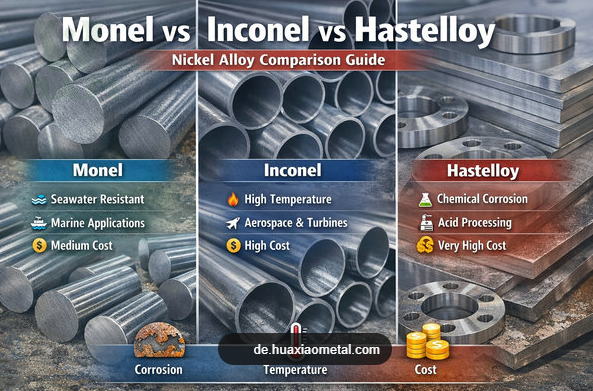
Inconel, Hastelloy, and Monel Alloy Introduction
These three alloys belong to the nickel-based alloy family but are designed for different industrial environments.
Inconel Alloy
Inconel is a nickel-chromium alloy designed for high-temperature strength and oxidation resistance. It is commonly used in aerospace engines and high-temperature industrial equipment.
Hastelloy Alloy
Hastelloy is a nickel-chromium-molybdenum alloy engineered for extreme corrosion resistance in aggressive chemical environments.
Monel Alloy
Monel is a nickel-copper alloy known for outstanding resistance to seawater corrosion and marine environments.
Overview of Nickel Alloy Factories
Nickel alloy factories specialize in producing high-performance materials that require strict control of chemical composition, melting technology, and heat treatment processes.
Main Alloy Grades Produced by the Factory
- Inconel 600, Inconel 625, Inconel 718
- Hastelloy C276, Hastelloy C22, Hastelloy B2
- Monel 400, Monel K500
Main Product Forms
- Plates and sheets
- Round bars and rods
- Pipes and tubes
- Forgings and flanges
- Custom machined parts
Chemical Composition and Material Standards
Each alloy grade has strict chemical composition limits defined by international standards such as ASTM and UNS.
Inconel Composition Characteristics
Inconel alloys mainly contain nickel and chromium for oxidation resistance at high temperatures.
Hastelloy Composition Characteristics
Hastelloy alloys include molybdenum and chromium to enhance resistance to pitting and chemical corrosion.
Monel Composition Characteristics
Monel alloys consist primarily of nickel and copper, providing excellent resistance to seawater and hydrofluoric acid.
Mechanical Properties and Material Quality Requirements
Nickel alloy products must meet strict requirements for tensile strength, yield strength, elongation, and hardness to ensure reliable industrial performance.
Production Equipment and Manufacturing Processes
- Vacuum induction melting (VIM)
- Electroslag remelting (ESR)
- Hot forging presses
- Hot and cold rolling mills
- Precision tube drawing equipment
Processing Capabilities
Most alloy factories also provide secondary processing services.
Cutting and Machining
Laser cutting, plasma cutting, and CNC machining are commonly used for precision processing.
Forging and Heat Treatment
Forging, solution annealing, and aging heat treatments improve material properties.
Quality Control System
Professional alloy manufacturers operate under strict quality management systems to ensure consistent material performance.
Testing Equipment and Inspection Procedures
- Chemical composition analysis
- Mechanical property testing
- Ultrasonic testing (UT)
- Radiographic testing (RT)
- Metallographic analysis
Standards and Certifications
- ASTM standards
- UNS material designation
- AMS aerospace specifications
- NACE certification for oil and gas environments
Main Application Industries
- Aerospace and aviation
- Chemical processing plants
- Marine engineering
- Oil and gas exploration
- Power generation
Global Market Supply Capability
Nickel alloy manufacturing is concentrated in industrial regions across Asia, Europe, and North America, supplying materials for global engineering projects.
Custom Manufacturing and OEM Services
Many factories provide customized production services including non-standard sizes, precision machining, and OEM manufacturing for industrial equipment manufacturers.
Frequently Asked Questions (FAQ)
What products can a nickel alloy factory supply?
Plates, bars, pipes, tubes, forgings, and custom machined components.
Which industries use these alloys?
Aerospace, marine engineering, chemical processing, oil and gas, and power generation industries.
Are custom sizes available?
Yes, most manufacturers offer customized sizes and machining services.


 English
  Korean
  Japanese
  Arabic
  Spanish
  German
  Portuguese
  French
  Russian
  Italian