

Inconel pipe material code is a standardized way to identify nickel-based superalloy pipes used in industries requiring high corrosion resistance, high temperature strength, and long-term reliability. Engineers, procurement managers, and project planners rely on these material codes to ensure proper selection, compatibility with specifications, and compliance with regulatory or engineering standards. Knowing the correct material code for Inconel pipes helps avoid costly errors, ensures traceability, and guarantees that the pipe will perform as expected in demanding applications.
What Is an Inconel Pipe Material Code?
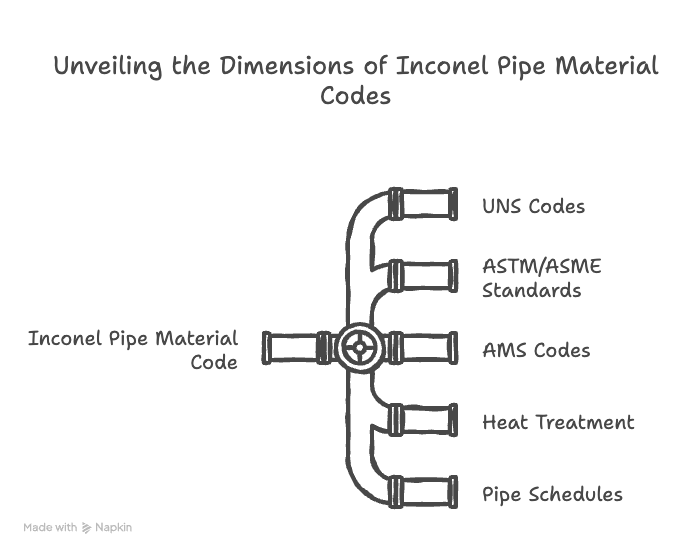
An Inconel pipe material code is a system of identification that defines the alloy grade, chemical composition, heat treatment, and applicable manufacturing standards. These codes are typically composed of UNS (Unified Numbering System) numbers, ASTM/ASME standards, and in aerospace applications, AMS specifications. Correct interpretation of these codes is critical for procurement, fabrication, and installation in high-pressure, high-temperature, and corrosive environments.
UNS Material Codes for Common Inconel Pipes
The UNS system is widely used for identifying specific Inconel alloys used in pipe manufacturing. Some of the most commonly used codes include:
| Inconel Grade | UNS Code | Typical Applications |
|---|---|---|
| Inconel 600 | N06600 | Heat exchangers, furnace tubes, chemical processing lines |
| Inconel 601 | N06601 | High-temperature oxidation resistance applications |
| Inconel 625 | N06625 | Oil & gas, chemical processing, marine piping, aerospace components |
| Inconel 718 | N07718 | Aerospace, high-strength pressure piping, turbine components |
| Inconel X-750 | N07750 | High-temperature fasteners, pressure systems, structural piping |
ASTM and ASME Standards for Inconel Pipes
Inconel pipes are manufactured according to stringent ASTM and ASME standards to ensure uniformity, safety, and performance under extreme conditions. Common standards include:
| Standard | Description |
|---|---|
| ASTM B444 | Seamless and welded Inconel 625 pipe for high-temperature and corrosive applications |
| ASME SB444 | ASME-adopted equivalent of ASTM B444 |
| ASTM B163 | Heat exchanger and condenser tubes for nickel alloys |
| ASTM B167 | Seamless nickel alloy pipe for elevated temperature service |
| ASTM B829 | General requirements for nickel and nickel alloy pipes |
AMS Codes for Aerospace Applications
For aerospace and defense industries, AMS standards often define Inconel pipe material codes, including chemical composition, mechanical properties, and manufacturing tolerances:
| AMS Code | Applicable Alloy | Application |
|---|---|---|
| AMS 5581 | Inconel 625 | Aerospace tubing and high-performance piping |
| AMS 5589 | Inconel 718 | Aerospace fuel, exhaust, and hydraulic piping |
| AMS 5542 | Inconel 625 | Sheet, strip, and tube for aerospace components |
Heat Treatment and Material Codes
Inconel pipes are supplied in various heat treatment conditions, which are often included in the material code to ensure proper mechanical properties:
Solution Annealed (SA): Most commonly used for corrosion resistance and dimensional stability.
Aged or Precipitation-Hardened (A): Applicable to alloys like Inconel 718 for maximum strength at elevated temperatures.
Including heat treatment in the material code ensures that the pipe meets the required mechanical properties for its specific application.
How to Read an Inconel Pipe Material Code
A typical Inconel pipe material code contains the alloy grade, standard, pipe type, schedule, and heat treatment condition. For example:
ASTM B444 UNS N06625 Seamless Pipe SCH 40 SA
Breaking it down:
- ASTM B444: The standard governing dimensions, testing, and mechanical properties.
- UNS N06625: The specific Inconel 625 alloy.
- Seamless Pipe: Manufacturing method.
- SCH 40: Pipe schedule indicating wall thickness.
- SA: Solution annealed heat treatment condition.
Pipe Schedules and Dimensions
Inconel pipes follow the same schedule and dimensional standards as carbon steel and stainless steel pipes. Common schedules include SCH 10, SCH 20, SCH 40, SCH 80, and SCH 160. While schedule is not technically part of the material code, it is essential for procurement, engineering drawings, and pressure calculations.
Applications and Industry Relevance
Correct identification using material codes is critical across multiple industries:
Oil & Gas: High-pressure pipelines, chemical transport lines, offshore systems.
Chemical Processing: Acid-resistant and high-temperature process piping.
Aerospace: Fuel lines, exhaust systems, and high-temperature hydraulic piping.
Power Generation: Heat recovery systems, turbine piping, and boiler connections.
Importance of Using Correct Material Codes
Using the correct Inconel pipe material code ensures:
- Compatibility with engineering and project specifications.
- Compliance with ASTM, ASME, or AMS standards.
- Traceability for quality control and certification purposes.
- Optimal performance in high-temperature, corrosive, or high-pressure applications.
Related Questions
What is the UNS code for Inconel 625 pipe?
The UNS code for Inconel 625 pipe is N06625.
Which ASTM standard is used for Inconel pipe?
The most commonly used ASTM standard for Inconel 625 pipe is ASTM B444. Other standards like ASTM B167 or B163 may also apply depending on the application.
Is ASME SB444 the same as ASTM B444?
Yes, ASME SB444 is the ASME-adopted equivalent of ASTM B444, and it maintains the same chemical, mechanical, and testing requirements.


 English
  Korean
  Japanese
  Arabic
  Spanish
  German
  Portuguese
  French
  Russian
  Italian