

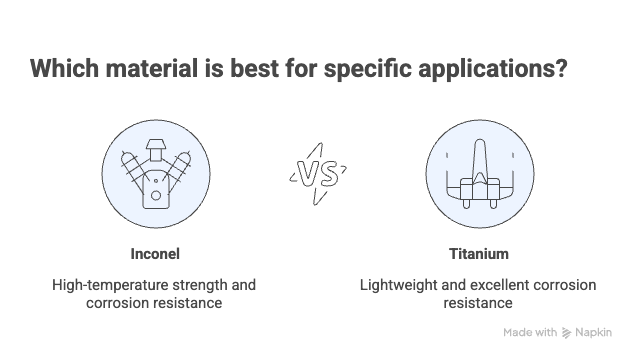
Inconel and titanium are two widely used high-performance materials in aerospace, marine, chemical, and industrial applications. Both offer excellent corrosion resistance and strength-to-weight advantages, but they differ significantly in composition, mechanical properties, and optimal applications. Understanding the differences between Inconel and titanium helps engineers select the right material for specific environments and performance requirements.
Overview of Inconel
Inconel is a family of nickel-chromium-based superalloys designed to maintain strength and resist oxidation in high-temperature environments. Common grades include Inconel 600, 625, and 718, which are used extensively in aerospace engines, chemical plants, and marine applications. Inconel alloys provide exceptional performance under extreme temperatures, corrosive chemicals, and cyclic stress conditions.
Overview of Titanium
Titanium is a lightweight metallic element with excellent corrosion resistance, high strength-to-weight ratio, and biocompatibility. It is commonly used in aerospace, medical implants, marine hardware, and chemical processing. Titanium alloys, such as Ti-6Al-4V, enhance strength, toughness, and temperature performance while remaining lightweight and resistant to oxidation and corrosion.
Chemical Composition Comparison
| Property | Inconel (e.g., 625) | Titanium Alloy (e.g., Ti-6Al-4V) |
|---|---|---|
| Major Elements | Nickel, Chromium, Molybdenum, Iron, Niobium | Titanium, Aluminum, Vanadium |
| Corrosion Resistance | Excellent in oxidizing and acidic environments | Excellent in seawater, chloride, and acidic environments |
| Density | ≈ 8.4 g/cm³ | ≈ 4.43 g/cm³ (about half of Inconel) |
| Melting Point | ≈ 1290–1350°C | ≈ 1660°C |
| High-Temperature Strength | Very high up to 1000°C+ | Good up to 600°C (some alloys higher) |
| Magnetic Properties | Non-magnetic | Non-magnetic |
Mechanical Properties
Inconel alloys are generally stronger at elevated temperatures and provide excellent creep and fatigue resistance, making them ideal for engine components, turbine blades, and high-stress industrial applications. Titanium, while not as strong as Inconel at extremely high temperatures, offers a superior strength-to-weight ratio, making it ideal where weight reduction is critical, such as in aerospace airframes and marine structures.
Corrosion Resistance
Both materials resist corrosion, but the environments where they excel differ:
– Inconel: Resists oxidation, acidic chemicals, seawater, and high-temperature corrosion. Ideal for chemical reactors, turbine components, and exhaust systems.
– Titanium: Extremely resistant to seawater, chlorides, and general atmospheric corrosion. Commonly used for marine hardware, desalination systems, and chemical process piping.
Applications Comparison
Based on their properties, the applications of Inconel and titanium differ significantly:
Inconel: Jet engine components, gas turbines, chemical plant equipment, furnace parts, heat exchangers, marine pumps.
Titanium: Aircraft structures, medical implants, marine propellers, desalination plants, lightweight chemical processing equipment.
Key Differences
While both materials are high-performance alloys, the main differences are:
– Density: Titanium is significantly lighter than Inconel, offering a major weight-saving advantage.
– High-Temperature Performance: Inconel outperforms titanium in extremely high-temperature environments.
– Corrosion Resistance: Titanium excels in seawater and chlorides, while Inconel is better in oxidizing, acidic, and high-temperature environments.
– Cost: Titanium alloys can be more expensive to manufacture and process due to their reactivity and fabrication challenges, while Inconel is costly mainly due to alloying elements.
Related Questions
Is titanium stronger than Inconel?
Titanium has an excellent strength-to-weight ratio but is generally weaker than Inconel at very high temperatures.
Which is better for high-temperature applications?
Inconel is superior for high-temperature applications above 600°C, such as turbine engines and exhaust systems.
Is titanium better for corrosion resistance?
Titanium is extremely resistant to seawater and chlorides, making it ideal for marine and chemical environments, whereas Inconel excels in oxidizing and acidic conditions.


 English
  Korean
  Japanese
  Arabic
  Spanish
  German
  Portuguese
  French
  Russian
  Italian