

Waspaloy is a high-strength, precipitation-hardened nickel-based superalloy widely used in aerospace and gas turbine applications. A common question among engineers and buyers is whether Waspaloy is magnetic, especially when selecting materials for high-temperature or precision components. This article clearly explains the magnetic behavior of Waspaloy, the reasons behind it, and what factors may influence its magnetism.
Is Waspaloy Magnetic?
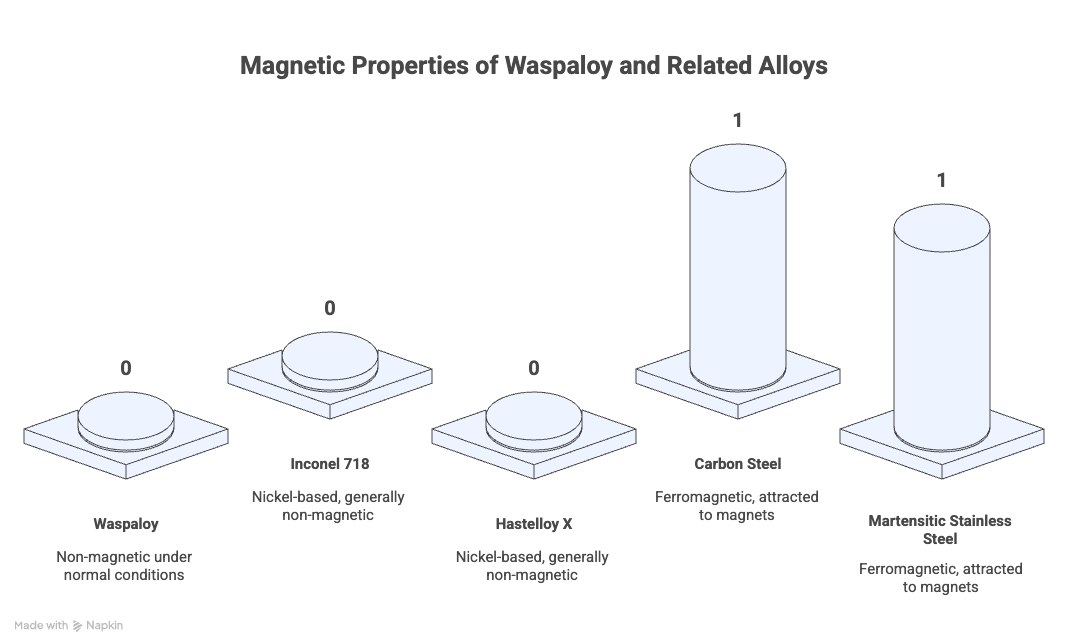
Waspaloy is generally considered non-magnetic under normal conditions. As a nickel-based alloy with an austenitic crystal structure, it does not exhibit ferromagnetic properties like carbon steel or martensitic stainless steel. In most applications, Waspaloy will not be attracted to a magnet.
Chemical Composition and Magnetic Behavior
Waspaloy is primarily composed of nickel, chromium, cobalt, molybdenum, titanium, and aluminum. Nickel-based alloys typically form a stable austenitic structure, which is inherently non-magnetic. The presence of alloying elements such as chromium and cobalt further stabilizes this structure, contributing to Waspaloy’s non-magnetic characteristics.
Effect of Heat Treatment
Waspaloy undergoes solution heat treatment and aging to achieve its high strength. These heat treatments promote the formation of gamma prime (γ’) precipitates, which significantly enhance mechanical properties but do not introduce ferromagnetism. As a result, properly heat-treated Waspaloy remains essentially non-magnetic.
Cold Working and Residual Magnetism
In rare cases, heavy cold working or severe plastic deformation may introduce a very slight magnetic response due to localized microstructural changes. However, this magnetism is extremely weak and does not affect performance or indicate a change in alloy composition. Subsequent solution annealing typically restores the fully non-magnetic state.
Comparison with Other Alloys
Compared to iron-based superalloys or martensitic stainless steels, Waspaloy remains non-magnetic across a wide temperature range. It behaves similarly to other nickel-based alloys such as Inconel 718 and Hastelloy X, which are also generally non-magnetic in their standard metallurgical condition.
Why Magnetism Matters in Applications
Non-magnetic behavior is critical in aerospace engines, precision instruments, and electronic systems where magnetic interference must be avoided. Waspaloy’s non-magnetic nature makes it suitable for rotating engine components, fasteners, and structural parts operating at high temperatures and under cyclic stress.
Related Questions
Is Waspaloy completely non-magnetic? Waspaloy is non-magnetic in normal service conditions, though extremely minor magnetism may appear after heavy cold work.
Does heat treatment make Waspaloy magnetic? No, standard solution and aging heat treatments do not make Waspaloy magnetic.
Is Waspaloy more magnetic than Inconel 718? No, both alloys are nickel-based and generally exhibit similar non-magnetic behavior.


 English
  Korean
  Japanese
  Arabic
  Spanish
  German
  Portuguese
  French
  Russian
  Italian