

Monel 400 and Hastelloy C276 are two well-known nickel-based alloys used in highly demanding industrial environments. Although both materials offer excellent corrosion resistance and durability, they are designed for very different service conditions. Monel 400 is a nickel-copper alloy optimized for marine and alkaline environments, while Hastelloy C276 is a nickel-chromium-molybdenum alloy engineered to resist some of the most aggressive chemical corrosion conditions. Understanding the differences between Monel 400 and Hastelloy C276 is critical when selecting materials for chemical processing, oil and gas, marine engineering, and pollution control systems.
Alloy Classification and Design Philosophy
Monel 400 is a solid-solution strengthened nickel-copper alloy. Its composition provides excellent resistance to seawater corrosion, alkaline solutions, and hydrofluoric acid.
Hastelloy C276 is a high-performance nickel-based alloy containing significant amounts of chromium and molybdenum. It is designed to resist localized corrosion such as pitting, crevice corrosion, and stress corrosion cracking.
Chemical Composition Comparison
| Element | Monel 400 | Hastelloy C276 |
|---|---|---|
| Nickel (Ni) | 63 – 70% | Balance |
| Copper (Cu) | 28 – 34% | — |
| Chromium (Cr) | — | 14.5 – 16.5% |
| Molybdenum (Mo) | — | 15 – 17% |
| Iron (Fe) | ≤ 2.5% | 4 – 7% |
| Tungsten (W) | — | 3 – 4.5% |
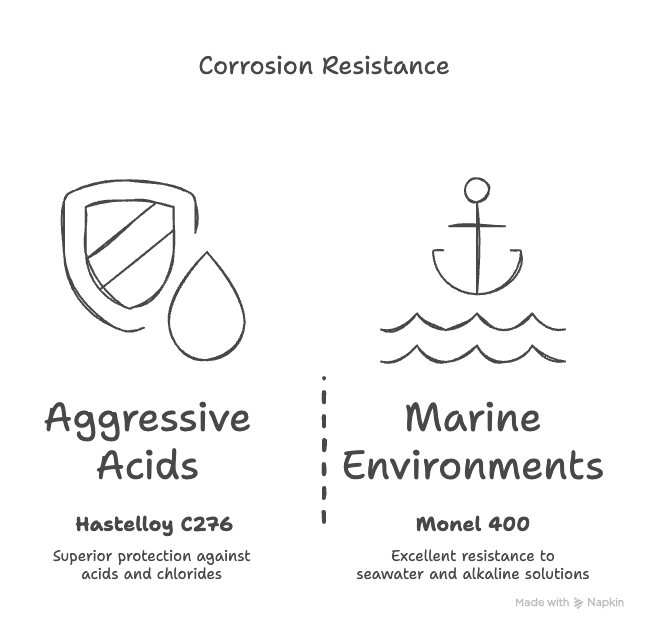
The high copper content in Monel 400 enhances resistance to seawater and reducing environments, while the chromium and molybdenum in Hastelloy C276 provide superior protection against aggressive acids.
Mechanical Properties
Monel 400 offers good strength and toughness over a wide temperature range and retains ductility even at subzero temperatures.
Hastelloy C276 provides moderate to high strength with excellent stability under extreme corrosion conditions.
| Property | Monel 400 | Hastelloy C276 |
|---|---|---|
| Room Temperature Strength | Moderate | Moderate to High |
| Ductility | Excellent | Good |
| High-Temperature Stability | Good | Good |
Corrosion Resistance Performance
Monel 400 is highly resistant to seawater, brine solutions, alkaline environments, and hydrofluoric acid. It performs exceptionally well in marine atmospheres.
Hastelloy C276 offers outstanding resistance to sulfuric acid, hydrochloric acid, wet chlorine gas, and mixed acid environments. It also resists pitting and crevice corrosion better than most nickel alloys.
Temperature Resistance
Monel 400 can operate continuously at temperatures up to approximately 480°C and maintains mechanical integrity at cryogenic temperatures.
Hastelloy C276 is typically used up to around 425–450°C in corrosive environments, where chemical resistance is more critical than extreme high-temperature strength.
Fabrication and Weldability
Monel 400 has good weldability and can be fabricated using standard methods, though it work-hardens quickly during machining.
Hastelloy C276 also offers excellent weldability without the need for post-weld heat treatment, making it suitable for complex chemical equipment fabrication.
Typical Applications
Monel 400 Applications:
Marine engineering components, seawater piping, heat exchangers, oil and gas equipment, pumps, valves, and chemical processing equipment handling alkaline media.
Hastelloy C276 Applications:
Chemical reactors, flue gas desulfurization systems, acid processing equipment, pollution control units, heat exchangers, and waste treatment systems.
Cost and Availability
Monel 400 is generally less expensive and more readily available due to its simpler alloy composition.
Hastelloy C276 is significantly more expensive because of its high alloy content and superior corrosion resistance capabilities.
How to Choose Between Monel 400 and Hastelloy C276
Choose Monel 400 if: the application involves seawater, marine exposure, or alkaline environments with moderate temperature requirements.
Choose Hastelloy C276 if: the application involves highly aggressive acids, mixed chemical environments, or severe localized corrosion risks.
Related Questions
Is Hastelloy C276 better than Monel 400?
Hastelloy C276 is superior in aggressive chemical environments, while Monel 400 performs better in marine and alkaline conditions.
Which alloy is more corrosion resistant?
Hastelloy C276 offers broader and stronger corrosion resistance against acids and chlorides.
Can Monel 400 replace Hastelloy C276?
No, Monel 400 is not suitable for severe acidic environments where Hastelloy C276 is required.


 English
  Korean
  Japanese
  Arabic
  Spanish
  German
  Portuguese
  French
  Russian
  Italian