

Monel K500 is a precipitation-hardenable nickel-copper alloy that combines the excellent corrosion resistance of Monel 400 with significantly higher strength and hardness. By adding aluminum and titanium, Monel K500 can undergo age-hardening heat treatment, which produces fine precipitates in the alloy structure and greatly improves its mechanical performance. Because of this unique combination of high strength, seawater corrosion resistance, and long-term stability, Monel K500 properties make the alloy widely used in marine engineering, offshore oil and gas equipment, chemical processing systems, and high-performance mechanical components.
Introduction to Monel K500 Alloy
Monel K500 belongs to the Monel nickel-copper alloy family and is known for its exceptional corrosion resistance and high mechanical strength. It was developed as an improved version of Monel 400 to provide higher strength while maintaining similar corrosion resistance in marine and chemical environments.
The alloy contains aluminum and titanium additions that enable precipitation hardening through heat treatment. This process significantly increases the strength and hardness of the material while preserving the excellent corrosion resistance typical of Monel alloys.
Chemical Composition of Monel K500
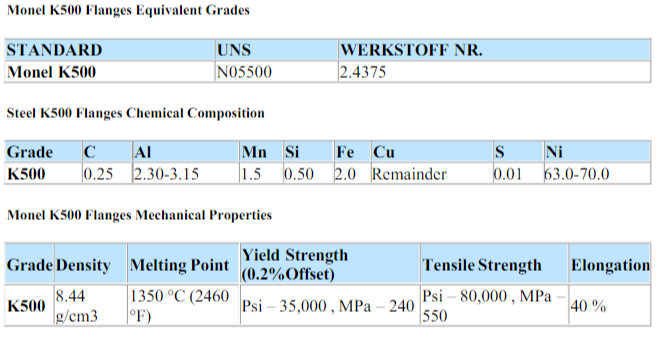
The chemical composition of Monel K500 is carefully controlled to achieve the desired balance between corrosion resistance and mechanical performance.
| Element | Typical Content (%) |
|---|---|
| Nickel (Ni) | 63.0 min |
| Copper (Cu) | 27.0 – 33.0 |
| Aluminum (Al) | 2.3 – 3.15 |
| Titanium (Ti) | 0.35 – 0.85 |
| Iron (Fe) | ≤ 2.0 |
| Manganese (Mn) | ≤ 1.5 |
| Carbon (C) | ≤ 0.25 |
| Silicon (Si) | ≤ 0.5 |
The high nickel content provides corrosion resistance, while copper enhances resistance to seawater and marine environments. Aluminum and titanium are responsible for precipitation hardening.
Strengthening Mechanism of Monel K500
The key difference between Monel K500 and other Monel alloys is its precipitation hardening mechanism.
During heat treatment, aluminum and titanium combine with nickel to form fine precipitates within the alloy matrix. These precipitates block dislocation movement in the crystal structure, significantly increasing strength and hardness.
Benefits of Precipitation Hardening
- Higher tensile and yield strength
- Improved fatigue resistance
- Better wear resistance
- Maintained corrosion resistance
Mechanical Properties of Monel K500
Monel K500 offers excellent mechanical strength compared with many corrosion-resistant alloys.
| Property | Typical Value |
|---|---|
| Tensile Strength | 965 – 1100 MPa |
| Yield Strength | 690 – 760 MPa |
| Elongation | 20 – 30 % |
| Hardness | 27 – 35 HRC |
These properties allow Monel K500 to be used in high-stress components such as shafts, fasteners, and marine hardware.
Physical Properties of Monel K500
Monel K500 also demonstrates stable physical properties that support its performance in industrial environments.
| Property | Value |
|---|---|
| Density | 8.44 g/cm³ |
| Melting Range | 1288 – 1343 °C |
| Thermal Conductivity | 17 W/m·K |
| Electrical Resistivity | 0.615 µΩ·m |
These characteristics help engineers evaluate the thermal and electrical performance of Monel K500 components.
Corrosion Resistance of Monel K500
One of the most important Monel K500 properties is its outstanding resistance to corrosion in a wide range of environments.
The alloy performs well in:
- Seawater and marine atmospheres
- Alkaline solutions
- Neutral salts
- Hydrofluoric acid environments
- Chemical processing systems
The nickel-copper matrix forms a stable protective oxide layer that helps prevent rapid corrosion.
Seawater Corrosion Resistance
Monel K500 is widely used in marine environments because it provides exceptional resistance to seawater corrosion and biofouling.
Components made from this alloy can operate for long periods in seawater without significant degradation. As a result, it is commonly used in propeller shafts, marine fasteners, seawater pumps, and offshore equipment.
High Strength Characteristics
Another important property of Monel K500 is its high strength compared to other corrosion-resistant alloys.
The precipitation hardening mechanism enables the alloy to achieve strength levels similar to some high-strength stainless steels while maintaining excellent corrosion resistance.
This combination makes Monel K500 particularly valuable in industries where both strength and corrosion resistance are required.
Heat Treatment of Monel K500
Monel K500 achieves its high strength through controlled heat treatment.
Solution Annealing
The alloy is heated to dissolve aluminum and titanium into the matrix structure.
Aging Treatment
After solution annealing, the alloy is aged at a lower temperature to form strengthening precipitates, which increase hardness and strength.
Machining and Fabrication Properties
Monel K500 exhibits work hardening behavior during machining, which means the material becomes harder as it is deformed.
Recommended machining practices include:
- Using rigid tooling and carbide cutting tools
- Maintaining steady cutting speeds
- Applying adequate cooling and lubrication
Welding can be performed using standard nickel alloy welding techniques, although post-weld heat treatment may be necessary to restore mechanical strength.
Standards and Designations
Monel K500 is produced according to several international standards.
| Standard System | Designation |
|---|---|
| UNS | N05500 |
| ASTM | B865, B127, B164 |
| DIN | 2.4375 |
These standards define the required chemical composition, mechanical properties, and manufacturing processes.
Common Product Forms
Monel K500 is available in a variety of product forms to meet industrial manufacturing needs.
- Round bars and rods
- Plates and sheets
- Seamless pipes and tubes
- Forgings and flanges
- Wire and fasteners
Main Applications of Monel K500
Due to its excellent mechanical strength and corrosion resistance, Monel K500 is widely used in demanding industries.
- Marine engineering components
- Offshore oil and gas equipment
- Valve stems and pump shafts
- High-strength fasteners
- Chemical processing equipment
- Aerospace components
Frequently Asked Questions (FAQ)
What are the main properties of Monel K500?
Monel K500 offers high strength, excellent corrosion resistance, good fatigue resistance, and outstanding seawater corrosion resistance.
Is Monel K500 stronger than Monel 400?
Yes, Monel K500 is significantly stronger because it can be precipitation hardened through heat treatment.
Is Monel K500 suitable for marine applications?
Yes, Monel K500 has excellent resistance to seawater corrosion and is widely used in marine engineering and offshore oil and gas equipment.


 English
  Korean
  Japanese
  Arabic
  Spanish
  German
  Portuguese
  French
  Russian
  Italian