

Monel and Hastelloy are both high-performance nickel-based alloys widely used in corrosive industrial environments. However, they differ significantly in chemical composition, alloy design philosophy, corrosion resistance focus, and typical applications. Understanding these differences is critical when selecting materials for marine, chemical, or oil & gas projects.
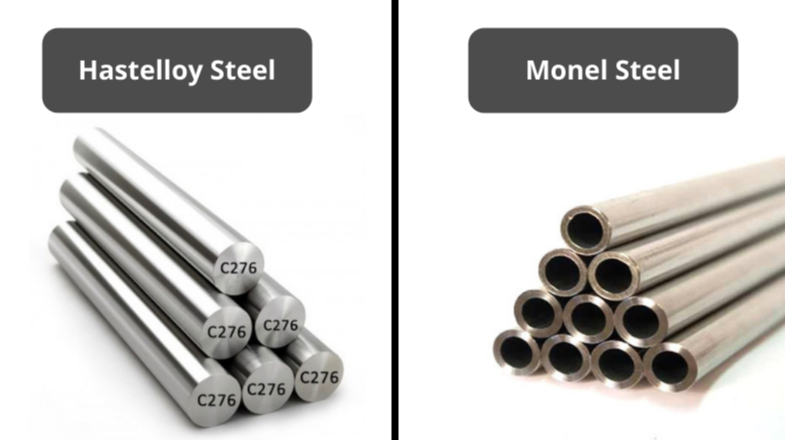
Introduction to Monel and Hastelloy
Monel is a nickel-copper alloy primarily designed for excellent seawater and hydrofluoric acid resistance. It is especially popular in marine engineering.
Hastelloy is a nickel-chromium-molybdenum alloy family engineered for extreme corrosion resistance in highly aggressive chemical environments, including strong oxidizing and reducing acids.
Brand and Development Background Comparison
Monel
Originally developed by International Nickel Company (INCO) in the early 1900s. The trademark is currently owned by Special Metals Corporation.
Hastelloy
Developed by Haynes International in the 20th century, Hastelloy became widely recognized for its performance in chemical processing industries.
Main Chemical Composition Comparison
- Monel 400: ≥63% Ni, 28–34% Cu, small amounts of Fe, Mn, C, Si
- Hastelloy C-276: ~57% Ni, ~16% Cr, ~16% Mo, ~4–5% Fe, small W and Co
Monel is a nickel-copper (Ni-Cu) alloy, while Hastelloy belongs to the nickel-chromium-molybdenum (Ni-Cr-Mo) system.
Alloy Design Philosophy (Nickel-Copper vs Nickel-Chromium-Molybdenum)
Monel relies on a Ni-Cu solid solution structure for corrosion resistance in marine and reducing acid environments.
Hastelloy uses chromium for oxidation resistance and molybdenum for superior resistance to pitting and crevice corrosion in highly aggressive chemical media.
Corrosion Resistance Comparison (Seawater Environment)
Monel exhibits outstanding resistance to flowing seawater, marine atmospheres, and brine solutions. It is widely used for seawater pumps, shafts, and valves.
Hastelloy also performs well in seawater but is generally selected for more chemically aggressive conditions rather than purely marine exposure.
Resistance to Strong Acids (Sulfuric Acid, Hydrochloric Acid, etc.)
Hastelloy significantly outperforms Monel in strong oxidizing and reducing acids such as sulfuric acid, hydrochloric acid, and mixed acid environments.
Monel performs well in hydrofluoric acid and certain reducing acids but is less suitable for strongly oxidizing acids like nitric acid.
Pitting and Crevice Corrosion Resistance
Hastelloy offers superior resistance to pitting and crevice corrosion due to its high molybdenum content.
Monel provides good general corrosion resistance but is less resistant to localized corrosion in highly oxidizing chloride environments compared to Hastelloy.
Mechanical Properties Comparison
Strength and Hardness
- Monel 400: Tensile ~550 MPa, moderate hardness
- Hastelloy C-276: Tensile ~690 MPa
Hastelloy generally offers higher strength in standard conditions.
Ductility
Monel typically provides excellent ductility and toughness, especially at low temperatures.
High-Temperature Performance Comparison
Hastelloy retains mechanical strength and corrosion resistance at higher temperatures compared to Monel. Monel is typically suitable up to approximately 480–550°C, while certain Hastelloy grades can operate at higher temperatures in chemical processing systems.
Stress Corrosion Cracking Resistance
Monel has excellent resistance to chloride-induced stress corrosion cracking, especially in marine environments.
Hastelloy also provides strong resistance, particularly in mixed acid and high-chloride chemical systems.
Machining and Welding Comparison
Both alloys are difficult to machine due to work-hardening tendencies. Monel is generally easier to machine than Hastelloy.
Hastelloy requires careful welding procedures but offers good weldability when proper filler materials and heat control are used.
Typical Application Differences
- Monel: Marine engineering (shafts, propellers, seawater valves), offshore oil equipment, hydrofluoric acid service.
- Hastelloy: Chemical reactors, heat exchangers, acid processing equipment, pollution control systems.
Price Difference Analysis
Hastelloy is generally more expensive than Monel due to its higher molybdenum and chromium content. Price fluctuations are influenced by nickel and molybdenum market conditions.
Common Grade Comparison (Monel 400 vs Hastelloy C-276)
Monel 400 is optimized for seawater and reducing environments. Hastelloy C-276 offers superior resistance in aggressive acid mixtures and severe corrosion conditions.
How to Choose Between Monel and Hastelloy
Choose Monel for long-term seawater exposure, hydrofluoric acid environments, and applications requiring excellent toughness.
Choose Hastelloy for strong acids, high chloride concentrations, mixed chemical environments, and where superior pitting resistance is required.
Frequently Asked Questions (FAQ)
Which alloy is better for seawater applications?
Monel is often preferred for pure marine environments due to its proven seawater resistance.
Which alloy performs better in strong acids?
Hastelloy provides superior resistance in sulfuric, hydrochloric, and mixed acid environments.
Is Monel cheaper than Hastelloy?
Generally yes, because Hastelloy contains higher levels of molybdenum and chromium.
Can Monel replace Hastelloy in chemical plants?
Only in less aggressive environments. For highly corrosive chemical systems, Hastelloy is typically the safer choice.


 English
  Korean
  Japanese
  Arabic
  Spanish
  German
  Portuguese
  French
  Russian
  Italian