

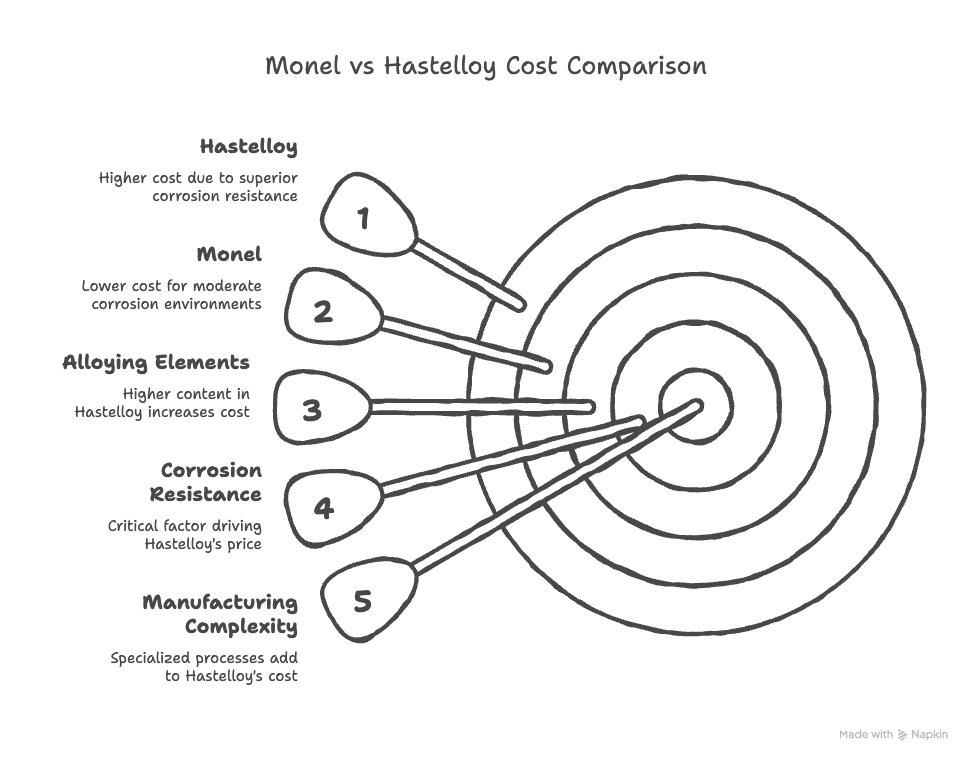
When selecting materials for corrosive or extreme environments, cost is often a major consideration. Monel and Hastelloy are both high-performance nickel-based alloys, but they differ significantly in composition, corrosion resistance, and overall pricing. Generally, Hastelloy alloys are more expensive than Monel due to higher alloying element content and broader corrosion resistance. This article breaks down the price differences, the factors that influence cost, and guidance for choosing the most cost-effective material for your application.
Overview of Monel and Hastelloy
Monel is a family of nickel-copper alloys, with Monel 400 and Monel K500 being the most widely used. These alloys are known for strong corrosion resistance in seawater, brine, and alkaline environments.
Hastelloy refers to a group of nickel-chromium-molybdenum alloys such as C276, C22, and X, engineered for exceptional corrosion resistance in highly aggressive chemical environments, including strong acids and mixed corrosive media.
Typical Relative Price Range
In general market conditions, **Hastelloy alloys typically cost more than Monel alloys** due to higher content of molybdenum, chromium, and other expensive alloying elements.
| Alloy | Typical Relative Price Level | Cost Factor |
|---|---|---|
| Monel 400 | Lower | High nickel & copper; moderate alloying |
| Monel K500 | Mid | Precipitation-hardening alloy with added aluminum/titanium |
| Hastelloy C276 | Higher | High molybdenum & chromium for chemical resistance |
| Hastelloy C22 | Highest | Enhanced corrosion resistance; extensive alloying |
Why Hastelloy Often Costs More Than Monel
Raw Material Content: Hastelloy alloys contain more costly elements like molybdenum and chromium in higher percentages, driving up the base metal cost.
Corrosion Resistance Requirements: Hastelloy is specified for severe chemical environments (strong acids, mixed corrosion conditions), requiring tighter composition control and more sophisticated manufacturing.
Processing Complexity: Some Hastelloy grades require specialized melting, forging, and heat treatment to achieve desired corrosion resistance and mechanical stability.
Typical Price Differences by Product Form
Prices vary by product form (pipe, plate, bar, wire) and specific grade, but the following illustrates **general market trends**:
| Material Form | Monel 400 Approx. Price | Hastelloy C276 Approx. Price |
|---|---|---|
| Pipe/Tubing (per kg) | $30 – $60 | $60 – $120+ |
| Sheet/Plate (per kg) | $28 – $58 | $65 – $130+ |
| Bar/Round (per kg) | $32 – $62 | $70 – $140+ |
These price ranges are approximate and depend on size, specification, surface finish, and quantity. In many cases, Hastelloy can be **2× to 3× the cost of Monel**, especially for high-alloy grades like C22 or C263.
Factors That Affect Monel and Hastelloy Pricing
Alloy Grade: Higher alloy content increases cost.
Raw Material Market: Nickel, molybdenum, and chromium prices fluctuate with global metal markets.
Manufacturing Standard: ASTM/ASME certifications, NACE compliance, and aerospace standards add to cost.
Heat Treatment: Some alloys require specialized heat treatment, affecting price.
Surface Finish: Polished or plated finishes increase cost.
Order Quantity: Bulk orders usually achieve lower unit pricing.
Regional and Supply Chain Influences
Material costs vary by region due to labor rates, local supply, tariffs, and logistics. For example:
• Asia factory pricing for common Monel products may be lower than Western distributor prices, but buyers should factor in shipping and duties.
• Hastelloy products often carry a higher premium in regions with strong corrosion service demand (chemical plants, refineries).
Application Impact on Total Cost
Choosing a higher-priced alloy like Hastelloy can lead to **lower lifecycle costs** in environments where Monel would fail prematurely due to corrosion. Engineers often weigh:
Initial Material Cost vs.
Maintenance, Downtime, and Replacement Costs
In highly corrosive chemical environments, Hastelloy’s higher upfront cost may be justified by extended service life and reduced failure risk.
How to Choose Based on Price and Performance
Choose Monel if:
• The environment is primarily seawater or mildly corrosive alkaline solutions
• Moderate mechanical strength is sufficient
• Cost sensitivity is high
Choose Hastelloy if:
• The service involves aggressive acids or mixed corrosive media
• Localized corrosion (pitting/crevice) resistance is critical
• Extended maintenance intervals and long service life are priorities
Related Questions
Is Hastelloy always more expensive than Monel?
Yes — Hastelloy alloys generally cost more than Monel due to higher alloying elements and tougher corrosion resistance requirements.
Which has better corrosion resistance, Monel or Hastelloy?
Hastelloy typically offers broader corrosion resistance, especially in aggressive chemical environments.
Can Monel be chosen to reduce cost?
Yes — in marine, seawater, or alkaline environments where corrosion is less severe, Monel can be a cost-effective choice.


 English
  Korean
  Japanese
  Arabic
  Spanish
  German
  Portuguese
  French
  Russian
  Italian