

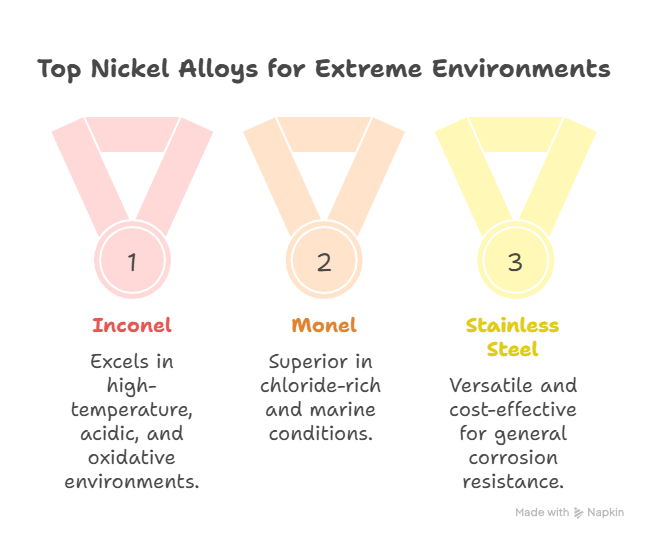
Monel and Inconel are two premium nickel-based alloy families widely used in aerospace, marine, chemical processing, and high-temperature industries. Although both exhibit exceptional corrosion resistance and mechanical strength, their performance differs significantly under seawater, acidic media, high temperatures, and extreme mechanical stress. Choosing the correct alloy directly affects safety, durability, and project cost. This comprehensive comparison covers composition, corrosion behavior, heat resistance, machinability, weldability, applications, and pricing.
Chemical Composition Comparison
The composition difference between Monel and Inconel leads to major variations in corrosion resistance, hardness, and heat tolerance.
| Alloy | Main Composition | Notes |
|---|---|---|
| Monel (e.g., Monel 400) | ~67% Ni, ~30% Cu, small Fe & Mn | Excellent seawater corrosion resistance; softer and more ductile |
| Inconel (e.g., Inconel 600/625/718) | >50% Ni, high Cr, Fe, Nb, Mo | Superior oxidation and high-temperature strength |
Corrosion Resistance Comparison
Monel excels in chloride-rich environments, while Inconel provides broader protection against oxidative and acidic attack.
| Environment | Monel Performance | Inconel Performance |
|---|---|---|
| Seawater | Outstanding; one of the best materials | Good; but Monel is better |
| Acids (Sulfuric, Hydrochloric) | Moderate to good depending on concentration | Excellent in strong acids |
| Alkaline Solutions | Excellent | Excellent |
| Oxidizing Environments | Fair | Superior (high Cr content) |
Temperature Resistance
Inconel clearly leads when used at high temperature due to solid-solution and precipitation-hardening mechanisms.
| Property | Monel | Inconel |
|---|---|---|
| Max Operating Temperature | ~550°C | Up to 1100°C depending on grade |
| Thermal Stability | Good | Outstanding |
| Creep Resistance | Limited | Very high (especially Inconel 718) |
Mechanical Strength Comparison
Inconel offers significantly higher tensile, yield, and fatigue strength, especially at elevated temperatures.
| Property | Monel 400 | Inconel 718 |
|---|---|---|
| Tensile Strength | ~550 MPa | ~1250 MPa |
| Yield Strength | ~240 MPa | ~1030 MPa |
| Fatigue Strength | Moderate | Excellent |
Machinability & Weldability
Both alloys are known for being difficult to machine due to work-hardening, but their weldability differs depending on grade.
| Factor | Monel | Inconel |
|---|---|---|
| Machinability | Better than Inconel; still challenging | More difficult; hardens rapidly under cutting |
| Weldability | Good overall | Good but some grades (e.g., 718) require strict control |
Applications of Monel
Monel is commonly used in chloride-rich and marine conditions due to its exceptional resistance to seawater corrosion.
| Industry | Common Use |
|---|---|
| Marine Engineering | Pumps, propeller shafts, seawater valves |
| Chemical Processing | Heat exchangers, tanks |
| Aerospace | Fuel tanks & piping |
Applications of Inconel
Inconel is widely used in high-temperature and extreme-stress environments.
| Industry | Common Use |
|---|---|
| Aerospace | Turbine blades, exhaust systems |
| Oil & Gas | Downhole tools, high-pressure components |
| Power Generation | Boiler components, superheaters |
Cost Comparison
Inconel is generally more expensive due to complex alloying, higher performance, and more difficult manufacturing.
| Aspect | Monel | Inconel |
|---|---|---|
| Material Cost | Lower | Higher |
| Machining Cost | Moderate | High (tool wear) |
| Overall Project Cost | More cost-effective | More expensive but higher performance |
Which Alloy Should You Choose?
The best choice depends on environmental demands.
| Application Need | Recommended Alloy | Reason |
|---|---|---|
| Seawater exposure | Monel | Superior chloride resistance |
| High temperatures | Inconel | Handles >1000°C |
| Strong acids | Inconel | High Cr protects against oxidation |
| Cost-sensitive projects | Monel | Generally cheaper |
Related Questions
1. Is Monel better than Inconel in seawater?
Monel performs better in seawater due to its high nickel-copper composition, giving it superior chloride resistance.
2. Which alloy has higher heat resistance, Monel or Inconel?
Inconel has significantly higher heat resistance and can operate up to about 1100°C depending on the grade.
3. Why is Inconel more expensive than Monel?
Inconel costs more because of its complex alloying (Cr, Mo, Nb), difficult machining characteristics, and superior high-temperature performance.


 English
  Korean
  Japanese
  Arabic
  Spanish
  German
  Portuguese
  French
  Russian
  Italian