

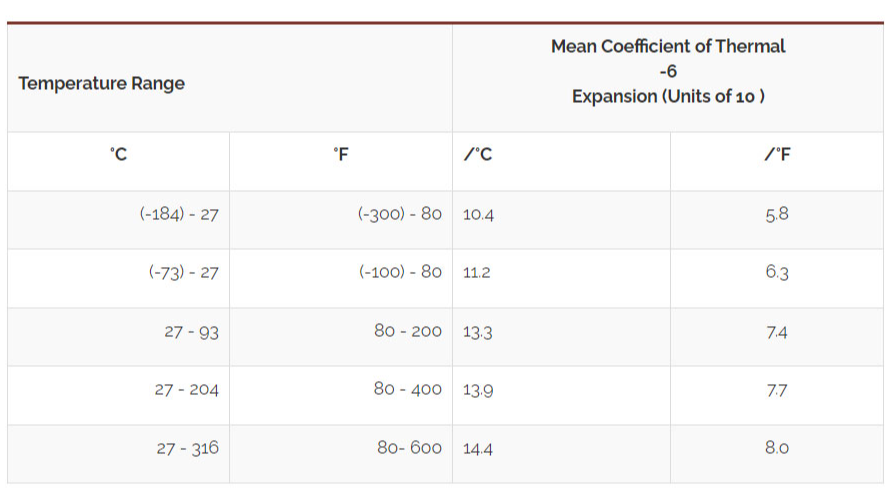
Nickel 200 is a commercially pure nickel alloy known for its stable physical properties, including a well-defined thermal expansion behavior. The thermal expansion coefficient of Nickel 200 is an important parameter in engineering design, especially in applications involving temperature fluctuations. Its predictable expansion characteristics make it suitable for heat exchangers, electronics, and chemical processing equipment where dimensional stability is critical.
Introduction to Nickel 200 Material
Nickel 200 (UNS N02200) is a high-purity nickel alloy (≥99% Ni) with excellent corrosion resistance, good mechanical properties, and high thermal and electrical conductivity. It is widely used in environments requiring stability under thermal cycling.
What is Thermal Expansion Coefficient?
The thermal expansion coefficient refers to the rate at which a material expands when the temperature changes. It is typically expressed as linear expansion (change in length per unit length per degree) and is critical in preventing thermal stress and distortion in engineering systems.
Thermal Expansion Coefficient of Nickel 200
| Temperature Range (°C) | Coefficient (µm/m·°C) |
|---|---|
| 20 – 100 | 13.3 |
| 20 – 200 | 13.8 |
| 20 – 300 | 14.3 |
| 20 – 400 | 14.8 |
| 20 – 600 | 15.6 |
Variation of Thermal Expansion with Temperature
The thermal expansion coefficient of Nickel 200 increases gradually with temperature. This means that the material expands more rapidly at higher temperatures, which must be considered in high-temperature applications to avoid dimensional mismatch.
Difference Between Linear and Volumetric Expansion
| Type | Description |
|---|---|
| Linear Expansion | Change in length per unit length |
| Volumetric Expansion | Change in volume; approximately three times linear expansion |
Effect of Temperature on Dimensional Stability
As temperature increases, Nickel 200 experiences predictable dimensional changes. Its relatively uniform expansion behavior ensures stability in components exposed to repeated thermal cycles.
Comparison with Other Nickel Alloys (Ni 201, Inconel)
| Material | Thermal Expansion (µm/m·°C) | Characteristics |
|---|---|---|
| Nickel 200 | 13 – 16 | High purity, stable expansion |
| Nickel 201 | 13 – 16 | Similar, better high-temp stability |
| Inconel 625 | 12 – 14 | Lower expansion, better for extreme conditions |
Comparison with Stainless Steel
| Material | Thermal Expansion (µm/m·°C) |
|---|---|
| Nickel 200 | 13 – 16 |
| 304 Stainless Steel | 16 – 18 |
| 316 Stainless Steel | 15 – 17 |
Impact on High-Temperature Equipment Design
Designers must account for thermal expansion to prevent stress, distortion, or failure. Nickel 200’s moderate expansion makes it suitable for components that require compatibility with other metals.
Importance in Heat Exchangers
In heat exchangers, consistent thermal expansion reduces the risk of thermal fatigue and leakage. Nickel 200 ensures stable performance under repeated heating and cooling cycles.
Applications in Electronics and Precision Equipment
Nickel 200 is used in electronics where dimensional stability and conductivity are critical. Controlled expansion helps maintain alignment and reliability in sensitive components.
Relationship Between Thermal Expansion and Thermal Stress
Thermal stress occurs when expansion is constrained. Even moderate expansion can generate significant stress if not properly accommodated in design.
Factors Affecting Thermal Expansion Coefficient
| Factor | Effect |
|---|---|
| Composition | Higher purity leads to more stable expansion |
| Temperature | Higher temperature increases expansion rate |
| Processing condition | Cold working may slightly affect expansion behavior |
How to Consider Thermal Expansion in Material Selection
- Match expansion coefficients between joined materials
- Allow for expansion gaps in design
- Consider operating temperature range
- Evaluate thermal cycling conditions
Frequently Asked Questions (FAQ)
What is the thermal expansion coefficient of Nickel 200?
It typically ranges from 13 to 16 µm/m·°C depending on temperature.
Does Nickel 200 expand more than stainless steel?
No, Nickel 200 generally has slightly lower thermal expansion than common stainless steels.
Is Nickel 200 suitable for high-temperature applications?
Yes, especially where predictable expansion and corrosion resistance are required.
Why is thermal expansion important in engineering?
It helps prevent thermal stress, deformation, and failure in temperature-varying environments.


 English
  Korean
  Japanese
  Arabic
  Spanish
  German
  Portuguese
  French
  Russian
  Italian