

Nickel 201 is a low-carbon version of commercially pure nickel, specifically designed to improve performance at elevated temperatures. With carbon content significantly reduced compared to Nickel 200, Nickel 201 offers better resistance to graphitization while maintaining excellent ductility, corrosion resistance, and stable mechanical properties. These characteristics make it widely used in chemical processing, electronics, and high-temperature applications.
Introduction to Nickel 201 Material
Nickel 201 (UNS N02201) is a wrought nickel alloy with very low carbon content (≤0.02%), providing enhanced high-temperature stability compared to Nickel 200. It retains the excellent corrosion resistance and formability of pure nickel while improving long-term performance at elevated temperatures.
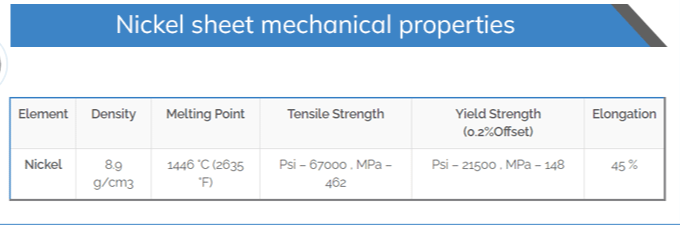
Overview of Nickel 201 Mechanical Properties
| Property | Typical Value |
|---|---|
| Tensile Strength | ~380 – 550 MPa |
| Yield Strength | ~100 – 240 MPa |
| Elongation | 35 – 50% |
| Hardness | ~70 – 120 HB |
Tensile Strength
Nickel 201 exhibits moderate tensile strength compared to alloyed nickel materials. Its strength is sufficient for structural applications where corrosion resistance and ductility are more critical than high load-bearing capacity.
Yield Strength
The yield strength of Nickel 201 is relatively low, which allows for significant plastic deformation before permanent damage occurs. This property is beneficial in forming and shaping processes.
Ductility and Elongation
Nickel 201 offers excellent ductility, with elongation typically exceeding 35%. This makes it highly suitable for applications requiring bending, forming, and deep drawing.
Hardness
The hardness of Nickel 201 is relatively low compared to hardened alloys. This softness contributes to its excellent machinability and formability.
High-Temperature Mechanical Performance
Nickel 201 performs well at elevated temperatures, maintaining ductility and structural integrity. Its low carbon content prevents embrittlement and graphitization during prolonged exposure above 315°C.
Performance at Low Temperatures
Nickel 201 maintains excellent toughness and ductility at cryogenic temperatures, making it suitable for low-temperature and liquefied gas applications.
Effect of Cold Working on Mechanical Properties
| Condition | Effect |
|---|---|
| Cold Worked | Increased strength and hardness, reduced ductility |
| Annealed | Lower strength, higher ductility |
Effect of Heat Treatment on Mechanical Properties
Annealing is commonly used to restore ductility after cold working. Heat treatment helps refine grain structure and improve formability without significantly increasing strength.
Role of Low Carbon Content in Performance
The reduced carbon content in Nickel 201 minimizes the risk of carbon precipitation at high temperatures, ensuring stable mechanical properties and preventing embrittlement.
Comparison with Nickel 200 Mechanical Properties
| Property | Nickel 200 | Nickel 201 |
|---|---|---|
| Carbon Content | Higher | Lower |
| High-Temp Stability | Moderate | Better |
| Strength | Slightly higher | Slightly lower |
| Ductility | High | Very high |
Strength Comparison with Stainless Steel
| Material | Tensile Strength |
|---|---|
| Nickel 201 | ~380 – 550 MPa |
| 304 Stainless Steel | ~520 – 750 MPa |
| 316 Stainless Steel | ~520 – 750 MPa |
Impact of Mechanical Properties on Applications
The combination of moderate strength and excellent ductility makes Nickel 201 ideal for applications requiring forming, corrosion resistance, and stability under thermal cycling.
Typical Applications
- Chemical processing equipment
- Caustic handling systems
- Electronic components
- Heat exchangers
- Food processing equipment
Frequently Asked Questions (FAQ)
Is Nickel 201 stronger than Nickel 200?
No, Nickel 200 typically has slightly higher strength, but Nickel 201 offers better high-temperature stability.
What is the main advantage of Nickel 201?
Its low carbon content provides superior resistance to embrittlement at high temperatures.
Is Nickel 201 suitable for cryogenic applications?
Yes, it maintains excellent toughness and ductility at very low temperatures.
Can Nickel 201 be cold worked?
Yes, and cold working increases its strength while reducing ductility.


 English
  Korean
  Japanese
  Arabic
  Spanish
  German
  Portuguese
  French
  Russian
  Italian