

Nickel chrome powder factories play a crucial role in supplying high-performance alloy powders used in aerospace, energy, additive manufacturing, and corrosion-resistant applications. These facilities integrate advanced atomization, strict quality control, and precise chemical management to deliver powders with consistent particle size and purity. This article explains how a nickel chrome powder factory operates, what influences the quality and price of its products, and how buyers can evaluate suppliers effectively.
Key Characteristics of a Nickel Chrome Powder Factory
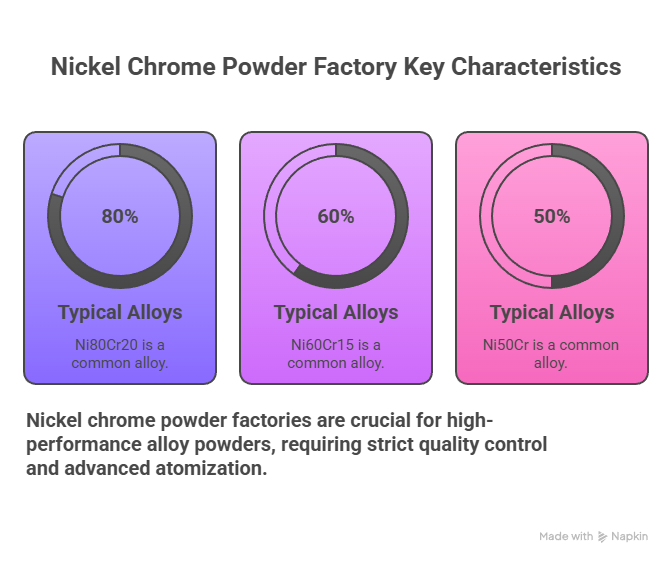
A nickel chrome powder factory focuses on producing Ni-Cr alloy powders with controlled chemistry and tightly regulated particle size distributions. These powders are commonly used for thermal spray, welding, metal injection molding, and 3D printing. The factory’s capability determines the powder’s performance stability, oxidation resistance, and mechanical strength at high temperatures.
| Characteristic | Description |
| Typical Alloys | Ni80Cr20, Ni60Cr15, Ni50Cr, custom compositions |
| Production Methods | Gas atomization, water atomization, plasma spheroidization |
| Particle Size Range | -325 mesh, 15–53 μm, 45–105 μm, or nano-scale options |
| Main Applications | Thermal spray, AM, welding consumables, corrosion-resistant coatings |
Manufacturing Processes Used in Nickel Chrome Powder Factories
A professional nickel chrome powder factory usually operates multiple powder-making lines to cover different customer requirements. Gas atomization is the most widely adopted method because it provides excellent flowability and spherical particles ideal for industrial applications.
| Process | Advantages | Typical Uses |
| Gas Atomization | High sphericity, low oxygen, stable chemistry | 3D printing, thermal spray |
| Water Atomization | Lower cost, higher output | Welding powders, MIM feedstock |
| Plasma Spheroidization | Improves irregular powder flowability | High-performance AM materials |
Quality Standards in a Nickel Chrome Powder Factory
To ensure product stability, factories follow strict testing procedures. Laboratories typically include particle analyzers, ICP-OES equipment for chemical validation, and oxygen-nitrogen analyzers. Buyers should confirm that the factory operates under consistent quality-control systems.
| Quality Parameter | Importance |
| Chemical Composition | Ensures corrosion resistance and temperature-strength properties |
| Particle Size Distribution | Affects flowability, deposition efficiency, and coating density |
| O/N Content | Critical for aerospace-grade performance |
| Sphericity | Determines flow characteristics, especially for AM |
How to Choose a Reliable Nickel Chrome Powder Factory
When comparing suppliers, buyers should evaluate production capability, certifications, testing equipment, and consistency between batches. Price should not be the only factor—long-term performance and stability often bring much lower overall cost.
| Evaluation Item | Why It Matters |
| Factory Scale | Larger plants typically maintain stable batch sizes and better QA capability |
| Certifications | ISO 9001, aerospace certifications, or specific industry approvals |
| Sample Testing | Ensures the powder fits the user’s equipment and application |
| Technical Support | Engineering guidance improves end-use performance |
Pricing Factors for Nickel Chrome Powder
Prices vary widely depending on purity, alloy composition, atomization method, particle size, and order quantity. Aerospace-grade powder often costs significantly more due to high sphericity and low gas content requirements.
| Factor | Impact on Price |
| Alloy Composition | Higher alloy content and tighter chemistry raise production cost |
| Production Method | Gas atomized powders usually cost more than water-atomized |
| Particle Size | Narrow PSD ranges are more expensive due to screening losses |
| Batch Certifications | Additional documentation and testing increase cost |
Global Supply Capabilities of Nickel Chrome Powder Factories
Leading factories export worldwide and provide customized powder grades for specific industries. Regional differences in energy cost, nickel pricing, and labor also influence factory competitiveness. Buyers should evaluate shipping capability, packaging standards, and lead time.
| Region | Features |
| Asia | Competitive pricing, flexible customization |
| Europe | High standards, aerospace-grade production |
| North America | Strong R&D capability, stable supply for advanced industries |
FAQ
1. What is nickel chrome powder used for?
Nickel chrome powder is mainly used in thermal spray coatings, welding, corrosion-resistant applications, and additive manufacturing due to its excellent oxidation resistance and high-temperature stability.
2. How is nickel chrome powder made?
Most factories use gas atomization or water atomization to melt the alloy and break it into fine particles, followed by screening and quality testing.
3. How do I choose a good nickel chrome powder supplier?
You should check the factory’s certifications, testing equipment, production capability, sample stability, and technical support to ensure reliable long-term supply.


 English
  Korean
  Japanese
  Arabic
  Spanish
  German
  Portuguese
  French
  Russian
  Italian