

Nimonic 75 round bar is a nickel-chromium alloy bar designed for high-temperature environments requiring excellent oxidation resistance and structural stability. Compared with precipitation-hardened superalloys, Nimonic 75 is primarily strengthened by solid solution and work hardening. Because of its ability to resist oxidation and maintain mechanical integrity at temperatures approaching 1000°C, Nimonic 75 round bars are widely used in aerospace components, industrial furnace equipment, and heating elements.
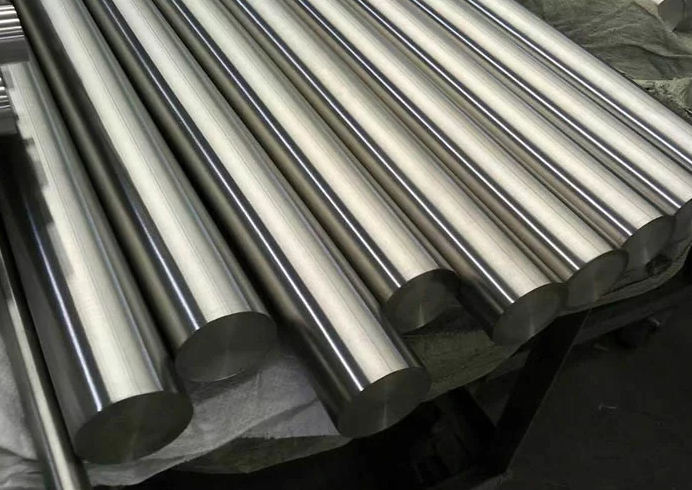
Introduction to Nimonic 75 Alloy
Nimonic 75 is one of the earliest nickel-chromium alloys developed for high-temperature service. The alloy contains a high percentage of nickel combined with chromium to provide strong oxidation resistance and corrosion resistance. Although its strength is lower than precipitation-hardened alloys like Nimonic 80A, it offers excellent ductility and stability during prolonged exposure to high temperatures.
Nimonic 75 Round Bar Product Features
| Feature | Description |
|---|---|
| High oxidation resistance | Stable chromium oxide layer protects the alloy at high temperature |
| Good ductility | Maintains formability during hot and cold working |
| Thermal stability | Suitable for long-term exposure in furnace environments |
| Corrosion resistance | Resistant to oxidation and scaling in hot gases |
Chemical Composition of Nimonic 75
| Element | Content (%) |
|---|---|
| Nickel (Ni) | Balance |
| Chromium (Cr) | 19 – 21 |
| Iron (Fe) | ≤ 5 |
| Manganese (Mn) | ≤ 1 |
| Silicon (Si) | ≤ 1 |
| Carbon (C) | ≤ 0.12 |
| Sulfur (S) | ≤ 0.015 |
Nimonic 75 High-Temperature Oxidation Resistance
The chromium content in Nimonic 75 allows the alloy to form a protective chromium oxide layer when exposed to high temperatures. This oxide film prevents rapid oxidation and scaling, enabling the alloy to perform reliably in furnace atmospheres and high-temperature industrial processes.
Nimonic 75 High-Temperature Strength
Although Nimonic 75 is not precipitation hardened, it still offers moderate high-temperature strength combined with excellent ductility. The alloy maintains structural integrity during continuous service at temperatures up to approximately 1000°C.
Advantages of Nimonic 75 in Heating Elements
Nimonic 75 is widely used in heating elements and furnace components because it can withstand repeated heating cycles without significant degradation. The alloy resists scaling and maintains dimensional stability under thermal stress.
Nimonic 75 Creep Resistance
Nimonic 75 demonstrates reasonable creep resistance under moderate stress conditions at elevated temperatures. While it does not match the creep strength of precipitation-hardened alloys such as Nimonic 80A, it performs well in furnace hardware and structural components.
Nimonic 75 Machining and Forming Properties
Nimonic 75 has good workability compared with many other nickel-based superalloys. It can be hot worked, cold formed, and machined using conventional methods. However, slower cutting speeds and sharp tooling are recommended to avoid excessive work hardening.
Nimonic 75 Round Bar Manufacturing Process
Nimonic 75 round bars are typically produced using hot rolling or forging processes followed by heat treatment to ensure uniform microstructure and mechanical properties.
| Production Stage | Description |
|---|---|
| Melting | Vacuum induction or electric arc melting |
| Hot forging | Forming large billets into bar shapes |
| Hot rolling | Producing round bars with required diameters |
| Heat treatment | Improving microstructure and mechanical properties |
Common Size Range and Supply Specifications
| Product Form | Diameter Range | Length |
|---|---|---|
| Hot Rolled Round Bar | 10 – 120 mm | Up to 6 m |
| Forged Round Bar | 120 – 500 mm | Custom length |
| Bright Round Bar | 6 – 80 mm | Up to 6 m |
Standards and Material Designations
| Standard | Designation |
|---|---|
| UNS | N06075 |
| BS | HR5 |
| EN | 2.4951 |
Difference Between Nimonic 75 and Nimonic 80A
| Feature | Nimonic 75 | Nimonic 80A |
|---|---|---|
| Strengthening mechanism | Solid solution | Precipitation hardened |
| High-temperature strength | Moderate | High |
| Creep resistance | Moderate | Excellent |
| Typical applications | Furnace parts, heating elements | Turbine blades, aerospace components |
Typical Application Industries
- Aerospace engine components
- Industrial furnace hardware
- Heating elements and thermal equipment
- Gas turbine components
- High-temperature structural parts
Considerations When Purchasing Nimonic 75 Round Bar
When sourcing Nimonic 75 round bars, buyers should pay attention to several important factors, including material certification, manufacturing standards, dimensional tolerance, and heat treatment condition. Reliable suppliers typically provide full inspection reports and chemical composition certificates.
Frequently Asked Questions (FAQ)
What is Nimonic 75 round bar mainly used for?
It is commonly used in furnace components, heating elements, and aerospace equipment requiring high oxidation resistance.
Can Nimonic 75 operate at very high temperatures?
Yes. Nimonic 75 can operate at temperatures close to 1000°C while maintaining oxidation resistance and structural stability.
Is Nimonic 75 stronger than Nimonic 80A?
No. Nimonic 80A has higher strength due to precipitation hardening, while Nimonic 75 focuses more on oxidation resistance and ductility.


 English
  Korean
  Japanese
  Arabic
  Spanish
  German
  Portuguese
  French
  Russian
  Italian