

Nimonic 90 is a high-performance nickel-based superalloy strengthened by aluminum and titanium precipitation hardening, with additional cobalt to enhance high-temperature strength. Due to its complex composition and superior creep resistance, Nimonic 90 is generally more expensive than other Nimonic grades such as 75 and 80A. It is widely used in aerospace engines, gas turbines, and high-stress environments.
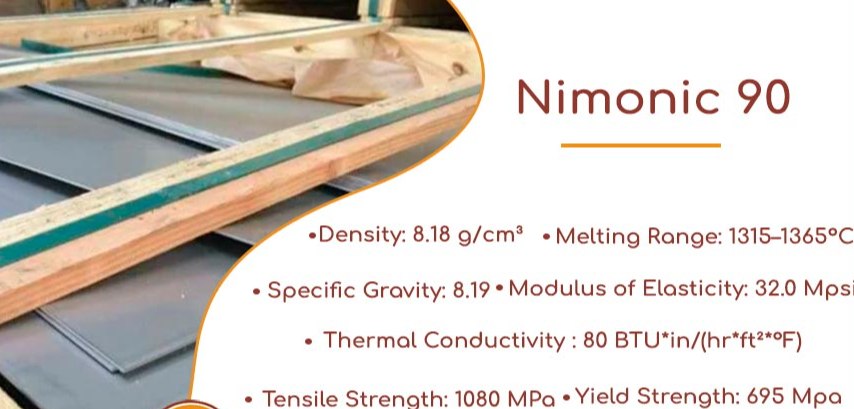
Overview of Nimonic 90 Alloy Pricing
The price of Nimonic 90 depends on raw material costs, manufacturing complexity, certification requirements, and market demand. Its high cobalt and nickel content significantly increases overall cost compared to standard nickel alloys.
Nimonic 90 Price Per Kg
| Product | Price Range (USD/kg) |
|---|---|
| Nimonic 90 Round Bar | 50 – 95 |
| Nimonic 90 Plate | 60 – 110 |
| Nimonic 90 Tube / Pipe | 80 – 140 |
| Nimonic 90 Strip | 70 – 120 |
Note: Prices vary depending on size, certification, and order quantity.
Price Differences by Product Form
Different product forms require different production processes, which directly impact pricing.
| Form | Price Level | Reason |
|---|---|---|
| Round Bar | Medium | Standard forging and rolling process |
| Plate / Sheet | Higher | Additional rolling and finishing |
| Tube / Pipe | Highest | Complex forming and strict tolerance |
| Strip | High | Precision cold rolling |
Price Comparison with Other Nimonic Grades
| Alloy | Price Level | Reason |
|---|---|---|
| Nimonic 75 | Low | Simple composition, no precipitation hardening |
| Nimonic 80A | Medium | Al + Ti strengthening |
| Nimonic 90 | High | Contains Co + higher alloying elements |
Aerospace Grade vs Industrial Grade Pricing
Aerospace-grade Nimonic 90 (AMS standards) is significantly more expensive due to strict testing, traceability, and certification requirements. Industrial-grade materials are more cost-effective but may not meet aerospace specifications.
Impact of Raw Material Costs
The cost of Nimonic 90 is heavily influenced by its alloying elements:
- Nickel (Ni): Primary cost driver
- Cobalt (Co): Significantly increases price
- Chromium (Cr): Improves oxidation resistance
- Aluminum (Al) & Titanium (Ti): Enable precipitation strengthening
Impact of Nickel Price Fluctuations
Global nickel price fluctuations directly affect Nimonic 90 pricing. When nickel prices increase, the cost of Nimonic alloys rises accordingly, often with a delayed but noticeable effect.
Regional Price Differences
| Region | Price Level | Characteristics |
|---|---|---|
| China | Lower | Cost-effective production |
| Europe | High | Strict standards, higher labor costs |
| USA | Very High | Aerospace certification demand |
Impact of Certification Standards
Materials meeting AMS or ASTM standards are more expensive due to additional testing, documentation, and quality assurance processes required for critical applications.
Effect of Size and Machining Precision
Larger diameters, tight tolerances, and precision machining significantly increase production complexity and cost. Custom sizes are typically more expensive than standard stock sizes.
Small Quantity vs Bulk Purchase
Bulk purchasing reduces unit cost due to economies of scale, while small orders incur higher production and setup costs.
Factory Direct Price vs Trader Price
| Supply Type | Price Level | Features |
|---|---|---|
| Factory Direct | Lower | Better pricing for large orders |
| Trader / Distributor | Higher | Flexible quantity and faster delivery |
Comparison with Inconel 718 and Hastelloy
| Alloy | Price Level | Key Feature |
|---|---|---|
| Nimonic 90 | High | High-temperature strength and creep resistance |
| Inconel 718 | High | Excellent strength and versatility |
| Hastelloy | Very High | Superior corrosion resistance |
2026 Nimonic 90 Market Price Trend
In 2026, Nimonic 90 prices are expected to remain strong due to demand from aerospace and energy industries. The market will continue to be influenced by nickel and cobalt price fluctuations, as well as global supply chain conditions.
Frequently Asked Questions (FAQ)
What is the price range of Nimonic 90?
Typically between 50 and 140 USD per kg depending on product form and specifications.
Why is Nimonic 90 more expensive than Nimonic 80A?
Because it contains cobalt and higher alloying content, increasing raw material and production costs.
Does certification affect price?
Yes. AMS-certified materials are significantly more expensive due to strict quality requirements.
Is bulk purchasing cheaper?
Yes. Larger orders generally result in lower unit prices.


 English
  Korean
  Japanese
  Arabic
  Spanish
  German
  Portuguese
  French
  Russian
  Italian