

Nimonic 90 wire is a precipitation-hardened nickel-chromium-cobalt alloy reinforced with aluminum and titanium. It is widely used in high-temperature and high-stress environments due to its excellent creep resistance, oxidation resistance, and fatigue strength—especially in spring and fastener applications.
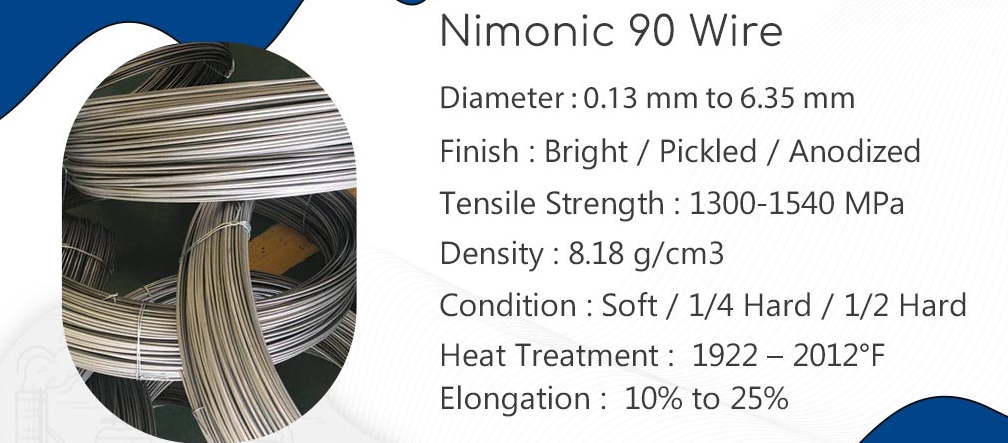
Nimonic 90 Wire Overview
Nimonic 90 wire is specifically designed for demanding applications where high strength and structural stability are required at elevated temperatures up to approximately 920°C. It is commonly supplied in cold-drawn and heat-treated conditions.
Main Characteristics of Nimonic 90 Wire
- Excellent high-temperature strength
- Outstanding creep resistance
- Good oxidation resistance
- High fatigue strength and elasticity
- Suitable for spring and fastener applications
Chemical Composition of Nimonic 90 Wire
| Element | Content (%) |
|---|---|
| Nickel (Ni) | Balance |
| Chromium (Cr) | 18.0 – 21.0 |
| Cobalt (Co) | 15.0 – 21.0 |
| Aluminum (Al) | 1.0 – 1.8 |
| Titanium (Ti) | 2.0 – 3.0 |
| Iron (Fe) | ≤ 1.5 |
| Carbon (C) | ≤ 0.13 |
Effect of Precipitation Strengthening (Al + Ti)
The combination of aluminum and titanium forms gamma prime (γ′) precipitates during aging treatment, significantly improving strength, creep resistance, and long-term stability at high temperatures.
High-Temperature Strength and Creep Resistance
Nimonic 90 wire maintains excellent tensile strength and creep resistance at elevated temperatures, making it suitable for critical components in gas turbines and aerospace engines.
Oxidation and Corrosion Resistance
The chromium content provides strong oxidation resistance, while the nickel matrix ensures stability in various corrosive environments. However, it is not intended for highly aggressive chemical environments like Hastelloy alloys.
Elasticity and Fatigue Performance (Key Advantage)
| Property | Performance Level |
|---|---|
| Elastic Modulus | High |
| Fatigue Strength | Excellent |
| Spring Performance | Outstanding |
Nimonic 90 wire is widely used for springs due to its ability to maintain elasticity and resist fatigue under cyclic loading at high temperatures.
Advantages for Springs and Fasteners
- Maintains spring force at high temperatures
- Resists relaxation and deformation
- Long service life under cyclic stress
Welding Applications (Filler Wire)
Nimonic 90 wire can also be used as welding filler material for compatible high-temperature alloys, providing strong joints with good mechanical properties.
Wire Forms Available
- Round wire
- Flat wire
- Shaped/profile wire
Wire Diameter Range and Tolerances
| Wire Type | Diameter Range | Tolerance |
|---|---|---|
| Fine Wire | 0.1 – 1.0 mm | High precision |
| Medium Wire | 1.0 – 5.0 mm | Standard |
| Heavy Wire | 5.0 – 12 mm | Custom |
Effect of Cold Working and Aging Treatment
Cold working increases strength and hardness, while aging treatment enhances precipitation hardening. The combination allows precise control of mechanical properties for different applications.
Standards and Specifications
| Standard | Description |
|---|---|
| AMS 5829 | Aerospace wire specification |
| BS HR Series | British high-temperature alloy standards |
Typical Applications
- Aerospace springs
- Gas turbine components
- Nuclear industry components
- High-temperature fasteners
Comparison with Other High-Temperature Alloy Wires
| Alloy | Strength | Fatigue Resistance | Application Focus |
|---|---|---|---|
| Nimonic 90 | Very High | Excellent | Springs & high-stress parts |
| Inconel X-750 | High | Good | General high-temp fasteners |
Frequently Asked Questions (FAQ)
Is Nimonic 90 wire suitable for springs?
Yes, it is one of the best materials for high-temperature spring applications.
What is the maximum service temperature?
Typically up to around 920°C depending on application conditions.
Can it be used as welding wire?
Yes, for compatible nickel-based alloys.
What standards apply to Nimonic 90 wire?
AMS 5829 and BS HR series are commonly used.


 English
  Korean
  Japanese
  Arabic
  Spanish
  German
  Portuguese
  French
  Russian
  Italian