

Nimonic alloys are high-performance nickel-based superalloys widely used in aerospace, gas turbines, and high-temperature industrial applications. Due to their complex composition and strict manufacturing standards, Nimonic materials are generally more expensive than conventional alloys. Understanding Nimonic pricing helps buyers make informed procurement decisions.
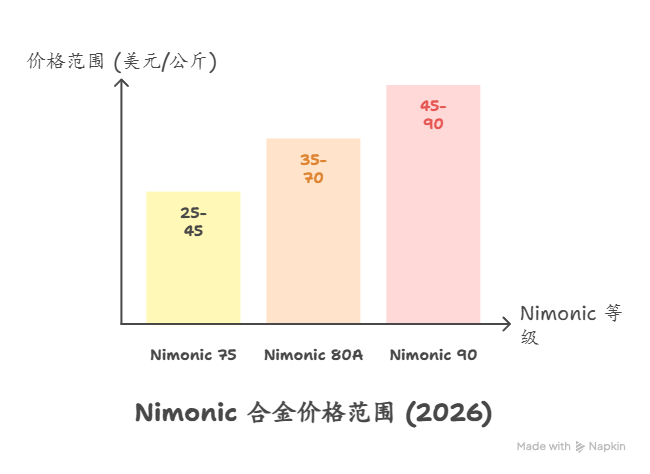
Overview of Nimonic Alloy Pricing
The price of Nimonic alloys varies depending on grade, product form, certification requirements, and market conditions. Since these alloys contain high levels of nickel, chromium, and sometimes titanium and aluminum, their cost is closely tied to raw material prices.
Nimonic Price Per Kg Range
| Grade | Price Range (USD/kg) |
|---|---|
| Nimonic 75 | 25 – 45 |
| Nimonic 80A | 35 – 70 |
| Nimonic 90 | 45 – 90 |
Note: Prices vary based on specifications, quantity, and certification requirements.
Price Differences Between Grades
Nimonic 75 is typically the most cost-effective due to its simpler composition. Nimonic 80A and 90 are more expensive because of precipitation-hardening elements such as titanium and aluminum, which increase both performance and production cost.
Price Comparison by Product Form
| Product Form | Price Level | Reason |
|---|---|---|
| Round Bar | Medium | Standard processing |
| Plate / Sheet | Higher | More rolling and finishing processes |
| Tube / Pipe | Highest | Complex manufacturing and strict tolerances |
Aerospace Grade vs Industrial Grade Pricing
Aerospace-grade Nimonic materials (AMS standards) are significantly more expensive than industrial-grade materials due to stricter quality control, traceability, and certification requirements.
Impact of Raw Material Costs
The price of Nimonic alloys is heavily influenced by the cost of raw materials:
- Nickel (Ni): Primary cost driver
- Chromium (Cr): Affects oxidation resistance and cost
- Titanium (Ti) & Aluminum (Al): Increase cost in precipitation-hardened grades
Impact of Global Nickel Price Fluctuations
Since nickel is the base element, fluctuations in global nickel prices directly affect Nimonic alloy pricing. When nickel prices rise, Nimonic prices typically increase accordingly.
Regional Price Differences
| Region | Price Level | Characteristics |
|---|---|---|
| China | Lower | Competitive manufacturing cost |
| Europe | Higher | Strict standards and higher labor cost |
| USA | High | Aerospace certification demand |
Impact of Standards and Certifications
Materials certified under AMS, ASTM, or BS standards are more expensive due to additional testing, documentation, and compliance requirements.
Effect of Size and Processing Precision
Larger sizes, tighter tolerances, and precision machining increase production complexity, leading to higher prices. Custom dimensions usually cost more than standard sizes.
Small Quantity vs Bulk Pricing
Bulk orders benefit from economies of scale, resulting in lower unit prices. Small orders typically have higher per-unit costs due to setup and production overhead.
Factory Price vs Trader Price
| Supply Type | Price Level | Features |
|---|---|---|
| Factory Direct | Lower | Better for bulk orders |
| Trader / Distributor | Higher | Faster delivery, smaller MOQ |
Comparison with Inconel and Hastelloy Prices
| Alloy | Typical Price Level | Reason |
|---|---|---|
| Nimonic | Medium to High | High-temperature strength focus |
| Inconel | High | Balanced performance and wide usage |
| Hastelloy | Very High | Superior corrosion resistance (Mo content) |
2026 Nimonic Market Price Trend
In 2026, Nimonic prices are expected to remain relatively high due to stable demand from aerospace and energy sectors. However, price fluctuations will continue to follow nickel market trends and global supply chain conditions.
Frequently Asked Questions (FAQ)
What is the average price of Nimonic alloys?
Typically between 25 and 90 USD per kg depending on grade and specifications.
Why is Nimonic so expensive?
Because it contains high-cost elements like nickel and requires complex manufacturing and strict quality control.
Which Nimonic grade is the most affordable?
Nimonic 75 is usually the most cost-effective option.
Does quantity affect the price?
Yes, larger orders usually receive better pricing due to lower production cost per unit.


 English
  Korean
  Japanese
  Arabic
  Spanish
  German
  Portuguese
  French
  Russian
  Italian