

Nimonic alloys are high-performance nickel-based superalloys widely used in aerospace, gas turbines, and high-temperature industrial applications. To ensure consistent quality and performance, Nimonic materials are governed by various international standards, including British (BS), American (ASTM/AMS), and UNS systems. Understanding these standards is essential for correct material selection and procurement.
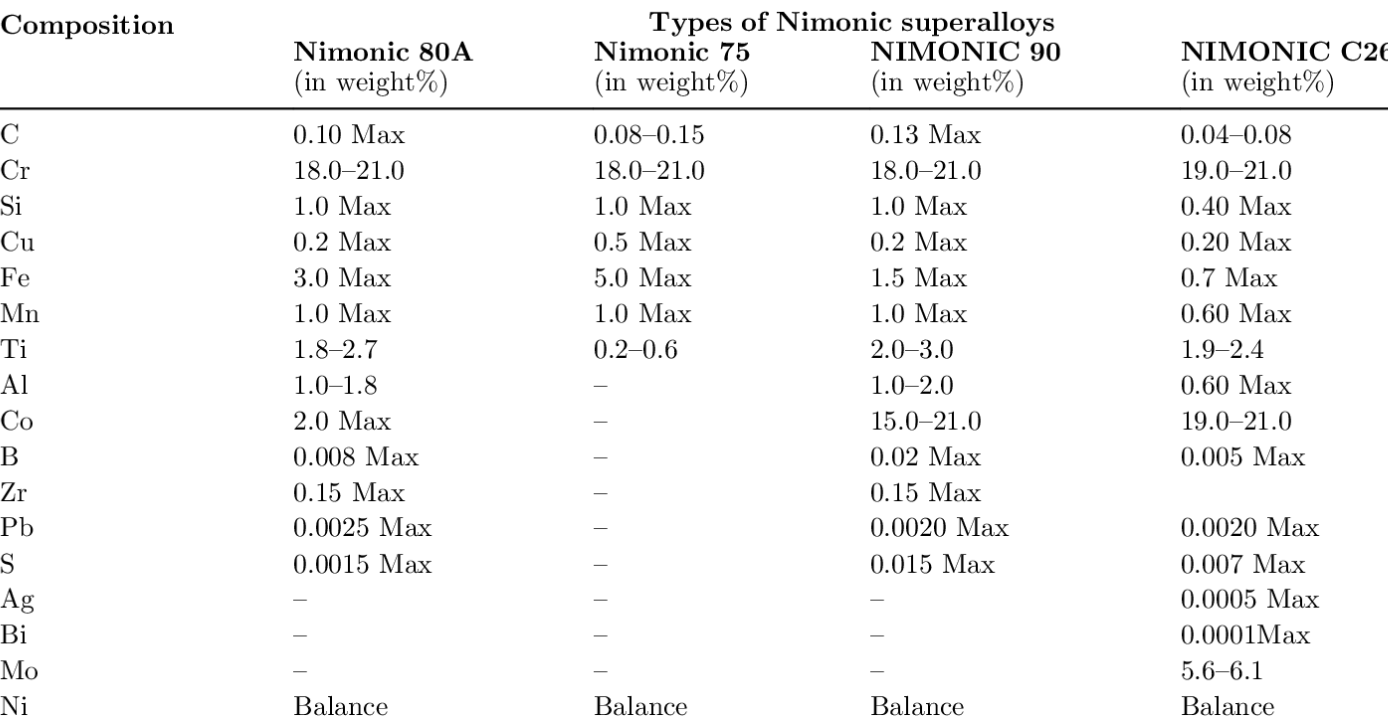
Overview of Nimonic Alloy Standards
Nimonic standards define the chemical composition, mechanical properties, heat treatment conditions, and inspection requirements of each alloy grade. These standards ensure that materials meet the performance demands of high-temperature and high-stress environments.
Common Nimonic Grades and Standard Equivalents
| Nimonic Grade | UNS | BS Standard | AMS Standard |
|---|---|---|---|
| Nimonic 75 | N06075 | HR5 | — |
| Nimonic 80A | N07080 | HR1 / HR201 | AMS 5829 |
| Nimonic 90 | N07090 | HR2 | AMS 5827 |
British Standards (BS) for Nimonic Alloys
The BS standard system is one of the earliest specifications for Nimonic alloys. It defines composition limits, mechanical properties, and heat treatment conditions. BS grades such as HR5, HR1, and HR2 are widely used in Europe and other regions.
American Standards (ASTM / AMS) for Nimonic Alloys
In the United States, Nimonic alloys are often specified under AMS (Aerospace Material Specifications), especially for aerospace applications. ASTM standards may also apply depending on the product form and application.
UNS Numbering System for Nimonic
The UNS (Unified Numbering System) provides a unified designation for alloys. Nimonic alloys fall under the “N” series, representing nickel-based alloys.
| UNS Number | Equivalent Nimonic Grade |
|---|---|
| N06075 | Nimonic 75 |
| N07080 | Nimonic 80A |
| N07090 | Nimonic 90 |
Role of AMS Standards in Aerospace Applications
AMS standards are critical for aerospace-grade Nimonic alloys. They include strict requirements for chemical composition, mechanical performance, traceability, and inspection, ensuring reliability in critical applications such as turbine engines.
Standards for Different Product Forms
| Product Form | Applicable Standards |
|---|---|
| Round Bar | AMS 5829, BS HR standards |
| Plate / Sheet | BS standards, ASTM equivalents |
| Tube / Pipe | ASTM specifications |
Chemical Composition Requirements
Standards specify the allowable range for each alloying element, ensuring consistent material performance. Tight control of elements such as nickel, chromium, aluminum, and titanium is essential for achieving the desired properties.
Mechanical Property Requirements
Mechanical standards define minimum tensile strength, yield strength, elongation, and hardness values. These requirements vary depending on alloy grade and heat treatment condition.
Heat Treatment and Delivery Conditions
Standards also define heat treatment processes such as solution annealing and aging. Delivery conditions may include annealed, aged, or hot-worked states depending on application requirements.
Dimensional Tolerances and Surface Quality
Dimensional tolerances are specified to ensure proper fit and performance in engineering applications. Surface quality requirements may include limits on defects, roughness, and finishing conditions.
Inspection and Testing Standards
| Test Type | Purpose |
|---|---|
| Ultrasonic Testing (UT) | Detect internal defects |
| Radiographic Testing (RT) | Identify internal discontinuities |
| Mechanical Testing | Verify strength and ductility |
| Chemical Analysis | Confirm composition compliance |
Differences Between British and American Standards
| Aspect | BS Standard | ASTM / AMS Standard |
|---|---|---|
| Focus | Traditional alloy designation | Aerospace and industrial applications |
| Usage Region | Europe | USA and global aerospace |
| Documentation | Less strict | Highly detailed and strict |
Impact of Standards on Applications and Certification
Choosing the correct standard is critical for ensuring compliance with industry requirements. Aerospace and nuclear applications require strict certification, while general industrial uses may allow more flexibility.
Frequently Asked Questions (FAQ)
What is the most common standard for Nimonic alloys?
BS standards and AMS specifications are the most commonly used.
What does UNS mean in Nimonic alloys?
UNS is a unified numbering system that provides a global identification for alloy grades.
Are AMS standards required for all applications?
No. AMS standards are mainly required for aerospace applications, while industrial uses may follow BS or ASTM standards.


 English
  Korean
  Japanese
  Arabic
  Spanish
  German
  Portuguese
  French
  Russian
  Italian