

Rene 41 price is one of the most frequently searched topics among buyers of high-temperature nickel-based alloys, especially those sourcing materials for aerospace, gas turbines, and high-stress industrial applications. This article provides a detailed and structured breakdown of Rene 41 pricing factors, market trends, comparison charts, machining cost influences, and procurement strategies. All information is organized clearly with tables to help buyers quickly understand how Rene 41 prices are determined and what cost ranges they may expect in different forms such as bar, sheet, plate, wire, and forgings.
What Influ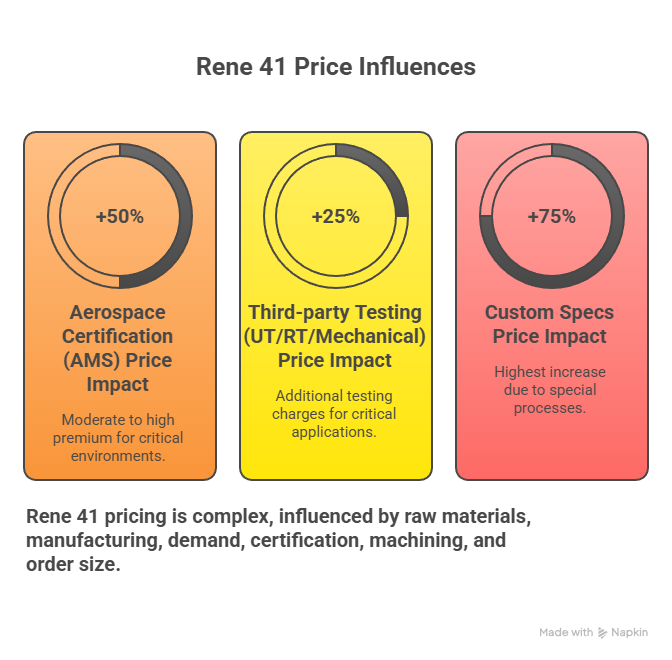 ences Rene 41 Price
The price of Rene 41 is driven by several key variables. Because this alloy is designed for extreme environments, its raw material composition contains high levels of nickel, chromium, molybdenum, and cobalt, all of which impact cost. Below is a structured table summarizing the major elements affecting Rene 41 pricing.
| Factor | Impact on Price |
| Raw Material Costs | Nickel and cobalt volatility directly increases alloy cost |
| Manufacturing Difficulty | High-strength hard-to-machine alloy increases production cost |
| Form & Size | Bars, forgings, and larger thicknesses cost more |
| Heat Treatment | Additional aging treatments raise price |
| Supply & Demand | Aerospace procurement cycles strongly influence cost |
| Certification Requirements | Aerospace/Defense certifications significantly increase pricing |
Rene 41 Typical Market Price Range by Form
The following table summarizes common price ranges buyers encounter for different product forms. Values are expressed as general market trends rather than exact quotations, since pricing varies by supplier, country, and certification.
| Product Form | Typical Market Price Range (USD/kg) |
| Rene 41 Bar | Based on market conditions, often positioned in a premium alloy category |
| Rene 41 Sheet | Generally lower than bar due to thinner cross-sections |
| Rene 41 Plate | Higher than sheet due to thickness and rolling difficulty |
| Rene 41 Wire | Usually higher because of complex wire-drawing processes |
| Rene 41 Forgings | Highest among all forms because of intensive forging operations |
These values help buyers understand relative cost comparisons, even though specific quotes depend on order quantity and material condition.
Rene 41 Price Trends in Aerospace Applications
Aerospace remains the single largest consumer of Rene 41. Procurement cycles from turbine engine manufacturers influence global supply. During periods of high order volume, lead times extend and pricing tends to rise.
| Industry Cycle | Effect on Rene 41 Price |
| High Aerospace Demand | Prices rise due to limited mill capacity |
| Stable Market | Prices remain moderate and predictable |
| Low Production Cycles | Prices soften, especially for surplus stock |
How Certification Affects Rene 41 Price
Rene 41 used in critical environments requires specific certifications such as aerospace-grade heat numbers, traceability documents, AMS or equivalent specifications, and mechanical testing reports.
| Certification Type | Price Impact |
| Standard Mill Certificate (MTC 3.1) | Lowest added cost |
| Aerospace Certification (AMS) | Moderate to high premium |
| Third-party Testing (UT/RT/Mechanical) | Additional testing charges |
| Custom Specs | Highest increase due to special processes |
Rene 41 Machining Costs and Final Part Pricing
The cost of machining Rene 41 is frequently overlooked but significantly influences final part pricing. As a precipitation-hardenable nickel alloy, Rene 41 is extremely tough, making tool wear and machining time much higher than standard stainless steel. Buyers of finished components often see this reflected in the final quotation.
| Machining Factor | Influence |
| Tool Wear | Higher cost due to frequent tool replacement |
| Cutting Speed | Slower speeds increase machining time |
| Heat Treatment Condition | Aged materials are harder to machine |
| Complex Geometries | Increase operational time and cost |
Rene 41 Price Comparison with Other Superalloys
Understanding how Rene 41 compares with other nickel-based alloys helps procurement teams estimate budgets more accurately. The following table summarizes relative market positions.
| Alloy | Relative Price Level |
| Inconel 718 | Lower than Rene 41 |
| Inconel 625 | Moderate; sometimes similar depending on form |
| Waspaloy | Generally similar or slightly higher |
| Rene 41 | High due to composition and manufacturing complexity |
How Order Quantity Influences Rene 41 Price
Like most specialty alloys, Rene 41 benefits from larger order quantities. Small batches require individual setups, adding to cost. Below is a typical trend analysis.
| Order Size | Typical Price Trend |
| Small Orders (<50 kg) | Highest price per kg |
| Mid-scale Orders (50–500 kg) | Moderate pricing |
| Bulk Orders (>500 kg) | Lowest pricing due to economies of scale |
Why Rene 41 Has Higher Price Stability
Compared with many other metal products, Rene 41 has relatively stable long-term pricing because it serves specialized industries with consistent quality requirements. Supply is generally controlled by experienced mills with well-established production lines, reducing volatility in the market.
Best Practices When Requesting a Rene 41 Price Quote
To ensure accurate quotations, buyers should provide detailed specifications. Incomplete information often leads to delays or higher prices due to uncertainty. Below is a table outlining recommended details to include.
| Information to Include | Reason |
| Exact Size and Form | Direct influence on production cost |
| Required Standard (AMS/MIL/ASTM) | Determines testing and quality level |
| Heat Treatment Condition | Affects price and lead time |
| Quantity | Determines unit price |
| Delivery Location | Shipping cost calculation |
Frequently Asked Questions About Rene 41 Price
What is the typical price range of Rene 41?
The general price range varies by form, with bar, plate, wire, and forgings often positioned in the higher tier due to production complexity. Sheets tend to be less expensive, while forgings are typically the most costly.
Why is Rene 41 more expensive than common nickel alloys?
Its high-strength chemistry, difficult manufacturing process, strict aerospace certifications, and limited production mills all contribute to a higher price compared with standard nickel alloys.
Does order quantity affect Rene 41 pricing?
Yes. Larger quantities reduce unit cost because they allow mills to optimize production, while small batches require custom setups that increase price.


 English
  Korean
  Japanese
  Arabic
  Spanish
  German
  Portuguese
  French
  Russian
  Italian