

Rene 41 springs are highly specialized components made from a nickel-based superalloy known for exceptional high-temperature strength, oxidation resistance, and stability under extreme mechanical loads. A manufacturer producing Rene 41 springs must have advanced forming capabilities, precision heat-treatment systems, and expertise in handling age-hardening superalloys. The following article details material properties, manufacturing processes, supplier characteristics, quality control methods, and industry applications, providing a comprehensive overview for buyers seeking a reliable Rene 41 springs manufacturer.
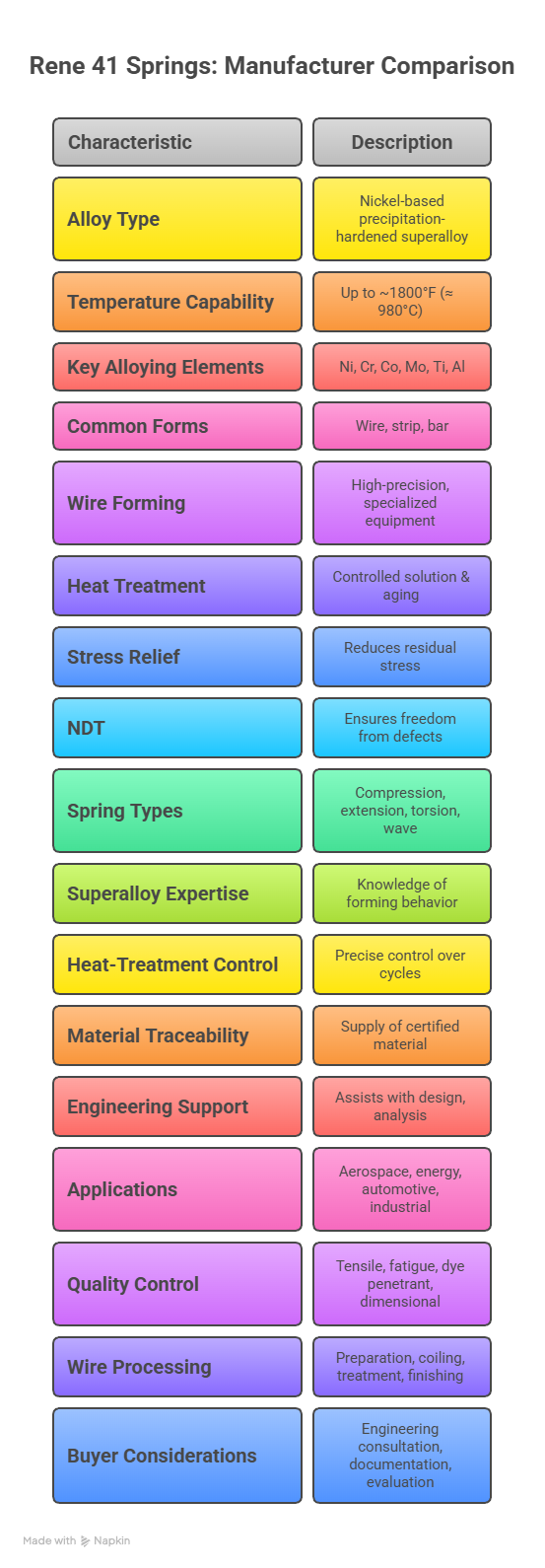
What Is Rene 41 Alloy?
Rene 41 is a precipitation-hardened nickel-chromium-cobalt superalloy widely used in extreme heat environments. It retains high strength above 1000°F and offers excellent fatigue resistance. Because of its outstanding heat stability and creep resistance, it is commonly selected for springs operating in engines, turbines, and aerospace hardware.
| Property | Description |
|---|---|
| Alloy Type | Nickel-based precipitation-hardened superalloy |
| Typical Temperature Capability | Up to ~1800°F (≈ 980°C) |
| Key Alloying Elements | Ni, Cr, Co, Mo, Ti, Al |
| Common Forms for Springs | Wire, strip, bar |
Manufacturing Capabilities Required for Rene 41 Springs
Rene 41 is far more difficult to process than common stainless steels or standard nickel alloys. Effective manufacturing requires engineering-level precision from raw material all the way to final testing.
| Capability | Why It Matters |
|---|---|
| High-precision wire forming | The alloy is stiff and work-hardens; coiling requires specialized equipment. |
| Controlled solution & aging heat treatment | Essential for achieving final high-temperature strength. |
| Stress-relief processing | Reduces residual stress that may cause failure in extreme environments. |
| Non-destructive testing (NDT) | Ensures freedom from cracks and micro-defects. |
Types of Rene 41 Springs a Manufacturer Can Supply
Due to the material’s mechanical behavior, manufacturers typically provide multiple types of precision-formed springs.
| Spring Type | Typical Use |
|---|---|
| Compression springs | Engine and turbine assemblies requiring stable load at high temperature |
| Extension springs | High-temperature actuation and tension systems |
| Torsion springs | Rotational mechanisms exposed to extreme heat |
| Wave & flat springs | Compact high-load environments such as aerospace seals |
Key Characteristics of a Reliable Rene 41 Springs Manufacturer
Choosing the right manufacturer ensures long-term performance and safety. The best suppliers often have decades of experience with high-temperature nickel alloys.
| Characteristic | Description |
|---|---|
| Expertise in superalloys | Knowledge of forming behavior, aging curves, and metallurgical controls |
| Advanced heat-treatment capability | Precise control over solution and precipitation cycles |
| Material traceability | Supply of certified wire or strip with chemical analysis |
| Custom engineering support | Assists with spring design, load analysis, and failure prevention |
Applications of Rene 41 Springs
Industries that require components to maintain elasticity and load strength under extreme temperatures often rely on Rene 41 springs.
| Industry | Application |
|---|---|
| Aerospace | Jet engines, afterburner assemblies, hot-section mechanisms |
| Energy & Power | Gas turbines, combustion systems |
| Automotive racing | High-temperature engine components |
| Industrial furnaces | Springs operating in constant high-heat environments |
Quality Control Methods Used by Manufacturers
Rene 41 springs undergo strict quality testing due to their use in safety-critical applications.
| Test Method | Purpose |
|---|---|
| Tensile test | Verifies mechanical strength after heat treatment |
| Fatigue test | Ensures performance in cyclic high-stress conditions |
| Dye penetrant or magnetic inspection | Detects surface cracks |
| Dimensional inspection | Ensures tight tolerances for aerospace requirements |
How Manufacturers Process Rene 41 Wire for Springs
Spring production involves several controlled steps to prevent cracking and ensure optimal performance.
| Process Step | Description |
|---|---|
| Wire preparation | Cleaning, tension adjustment, and drawing |
| Coiling | Specialized cold-work forming with precision tools |
| Solution treatment | High-temperature heating to homogenize alloy structure |
| Aging | Precipitation hardening to achieve final strength |
| Final finishing | Shot peening, stress relief, or surface treatment |
Buyer Considerations When Choosing a Rene 41 Springs Manufacturer
To ensure reliability in high-risk environments, buyers should evaluate the following criteria.
| Consideration | Reason |
|---|---|
| Engineering consultation availability | Custom springs require design optimization |
| Heat-treatment documentation | Critical for verifying mechanical properties |
| Sample evaluation capability | Useful for prototype aerospace or turbine testing |
| Lead time and capacity | Superalloy processing requires longer scheduling |
Related Questions
1. What makes Rene 41 suitable for high-temperature springs?
Its precipitation-hardened structure provides exceptional strength, oxidation resistance, and load stability at temperatures approaching 1800°F.
2. Are Rene 41 springs better than Inconel springs?
Rene 41 generally offers higher high-temperature strength than many Inconel grades, making it advantageous for extreme aerospace or turbine environments.
3. What industries commonly use Rene 41 springs?
Aerospace, gas turbine manufacturing, high-temperature industrial systems, and advanced automotive engineering frequently use Rene 41 springs.


 English
  Korean
  Japanese
  Arabic
  Spanish
  German
  Portuguese
  French
  Russian
  Italian