

Rene 41 is a precipitation-hardenable nickel-based superalloy supplied for demanding high-temperature applications where strength, oxidation resistance, and long-term reliability are critical. As a Rene 41 supplier, we provide alloy materials in bar, sheet, plate, wire, forgings, and custom dimensions according to project requirements. This guide explains what Rene 41 alloy is, why it is selected for high-temperature service, its chemical composition, mechanical properties, standards, available sizes, manufacturing capabilities, inspection procedures, applications, price factors, and how to choose a reliable Rene 41 supplier.
What Is Rene 41 Alloy?
Rene 41, also known as R-41, Alloy 41, UNS N07041, and W.Nr. 2.4973, is a nickel-chromium-cobalt-molybdenum superalloy strengthened by precipitation hardening. It contains important additions of titanium and aluminum, which help the alloy develop high strength after proper heat treatment.
This alloy is mainly used in severely stressed high-temperature components. Compared with ordinary stainless steel or general nickel alloys, Rene 41 provides stronger performance under heat, stress, oxidation, and long service exposure.
Key Features of Rene 41
Rene 41 is known for high room-temperature strength, excellent elevated-temperature strength, good oxidation resistance, good corrosion resistance, and strong performance in aerospace and turbine-related environments. It is not a general-purpose low-cost alloy. It is selected when material failure risk must be reduced in demanding working conditions.
Why Choose Rene 41 for High-Temperature Applications?
Rene 41 is chosen because it can maintain high strength at elevated temperatures, especially in hot-section environments where many alloys lose mechanical stability. Its nickel-based matrix, chromium content, cobalt addition, molybdenum strengthening, and precipitation-hardening structure make it suitable for thermal stress, oxidation, creep, and long-term load.
Main Reasons to Select Rene 41
| Reason | Performance Benefit | Typical Application Value |
|---|---|---|
| High-temperature strength | Maintains load-bearing ability under heat | Suitable for turbine and aerospace components |
| Oxidation resistance | Resists surface degradation in hot air and gas | Useful for combustion and hot-section parts |
| Precipitation hardening | Strength can be improved by heat treatment | Allows controlled mechanical performance |
| Creep resistance | Reduces deformation under long-term high-temperature stress | Important for high-load components |
| Good corrosion resistance | Performs well in many harsh atmospheres | Supports longer service life |
Chemical Composition of Rene 41
The chemical composition of Rene 41 must be carefully controlled because each element affects strength, oxidation resistance, heat treatment response, and processing behavior. The following values are common reference ranges. Final composition should be confirmed according to the required standard and material test certificate.
| Element | Typical Range | Main Function |
|---|---|---|
| Nickel (Ni) | Balance | Base matrix for high-temperature stability |
| Chromium (Cr) | 18.00% – 20.00% | Improves oxidation and corrosion resistance |
| Cobalt (Co) | 10.00% – 12.00% | Improves elevated-temperature strength |
| Molybdenum (Mo) | 9.00% – 10.50% | Provides solid-solution strengthening and creep resistance |
| Titanium (Ti) | 3.00% – 3.30% | Supports precipitation hardening |
| Aluminum (Al) | 1.40% – 1.80% | Works with titanium to improve age-hardening response |
| Iron (Fe) | Max. 5.00% | Controlled residual element |
| Carbon (C) | Max. 0.12% | Affects carbide formation and grain boundary behavior |
| Boron (B) | 0.003% – 0.010% | Improves grain boundary strength |
Rene 41 Mechanical Properties
Rene 41 mechanical properties depend on product form, size, heat treatment condition, cold work level, and testing standard. Solution-treated material, aged material, and cold-worked aged material can show different strength and hardness values.
Typical Mechanical Property Considerations
| Property | General Performance | Buyer Note |
|---|---|---|
| Tensile strength | High, especially after aging | Confirm according to condition and standard |
| Yield strength | Strong load-bearing capacity | Important for fasteners and structural parts |
| Elongation | Depends on heat treatment and cold work | Higher ductility is usually found in solution-treated condition |
| Hardness | Can be increased by precipitation hardening | Specify required hardness if needed |
| Density | About 8.25 g/cm³ | Useful for weight calculation |
High-Temperature Strength of Rene 41
High-temperature strength is one of the main reasons buyers choose Rene 41. The alloy is designed for service in severely stressed high-temperature applications and is commonly used in the 1200°F to 1800°F range, depending on component design and service condition.
Strength Retention Under Heat
Many metals lose strength quickly when exposed to high temperature. Rene 41 keeps useful mechanical strength because of its nickel-based matrix and precipitation-hardened structure. This makes it suitable for turbine parts, engine hardware, combustion components, and high-temperature fasteners.
Creep and Stress-Rupture Resistance
For high-temperature components, short-term tensile strength is not enough. Materials must also resist slow deformation and rupture under constant load. Rene 41 is often selected when creep resistance, stress-rupture performance, and oxidation resistance must work together.
Oxidation and Corrosion Resistance of Rene 41
Rene 41 provides good oxidation resistance because of its chromium content and stable nickel-based structure. In high-temperature air or hot gas conditions, it can resist surface scaling better than many lower-alloy materials.
Oxidation Resistance
Oxidation resistance is important for parts used in gas turbines, jet engines, afterburners, and combustion environments. Surface oxidation can reduce part life, affect dimensions, and weaken performance. Rene 41 helps reduce these risks when properly processed and heat treated.
Corrosion Resistance
Rene 41 also provides good corrosion resistance in many service environments. However, if the main working condition is strong chemical corrosion at moderate temperature, buyers may need to compare Rene 41 with corrosion-focused alloys such as Hastelloy C-276 or Inconel 625. Rene 41 is usually more valuable when corrosion resistance must be combined with high-temperature strength.
Available Rene 41 Product Forms: Bar, Sheet, Plate, Wire, and Forgings
As a Rene 41 supplier, we can support different product forms according to customer drawings, machining plans, and application requirements. Common product forms include Rene 41 bar, Rene 41 sheet, Rene 41 plate, Rene 41 wire, Rene 41 strip, and Rene 41 forgings.
| Product Form | Common Supply Condition | Typical Use |
|---|---|---|
| Rene 41 Bar | Hot rolled, forged, peeled, ground, solution treated, aged | Bolts, shafts, pins, rings, machined parts |
| Rene 41 Sheet | Cold rolled or annealed sheet | Combustion liners, formed parts, aerospace panels |
| Rene 41 Plate | Hot rolled or solution treated plate | Structural hot-section components and machined plates |
| Rene 41 Wire | Cold drawn, annealed, or spring temper | Springs, fasteners, wire components |
| Rene 41 Forgings | Open-die or closed-die forged blanks | Turbine hardware, rings, discs, high-strength parts |
Rene 41 Bar Specifications and Standards
Rene 41 Bar is commonly supplied under aerospace and high-temperature alloy standards. Buyers should confirm the exact standard before ordering because different standards may control chemistry, heat treatment, testing, dimensions, and acceptance requirements.
Common Standards and Designations
| Standard / Designation | Description | Common Product Relevance |
|---|---|---|
| UNS N07041 | Unified Numbering System designation for Rene 41 | General material identification |
| AMS 5712 | Aerospace material specification commonly associated with Rene 41 bar/forging forms | Used for aerospace-grade supply |
| AMS 5713 | Aerospace material specification for specific Rene 41 product or condition requirements | Used when drawing or project requires it |
| AMS 5545 | Often associated with Rene 41 sheet, strip, or plate forms | Used for flat products |
| W.Nr. 2.4973 | European material number | Useful for international procurement |
For critical projects, the purchase order should clearly state the required standard, revision, heat treatment condition, inspection level, and certificate requirement.
Rene 41 Available Sizes and Custom Dimensions
Rene 41 is available in different sizes depending on product form, stock status, and production route. Standard sizes can often be supplied faster, while special sizes may require melting, forging, rolling, heat treatment, cutting, and testing.
Common Size Information for Inquiry
| Product | Common Inquiry Information | Custom Options |
|---|---|---|
| Bar | Diameter, length, tolerance, surface | Cut-to-length, peeling, grinding, machining allowance |
| Sheet | Thickness, width, length, surface | Custom cutting, shearing, protective film |
| Plate | Thickness, width, length, flatness | Saw cutting, waterjet cutting, machined blanks |
| Wire | Diameter, coil weight, temper | Straightened wire, cut wire, spring wire |
| Forgings | Drawing, weight, shape, heat treatment | Rings, discs, blocks, special forged shapes |
Rene 41 Manufacturing and Processing Capabilities
Reliable Rene 41 supply requires controlled manufacturing and processing. Because Rene 41 is a high-strength superalloy, the supplier must understand hot working, heat treatment, machining allowance, and inspection requirements.
Common Processing Services
Available processing may include forging, hot rolling, cold rolling, cutting, peeling, grinding, turning, straightening, solution treatment, aging treatment, ultrasonic testing, PMI testing, and export packing. For finished or semi-finished components, CNC machining can also be arranged according to customer drawings.
Why Processing Control Matters
Rene 41 can be more difficult to process than standard nickel alloys. Improper temperature control, incorrect aging, poor surface removal, or unsuitable machining parameters may affect performance. For this reason, drawings and specifications should be reviewed before production.
Heat Treatment and Delivery Conditions
Rene 41 can be supplied in different heat treatment conditions. The right condition depends on whether the buyer needs easier machining, higher strength, final part performance, or further processing after delivery.
| Delivery Condition | Main Purpose | Suitable For |
|---|---|---|
| Solution treated | Improves ductility and prepares for aging | Parts needing further machining or forming |
| Solution treated and aged | Develops high strength | High-strength finished or near-finished parts |
| Annealed | Improves workability | Sheet, strip, and processing applications |
| Cold worked and aged | Provides higher strength in selected forms | Wire, springs, and high-strength components |
| Custom heat treatment | Meets special specification or drawing | Aerospace and customer-specific projects |
Quality Inspection and Testing Procedures
Quality inspection is a key part of Rene 41 supply. Since the alloy is often used in safety-critical applications, buyers should pay attention to material traceability, test reports, and inspection procedures.
Common Quality Control Items
| Inspection Item | Purpose | Common Requirement |
|---|---|---|
| Chemical composition test | Confirms grade compliance | Shown on MTC |
| Mechanical testing | Checks tensile strength, yield strength, elongation | Required for mechanical-controlled orders |
| Hardness test | Verifies heat treatment condition | Common for aged material |
| PMI test | Prevents material mix-up | Useful before shipment |
| Ultrasonic testing | Checks internal defects | Important for bars, forgings, and critical parts |
| Dimension inspection | Confirms size, tolerance, straightness | Required for machining accuracy |
| Surface inspection | Checks cracks, pits, scratches, laps | Important for peeled, ground, and polished products |
| Microstructure inspection | Verifies grain structure when required | Used for high-specification projects |
Typical Industries and Applications of Rene 41
Rene 41 is used in industries where high temperature, high strength, oxidation resistance, and reliability are required. It is especially common in aerospace, gas turbine, defense, power equipment, and high-temperature fastening applications.
| Industry | Typical Applications | Reason for Use |
|---|---|---|
| Aerospace | Engine hardware, nozzle parts, afterburner components | High strength and oxidation resistance |
| Gas Turbine | Turbine wheels, rings, hot-section hardware | Elevated-temperature strength |
| Fastener Manufacturing | Bolts, studs, nuts, pins, washers | Strength retention under heat |
| Rocket and Defense | Rocket engine parts and severe-service components | Thermal and mechanical stability |
| Industrial Equipment | High-temperature shafts, springs, special machined parts | Heat resistance and long service life |
How to Choose a Reliable Rene 41 Supplier
Choosing a reliable Rene 41 supplier is not only about finding the lowest price. Buyers should check whether the supplier can provide correct grade, proper standards, stable quality, traceability, processing support, and export documentation.
Supplier Selection Checklist
| Checklist Item | What to Confirm | Why It Matters |
|---|---|---|
| Grade accuracy | Rene 41 / UNS N07041 / R-41 | Prevents wrong alloy supply |
| Standard capability | AMS 5712, AMS 5713, AMS 5545, or customer standard | Ensures project compliance |
| Certificate | MTC, heat number, chemical and mechanical data | Supports traceability |
| Processing ability | Cutting, forging, peeling, grinding, heat treatment | Reduces customer preparation work |
| Inspection support | PMI, UT, tensile, hardness, third-party inspection | Improves supply reliability |
| Export experience | Packing, documents, international shipping | Helps avoid delivery problems |
Factors Affecting Rene 41 Price and Lead Time
Rene 41 price is affected by raw material cost, product form, size, heat treatment, inspection requirement, quantity, and delivery schedule. Because it contains nickel, cobalt, molybdenum, titanium, and aluminum, raw material market changes can influence quotation validity.
Main Price Factors
| Factor | How It Affects Price |
|---|---|
| Raw material market | Nickel, cobalt, and molybdenum cost can change frequently |
| Product form | Bar, sheet, plate, wire, and forgings have different production costs |
| Size and tolerance | Tight tolerance and special dimensions increase processing cost |
| Heat treatment | Solution treatment and aging add cost and time |
| Testing requirement | UT, tensile test, hardness test, and third-party inspection increase cost |
| Quantity | Small orders may have higher unit cost due to setup and cutting loss |
| Stock status | In-stock sizes ship faster; custom production needs longer lead time |
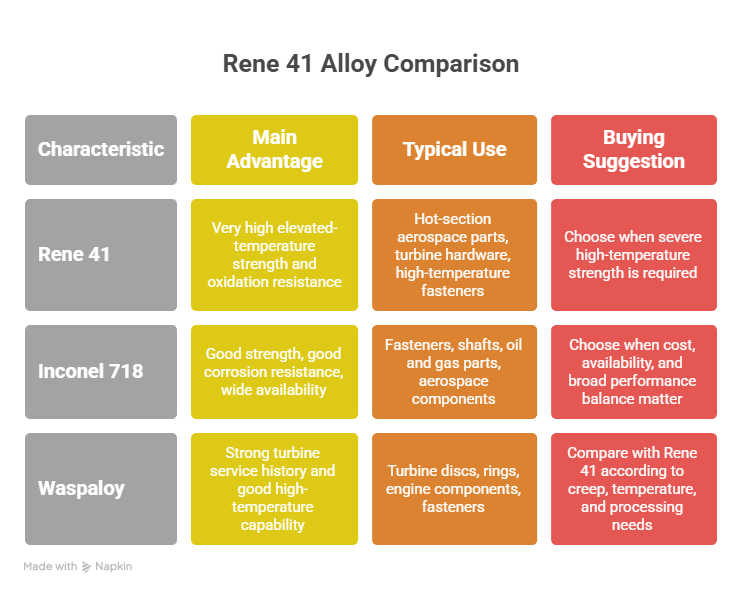
Rene 41 vs Inconel 718 vs Waspaloy
Rene 41, Inconel 718, and Waspaloy are all nickel-based high-performance alloys, but they are selected for different balances of strength, temperature capability, processing, availability, and cost.
| Material | Main Advantage | Typical Use | Buying Suggestion |
|---|---|---|---|
| Rene 41 | Very high elevated-temperature strength and oxidation resistance | Hot-section aerospace parts, turbine hardware, high-temperature fasteners | Choose when severe high-temperature strength is required |
| Inconel 718 | Good strength, good corrosion resistance, wide availability | Fasteners, shafts, oil and gas parts, aerospace components | Choose when cost, availability, and broad performance balance matter |
| Waspaloy | Strong turbine service history and good high-temperature capability | Turbine discs, rings, engine components, fasteners | Compare with Rene 41 according to creep, temperature, and processing needs |
Rene 41 Packaging, Export, and Global Supply Capability
For international supply, packaging and documentation are important. Rene 41 products should be packed to protect against surface damage, moisture, impact, and material mixing during transportation.
Export Packaging Options
Common packaging includes wooden cases, wooden pallets, plastic wrapping, anti-rust protection, end protection for bars, coil packing for wire, and custom labels. Each package can be marked with grade, size, heat number, quantity, net weight, gross weight, and customer order number.
Export Documents
Typical export documents include commercial invoice, packing list, material test certificate, certificate of origin if required, shipping documents, and third-party inspection report when requested. For aerospace or engineering projects, document control should be confirmed before shipment.
Rene 41 Related Questions
What is Rene 41 used for? Rene 41 is used for aerospace engine components, turbine hardware, afterburner parts, nozzle components, turbine wheels, hot-section fasteners, springs, rings, shafts, and other high-temperature parts requiring strength and oxidation resistance.
Is Rene 41 the same as Inconel 718? No. Rene 41 and Inconel 718 are both nickel-based superalloys, but Rene 41 is generally selected for stronger elevated-temperature performance in severe hot-section applications, while Inconel 718 is more widely available and often easier to source for general high-strength applications.
How to buy Rene 41 from a supplier? To buy Rene 41, provide the supplier with product form, grade, standard, size, tolerance, heat treatment condition, surface finish, quantity, testing requirement, certificate requirement, and delivery destination. Clear technical information helps the supplier quote accurately and avoid material mismatch.


 English
  Korean
  Japanese
  Arabic
  Spanish
  German
  Portuguese
  French
  Russian
  Italian