

Waspaloy is a nickel-based superalloy specifically developed for high-temperature strength and excellent creep resistance. It is widely used in aerospace engines, gas turbines, and other critical applications where materials must maintain performance under extreme thermal and mechanical stress.
What Is Waspaloy Material
Waspaloy is a precipitation-hardened nickel-based alloy designed to provide superior mechanical strength and stability at elevated temperatures. It performs well in environments up to approximately 870°C, making it suitable for demanding aerospace components.
Material Classification of Waspaloy
Nickel-Based Superalloy
Waspaloy belongs to the family of nickel-based superalloys, known for their excellent high-temperature strength, oxidation resistance, and creep performance.
Development Background and Design Purpose
Origin of Waspaloy
Waspaloy was developed to improve upon earlier nickel alloys by offering better creep resistance and high-temperature strength for jet engine components.
Design Objective
The alloy was engineered to maintain mechanical integrity under long-term high-temperature exposure and cyclic stress conditions.
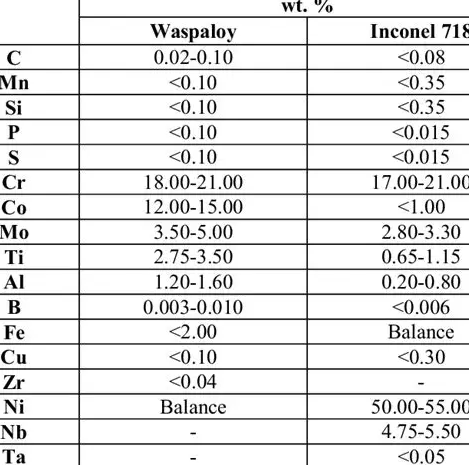
Main Chemical Composition of Waspaloy
| Element | Content (%) |
|---|---|
| Nickel (Ni) | Balance |
| Chromium (Cr) | 18.0 – 21.0 |
| Cobalt (Co) | 12.0 – 15.0 |
| Molybdenum (Mo) | 3.5 – 5.0 |
| Aluminum (Al) | 1.2 – 1.6 |
| Titanium (Ti) | 2.75 – 3.25 |
| Iron (Fe) | ≤ 2.0 |
| Carbon (C) | ≤ 0.10 |
Strengthening Mechanism (γ′ Precipitation)
Precipitation Hardening Principle
Waspaloy is strengthened by γ′ (gamma prime) precipitates formed from aluminum and titanium. These fine particles block dislocation movement, significantly enhancing high-temperature strength and creep resistance.
High-Temperature Strength Performance
Waspaloy maintains high tensile and yield strength at temperatures up to 800–870°C, making it suitable for critical rotating and static components in gas turbines.
Creep Resistance
The alloy offers excellent resistance to creep deformation under prolonged high-temperature stress, ensuring dimensional stability and long service life.
Oxidation and Corrosion Resistance
Oxidation Resistance
Chromium content enables the formation of a protective oxide layer, allowing Waspaloy to resist oxidation in high-temperature environments.
Corrosion Resistance
Waspaloy provides moderate corrosion resistance but is primarily designed for high-temperature performance rather than aggressive chemical environments.
Mechanical Properties Overview
| Property | Typical Value |
|---|---|
| Ultimate Tensile Strength | 1100 – 1400 MPa |
| Yield Strength | 700 – 1000 MPa |
| Elongation | 10 – 20% |
| Hardness | 30 – 40 HRC |
Heat Treatment Process
Solution Treatment
Performed to dissolve alloying elements into the matrix.
Aging Treatment
Promotes γ′ precipitation, enhancing strength, creep resistance, and fatigue performance.
Machining and Welding Performance
Machining
Waspaloy is difficult to machine due to its high strength and work hardening tendency. Carbide tools and controlled cutting parameters are recommended.
Welding
Welding is possible but requires careful control and post-weld heat treatment to avoid cracking.
Typical Applications
- Aerospace turbine discs
- Gas turbine blades and shafts
- High-temperature fasteners
- Combustion chamber components
Difference Between Waspaloy and Rene 41
Performance Comparison
Waspaloy and Rene 41 are similar in high-temperature strength, but Waspaloy generally offers better oxidation resistance and improved stability in certain applications.
Composition Difference
Rene 41 contains higher cobalt and aluminum content, while Waspaloy has higher chromium for oxidation resistance.
Comparison with Inconel 718
Temperature Capability
Waspaloy performs better at temperatures above 700°C, while Inconel 718 is typically limited to around 650°C.
Manufacturability
Inconel 718 is easier to machine and weld, making it more versatile for general applications.
Why Choose Waspaloy Material
- Excellent high-temperature strength
- Outstanding creep resistance
- Good oxidation resistance
- Reliable performance in aerospace applications
Frequently Asked Questions (FAQ)
What type of alloy is Waspaloy?
It is a nickel-based superalloy designed for high-temperature applications.
What is the maximum operating temperature?
Approximately 870°C depending on conditions.
How does Waspaloy compare to Inconel 718?
Waspaloy performs better at higher temperatures, while Inconel 718 is easier to process.
Where is Waspaloy commonly used?
In aerospace engines, gas turbines, and high-temperature structural components.


 English
  Korean
  Japanese
  Arabic
  Spanish
  German
  Portuguese
  French
  Russian
  Italian