

Waspaloy and Hastelloy are two high-performance nickel-based alloys used in demanding industrial and aerospace applications. While both alloys offer excellent corrosion resistance and strength at elevated temperatures, they are optimized for different environments and mechanical requirements. This article compares Waspaloy and Hastelloy in terms of composition, mechanical properties, corrosion resistance, applications, and fabrication characteristics.
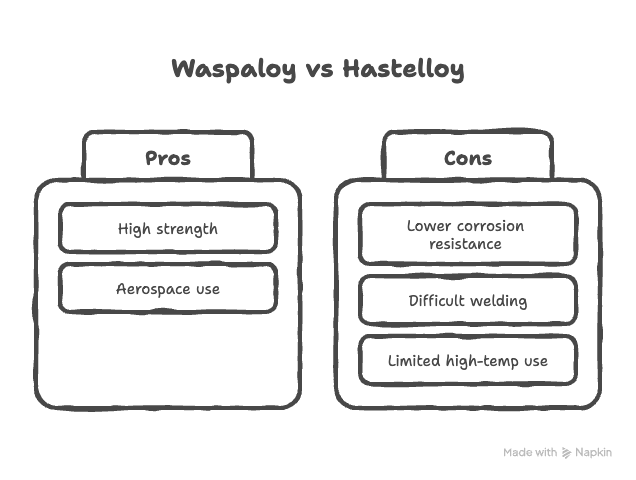
Comparison Table
| Property | Waspaloy | Hastelloy (C-22) |
|---|---|---|
| Primary Composition | Ni 50–60%, Cr 18–21%, Co 12–15%, Mo 3–5%, Ti 1–2%, Al 0.4–1% | Ni 56%, Cr 22%, Mo 13%, Fe 3% |
| Tensile Strength | 1,300–1,500 MPa | 700–950 MPa |
| Yield Strength | 950–1,100 MPa | 450–600 MPa |
| Elongation | 10–20% | 35–50% |
| High-Temperature Performance | Up to 700–750°C | Moderate; designed mainly for corrosion resistance rather than extreme high-temperature strength |
| Corrosion Resistance | Good (oxidation, hot corrosion) | Excellent (acids, chlorides, seawater) |
| Weldability | Moderate; requires post-weld heat treatment | Good; easier to weld without special treatment |
| Typical Applications | Aerospace engines, gas turbines, high-temperature structural components | Chemical processing equipment, marine piping, heat exchangers |
Related Questions
Which alloy has higher high-temperature strength? Waspaloy has higher tensile and yield strength at elevated temperatures compared to Hastelloy.
Which alloy is more corrosion-resistant? Hastelloy is generally superior in chemical corrosion resistance, especially in acids and chlorides.
Which alloy is easier to weld? Hastelloy is easier to weld and fabricate, while Waspaloy requires careful post-weld heat treatment.


 English
  Korean
  Japanese
  Arabic
  Spanish
  German
  Portuguese
  French
  Russian
  Italian