

Incoloy 800 and Incoloy 825 are nickel-iron based alloys designed for demanding industrial environments, but they are optimized for very different service conditions. Incoloy 800 is primarily engineered for high-temperature strength and oxidation resistance, while Incoloy 825 focuses on superior corrosion resistance in aggressive chemical environments. Understanding the differences between Incoloy 800 and Incoloy 825 helps engineers and buyers choose the correct alloy for heat treatment equipment, chemical processing, oil and gas, and power generation applications.
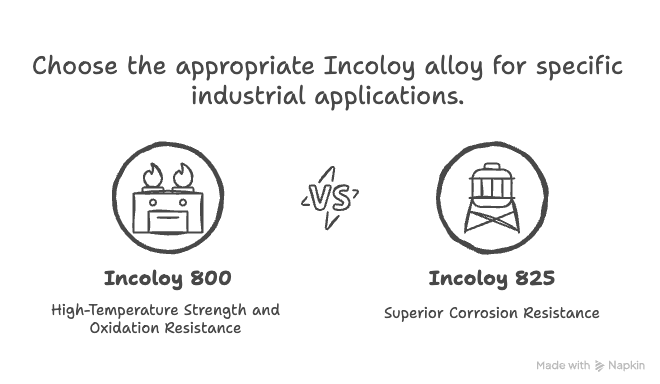
Alloy Design and Purpose
Incoloy 800 is a nickel-iron-chromium alloy developed for excellent strength, structural stability, and oxidation resistance at elevated temperatures. It is commonly used in heat-intensive environments.
Incoloy 825 is a nickel-iron-chromium alloy with additions of molybdenum, copper, and titanium. It is designed primarily for resistance to acidic and reducing chemical environments rather than high-temperature strength.
Comparação da composição química
| Elemento | Incoloy 800 | Incoloy 825 |
|---|---|---|
| Níquel (Ni) | 30 – 35% | 38 - 46% |
| Crómio (Cr) [European] | 19 – 23% | 19,5 - 23,5% |
| Ferro (Fe) | Balanço | ≥ 22% |
| Molibdênio (Mo) | - | 2,5 - 3,5% |
| Cobre (Cu) | - | 1,5 - 3% |
| Titânio (Ti) | ≤ 0.6% | 0,6 - 1,2% |
The additional molybdenum and copper in Incoloy 825 significantly enhance its resistance to acidic corrosion, while Incoloy 800 maintains a simpler composition optimized for high-temperature stability.
Propriedades Mecânicas
Incoloy 800 provides good tensile strength, excellent creep resistance, and structural stability during prolonged exposure to high temperatures.
Incoloy 825 offers moderate mechanical strength similar to corrosion-resistant stainless steels and is not intended for high-load structural applications.
| Imóveis | Incoloy 800 | Incoloy 825 |
|---|---|---|
| Resistência à temperatura ambiente | Moderado | Moderado |
| Resistência a altas temperaturas | Excelente | Limitada |
| Resistência à fluência | Bom | Baixa |
Resistência à corrosão
Incoloy 800 offers good resistance to oxidation and carburization at elevated temperatures but is not designed for highly aggressive chemical environments.
Incoloy 825 excels in resistance to sulfuric acid, phosphoric acid, nitric acid, and mixed acid environments. The copper content improves resistance to reducing acids.
Capacidade de temperatura
Incoloy 800 is commonly used at temperatures up to approximately 815–870°C and can tolerate long-term exposure to heat without significant loss of strength.
Incoloy 825 is typically limited to service temperatures below about 540°C, where corrosion resistance is more important than high-temperature strength.
Fabrico e soldabilidade
Incoloy 800 has good weldability and fabrication characteristics for high-temperature alloys, making it suitable for complex furnace and heat exchanger components.
Incoloy 825 is easier to fabricate and machine compared with many high-strength nickel alloys and is well suited for chemical processing equipment.
Aplicações típicas
Incoloy 800 Applications:
Heat exchangers, furnace components, petrochemical processing equipment, steam generators, superheater tubing, and thermal processing systems.
Incoloy 825 Aplicações:
Chemical processing equipment, acid production plants, pickling equipment, pollution control systems, oil and gas sour service piping, and heat exchangers.
Comparação de custos
Incoloy 800 is generally less expensive than Incoloy 825 due to its lower nickel content and simpler alloying system.
Incoloy 825 is more expensive because of higher nickel content and additional alloying elements designed for superior corrosion resistance.
How to Choose Between Incoloy 800 and Incoloy 825
Choose Incoloy 800 if: the application involves continuous high-temperature exposure, oxidation resistance, and structural stability.
Escolha o Incoloy 825 se: resistance to aggressive acids and chemical corrosion is the primary requirement.
Perguntas relacionadas
Is Incoloy 800 stronger than Incoloy 825 at high temperatures?
Yes, Incoloy 800 provides significantly better strength and creep resistance at elevated temperatures.
Which alloy is better for chemical corrosion resistance?
Incoloy 825 is superior for acidic and chemically aggressive environments.
Can Incoloy 825 replace Incoloy 800?
No, Incoloy 825 is not suitable for applications requiring long-term high-temperature strength.


 English
  Korean
  Japanese
  Arabic
  Spanish
  German
  Portuguese
  French
  Russian
  Italian