

A liga Inconel 602CA, normalmente fornecida como liga 602 CA, UNS N06025, W.Nr. 2.4633, ou Nicrofer 6025 HT, é uma liga de níquel-crómio-ferro de alto desempenho concebida para ambientes severos de alta temperatura. É amplamente utilizada onde o aço inoxidável padrão, o Inconel 600 ou o Inconel 601 podem não fornecer resistência suficiente à oxidação, carburação, fluência e atmosferas agressivas do forno. Para os compradores nas indústrias de tratamento térmico, petroquímica, fabrico de fornos, produção de hidrogénio, escape automóvel, geração de energia e processamento térmico, a liga Inconel 602CA oferece um forte equilíbrio entre resistência a altas temperaturas, resistência à oxidação, resistência à carburação e longa vida útil. Este artigo explica o que é a liga Inconel 602CA, a sua composição química, propriedades-chave, desempenho mecânico, condições de tratamento térmico, formas de produto disponíveis, especificações, aplicações, comparação com o Inconel 601 e o Inconel 600, factores de preço e como escolher o material 602CA adequado para o seu projeto.
O que é a liga Inconel 602CA?
A liga Inconel 602CA é uma liga de níquel-crómio-ferro de elevado teor de carbono com adições controladas de alumínio, titânio, ítrio e zircónio. No mercado, é frequentemente designada por Liga 602 CA, liga 602CA, UNS N06025, W.Nr. 2.4633, ou Nicrofer 6025 HT. O termo “Liga Inconel 602CA” é normalmente utilizado pelos compradores quando procuram materiais de liga resistente ao calor à base de níquel, embora muitas normas técnicas o identifiquem por UNS N06025 ou Liga 602 CA.
A liga é desenvolvida principalmente para serviço a alta temperatura, onde a oxidação, a carburação, o pó de metal, o ciclo térmico e a deformação por fluência são as principais preocupações. É especialmente adequada para componentes expostos a atmosferas de fornos, gases ricos em carbono, meios oxidantes, ambientes clorados e cargas térmicas de longa duração.
Descrição do material de base
A liga 602CA pertence à família das ligas de níquel-crómio. A sua elevada base de níquel confere ao material estabilidade térmica e resistência à corrosão. O crómio melhora a resistência à oxidação e à corrosão a alta temperatura. O alumínio ajuda a formar uma camada protetora de óxido. O carbono melhora a resistência à fluência através do reforço dos carbonetos. O ítrio melhora a aderência das incrustações de óxido, enquanto o zircónio suporta a estabilidade do grão e o desempenho a altas temperaturas.
Porque é que o 602CA é utilizado em ambientes de calor intenso
Muitas ligas resistentes ao calor podem sobreviver a temperaturas elevadas durante um curto período de tempo, mas podem sofrer de incrustações, deformação por fluência, absorção de carbono, fissuração ou perda de resistência durante o serviço a longo prazo. A liga Inconel 602CA é selecionada quando um componente necessita de trabalhar durante longos períodos a altas temperaturas, mantendo a estabilidade estrutural e a proteção da superfície.
Composição química da liga Inconel 602CA
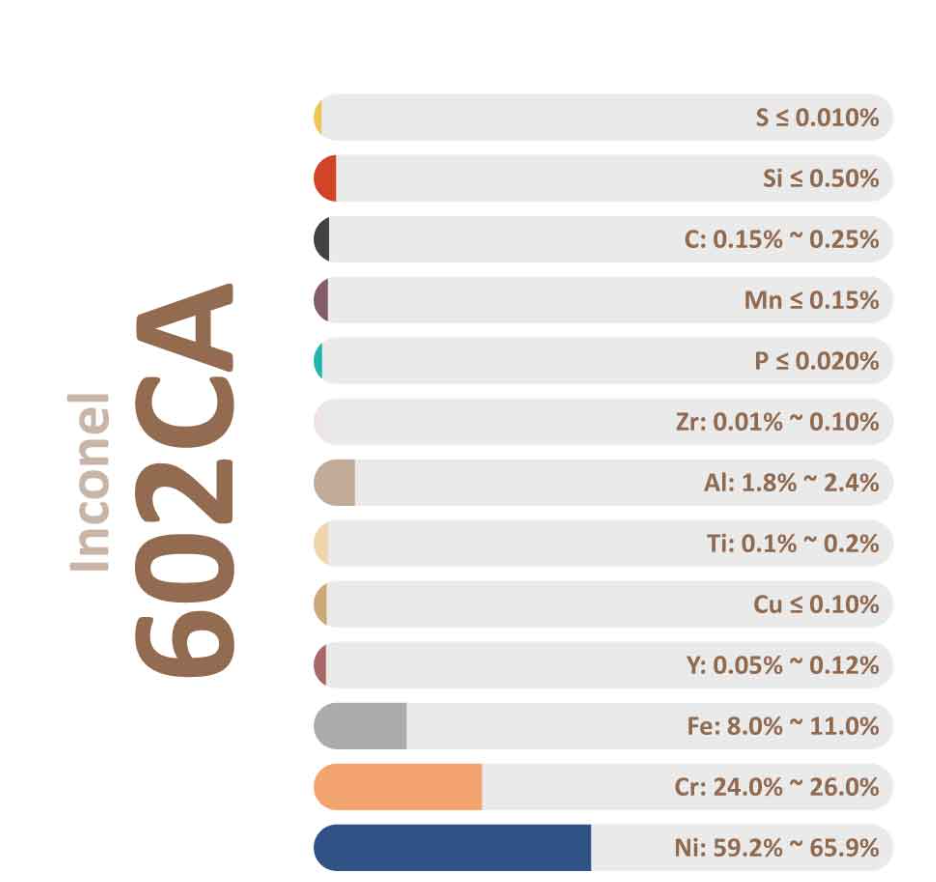
A composição química da liga Inconel 602CA é uma das principais razões para o seu excelente desempenho a altas temperaturas. Em comparação com o Inconel 600 e o Inconel 601, o 602CA tem mais crómio, alumínio controlado, mais carbono e adições de microligas como o ítrio e o zircónio.
| Elemento | Gama de conteúdos típicos | Função principal da liga Inconel 602CA |
|---|---|---|
| Níquel (Ni) | Balanço | Fornece a matriz de base, estabilidade a altas temperaturas e resistência a muitos gases corrosivos. |
| Crómio (Cr) [European] | 24.00% - 26.00% | Melhora a resistência à oxidação, a resistência à incrustação e a resistência à corrosão a alta temperatura. |
| Ferro (Fe) | 8.00% - 11.00% | Equilibra a estrutura da liga e apoia o desempenho prático do processamento. |
| Carbono (C) | 0,15% - 0,25% | Contribui para o reforço dos carbonetos e para um excelente desempenho em termos de rutura por fluência. |
| Alumínio (Al) | 1.80% - 2.40% | Ajuda a formar uma camada protetora de óxido rico em alumina a alta temperatura. |
| Titânio (Ti) | 0,10% - 0,20% | Suporta a formação de carbonetos e carbonitretos para estabilidade a altas temperaturas. |
| Ítrio (Y) | 0,05% - 0,12% | Melhora a aderência das incrustações de óxido, especialmente sob aquecimento e arrefecimento cíclicos. |
| Zircônio (Zr) | 0,01% - 0,10% | Ajuda a controlar o crescimento do grão e melhora a estabilidade estrutural a altas temperaturas. |
| Manganês (Mn) | Máx. 0,50% | Elemento menor controlado. |
| Silício (Si) | Máx. 0,50% | Controlado para manter um processamento estável e a limpeza da liga. |
| Cobre (Cu) | Máx. 0,10% | Limitado para manter o desempenho da liga a altas temperaturas. |
| Fósforo (P) | Máx. 0,02% | Mantido a um nível baixo para reduzir os efeitos nocivos dos limites de grão. |
| Enxofre (S) | Máx. 0,01% | Mantido baixo para melhorar a trabalhabilidade a quente e reduzir o risco de fissuração. |
Como a composição melhora o desempenho
O forte desempenho da liga Inconel 602CA não provém de um único elemento. Provém do efeito combinado do níquel, crómio, alumínio, carbono, ítrio, zircónio e titânio. O crómio e o alumínio formam camadas de óxido protetor. O ítrio melhora a aderência dessa camada protetora. O carbono, o titânio e o zircónio ajudam a desenvolver estruturas de carboneto estáveis, que melhoram a resistência à fluência e a capacidade de suportar cargas a altas temperaturas.
Porque é que o controlo químico é importante
Para o fornecimento de ligas de alta temperatura, a composição química deve ser verificada cuidadosamente. Mesmo pequenas variações no carbono, alumínio, ítrio ou zircónio podem afetar o comportamento de fluência, a resistência à oxidação, o desempenho do fabrico e a vida útil a longo prazo. Os compradores devem sempre solicitar um certificado de teste de material que mostre o número de calor, a composição química, a forma do produto, o tamanho, as condições de entrega e a norma aplicável.
Propriedades principais da liga Inconel 602CA
A liga Inconel 602CA é valorizada principalmente pela sua resistência à oxidação a alta temperatura, resistência à fluência, resistência à carburação, estabilidade térmica e resistência a atmosferas de forno agressivas. Normalmente, não é selecionada como uma liga de níquel de baixo custo para uso geral. É utilizada quando as condições de serviço são suficientemente severas para justificar um material de desempenho superior.
| Imóveis | Significado do desempenho | Vantagem prática |
|---|---|---|
| Excelente resistência à oxidação | Forma uma camada protetora de óxido a alta temperatura. | Reduz a incrustação, a perda de superfície e o risco de contaminação. |
| Forte resistência à oxidação cíclica | As escamas de proteção permanecem mais estáveis durante o aquecimento e arrefecimento repetidos. | Útil para componentes de fornos e equipamento de ciclos térmicos. |
| Elevada resistência à fluência | Resiste à deformação lenta sob calor e tensão. | Importante para tubos radiantes, rolos de fornos e peças de fornos de suporte de carga. |
| Resistência à carburação | Reduz a captação de carbono em gases ricos em carbono. | Adequado para fornos de cementação e ambientes petroquímicos. |
| Resistência ao pó de metal | Melhora a resistência a atmosferas agressivas com carbono. | Útil para reformadores e sistemas de produção de hidrogénio. |
| Boa resistência à corrosão a altas temperaturas | Tem um bom desempenho em meios oxidantes, carburizantes e oxidantes/clorantes. | Suporta uma vida útil mais longa em ambientes de processo exigentes. |
Alto desempenho, mas específico da aplicação
A liga Inconel 602CA é especialmente forte no serviço a altas temperaturas, mas nem sempre é necessária para todos os projectos. Se a temperatura de funcionamento for moderada e o ambiente não for agressivo, o Inconel 600, o Inconel 601 ou o aço inoxidável resistente ao calor podem ser mais económicos. No entanto, se o serviço envolver alta temperatura, gás rico em carbono, ciclos térmicos, carga de fluência e oxidação ao mesmo tempo, o 602CA torna-se uma escolha muito mais forte.
Resistência a altas temperaturas do Inconel 602CA
A resistência a altas temperaturas é uma das vantagens mais importantes da liga Inconel 602CA. A liga foi concebida para resistir à fluência e à deformação durante a exposição prolongada ao calor. Em equipamentos de alta temperatura, a resistência à tração a curto prazo é útil, mas a resistência à deformação a longo prazo é frequentemente mais importante.
Porque é que a resistência à fluência é importante
A fluência é uma deformação lenta que ocorre quando um metal é exposto a altas temperaturas e tensões durante um longo período de tempo. Em tubos de fornos, rolos de fornos, componentes de reformadores e tubos radiantes, mesmo uma pequena deformação pode levar a um mau alinhamento, fugas, fissuras, redução da eficiência ou falha do equipamento.
A liga Inconel 602CA utiliza um sistema de níquel-crómio com elevado teor de carbono para melhorar a resistência à rutura por fluência. A liga forma carbonetos estáveis, e estes carbonetos ajudam o material a resistir à deformação a temperaturas elevadas. Isto torna a 602CA adequada para componentes que têm de manter a forma e a capacidade de suporte de carga durante um serviço prolongado.
602CA para carga térmica a longo prazo
Quando a peça apenas necessita de resistência à oxidação, o Inconel 601 pode ser suficiente. Mas quando a peça também tem de suportar cargas a altas temperaturas, o 602CA proporciona normalmente uma melhor margem de segurança. É por esta razão que é frequentemente selecionado para tubos radiantes, rolos de fornos, rolos de fornos, componentes de reformadores e equipamento de processamento térmico severo.
Resistência à oxidação da liga Inconel 602CA
A liga Inconel 602CA é uma das ligas de níquel mais resistentes à oxidação utilizada em aplicações de processamento térmico. Os seus elevados teores de crómio e alumínio ajudam a formar uma escala de óxido protetora. A adição de ítrio melhora a aderência desta camada, especialmente sob aquecimento e arrefecimento repetidos.
Escala de óxido de proteção
A altas temperaturas, muitos metais reagem com o oxigénio e formam incrustações. Se a incrustação for solta, espessa ou fácil de quebrar, o metal base continua a oxidar, causando perda de material e contaminação. A liga Inconel 602CA forma uma camada de óxido apertada e aderente que ajuda a proteger a superfície do metal.
Resistência à oxidação cíclica
Muitas peças do forno não permanecem sempre à mesma temperatura. São aquecidas, arrefecidas, reaquecidas e expostas a atmosferas variáveis. Este ciclo térmico pode fazer com que a escala de óxido se rache ou se desfaça. Como o 602CA contém alumínio e ítrio, tem um bom desempenho em condições de oxidação cíclica e ajuda a reduzir a perda de incrustações.
Porque é que isto é importante para o equipamento do forno
No processamento térmico, a perda de incrustações pode contaminar os produtos, reduzir a espessura das peças e diminuir a vida útil do equipamento. Para tubos radiantes, muflas, retortas, rolos de forno e acessórios de forno, uma boa resistência à oxidação ajuda a reduzir a frequência de manutenção e a substituição não planeada.
| Condição de oxidação | Desempenho do 602CA | Benefício da candidatura |
|---|---|---|
| Ar contínuo a alta temperatura | Excelente resistência à oxidação | Adequado para o interior do forno e componentes de gás quente. |
| Aquecimento e arrefecimento cíclicos | Forte aderência das escamas | Reduz a fragmentação e a degradação da superfície. |
| Atmosfera contendo enxofre a alta temperatura | Boa resistência em muitos ambientes oxidantes com enxofre | Útil para sistemas selecionados de processos e fornos. |
| Componentes de parede fina | Ajuda a preservar a espessura da parede | Importante para tubos radiantes e peças fabricadas em chapa. |
Resistência à carburação do Inconel 602CA
A resistência à carburação é outra das principais razões pelas quais os compradores escolhem a liga Inconel 602CA. A carburação ocorre quando o carbono da atmosfera entra no metal a alta temperatura. Isto pode reduzir a ductilidade, causar fragilização, aumentar o risco de fissuração e reduzir a vida útil do componente.
Onde ocorre a carburação
A carburação é comum em ambientes que contêm metano, monóxido de carbono, hidrocarbonetos ou outros gases contendo carbono. Pode ocorrer em fornos de tratamento térmico, reformadores petroquímicos, sistemas de produção de hidrogénio, equipamento de síntese de amoníaco e metanol e componentes de fornos de cementação.
Como o 602CA resiste à captação de carbono
A liga Inconel 602CA resiste à carburação através da sua matriz rica em níquel e da escala protetora de óxido. O sistema de crómio e alumínio ajuda a formar uma camada superficial apertada, que reduz a difusão de carbono no metal de base. Isto ajuda o material a manter a ductilidade e a resistência durante mais tempo.
Resistência ao pó de metal
A poeira metálica é uma forma grave de carburização que pode causar um ataque rápido do material em certos ambientes de gás ricos em carbono. A liga Inconel 602CA é frequentemente selecionada onde existe o risco de poeira metálica, especialmente em equipamentos petroquímicos, reformadores e relacionados com o hidrogénio.
| Ambiente | Risco | Porque é que o 602CA é utilizado |
|---|---|---|
| Forno de cementação | Captação e fragilização de carbono | As escamas de proteção ajudam a reduzir a difusão do carbono. |
| Reformador petroquímico | Pó de metal e corrosão a alta temperatura | O 602CA oferece uma resistência mais forte do que muitas ligas padrão. |
| Produção de hidrogénio | Gás com carbono e stress térmico | Útil para atmosferas de processo severas. |
| Síntese do metanol e do amoníaco | Exposição a gases quentes de processo | Boa resistência às condições de cementação e de oxidação. |
Desempenho da resistência à corrosão da liga Inconel 602CA
A liga Inconel 602CA oferece uma boa resistência à corrosão em muitos ambientes de alta temperatura, especialmente em meios de cementação, oxidação e oxidação/cloração. A sua resistência à corrosão é mais valiosa quando combinada com a resistência a altas temperaturas e a resistência à oxidação.
Resistência à corrosão a altas temperaturas
A alta temperatura, a corrosão é frequentemente mais complexa do que a corrosão química normal à temperatura ambiente. Um componente pode enfrentar simultaneamente oxigénio, carbono, cloro, enxofre, vapor de água, gases de combustão e tensão mecânica. O 602CA foi concebido para estas difíceis condições combinadas.
Meios de oxidação e de cloração
Nalguns processos térmicos e químicos, as condições de oxidação e de cloração podem aparecer em conjunto. Estes ambientes são agressivos e podem atacar muitos aços inoxidáveis e ligas de níquel comuns. A liga Inconel 602CA é utilizada porque a sua proteção de óxido de crómio-alumínio e a base de níquel proporcionam uma melhor resistência em muitas destas condições.
Nem sempre a melhor escolha para a corrosão ácida a baixa temperatura
Embora o 602CA tenha uma boa resistência à corrosão a alta temperatura, nem sempre é a melhor liga para todos os ambientes químicos. Se o principal problema for uma forte corrosão ácida a uma temperatura baixa ou moderada, ligas como Hastelloy C-276, Alloy 625 ou outras ligas de níquel com enfoque na corrosão podem ser mais adequadas. O 602CA é preferido principalmente quando o calor, a oxidação, a carburação e a resistência à fluência são as principais preocupações.
Estabilidade térmica e gama de temperaturas de serviço
A liga Inconel 602CA foi concebida para funcionar a temperaturas muito elevadas. É normalmente utilizada em aplicações de processamento térmico a alta temperatura até cerca de 1.200°C, dependendo da atmosfera, da conceção do componente, da carga, da espessura da parede, da frequência do ciclo e da vida útil prevista.
A temperatura de serviço não é apenas um número
Ao escolher o 602CA, a temperatura máxima não deve ser considerada isoladamente. Um componente exposto a 1.050°C numa atmosfera oxidante limpa pode ter um comportamento diferente de um componente exposto a 1.050°C num gás de cementação sob carga mecânica. A atmosfera, a tensão, o tempo de ciclo e o fator de segurança do projeto afectam a seleção do material.
Desempenho de ciclo térmico
O ciclo térmico é uma das principais razões para a falha de materiais em equipamentos de fornos. O aquecimento e arrefecimento repetidos podem causar fragmentação do óxido, fadiga térmica, distorção e fissuração. A liga Inconel 602CA tem uma forte resistência à oxidação cíclica, tornando-a adequada para equipamento que não funciona a uma temperatura estável durante todo o tempo.
Estabilidade dimensional a altas temperaturas
Para tubos radiantes, rolos de forno, muflas de forno e peças de forno rotativas, a estabilidade dimensional é importante. Se a peça se deformar, todo o sistema pode perder o alinhamento. A elevada resistência à deformação do 602CA ajuda a manter a forma e reduz o risco de distorção durante o serviço de alta temperatura a longo prazo.
Propriedades mecânicas da liga Inconel 602CA
As propriedades mecânicas da liga Inconel 602CA dependem da forma do produto, espessura, diâmetro, condição de tratamento térmico, tamanho do grão e temperatura de ensaio. A maioria dos materiais 602CA são fornecidos em condições de solução recozida, e os valores finais devem ser confirmados pela norma aplicável e pelo certificado de teste do material.
| Imóveis | Valor de referência típico ou descrição | Nota do comprador |
|---|---|---|
| Densidade | Cerca de 7,93 g/cm³ | Útil para o cálculo do peso e a estimativa do projeto. |
| Intervalo de fusão | Cerca de 1.340°C - 1.400°C | Importante para o processamento térmico e o planeamento do fabrico. |
| Resistência ao escoamento à temperatura ambiente | Normalmente, cerca de 270 MPa no mínimo em dados de referência recozidos em solução | O valor real depende da forma e da norma do produto. |
| Resistência à tração à temperatura ambiente | Normalmente, cerca de 675 MPa no mínimo em dados de referência recozidos em solução | Deve ser verificado pelo MTC quando forem necessários valores mecânicos. |
| Alongamento | Normalmente bom em condições de solução recozida | Importante para a enformação, a dobragem e o fabrico. |
| Resistência à fluência | Excelente em comparação com muitas ligas resistentes ao calor padrão | Uma das principais razões para escolher a 602CA. |
Propriedades mecânicas a temperaturas elevadas
A temperaturas elevadas, o 602CA mantém uma força útil e resistência à fluência. Isto é especialmente importante para peças que suportam carga durante a exposição prolongada a altas temperaturas. Para o projeto de engenharia, os compradores devem utilizar os dados da norma relevante, do código de projeto ou da folha de dados do material aprovado, em vez de se basearem apenas nos valores gerais do catálogo.
Importância do tamanho do grão e do tratamento térmico
Para um desempenho de fluência a alta temperatura, o tratamento térmico e o tamanho do grão são importantes. O 602CA é normalmente utilizado na condição de solução recozida e o processo de tratamento térmico é concebido para suportar a resistência a altas temperaturas. Os compradores devem indicar claramente se o material se destina a equipamento sob pressão, peças de fornos, fabrico de soldadura ou componentes maquinados.
Tratamento térmico e condições de entrega
A liga Inconel 602CA é normalmente fornecida em condições de solução recozida com superfície oxidada, descalcificada, decapada, moída ou maquinada, dependendo da forma do produto e dos requisitos da encomenda. O tratamento térmico é importante porque afecta a resistência à fluência, a ductilidade, o desempenho do fabrico e o comportamento final do serviço.
Condição de solução recozida
O recozimento em solução é a condição de entrega mais comum para a liga 602CA. Esta condição ajuda a fornecer a microestrutura correta para a resistência à fluência a alta temperatura e para o fabrico. Para muitos produtos, o recozimento em solução é seguido de um arrefecimento rápido, dependendo da espessura e da rota de processamento.
Recozimento de estabilização
Para algumas condições de serviço, especialmente quando a exposição permanente ocorre em determinadas gamas de temperaturas intermédias, pode ser recomendado o recozimento de estabilização. Isto é frequentemente considerado para peças soldadas, peças soldadas para reparação ou componentes que irão funcionar em condições em que o risco de fissuração por relaxamento de tensão deve ser reduzido.
Condições da superfície
As condições de superfície disponíveis podem incluir oxidada, descalcificada, decapada, polida, moída, descascada ou maquinada. O estado de superfície correto depende da aplicação final. Para serviço em fornos, pode ser aceitável uma superfície formadora de óxido adequada. Para maquinação de precisão ou superfícies de vedação, pode ser necessário um acabamento polido ou maquinado.
| Condição de entrega | Objetivo principal | Utilização típica |
|---|---|---|
| Solução recozida | Fornece uma estrutura adequada para serviço a alta temperatura | Condição de fornecimento padrão para muitos produtos 602CA. |
| Superfície oxidada | Comum após tratamento térmico | Adequado para alguns fornos e peças industriais. |
| Descalcificado / em conserva | Elimina as incrustações de óxidos pesados | Utilizado quando é necessária uma superfície mais limpa. |
| Moído / polido | Melhora a suavidade da superfície e o controlo dimensional | Utilizado para peças de precisão, barras e componentes maquinados. |
| Corte à medida | Reduz o trabalho de preparação do cliente | Útil para chapas, folhas, barras e secções de tubos. |
Formas de produto disponíveis do Inconel 602CA
A liga Inconel 602CA pode ser fornecida em várias formas de produto para satisfazer diferentes necessidades de fabrico e aplicação. As formas comuns incluem barras, varões, chapas, folhas, tiras, canos, tubos, fios, forjamento e peças fabricadas por medida.
| Forma do produto | Tipo de alimentação comum | Aplicação típica |
|---|---|---|
| 602CA Barra / Haste | Barra redonda, barra forjada, barra descascada, barra retificada | Eixos, fixadores, pinos, peças maquinadas, suportes de fornos. |
| Placa 602CA | Placa laminada a quente, placa cortada, placa maquinada em branco | Estruturas de fornos, peças de processos químicos, placas de alta temperatura. |
| Folha 602CA | Chapa fina, chapa cortada, chapa formada | Muflas, revestimentos, protecções, peças moldadas resistentes ao calor. |
| Tira 602CA | Tira de bobina, tira de fenda | Peças moldadas, vedantes, componentes flexíveis para altas temperaturas. |
| Tubo 602CA | Tubos sem costura ou soldados, secções de tubos | Tubos radiantes, peças para reformadores, sistemas de gás de alta temperatura. |
| Fio 602CA | Fio de bobina, fio reto, fio de soldadura | Molas, redes, elementos de fixação, soldadura e componentes especiais. |
| Forjados 602CA | Anéis forjados, blocos, discos, formas personalizadas | Componentes de alta temperatura e pressão para trabalhos pesados. |
Dimensões personalizadas
Muitos projectos exigem dimensões não normalizadas. A 602CA pode frequentemente ser cortada, maquinada, forjada, laminada, dobrada ou soldada de acordo com os desenhos. Para encomendas personalizadas, os compradores devem fornecer dimensões, tolerância, quantidade, acabamento de superfície, padrão, requisitos de inspeção e ambiente de aplicação final.
Especificações de barras, chapas, folhas, tubos e fios de Inconel 602CA
A liga Inconel 602CA é normalmente fornecida de acordo com as especificações internacionais do material. A norma exacta depende da forma do produto, da indústria e dos requisitos do cliente. Os compradores devem confirmar a norma exigida antes de efetuar a encomenda, uma vez que as normas controlam a química, as propriedades mecânicas, o tratamento térmico, os ensaios e as regras de aceitação.
| Forma do produto | Referência Normalizada Comum | Designação do material |
|---|---|---|
| Barra / Haste | ASTM B166, ASME SB166, EN 10302, ISO 286 | UNS N06025 / 2.4633 / NiCr25FeAlY |
| Folha / Placa | ASTM B168, ASME SB168, EN 10302 | UNS N06025 / 2.4633 / Liga 602 CA |
| Faixa | ASTM B168, ASME SB168, EN 10302 | UNS N06025 / 2.4633 |
| Arame | ASTM B166, ASME SB166 | UNS N06025 / Liga 602 CA |
| Tubo / Tubo | Especificação do cliente, norma de projeto ASTM/ASME, requisito de desenho | UNS N06025 / 2.4633 |
| Forjamento | Desenho do cliente ou especificação do projeto | UNS N06025 / Liga 602 CA |
Informações que os compradores devem fornecer
Ao enviar um inquérito sobre o Inconel 602CA, o comprador deve fornecer a forma do produto, tamanho, espessura ou diâmetro, comprimento, tolerância, quantidade, padrão, condição de tratamento térmico, acabamento de superfície, requisitos de teste e destino de entrega. Se o material for utilizado em equipamento de pressão, sistemas de fornos, produção de hidrogénio ou reformadores petroquímicos, o ambiente de serviço também deve ser mencionado.
Aplicações típicas da liga Inconel 602CA
A liga Inconel 602CA é utilizada em indústrias onde são necessárias altas temperaturas, oxidação, carburação, resistência à fluência e resistência a gases de processo. É especialmente comum no processamento térmico, petroquímico, processamento químico, produção de hidrogénio, geração de energia e sistemas de escape de automóveis.
Processamento térmico e equipamento para fornos
O 602CA é amplamente utilizado em tubos radiantes, muflas de fornos, retortas, rolos de fornos, fornos rotativos, fornos de eixo, internos de fornos, cestos, tabuleiros, acessórios e suportes de alta temperatura. Estas peças enfrentam frequentemente oxidação, ciclos térmicos e exposição prolongada a atmosferas de fornos.
Processamento químico e petroquímico
Nos processos petroquímicos e químicos, o 602CA é utilizado para componentes de reformadores, equipamento de síntese de metanol, equipamento de síntese de amoníaco, sistemas de produção de hidrogénio e peças de processos de alta temperatura expostas a gases com carbono.
Sistemas de produção e reforma de hidrogénio
Os sistemas relacionados com o hidrogénio podem envolver altas temperaturas, vapor, metano, monóxido de carbono e outros gases reactivos. A liga Inconel 602CA é adequada quando é necessária resistência à carburação, poeiras metálicas e oxidação.
Centrais eléctricas e sistemas energéticos
O 602CA pode ser utilizado em componentes de alta temperatura para centrais eléctricas, sistemas de concentração de energia solar, sistemas de arrefecimento de gás de síntese e equipamento avançado de energia. A sua resistência à fluência a alta temperatura e a resistência à oxidação ajudam a melhorar a fiabilidade.
Componentes de escape e diesel para automóveis
Devido à sua resistência aos ciclos térmicos e ao seu desempenho em termos de oxidação, a liga 602CA pode ser utilizada em componentes de escape de automóveis e em aplicações de velas de incandescência a gasóleo, em que o aquecimento e o arrefecimento repetidos são comuns.
| Indústria | Peças típicas do 602CA | Motivo da seleção |
|---|---|---|
| Tratamento térmico | Tubos radiantes, muflas, cestos, tabuleiros, retortas | Resistência à oxidação e resistência à carburação. |
| Petroquímica | Peças do transformador, componentes internos do forno, componentes do gás de processo | Resistência à poeira metálica e a atmosferas ricas em carbono. |
| Processamento químico | Síntese de metanol, síntese de amoníaco, reactores de alta temperatura | Resistência à corrosão a alta temperatura. |
| Produção de hidrogénio | Peças de gás quente, componentes do sistema de reforma | Estabilidade térmica e resistência à carburação. |
| Potência e energia | Peças de arrefecimento de gás de síntese, componentes de tubos CSP, sistemas de fornos | Resistência à deformação e resistência à oxidação. |
| Automóvel | Componentes do sistema de escape, velas de incandescência | Resistência ao ciclo térmico e à oxidação. |
Inconel 602CA vs Inconel 601 e Inconel 600
O Inconel 602CA é frequentemente comparado com o Inconel 601 e o Inconel 600 porque os três são ligas à base de níquel utilizadas em ambientes de alta temperatura ou corrosivos. No entanto, foram concebidas para níveis de desempenho diferentes.
Inconel 602CA vs Inconel 601
O Inconel 601 é uma liga de níquel-crómio-ferro com alumínio, muito utilizada para resistência à oxidação e equipamento de fornos. É mais fácil de obter em muitos mercados e é frequentemente mais económico. No entanto, o 602CA oferece geralmente uma maior resistência à fluência a alta temperatura, uma melhor resistência à oxidação cíclica e uma melhor resistência à carburação e à poeira metálica.
Se a aplicação for um acessório de forno padrão ou uma peça resistente à oxidação geral, o Inconel 601 pode ser suficiente. Se o componente funcionar com gás de cementação severo, ciclos térmicos repetidos ou carga de alta temperatura a longo prazo, o Inconel 602CA é normalmente a melhor escolha.
Inconel 602CA vs Inconel 600
O Inconel 600 é uma liga de níquel-crómio-ferro conhecida pela sua resistência geral à corrosão e utilização a altas temperaturas. Tem boa resistência em muitos ambientes, mas não oferece o mesmo desempenho de oxidação, fluência e carburação que o 602CA em serviço severo a alta temperatura.
O Inconel 600 é frequentemente utilizado para processamento químico, tratamento térmico, ambientes cáusticos e aplicações gerais de ligas de níquel. O Inconel 602CA é selecionado quando o ambiente de serviço é mais severo e requer uma maior proteção contra a oxidação, a carburação e a deformação a alta temperatura.
| Material | Força principal | Limitações em comparação com o 602CA | Melhor utilização |
|---|---|---|---|
| Inconel 600 | Boa resistência geral à corrosão e estabilidade a altas temperaturas | Menor oxidação e desempenho de fluência em serviço de forno severo | Processamento químico, serviço cáustico, peças de ligas de níquel em geral. |
| Inconel 601 | Excelente resistência à oxidação e bom desempenho de fabrico | Menor resistência à fluência e à carburação em serviço severo do que o 602CA | Peças para fornos, dispositivos de tratamento térmico, equipamento de processamento térmico. |
| Liga Inconel 602CA | Excelente resistência à oxidação, à carburação, ao pó de metal e à fluência | Custo mais elevado e disponibilidade mais especializada | Tubos radiantes, reformadores, rolos de forno, componentes de fornos severos. |
Como escolher o material Inconel 602CA correto
A escolha do material Inconel 602CA correto requer mais do que a seleção do nome da classe. Os compradores devem considerar a forma do produto, a temperatura de serviço, a atmosfera, a carga mecânica, o processo de fabrico, o estado da superfície, os requisitos de ensaio e a expetativa de vida útil final.
Verificar o ambiente de trabalho
A primeira questão é a atmosfera de trabalho. Se o componente tiver de enfrentar ar oxidante, gás de cementação, monóxido de carbono, metano, hidrogénio, meios que contenham cloro ou uma atmosfera com enxofre, a seleção da liga deve ser revista cuidadosamente. O 602CA tem um desempenho especialmente bom quando existem várias condições agressivas de alta temperatura em conjunto.
Verificar o estado da carga
Se o componente suportar carga a alta temperatura, a resistência à fluência torna-se muito importante. Para tubos radiantes, rolos, suportes e componentes estruturais de fornos, o 602CA pode oferecer uma melhor estabilidade a longo prazo do que muitas ligas resistentes ao calor padrão.
Verificar a forma do produto e o método de fabrico
Para peças de chapa e folha, devem ser confirmados os requisitos de dobragem, soldadura, corte e conformação. Para barras e peças forjadas, pode ser importante a tolerância de maquinação, tolerância de diâmetro, dureza e testes ultra-sónicos. Para tubos e canos, devem ser verificados a espessura da parede, a retidão, o método de soldadura e os requisitos de pressão.
Verificar a norma exigida
Os compradores devem confirmar se é necessário utilizar as normas ASTM B166, ASTM B168, ASME SB166, ASME SB168, EN 10302, DIN, ISO ou um desenho do cliente. A norma afecta a gama de aceitação, o método de ensaio, o conteúdo do certificado e a responsabilidade da inspeção.
Verificar o tratamento térmico e o estado da superfície
A maioria dos produtos 602CA é fornecida em estado recozido. No entanto, o acabamento da superfície pode variar. Antes de efetuar a encomenda, os compradores devem confirmar se é necessária uma superfície oxidada, descalcificada, decapada, moída, polida, descascada ou maquinada.
Verificar a certificação e a rastreabilidade
Para aplicações críticas, o material deve ser fornecido com total rastreabilidade. Um certificado completo de ensaio do material deve incluir o número de calor, a composição química, a forma do produto, o tamanho, a condição de tratamento térmico, as propriedades mecânicas quando necessário, a norma e os resultados da inspeção.
| Ponto de seleção | O que confirmar | Porque é que é importante |
|---|---|---|
| Grau | Liga 602 CA / UNS N06025 / 2.4633 | Evita a confusão com o Inconel 600 ou o Inconel 601. |
| Temperatura | Temperatura de serviço máxima e contínua | Determina se o desempenho 602CA é necessário. |
| Atmosfera | Gás de oxidação, de cementação, de cloração, sulfuroso ou misto | Afecta fortemente a vida material. |
| Carga | Carga estática, carga rotativa, pressão ou tensão térmica | A resistência à deformação pode ser crítica. |
| Forma do produto | Barra, chapa, folha, cano, tubo, fio, forjamento | Afecta a norma, o preço e o prazo de entrega. |
| Fabrico | Soldadura, dobragem, maquinagem, moldagem, laminagem | Requer condições adequadas e um plano de transformação. |
| Inspeção | MTC, PMI, ensaio de tração, dureza, UT, inspeção por terceiros | Assegura a qualidade e a conformidade do projeto. |
Factores que afectam o preço da liga Inconel 602CA
A liga Inconel 602CA é uma liga de níquel de alta temperatura de qualidade superior, pelo que o seu preço é normalmente superior ao do aço inoxidável comum, Inconel 600, e frequentemente superior ao do Inconel 601. O preço final depende do mercado da matéria-prima, da forma do produto, do tamanho, da norma, do tratamento térmico, dos ensaios, do acabamento da superfície, da quantidade da encomenda e do prazo de entrega.
Custo das matérias-primas
O 602CA contém alto teor de níquel e crómio, além de alumínio, titânio, ítrio, zircónio e carbono controlado. As alterações de preço do níquel e do crómio podem afetar diretamente a cotação do material. Uma vez que o 602CA é uma liga especializada, a sua disponibilidade também pode afetar o preço.
Forma do produto
Barras, chapas, folhas, canos, tubos, fios e peças forjadas têm custos de produção diferentes. Por exemplo, a folha padrão pode ser mais fácil de cotar, enquanto os anéis forjados personalizados ou os tubos radiantes de tamanho especial podem exigir um planeamento de produção mais longo e um custo de processamento mais elevado.
Tamanho e tolerância
As barras de grande diâmetro, as chapas grossas, as barras rectificadas com precisão, as chapas finas e os tubos de tolerância apertada têm estruturas de custos diferentes. Quanto mais precisa for a tolerância e o requisito de superfície, mais elevado poderá ser o custo de processamento.
Tratamento térmico e processamento de superfícies
O recozimento em solução, a descalcificação, a decapagem, a moagem, o polimento, o corte e a maquinagem podem afetar o custo. No caso de peças críticas, um tratamento de estabilização adicional ou um tratamento térmico personalizado pode também aumentar o preço e o prazo de entrega.
Requisitos de inspeção
O certificado de material padrão pode ser suficiente para algumas encomendas industriais. Para projectos críticos, os compradores podem exigir testes PMI, testes de tração, testes de dureza, testes ultra-sónicos, testes de achatamento, testes de corrosão, inspeção da microestrutura ou inspeção por terceiros. Estes requisitos aumentam o custo e o prazo de entrega.
Quantidade e prazo de entrega
As encomendas pequenas podem ter um custo unitário mais elevado devido a perdas de corte, quantidade mínima de produção e custos de ensaio. As encomendas de grandes dimensões podem oferecer um melhor preço unitário, mas exigem um tempo de produção mais longo. As encomendas urgentes podem depender muito do stock disponível.
| Fator de preço | Como afecta o custo | Sugestão do comprador |
|---|---|---|
| Mercado do níquel e do crómio | O preço do material pode variar consoante as flutuações do mercado. | Confirmar a validade da cotação antes de efetuar a encomenda. |
| Forma do produto | A chapa, a placa, a barra, o tubo e o forjamento têm custos diferentes. | Indicar o tipo de produto exato no pedido de informação. |
| Tamanho personalizado | As dimensões não normalizadas podem exigir uma produção especial. | Verificar se o tamanho do stock pode ser utilizado. |
| Acabamento da superfície | As superfícies retificadas, polidas ou maquinadas aumentam o custo de processamento. | Escolha o acabamento da superfície de acordo com as necessidades reais. |
| Ensaios | A inspeção adicional aumenta o custo total. | Especificar claramente os ensaios necessários na fase de orçamentação. |
| Prazo de execução | A entrega urgente pode limitar as opções de aprovisionamento. | Confirmar antecipadamente o stock e o calendário de produção. |
Inspeção de Qualidade para Fornecimento de Liga Inconel 602CA
Para a liga Inconel 602CA, a inspeção de qualidade é importante porque o material é frequentemente utilizado em serviços severos de alta temperatura. Um fornecedor fiável deve fornecer documentos de inspeção claros e apoiar testes adicionais quando exigido pelo cliente.
Itens comuns de inspeção
| Item de inspeção | Objetivo | Aplicação comum |
|---|---|---|
| Análise química | Confirma a composição UNS N06025 | Todas as formas de produtos. |
| Ensaio mecânico | Verifica a resistência à tração, o limite de elasticidade e o alongamento | Barras, chapas, folhas e peças críticas. |
| Ensaio de dureza | Verifica o estado do material e a consistência do processamento | Peças maquinadas, barras e peças forjadas. |
| Teste PMI | Evita a mistura de materiais | Antes da expedição ou do fabrico. |
| Ensaios por ultra-sons | Detecta defeitos internos | Chapas grossas, barras e peças forjadas. |
| Controlo das dimensões | Verifica o diâmetro, a espessura, o comprimento, a largura, a espessura da parede e a tolerância | Todos os produtos fornecidos. |
| Inspeção da superfície | Verifica fissuras, buracos, riscos, incrustações e defeitos de superfície | Folhas, chapas, barras, tubos e peças acabadas. |
| Inspeção por terceiros | Proporciona uma verificação independente | Encomendas de exportação e projectos de engenharia críticos. |
Liga Inconel 602CA Embalagem e fornecimento para exportação
Uma vez que a liga Inconel 602CA é uma liga de níquel de elevado valor, é necessária uma embalagem adequada para a entrega internacional. A embalagem deve evitar danos na superfície, exposição à humidade, mistura de materiais e deformação durante o transporte.
Métodos de embalagem comuns
As barras são normalmente agrupadas e protegidas com película plástica, papel anti-ferrugem, caixas de madeira ou paletes de madeira. As folhas e chapas podem ser embaladas com papel impermeável, tiras de aço, paletes de madeira e proteção das extremidades. Os canos e tubos requerem uma proteção nas extremidades e um agrupamento seguro. Os fios podem ser fornecidos em bobinas ou carretéis com embalagens resistentes à humidade.
Exportar documentos
Os documentos de exportação típicos incluem a fatura comercial, a lista de embalagem, o certificado de ensaio de materiais, o certificado de origem, se necessário, o relatório de inspeção de terceiros, se solicitado, e os documentos de expedição. Para o fornecimento de projectos, o número de calor e o número de lote devem ser claramente rastreáveis desde o MTC até à marcação da embalagem.
Perguntas relacionadas com a liga Inconel 602CA
Para que é utilizado o Inconel 602CA? A liga Inconel 602CA é utilizada para tubos radiantes, muflas de fornos, rolos de fornos, peças de fornos rotativos, componentes de fornos de eixo, peças de reformadores, equipamento de produção de hidrogénio, sistemas de síntese de metanol e amoníaco, componentes de escape de automóveis, velas de incandescência a diesel e outras peças de alta temperatura que requerem resistência à oxidação, resistência à carburação e resistência à fluência.
O Inconel 602CA é melhor do que o Inconel 601? O Inconel 602CA é normalmente melhor do que o Inconel 601 para serviço severo a alta temperatura, especialmente quando a oxidação cíclica, a carburação, a pulverização de metal e a carga de fluência a longo prazo são preocupações. O Inconel 601 continua a ser uma boa escolha e frequentemente mais económica para resistência geral à oxidação, peças de fornos e equipamento de processamento térmico padrão.
Qual é a temperatura máxima do Inconel 602CA? A liga Inconel 602CA é normalmente utilizada em aplicações de alta temperatura até cerca de 1.200°C, dependendo da atmosfera, carga, conceção do componente, espessura da parede e requisitos de vida útil. Para equipamento sob pressão ou aplicações de código, a temperatura permitida e os valores de tensão devem seguir a norma exigida ou o código de projeto de engenharia.


 English
  Korean
  Japanese
  Arabic
  Spanish
  German
  Portuguese
  French
  Russian
  Italian