

Custom Alloy 20 springs are corrosion-resistant spring components made for demanding chemical, marine, acid-handling, and industrial environments where ordinary stainless steel springs may lose strength, corrode, or fail too early. Alloy 20, also known as UNS N08020, is a nickel-iron-chromium alloy developed for strong resistance to sulfuric acid and many aggressive chemical media. When designed and manufactured correctly, Alloy 20 springs can provide a useful balance of corrosion resistance, elastic performance, mechanical stability, and service life in applications where the spring must keep working under exposure to moisture, acids, chlorides, process chemicals, or fluctuating loads.
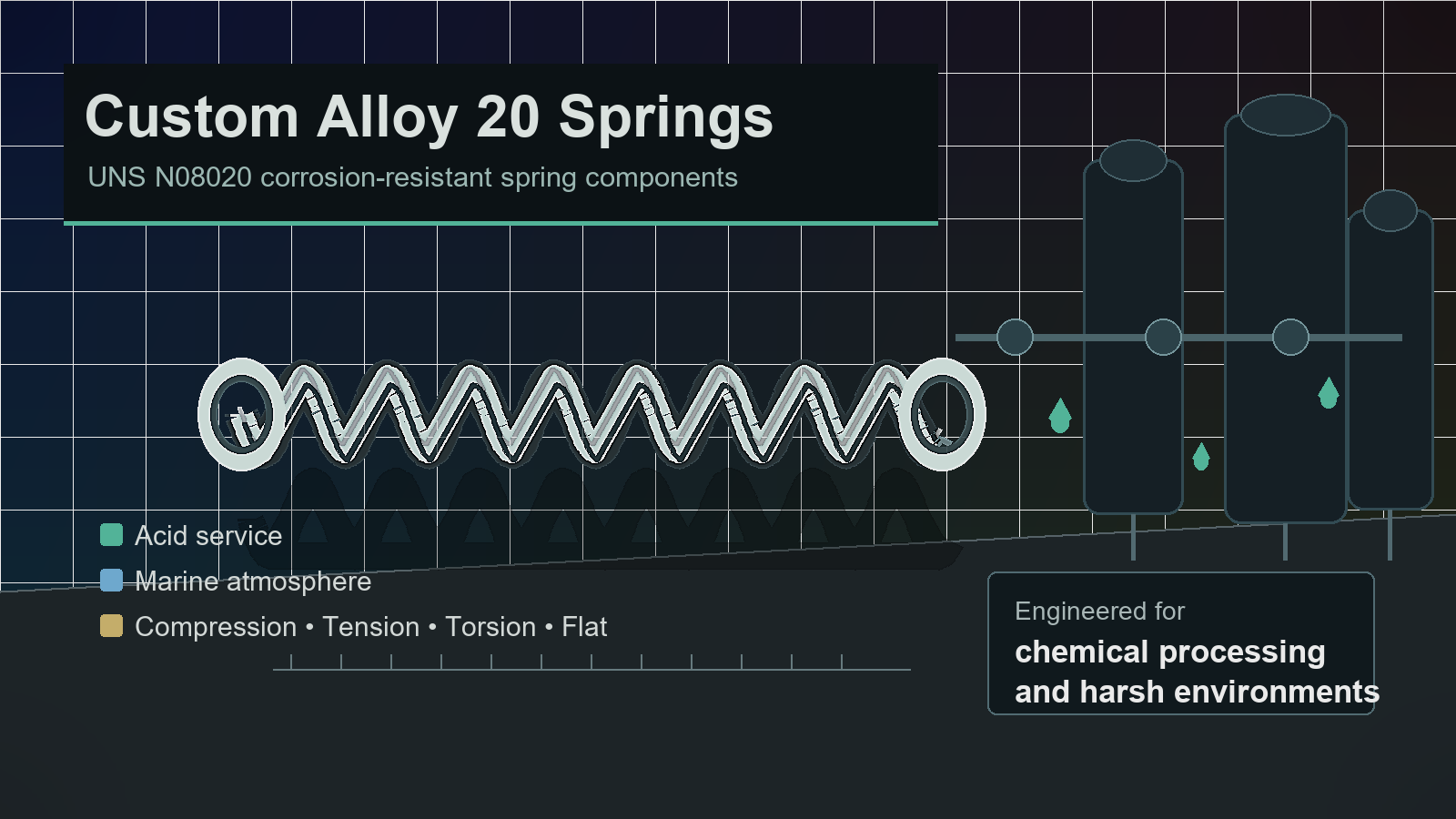
Custom Alloy 20 Springs Overview
Custom Alloy 20 springs are engineered springs manufactured according to specific working conditions, dimensions, load requirements, installation space, and environmental exposure. Unlike standard catalog springs, custom springs are designed around the actual application. This may include spring type, wire diameter, outside diameter, free length, number of coils, spring rate, working load, maximum deflection, end style, surface finish, tolerance grade, and packaging requirements.
Alloy 20 springs are often selected when the main challenge is not only mechanical movement, but also chemical durability. In many industrial systems, a spring may look simple, but its failure can affect valve operation, sealing pressure, electrical contact force, pump performance, flow control, safety devices, or assembly reliability. For this reason, material selection is an important part of spring design.
Alloy 20 is commonly used where 304 stainless steel is not resistant enough, where 316 stainless steel may still face pitting or acid attack, and where a more expensive nickel alloy may not always be necessary. It is especially valued in applications involving sulfuric acid, acidic process streams, chemical processing equipment, pickling systems, pharmaceutical processing, marine atmospheres, food-related chemical environments, and industrial fluid control systems.
What Is Alloy 20 for Spring Applications
Alloy 20 is an austenitic nickel-iron-chromium alloy with added copper and molybdenum. These alloying elements help improve resistance to acid corrosion, pitting, crevice corrosion, and stress-related degradation in many industrial environments. The material is also known by several common names, including Alloy 20, Carpenter 20, 20Cb-3, and UNS N08020.
For spring applications, Alloy 20 is used when the spring must resist corrosive media while still maintaining enough strength and elasticity for repeated movement. Because springs store and release mechanical energy, the material must be able to withstand stress, deflection, and repeated loading without losing its shape too quickly. Alloy 20 can be cold worked to improve strength, which makes it suitable for custom spring manufacturing when proper forming and processing methods are applied.
In practical terms, Alloy 20 is not usually chosen for low-cost general-purpose springs. It is selected when corrosion resistance, process reliability, and longer service life are more important than the lowest initial price. For many buyers, the value of Alloy 20 springs comes from reducing maintenance, avoiding unexpected downtime, and improving performance in harsh operating conditions.
Alloy 20 UNS N08020 Chemical Composition
The chemical composition of Alloy 20 gives it its corrosion-resistant behavior. Nickel supports a stable austenitic structure and improves resistance in reducing environments. Chromium helps resist oxidation and general corrosion. Molybdenum improves resistance to pitting and crevice corrosion. Copper is especially helpful in sulfuric acid service. Niobium, also called columbium, contributes to stabilization against intergranular corrosion.
| Element | Typical Content | Role in Alloy 20 Springs |
|---|---|---|
| Nickel | Approx. 32.0-38.0% | Improves corrosion resistance and supports a stable austenitic structure. |
| Chromium | Approx. 19.0-21.0% | Helps resist oxidation and many forms of general corrosion. |
| Iron | Balance | Base element that contributes to strength and alloy structure. |
| Copper | Approx. 3.0-4.0% | Improves resistance to sulfuric acid and reducing chemical environments. |
| Molybdenum | Approx. 2.0-3.0% | Enhances pitting and crevice corrosion resistance. |
| Niobium | Stabilizing addition | Helps resist intergranular corrosion after thermal exposure. |
| Carbon | Low content | Reduces risk of carbide precipitation and corrosion sensitivity. |
Actual material composition should be confirmed by material certificate when the spring is used in critical applications. For custom Alloy 20 springs, buyers often request a mill test certificate, material traceability, RoHS or REACH information, and inspection reports depending on the industry and project requirements.
Key Properties of Alloy 20 Springs
Alloy 20 springs combine corrosion resistance with useful mechanical properties. While it is not the strongest spring material available, it offers a strong advantage in chemically aggressive environments where ordinary spring steels and common stainless steels may not be suitable.
Strong Acid Corrosion Resistance
One of the main reasons to choose Alloy 20 springs is their resistance to sulfuric acid and mixed acid environments. The alloy was originally developed to perform well in acid service, and this remains one of its most important advantages. In spring applications, this can help prevent surface attack, rust staining, premature cracking, and loss of cross-section caused by corrosion.
Good Resistance to Pitting and Crevice Corrosion
Springs often have tight coil gaps, contact points, hidden surfaces, and areas where liquid can remain trapped. These conditions may increase the risk of localized corrosion. The molybdenum and chromium content in Alloy 20 helps improve resistance to pitting and crevice corrosion compared with many standard stainless steels.
Useful Strength After Cold Working
Spring wire requires enough strength to store energy and return to its original shape after deflection. Alloy 20 can be cold worked to increase tensile strength and improve spring performance. The exact performance depends on wire condition, diameter, forming method, stress relief, and final spring geometry.
Good Fabrication Capability
Alloy 20 can be formed into compression springs, extension springs, torsion springs, wire forms, clips, flat springs, and special shaped spring parts. Because it is a nickel alloy with different forming behavior than carbon steel or common stainless steel, experienced manufacturing control is important, especially for tight tolerances or small wire diameters.
Corrosion Resistance of Alloy 20 in Spring Service Environments
Corrosion resistance is often the deciding factor for Alloy 20 spring selection. A spring may perform well in a dry mechanical test but fail quickly in real service if the environment attacks the material. This is why chemical compatibility, temperature, concentration, oxygen level, chloride content, cleaning agents, and operating cycles should be reviewed before production.
Alloy 20 performs well in many acid-handling and chemical process environments, especially those involving sulfuric acid. It is also used in equipment exposed to phosphoric acid, nitric acid mixtures, organic acids, chemical cleaning fluids, and certain chloride-bearing environments. However, no alloy is universal. Strong hydrochloric acid, high-temperature chloride media, or highly oxidizing/reducing mixtures may require a more specialized nickel alloy.
| Service Environment | Alloy 20 Spring Suitability | Design Note |
|---|---|---|
| Sulfuric acid processing | Often suitable | Check acid concentration and temperature before final selection. |
| Chemical plant atmosphere | Very useful | Good choice when standard stainless springs corrode too quickly. |
| Marine atmosphere | Useful in many cases | Consider chloride level, splash exposure, and cleaning cycles. |
| Pharmaceutical and process equipment | Often suitable | Surface finish and cleanability may be important. |
| High-temperature aggressive chloride service | Case dependent | Inconel, Hastelloy, or other nickel alloys may be reviewed. |
| General indoor mechanical use | Usually more than required | Stainless steel or music wire may be more cost-effective. |
Mechanical Properties and Elastic Performance of Alloy 20 Springs
The mechanical performance of an Alloy 20 spring depends on the material condition and the spring design. For spring manufacturing, the most important factors include tensile strength, yield strength, modulus of elasticity, fatigue resistance, relaxation behavior, and the allowable stress under working deflection.
Alloy 20 has lower spring strength than some high-strength carbon spring steels and certain precipitation-hardened alloys. However, its corrosion resistance can make it the better choice in harsh environments. A spring made from a stronger but less corrosion-resistant material may fail earlier if corrosion pits become crack initiation points. For this reason, spring design is always a balance between strength, corrosion resistance, fatigue life, cost, and operating conditions.
Spring Rate and Load Stability
The spring rate is the force required to compress, extend, or rotate a spring by a specific amount. In custom Alloy 20 springs, the spring rate is controlled by wire diameter, coil diameter, number of active coils, material modulus, and spring type. A small change in wire diameter can have a large effect on load, so careful design and inspection are important.
Fatigue Performance
Fatigue performance matters when the spring is repeatedly cycled. A spring in a valve, pump, connector, switch, actuator, or control device may cycle thousands or millions of times. Fatigue life can be affected by stress level, surface condition, corrosion exposure, temperature, wire quality, shot peening, stress relief, and installation alignment.
Stress Relaxation
Stress relaxation occurs when a spring loses part of its load over time while held under deflection, especially at elevated temperature. Alloy 20 springs can perform well in many industrial conditions, but the expected load loss should be reviewed if the spring works at high temperature or under continuous compression for long periods.
Heat Treatment and Cold Working for Spring Manufacturing
Alloy 20 is not typically hardened by heat treatment in the same way as carbon spring steel. Instead, strength is commonly improved by cold working. Cold working increases strength by deforming the material during wire drawing or forming. After coiling or forming, springs may be stress relieved to reduce internal forming stress and improve dimensional stability.
The correct process depends on spring type, wire size, final load requirement, and material condition. Too little stress relief may leave excessive residual stress. Too much heat exposure may affect mechanical properties or surface condition. For critical springs, the manufacturer should control furnace temperature, holding time, atmosphere, and cooling conditions according to the material and application.
Cold Worked Alloy 20 Wire
Cold worked wire is often used when higher spring load is needed. The wire condition should be selected before production because it directly affects forming difficulty and final spring performance. Harder wire may provide better load capacity but can be more difficult to form into complex shapes.
Stress Relief After Forming
Stress relief is commonly used after spring forming to reduce internal stresses created during coiling, bending, or shaping. This can improve spring stability, reduce distortion, and help the spring maintain its designed load. The stress relief process should be matched to Alloy 20 rather than copied directly from standard carbon steel spring practice.
Types of Custom Alloy 20 Springs
Custom Alloy 20 springs can be manufactured in many forms depending on how force must be applied in the final assembly. The most common types include compression springs, tension springs, torsion springs, flat springs, and custom wire forms.
Alloy 20 Compression Springs
Compression springs are designed to resist compressive force. They are widely used in valves, pumps, seals, actuators, pressure devices, and mechanical assemblies. Custom Alloy 20 compression springs can be made with open ends, closed ends, closed and ground ends, variable pitch, conical shapes, barrel shapes, or special end configurations.
Alloy 20 Tension Springs
Tension springs, also called extension springs, are designed to resist pulling force. They usually include hooks, loops, threaded inserts, or special end attachments. In corrosive environments, hook design is especially important because high stress often concentrates at the end section. A well-designed end can improve service life and reduce failure risk.
Alloy 20 Torsion Springs
Torsion springs apply torque or rotational force. They are often used in hinges, levers, closures, clamps, and rotating mechanisms. Custom torsion springs may require left-hand or right-hand winding, single or double torsion configuration, special leg angles, and precise torque control.
Alloy 20 Flat Springs
Flat springs are produced from strip or sheet material rather than round wire. They are used for clips, contacts, retainers, clamps, battery components, shielding parts, and special industrial assemblies. Alloy 20 flat springs can be laser cut, stamped, formed, deburred, and finished according to application needs.
Alloy 20 Wire Forms
Wire forms are custom-shaped wire components that may not look like traditional springs but still provide elastic force, holding pressure, support, or positioning. Alloy 20 wire forms are useful in chemical equipment, marine hardware, process instruments, and custom assemblies exposed to corrosive media.
| Spring Type | Main Force Direction | Common Uses |
|---|---|---|
| Compression spring | Axial compression | Valves, pumps, seals, actuators, pressure equipment. |
| Tension spring | Axial extension | Return mechanisms, clamps, covers, linkages. |
| Torsion spring | Rotational torque | Hinges, levers, rotating arms, closures. |
| Flat spring | Bending force | Contacts, clips, retainers, electrical and mechanical assemblies. |
| Wire form | Custom force path | Holding, guiding, locking, positioning, and special fixtures. |
Available Wire Diameters and Spring Design Range
Custom Alloy 20 springs can be produced in a wide range of wire diameters, depending on material availability, forming equipment, spring geometry, and order quantity. Small wire diameters are suitable for precision springs, electrical contacts, instruments, and compact devices. Larger wire diameters are used for industrial valves, heavy chemical equipment, marine assemblies, and high-load components.
The design range is not determined by wire diameter alone. A spring manufacturer must also consider coil diameter, spring index, number of active coils, free length, solid height, pitch, end type, allowable stress, and whether the spring can be formed without cracking or excessive distortion.
Spring Index
Spring index is the ratio between mean coil diameter and wire diameter. If the index is too low, the spring may be difficult to manufacture and may have high stress concentration. If the index is too high, the spring may be unstable or prone to tangling and deformation. For Alloy 20 springs, a practical spring index helps improve manufacturability and performance.
Free Length and Working Stroke
The free length is the spring length without load. The working stroke is the distance the spring moves in service. A good design keeps the working stress within a suitable range and avoids compressing the spring to solid height unless the design specifically allows it.
End Configuration
End configuration affects load transfer, alignment, and stability. Compression springs may use closed ends, ground ends, or special seats. Extension springs may use machine hooks, crossover hooks, side loops, or custom fittings. Torsion springs require leg geometry that matches the assembly.
Precision Tolerance, Load Requirements, and Fatigue Performance
Custom Alloy 20 springs can be manufactured to different tolerance levels depending on the application. Precision springs require tighter control of wire diameter, coil diameter, free length, load at specified height, squareness, parallelism, end angle, and surface condition. However, tighter tolerances usually increase manufacturing cost and inspection time.
For many industrial applications, the most important tolerance is not simply the free length. The key requirement is often the load at a working height, torque at a working angle, or force at a defined extension. This is why buyers should provide actual working conditions instead of only sending a rough drawing.
| Design Item | Why It Matters | Information to Provide |
|---|---|---|
| Working load | Confirms whether the spring can perform the required function. | Load value and measurement position. |
| Deflection or stroke | Controls stress level and fatigue life. | Installed length, working length, maximum length. |
| Cycle life | Determines fatigue design requirements. | Expected number of cycles and operating speed. |
| Environment | Determines material and finish suitability. | Chemicals, temperature, humidity, chloride exposure. |
| Space limit | Controls diameter, length, and end design. | Available installation dimensions. |
Manufacturing Process of Custom Alloy 20 Springs
The manufacturing process for custom Alloy 20 springs usually begins with application review and material selection. After the design is confirmed, production may include wire procurement, wire inspection, CNC coiling, forming, stress relief, end grinding, surface treatment, dimensional inspection, load testing, cleaning, packaging, and final documentation.
Design Review
The manufacturer reviews the drawing, sample, or application information to confirm whether the spring can be produced in Alloy 20. This step may include checking stress level, spring index, working travel, fatigue requirements, tolerance feasibility, and environmental compatibility.
Material Preparation
Alloy 20 wire or strip is selected according to the required size, condition, and certification level. For critical orders, material traceability is maintained from raw material to finished spring. This may include batch number control and certificate matching.
Coiling and Forming
CNC spring machines are commonly used for precision coiling and forming. Compression springs are coiled to the required diameter, pitch, and length. Tension springs require body coiling and hook forming. Torsion springs require coil forming and leg positioning. Flat springs may require cutting, stamping, bending, and forming operations.
Heat Setting or Stress Relief
After forming, Alloy 20 springs may be stress relieved to stabilize dimensions and reduce forming stress. For certain compression springs, load setting or presetting may be used to reduce later height loss during service.
Grinding and Secondary Operations
Compression springs may need end grinding to improve seating and load alignment. Secondary operations may include chamfering, deburring, polishing, passivation, pickling, ultrasonic cleaning, marking, and special packaging.
Inspection and Testing
Inspection can include dimensional checks, load testing, torque testing, visual inspection, surface finish checks, material verification, and special testing when required. For high-reliability applications, the spring supplier may provide inspection reports with measured data.
Surface Finish, Pickling, and Passivation Options
Surface condition has a direct effect on corrosion behavior and fatigue performance. A rough or damaged surface may create points where corrosion starts or where fatigue cracks develop. For Alloy 20 springs used in chemical or marine service, surface finish should be considered part of the spring design, not only an appearance requirement.
Natural Bright Finish
Many Alloy 20 springs are supplied with a clean metallic finish after forming and cleaning. This is suitable for many industrial uses where appearance is not the main concern and corrosion exposure is within the material capability.
Pickling
Pickling removes scale, heat tint, oxides, and surface contamination caused by processing. It can improve the cleanliness of the surface and prepare the spring for better corrosion resistance. Pickling must be controlled carefully to avoid over-etching small or precision spring parts.
Passivation
Passivation helps remove free iron and promotes a corrosion-resistant surface film. It is often requested for stainless and nickel alloy parts used in chemical, pharmaceutical, marine, and clean process environments. For Alloy 20 springs, passivation can be a useful finishing option when clean surface condition is important.
Polishing and Deburring
Polishing and deburring can reduce sharp edges and improve surface smoothness. This is especially important for flat springs, wire forms, and spring ends where burrs may interfere with assembly or become corrosion initiation points.
Typical Applications of Alloy 20 Springs in Chemical and Marine Industries
Alloy 20 springs are used in applications where corrosion resistance is central to equipment reliability. They are common in chemical processing, acid handling, marine equipment, process control, pharmaceutical systems, and industrial fluid management.
Chemical Processing Equipment
In chemical plants, springs may be installed in valves, pumps, mixers, seals, filters, safety devices, and control instruments. Alloy 20 springs can help maintain mechanical function when exposed to acid vapors, liquid chemicals, cleaning fluids, or corrosive atmospheres.
Valve and Pump Components
Springs in valves and pumps often work under pressure, vibration, chemical exposure, and repeated movement. Alloy 20 compression springs and torsion springs are used where the spring must maintain force while resisting chemical attack.
Marine and Offshore Equipment
Marine environments expose metal parts to salt, humidity, spray, and temperature changes. Alloy 20 can be useful in selected marine applications where stronger corrosion resistance than common stainless steel is needed. For severe seawater immersion or high-chloride conditions, the exact alloy choice should be reviewed carefully.
Pharmaceutical and Food-Related Chemical Systems
Some process systems require springs that can tolerate cleaning chemicals, acidic solutions, or controlled sanitation environments. Alloy 20 springs may be used where both corrosion resistance and clean surface finish are required.
Pickling and Acid Cleaning Lines
Equipment used in pickling and acid cleaning can be highly corrosive. Alloy 20 springs may be selected for fixtures, clamps, valves, and mechanical assemblies exposed to acid solutions or vapors.
| Industry | Possible Alloy 20 Spring Use | Common Spring Type |
|---|---|---|
| Chemical processing | Valves, pumps, seals, flow control parts. | Compression, torsion, wire forms. |
| Marine equipment | Clamps, connectors, exposed mechanisms. | Tension, torsion, flat springs. |
| Pharmaceutical equipment | Clean process devices and chemical-resistant assemblies. | Compression, flat springs. |
| Acid handling systems | Pickling lines, tanks, process valves, safety devices. | Compression, wire forms, clips. |
| Industrial instruments | Pressure devices, control mechanisms, sensor assemblies. | Precision compression, torsion springs. |
Alloy 20 Springs vs Stainless Steel Springs 304, 316, and Inconel
Choosing between Alloy 20, 304 stainless steel, 316 stainless steel, and Inconel depends on the service environment, mechanical requirements, temperature, corrosion risk, and budget. Each material has a different strength profile and corrosion resistance level.
Alloy 20 vs 304 Stainless Steel Springs
304 stainless steel springs are widely used for general corrosion resistance, indoor equipment, light moisture exposure, and many standard industrial applications. However, 304 may not perform well in stronger acids or chloride-rich environments. Alloy 20 offers better resistance in many acid-handling applications, especially where sulfuric acid is present.
Alloy 20 vs 316 Stainless Steel Springs
316 stainless steel contains molybdenum, which improves resistance to pitting and chlorides compared with 304. It is a common choice for marine and chemical exposure. However, Alloy 20 can provide better performance in certain acid environments and more aggressive chemical service. If 316 springs show corrosion, staining, pitting, or early fatigue cracks, Alloy 20 may be a better upgrade.
Alloy 20 vs Inconel Springs
Inconel springs, such as Inconel 600, 625, or X-750, are often selected for high-temperature strength, oxidation resistance, and severe corrosion conditions. Inconel alloys may outperform Alloy 20 in high-temperature or highly aggressive environments, but they are usually more expensive. Alloy 20 can be a practical choice when the application requires acid corrosion resistance but does not require the higher temperature strength of Inconel.
| Material | Main Advantage | Best Used For | Cost Level |
|---|---|---|---|
| 304 stainless steel | Affordable general corrosion resistance | Indoor, light-duty, general industrial springs | Low to medium |
| 316 stainless steel | Better chloride resistance than 304 | Marine atmosphere, food equipment, moderate chemical exposure | Medium |
| Alloy 20 | Strong resistance to sulfuric acid and many chemicals | Chemical processing, acid handling, harsh industrial service | Medium to high |
| Inconel | High-temperature strength and severe environment resistance | Heat, aerospace, power, extreme corrosion service | High |
Price Factors, MOQ, and Custom Production Lead Time
The price of custom Alloy 20 springs depends on material cost, wire diameter, order quantity, design complexity, tolerance requirements, finishing process, inspection level, and delivery schedule. Alloy 20 is more expensive than common stainless steel, so the material portion of the spring cost can be significant, especially for large wire sizes or low-volume orders.
Material Availability
Alloy 20 wire and strip may not be as readily available as 304 or 316 stainless steel. If the required wire diameter is a standard available size, lead time can be shorter. If special wire drawing or imported material is needed, the production schedule may be longer.
Spring Complexity
A simple compression spring is usually easier and faster to produce than a complex torsion spring, extension spring with special hooks, or flat spring with multiple forming steps. Complex parts may require tooling, prototypes, or additional inspection.
Tolerance and Testing Requirements
Tight tolerances increase manufacturing control and inspection time. Load testing, fatigue testing, material verification, passivation validation, and full documentation can also affect price and lead time.
Minimum Order Quantity
The MOQ for custom Alloy 20 springs depends on raw material availability, machine setup time, and part complexity. Small trial orders may be possible for prototypes, but unit price is usually higher. Larger production runs reduce setup cost per piece and may make custom material procurement more economical.
| Cost Factor | Impact on Price | How to Control Cost |
|---|---|---|
| Wire diameter | Larger wire uses more material and may need heavier equipment. | Confirm actual load requirement to avoid overdesign. |
| Order quantity | Small batches have higher setup cost per piece. | Combine prototype and production planning when possible. |
| Tolerance | Tighter tolerances require more control and inspection. | Specify critical tolerances only where needed. |
| Surface finish | Pickling, passivation, polishing, and special cleaning add cost. | Select finish according to actual environment and cleanliness needs. |
| Documentation | Certificates and reports require additional processing. | Request only the documents required by the project. |
How to Specify Custom Alloy 20 Springs
To receive an accurate quotation and suitable spring design, buyers should provide as much technical information as possible. A drawing is helpful, but it is not always enough. The spring manufacturer also needs to understand how the spring works in the assembly.
Useful information includes spring type, material grade, wire diameter, outside diameter, inside diameter, free length, working length, solid height, number of coils, end style, load requirement, cycle life, operating temperature, chemical exposure, surface finish, tolerance, order quantity, and inspection requirements. If no drawing is available, a sample spring or application description can be used to develop a design.
| Information Needed | Example |
|---|---|
| Spring type | Compression spring, extension spring, torsion spring, flat spring, wire form. |
| Material | Alloy 20, UNS N08020, with certificate if required. |
| Dimensions | Wire diameter, outer diameter, free length, coil count, end type. |
| Working condition | Load at working height, stroke, torque angle, extension length. |
| Environment | Chemical type, concentration, temperature, humidity, chloride exposure. |
| Quantity | Prototype quantity and expected production order quantity. |
Quality Control for Custom Alloy 20 Springs
Quality control is essential for custom Alloy 20 springs because the material is often used in demanding service conditions. Inspection may begin with raw material verification and continue through forming, heat treatment, finishing, and final testing.
Common quality checks include dimensional inspection, load testing, torque testing, surface inspection, end grinding inspection, material certificate review, hardness or tensile confirmation when applicable, and packaging verification. For precision or critical applications, additional testing such as fatigue testing, salt spray testing, chemical compatibility review, or third-party inspection may be requested.
Dimensional Inspection
Dimensional inspection confirms that the spring matches the drawing or approved sample. Important dimensions may include wire diameter, outside diameter, inside diameter, free length, solid height, hook length, leg angle, pitch, and end squareness.
Load and Torque Testing
Load testing confirms spring force at a specified height or extension. Torque testing confirms rotational force for torsion springs. These tests are often more meaningful than free length alone because they confirm actual spring function.
Visual and Surface Inspection
Visual inspection checks for cracks, burrs, scratches, oxidation, deformation, contamination, and surface defects. Surface quality is especially important in corrosive service because defects can become starting points for corrosion or fatigue failure.
Custom Alloy 20 Springs Related Questions
What are Alloy 20 springs used for?
Alloy 20 springs are used in chemical processing, acid handling, marine equipment, valves, pumps, pharmaceutical systems, pickling lines, industrial instruments, and other applications where the spring needs strong corrosion resistance. They are especially useful when 304 or 316 stainless steel springs cannot provide enough service life in acidic or chemically aggressive environments.
Is Alloy 20 better than 316 stainless steel for springs?
Alloy 20 can be better than 316 stainless steel for springs in many acid-handling and chemical processing environments, especially where sulfuric acid or aggressive industrial chemicals are present. However, 316 stainless steel may still be a good and more economical choice for moderate corrosion exposure, marine atmosphere, food equipment, and general industrial use. The better choice depends on chemical concentration, temperature, load, cycle life, and budget.
Can Alloy 20 springs be custom made in small quantities?
Yes, Alloy 20 springs can often be custom made in small quantities for prototypes, maintenance replacement, equipment repair, and special projects. The unit price for small orders is usually higher because of material sourcing, machine setup, engineering review, and inspection time. For production orders, larger quantities usually reduce the cost per spring and make custom manufacturing more economical.


 English
  Korean
  Japanese
  Arabic
  Spanish
  German
  Portuguese
  French
  Russian
  Italian