

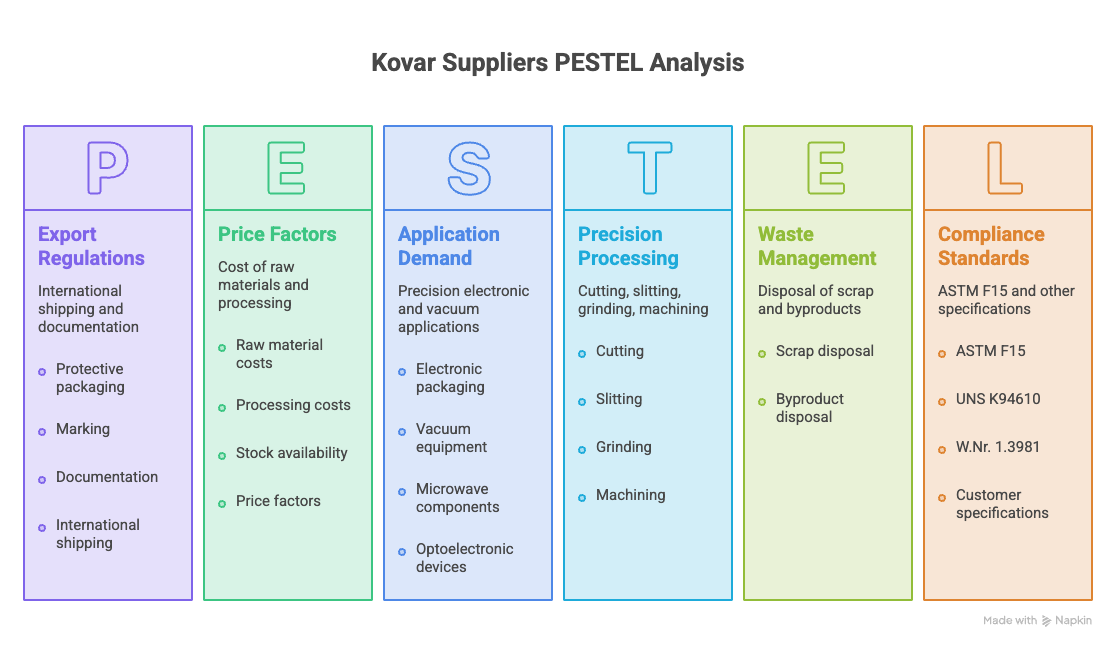
Kovar suppliers provide precision iron-nickel-cobalt controlled expansion alloy products for glass-to-metal sealing, ceramic-to-metal sealing, electronic packaging, vacuum equipment, microwave components, optoelectronic devices, sensors, relays, transistors, diodes, and other applications requiring a stable hermetic seal. Kovar is commonly identified as Alloy K, UNS K94610, ASTM F15, W.Nr. 1.3981, FeNi29Co17, FeNi29Co18, Nilo K, and 4J29. It is not selected primarily for high strength or severe corrosion resistance. Its most important feature is a controlled thermal expansion curve that closely matches selected borosilicate glasses and alumina ceramics over the sealing temperature range. Reliable Kovar suppliers should therefore control chemical composition, melting quality, heat treatment, surface condition, oxide preparation, dimensional tolerance, flatness, straightness, product traceability, and coefficient of thermal expansion performance. This article covers Kovar alloy identification, composition, properties, product forms, standards, dimensions, processing options, sealing applications, quality inspection, stock availability, price factors, quotation requirements, and how to select a suitable supplier.
Kovar Suppliers for Precision Expansion Alloy Products
Kovar is normally purchased for precision electronic, vacuum, optical, aerospace, and sealing applications. A supplier must therefore provide more than a material with approximately the correct nickel and cobalt content. The material must have uniform composition, suitable thermal expansion behavior, stable metallurgical condition, controlled surface quality, and reliable heat-number traceability.
The requirements for Kovar bar used as a machined housing can be different from those for thin Kovar strip used in electronic packages. A thick plate may be purchased as rough machining stock, while a thin strip may require micrometer-level thickness control, controlled camber, clean edges, specified temper, and a surface suitable for plating or sealing.
What Professional Kovar Suppliers Should Provide
| Supplier Capability | What Should Be Confirmed | Why It Matters |
|---|---|---|
| Grade identification | Kovar / Alloy K / UNS K94610 / ASTM F15 / W.Nr. 1.3981 | Prevents substitution with Invar 36, Alloy 42, Kovar-like material, or another sealing alloy. |
| Controlled chemistry | Nickel, cobalt, iron, carbon, manganese, and silicon limits | Thermal expansion behavior depends on accurate chemical control. |
| Product range | Bar, rod, sheet, plate, strip, foil, wire, tube, and machining blanks | Allows the buyer to select a form suited to forming, machining, stamping, or sealing. |
| Heat treatment support | Annealed, stress relieved, cold worked, hydrogen annealed, or customer-specified condition | Heat treatment affects expansion, hardness, formability, magnetic properties, and sealing performance. |
| Precision processing | Cutting, slitting, grinding, straightening, flattening, machining, and forming | Many electronic and sealing parts require tighter tolerances than ordinary mill products. |
| Inspection and certification | MTC, chemical analysis, mechanical testing, CTE testing, dimensional report, and PMI | Supports material approval and production traceability. |
| Export capability | Protective packaging, marking, documentation, and international shipping | Reduces damage, contamination, and document problems during delivery. |
Kovar Alloy Grade Identification and Material Overview
Kovar is a vacuum-melted iron-nickel-cobalt controlled expansion alloy. Its chemistry is maintained within narrow limits to produce a consistent thermal expansion curve. This curve is designed to follow the expansion behavior of selected hard borosilicate glasses and alumina ceramics more closely than ordinary metals.
When a glass and metal assembly is heated during sealing and then cooled, the two materials contract at different rates. A large thermal expansion mismatch creates residual stress at the interface. This stress can crack the glass, weaken the seal, create leakage, or reduce resistance to thermal cycling. Kovar reduces this mismatch and allows the production of reliable hermetic seals.
Common Kovar Names and Designations
| Name or Designation | Description | Procurement Note |
|---|---|---|
| Kovar | Widely used commercial and trademarked alloy name | Commonly used in supplier catalogs and engineering drawings. |
| Alloy K | Generic commercial designation | Often used for iron-nickel-cobalt glass sealing alloy products. |
| UNS K94610 | Unified Numbering System designation | Important for international material identification. |
| ASTM F15 | Common specification for iron-nickel-cobalt sealing alloy | Frequently specified for bar, wire, strip, sheet, and other wrought products. |
| W.Nr. 1.3981 | German material number | Common in European technical documents and purchase orders. |
| FeNi29Co17 / FeNi29Co18 | Composition-based European designation | Indicates approximately 29% nickel and 17% to 18% cobalt. |
| 4J29 | Chinese controlled expansion alloy designation | Frequently used by Asian mills and suppliers. |
| Nilo K / Pernifer 2918 | Commercial equivalents or related trade designations | Equivalent status should be verified against the required standard and certificate. |
Kovar Is Not the Same as Invar 36
Kovar and Invar 36 are both controlled expansion alloys, but they are designed for different functions. Invar 36 is mainly selected for low dimensional change around ambient temperature. Kovar is designed to match the expansion characteristics of specific glasses and ceramics during sealing and subsequent temperature cycling.
Kovar contains approximately 29% nickel and 17% cobalt, while Invar 36 contains approximately 36% nickel and normally does not contain the same level of cobalt. Substituting Invar 36 for Kovar without engineering approval can create a poor expansion match and lead to cracked or leaking seals.
Kovar Chemical Composition
The composition of Kovar must be tightly controlled. Nickel and cobalt establish the required controlled expansion behavior, while iron forms the balance. Carbon, manganese, silicon, sulfur, phosphorus, chromium, and other residual elements are limited because excessive variation can affect expansion, formability, oxidation, sealing, and metallurgical stability.
Typical Kovar Composition
| Element | Typical Nominal Value or Limit | Function in Kovar |
|---|---|---|
| Nickel (Ni) | Approximately 29% | Controls thermal expansion behavior and phase stability. |
| Cobalt (Co) | Approximately 17% | Adjusts the expansion curve to match hard glass and ceramic materials. |
| Iron (Fe) | Balance | Forms the main alloy matrix. |
| Carbon (C) | Usually controlled at a very low level | Excess carbon can affect cleanliness, forming, sealing, and thermal stability. |
| Manganese (Mn) | Controlled minor addition | Supports melting and processing but must remain within specification. |
| Silicon (Si) | Controlled minor addition | Affects deoxidation, surface oxide behavior, and processing quality. |
| Phosphorus and Sulfur | Low controlled limits | Kept low to support ductility, clean edges, forming, and reliable sealing. |
Why Exact Chemistry Is Important
A material can contain roughly 29% nickel and 17% cobalt but still fail to meet the required Kovar expansion curve if chemistry and manufacturing are not adequately controlled. Professional purchasing should therefore require compliance with ASTM F15, UNS K94610, or another clearly stated specification rather than relying only on a commercial description such as “Kovar-type alloy.”
For critical glass-to-metal sealing, buyers may request heat-specific chemical analysis and coefficient of thermal expansion data. A standard MTC confirms chemistry, but it does not always include heat-specific thermal expansion testing unless requested.
Controlled Thermal Expansion Properties of Kovar
The main property of Kovar is not simply a low coefficient of thermal expansion. Its expansion curve is engineered to correspond with selected hard glasses and ceramics over the sealing range. The coefficient changes with temperature, heat treatment, composition, and metallurgical condition.
Representative Mean Thermal Expansion Values
| Temperature Range | Representative Mean CTE | Engineering Meaning |
|---|---|---|
| 25°C to 100°C | Approximately 5.86 × 10⁻⁶/K | Relevant for moderate-temperature electronic and instrument service. |
| 25°C to 200°C | Approximately 5.20 × 10⁻⁶/K | Shows controlled expansion over a wider operating range. |
| 25°C to 300°C | Approximately 5.13 × 10⁻⁶/K | Useful for evaluating sealing and thermal-cycle compatibility. |
| 25°C to 450°C | Approximately 5.25 × 10⁻⁶/K | Important because this range relates closely to many hard-glass sealing processes. |
| 25°C to 500°C | Approximately 6.15 × 10⁻⁶/K | Expansion begins to rise as the temperature range extends beyond the main controlled region. |
| 25°C to 700°C | Approximately 9.12 × 10⁻⁶/K | Shows that Kovar does not maintain the same low expansion at all temperatures. |
Why One CTE Number Is Not Enough
A supplier may state that Kovar has a coefficient of thermal expansion of approximately 5 × 10⁻⁶/K, but this number is incomplete without the temperature range and heat treatment condition. The average CTE from 25°C to 100°C is not identical to the average value from 25°C to 450°C.
For precision sealing, purchase specifications should identify the required test range, test method, heat treatment condition, and acceptable coefficient. This is especially important when using specialized glass or ceramic materials with narrow expansion limits.
Glass and Ceramic Matching
Kovar is commonly matched with hard borosilicate glasses and selected alumina ceramics. However, not every glass composition has the same expansion curve. Engineers should compare the specific glass or ceramic manufacturer’s data with the Kovar expansion curve before approving the combination.
Kovar Mechanical and Physical Properties
Kovar provides moderate mechanical strength and good formability in annealed condition. It can be cold rolled or cold worked to increase strength and hardness. Mechanical properties vary with product form, thickness, cold reduction, heat treatment, grain size, and supplier processing route.
Representative Mechanical Properties for Strip
| Temper | Tensile Strength | 0.2% Yield Strength | Elongation | Hardness |
|---|---|---|---|---|
| Annealed | Approximately 450 – 585 MPa | Approximately 200 MPa minimum | Approximately 25% minimum | Approximately 110 – 170 HV |
| Half Hard | Approximately 600 – 800 MPa | Approximately 400 MPa minimum | Depends on thickness and processing | Approximately 170 – 260 HV |
| Hard | Approximately 830 MPa minimum | Approximately 750 MPa minimum | Lower than annealed material | Approximately 260 HV minimum |
These are representative values for selected flat products and should not be used as universal acceptance limits. Actual requirements must follow the applicable specification, product form, thickness, temper, and MTC.
Representative Physical Properties
| Physical Property | Representative Value | Design Significance |
|---|---|---|
| Density | Approximately 8.36 g/cm³ | Used for weight, freight, and component mass calculations. |
| Modulus of Elasticity | Approximately 138 GPa | Important for structural stiffness and seal-stress analysis. |
| Melting Point or Range | Approximately 1450°C | Relevant for high-temperature processing and welding considerations. |
| Curie Temperature | Approximately 435°C | Kovar is magnetic below its Curie temperature. |
| Thermal Conductivity at 20°C | Approximately 17.5 W/m·K | Relevant for heat flow through packages and sealing assemblies. |
| Specific Heat at 20°C | Approximately 500 J/kg·K | Useful in heating, cooling, and sealing process calculations. |
| Electrical Resistivity at 20°C | Approximately 49 µΩ·cm | Relevant for electronic housings, leads, and vacuum components. |
Magnetic Properties
Kovar is magnetic below its Curie temperature. Its permeability and hysteresis behavior depend on annealing temperature, hardness, cold work, grain structure, and magnetic history. Buyers using Kovar near magnetic sensors, relays, microwave components, or precision instruments should review the magnetic requirements separately from the expansion requirements.
Available Kovar Product Forms: Bar, Sheet, Plate, Strip, Wire, and Tube
Kovar suppliers may offer standard mill products, stock material, or custom-manufactured forms. Availability varies because Kovar is a specialized alloy and is not stocked as broadly as stainless steel or common nickel alloys.
Kovar Bar and Rod
Kovar bar and rod are used for machined housings, feedthrough bodies, relay components, sensor parts, optical packages, pins, supports, electronic headers, and sealing components. Bars may be supplied hot rolled, forged, cold drawn, peeled, turned, annealed, or precision ground.
Kovar Sheet and Plate
Sheet and plate are used for electronic package bases, covers, housings, vacuum components, structural frames, hybrid circuit packages, and machined sealing components. Thin sheet is commonly cold rolled, while heavier plate may be hot rolled or forged before machining.
Kovar Strip and Foil
Kovar strip and foil are used for stamped lead frames, electronic package components, sealing rings, lids, connector parts, and precision formed products. Strip may require tight control of thickness, width, camber, coil set, burr height, edge condition, surface roughness, and temper.
Kovar Wire
Kovar wire is used for electrical feedthroughs, leads, terminal pins, vacuum-tube components, sensor connections, and glass-sealed conductors. It may be supplied in coils, spools, straightened lengths, cut pieces, annealed condition, or cold-drawn temper.
Kovar Tube
Kovar tube is less commonly stocked than bar, strip, or wire. It may be produced by seamless drawing, welded fabrication, deep drawing, or machining from hollow or solid stock. Tube quotations depend heavily on outside diameter, inside diameter, wall thickness, length, tolerance, quantity, and required sealing condition.
| Product Form | Common Delivery Conditions | Typical Applications |
|---|---|---|
| Round Bar | Hot rolled, forged, annealed, cold drawn, ground | Machined housings, headers, supports, sensor bodies, sealing parts. |
| Flat Bar | Hot rolled, cold rolled, annealed, ground | Electronic frames, fixtures, structural sealing components. |
| Sheet | Cold rolled, annealed, half hard, hard | Package bases, covers, lids, stamped components. |
| Plate | Hot rolled, annealed, stress relieved, machined | Machining blanks, vacuum assemblies, optical and electronic structures. |
| Strip and Foil | Cold rolled, slit, annealed, custom temper | Lead frames, sealing rings, thin stamped parts, package components. |
| Wire | Cold drawn, annealed, coil, spool, straightened | Feedthrough pins, electrical leads, vacuum-tube and sensor parts. |
| Tube | Seamless, welded, drawn, annealed, custom machined | Electronic tubes, feedthrough bodies, microwave and vacuum components. |
Common Kovar Specifications and Standards
ASTM F15 is the most widely recognized specification associated with Kovar and iron-nickel-cobalt sealing alloys. Other national, military, commercial, or customer-specific standards may also appear on drawings and purchase orders.
| Standard or Designation | Description | Buyer Note |
|---|---|---|
| ASTM F15 | Standard specification for iron-nickel-cobalt sealing alloy | Common procurement reference for Kovar products. |
| UNS K94610 | Unified alloy designation | Should appear on the quotation and MTC when specified. |
| W.Nr. 1.3981 | European material number | Used in German and European drawings. |
| FeNi29Co17 / FeNi29Co18 | European composition designation | Exact standard and allowable chemistry should still be confirmed. |
| DIN 17745 | European controlled expansion alloy reference | May appear in older or regional technical documents. |
| MIL-I-23011 Class 1 | Military sealing-alloy reference used on some legacy drawings | Revision and class requirements must be confirmed before quotation. |
| 4J29 | Chinese expansion alloy designation | Check whether the order requires ASTM F15 equivalence or direct 4J29 compliance. |
| Customer Specification | Project-specific composition, CTE, surface, and dimensional requirements | Customer requirements may be stricter than the base material standard. |
Equivalent Designations Require Verification
Commercial equivalents can have similar nominal compositions but different manufacturing tolerances, heat treatments, inspection requirements, and documentation. A buyer should not accept a cross-reference table as the only proof of equivalence. The supplier should compare the complete chemistry, thermal expansion limits, product condition, mechanical properties, and test requirements.
Kovar Sizes, Thicknesses, Diameters, and Custom Dimensions
Kovar dimensions depend on product form, stock availability, mill capability, and tolerance. Standard stock sizes are normally faster and more economical, while custom dimensions may require rolling, drawing, forging, slitting, grinding, or machining.
Typical Size Categories
| Product Form | Typical Supply Category | Information Required for Quotation |
|---|---|---|
| Round Bar | Small precision rod through larger forged bar | Diameter, length, tolerance, straightness, surface, and condition. |
| Sheet | Thin cold-rolled gauges through heavier sheet | Thickness, width, length, flatness, temper, and surface. |
| Plate | Heavy flat stock and machining blanks | Thickness, width, length, flatness, stress relief, and cutting requirements. |
| Strip | Precision narrow strip and coil material | Thickness, width, coil weight, camber, edge condition, and temper. |
| Wire | Fine wire through larger feedthrough wire | Diameter, tolerance, coil or spool size, straight length, and annealed condition. |
| Tube | Custom seamless, welded, drawn, or machined tube | OD, ID, wall thickness, length, tolerance, seam type, and inspection. |
Thin Kovar Strip and Foil
Precision rolled Kovar strip may be supplied in very thin gauges for electronic packaging and stamped components. As thickness decreases, rolling control, flatness, coil handling, edge quality, and protective packaging become more difficult. Thin strip and foil therefore tend to have a higher price per kilogram than standard bar or plate.
Custom Diameters and Thicknesses
When the required dimension is not in stock, the supplier may propose a nearby size with machining allowance. This is often faster and less expensive than commissioning a new production batch. However, the added machining and material loss should be compared with the cost of custom production.
Cold Rolled, Hot Rolled, Annealed, and Precision Ground Kovar
The manufacturing route and final condition affect Kovar’s strength, hardness, dimensional accuracy, surface finish, formability, expansion behavior, and price.
Cold-Rolled Kovar
Cold rolling is commonly used for sheet, strip, and foil. It provides better thickness control and a smoother surface than hot rolling. Cold work increases strength and hardness but reduces ductility. If the material will be deeply drawn or formed, an annealed condition may be required.
Hot-Rolled Kovar
Hot-rolled Kovar is normally used for heavier plate, flat bar, and rough machining stock. It is generally more economical than precision cold-finished material but has wider tolerances and a rougher surface.
Annealed Kovar
Annealing reduces hardness, restores ductility, relieves cold-work effects, and helps establish the required metallurgical condition. For sealing parts, annealing may also be combined with degassing and surface preparation.
Precision-Ground Kovar
Precision grinding is used for rods, bars, plates, and machined blanks requiring tight dimensions, good straightness, controlled flatness, and smooth surfaces. Ground material is more expensive because it requires oversize input stock, material removal, grinding time, and dimensional inspection.
| Condition | Main Advantages | Typical Applications |
|---|---|---|
| Hot Rolled | Economical and suitable for heavier sections | Machining blanks, large bars, plates, and structural parts. |
| Cold Rolled | Better thickness control and smoother surface | Sheet, strip, foil, stamped electronic components. |
| Annealed | Higher ductility and lower hardness | Deep drawing, stamping, forming, machining, and sealing preparation. |
| Half Hard or Hard | Higher strength and stiffness | Thin structural package parts and components requiring spring resistance. |
| Precision Ground | Tight tolerance, smooth finish, and improved straightness | Pins, shafts, feedthroughs, precision frames, and machined assemblies. |
Heat Treatment and Annealing Requirements
Heat treatment is critical because Kovar’s expansion behavior, formability, magnetic properties, and sealing performance depend on metallurgical condition. The required cycle should follow the applicable specification and final sealing process.
General Annealing
A representative annealing cycle for selected strip products may be approximately 850°C for around 30 minutes in a protective atmosphere. Higher temperatures or extended holding times can produce excessive grain growth, reducing surface quality and affecting forming behavior.
Hydrogen Annealing and Degassing
Fabricated sealing components are often degreased, degassed, and annealed in wet or dry hydrogen or another suitable controlled atmosphere. This process removes contaminants, reduces internal stress, and prepares the surface for controlled oxidation and glass sealing.
Hydrogen processing requires strict furnace and safety controls. Carbon pickup, oil contamination, sulfur contamination, uncontrolled oxidation, and inappropriate cooling can reduce sealing quality.
Cooling After Annealing
Controlled cooling is important to reduce oxidation, distortion, thermal shock, and undesirable structural transformation. Parts may be retained in the protected furnace atmosphere until they reach a lower temperature before being exposed to air.
Oxide Preparation for Sealing
A thin, adherent oxide layer is usually preferred for direct glass-to-metal sealing. Excessive oxide can flake or weaken the interface, while insufficient oxide can produce poor glass wetting and bonding. Oxide preparation therefore requires control of temperature, time, atmosphere, surface cleanliness, and part geometry.
| Processing Stage | Main Purpose | Potential Risk if Poorly Controlled |
|---|---|---|
| Degreasing | Removes oil, lubricant, and machining residue | Contamination, poor oxide adhesion, gas generation, or seal leakage. |
| Annealing | Reduces stress and establishes a suitable metallurgical condition | Distortion, excessive grain growth, unstable expansion, or poor forming. |
| Degassing | Removes absorbed or trapped gases | Outgassing during sealing or vacuum service. |
| Controlled oxidation | Forms a thin adherent oxide for bonding to glass | Weak bonding if the oxide is too thin, thick, porous, or flaky. |
| Controlled cooling | Reduces distortion and unwanted surface reactions | Thermal shock, oxidation, warping, or structural transformation. |
Surface Finish, Straightness, Flatness, and Tolerance Options
Kovar components are frequently used in small precision assemblies, making surface condition and dimensional accuracy important. Requirements should be expressed numerically whenever possible.
Surface Finish Options
| Surface Condition | Common Product Forms | Typical Use |
|---|---|---|
| Hot-Rolled Mill Finish | Plate, flat bar, large round bar | Rough machining stock. |
| Pickled or Descaled | Plate, sheet, strip, bar | Cleaner surface before fabrication or machining. |
| Cold-Rolled Finish | Sheet, strip, foil | Stamping, drawing, electronic packaging, and plating. |
| Peeled or Turned | Round bar and rod | Removes mill scale and surface defects before machining. |
| Centerless Ground | Rod, wire, precision bar | Feedthrough pins, shafts, and close-tolerance components. |
| Polished | Sheet, strip, rod, machined parts | Clean electronic, optical, brazing, or plating applications. |
| Controlled Oxide | Finished sealing components | Direct glass-to-metal sealing. |
| Plated Surface | Electronic housings, lids, leads, and packages | Improves solderability, brazability, corrosion protection, or electrical contact. |
Straightness of Rod and Wire
Straightness affects machining, automated feeding, glass sealing, alignment, and assembly. A request for “straight rod” is not sufficient for precision supply. Buyers should provide an allowable deviation per meter or over the full length.
Sheet and Plate Flatness
Flatness is important for package bases, optical housings, ceramic assemblies, and precision frames. Thin annealed sheet may distort during cutting or heat treatment, while heavy plate may require leveling or surface grinding.
Thickness and Diameter Tolerance
Tight tolerance increases manufacturing cost because it requires additional rolling, drawing, grinding, inspection, and material selection. Buyers should distinguish between raw material tolerance and final component tolerance. It may be more economical to purchase standard stock and machine only the critical dimensions.
Kovar Processing Services: Cutting, Machining, Grinding, and Forming
Kovar can be cut, machined, ground, stamped, deep drawn, formed, welded, brazed, plated, and heat treated. Processing parameters must consider work hardening, thermal expansion, contamination, surface oxide behavior, and final sealing requirements.
Cutting Services
Suppliers may offer band-saw cutting for bar and plate, shearing for sheet, slitting for strip, laser cutting for thin flat products, waterjet cutting for plates, and precision blanking for repeated components. Heat-affected cutting methods should be reviewed when the cut edge will be part of a sealing surface.
Machining Kovar
Kovar can be machined with methods similar to those used for austenitic stainless steel. It tends to work harden, so tools should remain engaged and cutting parameters should prevent rubbing. Rigid equipment, sharp tools, suitable feeds, and effective coolant help maintain dimensional accuracy and surface quality.
Grinding
Grinding is used for tight diameter tolerance, parallelism, flatness, and low surface roughness. Heat generation must be controlled because local overheating can introduce distortion, residual stress, or surface damage.
Stamping and Deep Drawing
Annealed Kovar has useful formability and can be stamped or deeply drawn into electronic package components, cases, lids, and sealing shells. Grain size, annealed hardness, sheet direction, lubrication, die design, and reduction ratio all affect forming quality.
Welding and Brazing
Kovar can be welded and brazed, but filler metal, heat input, joint design, cleaning, post-weld heat treatment, and final expansion compatibility must be evaluated. For hermetic assemblies, the joint should also be tested for leakage and thermal-cycle durability.
| Processing Service | Important Requirement | Possible Quality Risk |
|---|---|---|
| Saw Cutting | Length tolerance, squareness, burr control | Deformed ends or excessive cutting allowance. |
| Strip Slitting | Width tolerance, burr height, camber, edge quality | Sharp edges, excessive camber, or inconsistent width. |
| CNC Machining | Rigid setup, sharp tools, controlled heat generation | Work hardening, distortion, poor finish, or dimensional drift. |
| Grinding | Coolant, controlled stock removal, final inspection | Grinding burn, residual stress, or loss of straightness. |
| Deep Drawing | Annealed condition, grain control, proper lubrication | Cracking, wrinkling, tearing, or uneven wall thickness. |
| Annealing | Protective atmosphere and controlled cooling | Oxidation, contamination, grain growth, or distortion. |
| Oxide Preparation | Clean surface and controlled temperature/time | Flaky oxide or weak glass adhesion. |
Quality Inspection, Material Certification, and Product Traceability
Kovar is often used in components whose failure can cause loss of vacuum, electrical failure, moisture ingress, or cracking of expensive glass and ceramic parts. Quality control should therefore match the application risk.
Material Test Certificate
The MTC should identify the material grade, heat number, chemical composition, product form, size, delivery condition, applicable standard, and mechanical properties when required. The heat number on the product or package should match the certificate.
Chemical Analysis
Chemical analysis confirms nickel, cobalt, carbon, manganese, silicon, and other controlled elements. For critical projects, the buyer may request independent verification or a heat-specific laboratory report.
Coefficient of Thermal Expansion Testing
CTE testing is especially important when the glass or ceramic has a narrow expansion window. The purchase order should define the temperature interval, sample orientation, heat treatment condition, test method, and acceptance limits.
Dimensional Inspection
Dimensional inspection may include thickness, width, length, diameter, roundness, straightness, flatness, camber, burr height, surface roughness, and cut-edge condition. Precision strip and ground rod normally require more extensive inspection than ordinary stock material.
Surface and Visual Inspection
Surface inspection checks scratches, dents, pits, scale, contamination, laminations, cracks, rolled-in defects, edge damage, and corrosion marks. Parts intended for glass sealing, plating, or high-vacuum service may require stricter cleanliness than ordinary machining stock.
Leak Testing of Finished Assemblies
Raw material suppliers do not always perform leak testing, but suppliers of fabricated Kovar packages or glass-sealed assemblies may provide helium leak testing, pressure testing, thermal cycling, or customer-specified hermeticity inspection.
| Inspection Item | Purpose | When It Is Commonly Required |
|---|---|---|
| MTC / EN 10204 3.1 | Confirms heat identity, chemistry, condition, and specification | Industrial, electronic, aerospace, and export purchases. |
| PMI | Helps prevent grade mixing | Warehouses handling multiple Fe-Ni-Co and nickel alloys. |
| CTE Test | Verifies expansion performance over a defined range | Critical glass, ceramic, aerospace, optical, and vacuum projects. |
| Tensile and Hardness Test | Confirms temper and mechanical condition | Cold-rolled strip, formed parts, and strength-controlled products. |
| Dimensional Report | Confirms size, tolerance, straightness, and flatness | Precision rod, strip, foil, and machined blanks. |
| Surface Roughness Test | Confirms suitability for sealing, plating, or precision assembly | Ground, polished, and machined products. |
| Helium Leak Test | Confirms hermetic integrity of a finished assembly | Electronic packages, vacuum devices, and glass-sealed components. |
| Third-Party Inspection | Provides independent verification | Critical projects, export contracts, and customer approval requirements. |
Kovar Applications in Glass-to-Metal and Ceramic-to-Metal Sealing
Kovar is most strongly associated with hermetic sealing. A hermetic seal prevents gases, moisture, and contaminants from entering or leaving a sealed component. This is essential for vacuum tubes, sensors, electronic packages, medical devices, microwave equipment, and aerospace electronics.
Glass-to-Metal Seals
Kovar is used for seals with selected hard borosilicate glass systems. Common components include electrical feedthroughs, headers, terminal pins, glass-sealed housings, vacuum windows, tube bases, and sensor assemblies.
Ceramic-to-Metal Seals
Kovar can also be joined to selected alumina ceramics and other ceramic materials through sealing, brazing, or metallization processes. The exact joining route depends on ceramic composition, metallized layer, braze alloy, atmosphere, and service temperature.
Electronic Packages
Kovar is widely used for flat packages, dual-in-line packages, hybrid circuit housings, transistor cases, diode packages, relay headers, optoelectronic housings, and sensor enclosures. Its controlled expansion helps reduce stress on ceramic substrates and glass feedthroughs.
Vacuum and Microwave Equipment
Applications include power tubes, microwave tubes, X-ray tubes, vacuum components, RF packages, waveguide components, and high-vacuum feedthroughs. These products require low outgassing, suitable thermal expansion, good dimensional control, and reliable sealing surfaces.
| Application | Common Kovar Product Form | Critical Requirement |
|---|---|---|
| Glass Feedthrough | Wire, rod, pin, machined header | Expansion match, surface cleanliness, oxide control, and hermeticity. |
| Hybrid Circuit Package | Sheet, strip, stamped case, machined housing | Flatness, plating quality, ceramic compatibility, and leak tightness. |
| Transistor or Diode Case | Deep-drawn sheet, strip, rod, and wire | Formability, controlled expansion, and consistent sealing. |
| Microwave Tube | Tube, ring, plate, and machined components | Vacuum compatibility, dimensional stability, and reliable joining. |
| X-Ray Tube | Machined ring, housing, tube, and plate | Thermal cycling, vacuum integrity, and glass compatibility. |
| Optoelectronic Package | Machined housing, lid, sheet, and feedthrough | Alignment, thermal stability, plating, and hermetic sealing. |
| Ceramic Sensor Assembly | Ring, pin, plate, and custom machined part | Expansion compatibility and controlled brazing or sealing. |
Kovar Stock Availability, MOQ, Lead Time, and Delivery Capability
Kovar is a specialized alloy. Standard strip, wire, sheet, and selected bar dimensions may be available from stock, but many sizes require mill production or custom processing.
Stock Material
Stock material offers a shorter lead time and may support small orders. Buyers should still verify heat number, standard, condition, surface quality, and storage condition. Material stored for a long period may remain usable if it is properly protected and fully traceable.
Minimum Order Quantity
Minimum order quantity depends on the product form. Cut pieces from stock may be supplied in small quantities. Custom strip rolling, foil production, special wire drawing, tube production, or nonstandard forgings usually require a mill MOQ or minimum production charge.
Lead Time
Lead time may include melting, rolling, drawing, annealing, slitting, grinding, machining, CTE testing, inspection, packaging, and international transportation. A stock bar cut to length may ship quickly, while custom precision strip with CTE certification can require a significantly longer schedule.
| Supply Situation | Typical Lead-Time Effect | Commercial Effect |
|---|---|---|
| Standard Stock Bar | Shorter after cutting and inspection | Suitable for samples, maintenance, and small machining orders. |
| Stock Sheet or Strip | Short if width and thickness are available | Slitting or cut-sheet charges may apply. |
| Custom Precision Strip | Longer due to rolling, annealing, and slitting | MOQ and setup cost normally apply. |
| Custom Ground Rod | Additional grinding and straightening time | Higher unit price but less customer machining. |
| Custom Tube | Longer because tooling or drawing may be required | Production MOQ can be significant. |
| CTE-Tested Order | Additional laboratory and report time | Testing cost and sample preparation are added. |
| Finished Sealing Component | Depends on machining, oxidation, sealing, and leak testing | Quoted according to drawing and process plan. |
Kovar Price Factors and Supplier Quotation Requirements
Kovar price depends on nickel and cobalt market costs, melting route, product form, size, tolerance, condition, quantity, processing, inspection, and delivery requirements. Cobalt can represent an important part of the raw material cost, while precision rolling and testing can be more important than raw alloy cost for thin or complex products.
Main Kovar Price Factors
| Price Factor | How It Affects Cost | Buyer Recommendation |
|---|---|---|
| Nickel and cobalt prices | Change the raw alloy and replacement cost. | Confirm the quotation validity period. |
| Vacuum melting and quality control | Increase production cost compared with ordinary steel. | Do not compare certified Kovar directly with uncontrolled Fe-Ni-Co alloy. |
| Product form | Strip, foil, wire, tube, and precision parts have different production costs. | State the exact required form. |
| Thickness or diameter | Very thin, very small, or very large products require additional processing. | Ask whether a standard stock size can be used. |
| Tolerance | Tight dimensional control requires grinding, drawing, precision rolling, or inspection. | Specify only functional tolerances. |
| Heat treatment | Annealing, degassing, and controlled-atmosphere processing add cost. | Define whether raw material or sealing-ready condition is required. |
| Surface preparation | Polishing, oxide control, plating preparation, and cleaning add processing steps. | Describe the final joining or sealing process. |
| CTE testing | Requires sample preparation, laboratory testing, and reporting. | State the required temperature range and acceptance limit. |
| Quantity and MOQ | Small orders carry higher handling cost; custom production may require MOQ. | Combine repeat requirements where practical. |
| Lead time | Urgent production or air freight can increase total cost. | Begin material approval before the project becomes urgent. |
Information Needed for a Kovar Quotation
| Inquiry Item | Example | Why It Is Needed |
|---|---|---|
| Grade | Kovar / Alloy K / UNS K94610 / ASTM F15 / W.Nr. 1.3981 | Confirms the required controlled expansion alloy. |
| Product Form | Bar, sheet, plate, strip, foil, wire, tube, or machined part | Determines the applicable production process and standard. |
| Dimensions | Diameter, thickness, width, length, OD, ID, and wall thickness | Required for stock checking and manufacturing calculations. |
| Quantity | Kilograms, pieces, meters, sheets, coils, or annual usage | Affects unit price, MOQ, and production route. |
| Temper or Condition | Annealed, half hard, hard, cold drawn, stress relieved, ground | Affects forming, strength, dimensions, and expansion behavior. |
| Surface Finish | Mill finish, pickled, polished, ground, oxide prepared, or plating ready | Determines finishing and cleaning operations. |
| Tolerance | Thickness tolerance, h7 diameter, straightness, flatness, camber, or roughness | Tight tolerances increase processing and inspection cost. |
| Testing | MTC, PMI, tensile test, hardness, CTE test, third-party inspection | Testing requirements must be included before pricing. |
| Application | Glass feedthrough, ceramic package, microwave tube, sensor housing | Helps confirm the appropriate condition and surface preparation. |
| Delivery Destination | Country, postal code, port, airport, or factory address | Required for packing, freight, insurance, and trade terms. |
Example of a Complete Kovar Inquiry
A professional inquiry may read: “Please quote Kovar strip, UNS K94610, ASTM F15, thickness 0.20 mm, width 25 mm, annealed condition, slit edges with controlled burr and camber, quantity 500 kg, with EN 10204 3.1 MTC and coefficient of thermal expansion report from 25°C to 450°C, packed in coils for delivery to Germany.”
For machined material, an inquiry may read: “Please quote Kovar round bar, ASTM F15, diameter 25 mm, length 1000 mm, annealed and centerless ground to h7 tolerance, straightness maximum 0.5 mm per meter, quantity 100 pieces, with MTC and PMI report.”
How to Choose Reliable Kovar Suppliers
A reliable Kovar supplier should understand that chemical composition alone does not guarantee a successful seal. The supplier should be able to discuss expansion behavior, heat treatment, surface preparation, tolerance, forming, machining, oxide control, and certification.
Kovar Supplier Selection Checklist
| Selection Point | What to Verify | Warning Sign |
|---|---|---|
| Grade Knowledge | Understanding of ASTM F15, UNS K94610, 1.3981, and 4J29 | Supplier treats all Fe-Ni low-expansion alloys as interchangeable. |
| CTE Capability | Ability to provide expansion data or testing when required | Supplier provides only a generic composition certificate. |
| Product Range | Bar, sheet, strip, wire, plate, tube, and custom parts | Supplier cannot explain the condition or origin of the material. |
| Heat Treatment Knowledge | Experience with annealing, hydrogen processing, degassing, and oxide preparation | Supplier recommends an uncontrolled air anneal for all sealing parts. |
| Precision Capability | Thickness, diameter, straightness, flatness, camber, burr, and roughness control | Quotation states only “standard tolerance” for a precision requirement. |
| Material Traceability | Heat number, MTC, package marking, and inventory separation | Certificate cannot be connected to the supplied batch. |
| Processing Support | Cutting, slitting, grinding, machining, forming, cleaning, and packaging | Processing is subcontracted without quality or traceability control. |
| Application Understanding | Knowledge of glass, ceramic, vacuum, and electronic packaging requirements | Supplier recommends Kovar only based on price or appearance. |
| Export Experience | Protective packaging, documentation, marking, and international delivery | Precision strip or ground rod is shipped without adequate protection. |
Do Not Select a Supplier by Price Alone
A low quotation may exclude CTE testing, controlled annealing, precision tolerance, certificate traceability, protective packaging, or the specified ASTM condition. Failure of a hermetic package can cost much more than the original raw material saving.
Quotations should be compared using the same grade, standard, product form, dimensions, condition, tolerance, testing, packaging, and delivery terms. Buyers should also confirm whether the supplier is quoting genuine trademarked Kovar material or a generic ASTM F15-compliant Alloy K product.
Kovar Packaging, Marking, and Export Delivery
Kovar products require packaging suited to their form and finish. Thin strip and foil must be protected from edge damage, coil collapse, moisture, and contamination. Ground bars require straightness protection. Polished or sealing-ready components require clean separators and individual protection.
| Product Form | Common Packaging | Main Protection Requirement |
|---|---|---|
| Bar and Rod | Bundles, plastic wrapping, wooden cases, rigid supports | Prevents bending, scratches, and material mixing. |
| Sheet and Plate | Waterproof wrapping, edge guards, separators, wooden pallets | Protects flatness, surfaces, and edges. |
| Strip and Foil | Coil packaging, inner cores, moisture barriers, side protection | Prevents coil collapse, edge damage, and contamination. |
| Wire | Spools, coils, sealed bags, cartons, wooden cases | Protects diameter, surface, coil condition, and cleanliness. |
| Ground Rod | Individual sleeves, rigid wooden case, supported bundles | Maintains surface finish and straightness. |
| Machined Components | Individual wrapping, labeled compartments, clean sealed packaging | Protects dimensions, sealing surfaces, and traceability. |
Package labels should identify the grade, standard, heat number, dimensions, quantity, net weight, gross weight, purchase-order number, and package number. Certificates and packing lists should use the same heat and batch identification.
Kovar Suppliers Related Questions
What is Kovar alloy used for?
Kovar alloy is mainly used for glass-to-metal and ceramic-to-metal hermetic seals. Typical products include electrical feedthroughs, transistor and diode cases, hybrid circuit packages, microwave tubes, X-ray tubes, vacuum components, optoelectronic housings, relay headers, sensors, and ceramic electronic packages. Its controlled thermal expansion reduces stress between the metal and the glass or ceramic during sealing and temperature cycling.
Is Kovar the same as Invar 36?
No. Kovar is an iron-nickel-cobalt sealing alloy containing approximately 29% nickel and 17% cobalt, while Invar 36 is an iron-nickel low-expansion alloy containing approximately 36% nickel. Kovar is designed to match selected borosilicate glasses and alumina ceramics, while Invar 36 is mainly selected for low dimensional change in precision structures and tooling.
What information should I send to a Kovar supplier?
Provide the required grade and standard, product form, thickness or diameter, width, length, quantity, temper, heat treatment, surface finish, dimensional tolerances, CTE test range, certification requirements, processing requirements, application, delivery destination, and trade term. For sealing parts, also identify the glass or ceramic type and whether the material must be supplied ready for machining, plating, oxidation, or direct sealing.


 English
  Korean
  Japanese
  Arabic
  Spanish
  German
  Portuguese
  French
  Russian
  Italian