

Monel 400 price depends on nickel and copper market prices, product form, size, quantity, surface condition, manufacturing route, dimensional tolerance, applicable standard, testing requirements, stock availability, and delivery destination. Monel 400, also known as Alloy 400, Nickel Alloy 400, UNS N04400, and W.Nr. 2.4360, is a nickel-copper alloy widely used in marine engineering, chemical processing, hydrocarbon equipment, pumps, valves, heat exchangers, fasteners, shafts, piping systems, and components exposed to seawater, brine, alkalis, and selected reducing acids. Based on publicly available supplier indications, standard commercial Monel 400 products are often discussed in a broad reference range of approximately USD 30 to USD 60 per kg. Seamless tubes, precision wire, certified forgings, small quantities, tight-tolerance bars, and machined components may cost considerably more. A final Monel 400 quotation must therefore be calculated from the exact grade, form, size, quantity, condition, testing level, and delivery terms rather than from one fixed price per kilogram.
What Is Monel 400 Alloy?
Monel 400 is a solid-solution nickel-copper alloy containing a minimum of approximately 63% nickel and generally 28% to 34% copper. It also contains controlled amounts of iron, manganese, carbon, silicon, and sulfur. Unlike Monel K-500, Monel 400 is not precipitation hardenable. Its strength can be increased mainly through cold working.
The alloy combines good strength, toughness, weldability, and corrosion resistance over a wide temperature range. It is especially valued for its resistance to rapidly flowing seawater, brine, many alkalis, hydrofluoric acid under suitable conditions, and several reducing chemical environments.
Common Monel 400 Designations
| Designation | Description | Procurement Use |
|---|---|---|
| Monel 400 | Common commercial and trade designation | Frequently used in inquiries, quotations, and product descriptions. |
| Alloy 400 | Generic commercial designation | Often used when describing the nickel-copper alloy without relying on a trade name. |
| UNS N04400 | Unified Numbering System designation | Important for international purchasing and material certification. |
| W.Nr. 2.4360 | German and European material number | Commonly shown on European drawings and technical specifications. |
| W.Nr. 2.4361 | Related European material designation | May appear in regional material documents and cross-reference tables. |
| NiCu30Fe | Composition-based European designation | Describes the nickel-copper alloy system. |
Typical Chemical Composition
| Element | Typical Requirement | Influence on Material and Cost |
|---|---|---|
| Nickel (Ni) | Minimum 63.0% | Main base element and usually the largest raw material cost component. |
| Copper (Cu) | 28.0% – 34.0% | Supports seawater and reducing-environment corrosion resistance and strongly affects alloy cost. |
| Iron (Fe) | Maximum 2.5% | Controlled secondary element affecting strength and alloy structure. |
| Manganese (Mn) | Maximum 2.0% | Controlled for manufacturing, deoxidation, and specification compliance. |
| Carbon (C) | Maximum 0.30% | Controlled to maintain mechanical properties and processing quality. |
| Silicon (Si) | Maximum 0.50% | Controlled minor element affecting melting and processing behavior. |
| Sulfur (S) | Controlled low level | Low sulfur supports workability and material quality. |
Why Monel 400 Costs More Than Stainless Steel
Monel 400 contains substantially more nickel than common stainless steels. Nickel is normally much more expensive than iron, which forms the base of stainless steel. The alloy also contains a significant amount of copper and requires specialized melting, rolling, forging, heat treatment, machining, testing, and inventory management.
The material may be difficult to machine because it work-hardens rapidly. This can increase cutting time, tooling consumption, machining cost, and scrap risk. For these reasons, the finished price of Monel 400 is determined by more than the value of the raw metal alone.
Monel 400 Price Overview
Monel 400 is normally quoted by kilogram, pound, piece, meter, sheet, plate, bar length, tube length, coil, or finished component. Price per kilogram is useful for preliminary comparison, but it does not always show the total cost of purchasing the required product.
A low price per kilogram may apply to large-volume mill production with standard tolerances and basic certification. A higher offer may include cut-to-length service, full traceability, ultrasonic testing, precision grinding, special packaging, export documentation, and delivery to the customer’s location. Buyers should compare quotations based on identical specifications rather than comparing only the headline price.
General Monel 400 Price Position
| Supply Category | General Price Position | Main Reason |
|---|---|---|
| Standard stock bar or plate | Moderate within the Monel 400 market | Common dimensions may be available without new production. |
| Cold-drawn or ground bar | Higher | Additional drawing, straightening, grinding, and inspection are required. |
| Thin sheet or precision strip | Higher per kilogram | Cold rolling, slitting, flatness control, and surface requirements add cost. |
| Seamless pipe or tube | High | Tube production, dimensional control, heat treatment, and nondestructive testing increase cost. |
| Custom forging | High to very high | Forging setup, machining allowance, heat treatment, testing, and low production volume add cost. |
| Finished machined component | Quoted by drawing | Material loss, machining time, tooling, tolerance, and inspection must be calculated. |
Monel 400 Price Per Kg Reference
For budget planning, standard commercial Monel 400 bar, plate, and sheet may commonly be discussed in a broad reference range of approximately USD 30 to USD 60 per kg. Larger commercial orders using standard dimensions may fall near the lower part of this range. Small quantities, imported material, certified aerospace or pressure-equipment material, special tolerances, and complex product forms may fall above it.
Seamless tube, precision wire, thin strip, forged rings, machined components, and urgent export orders can exceed USD 60 per kg. In some cases, the total effective cost can be much higher after processing, testing, cutting, packaging, and freight are added.
Monel 400 Reference Price by Product Form
| Product Form | General Market Reference | Important Price Conditions |
|---|---|---|
| Monel 400 Round Bar | Approximately USD 32 – 58/kg | Diameter, condition, tolerance, surface, quantity, and ASTM B164 compliance affect price. |
| Monel 400 Plate | Approximately USD 30 – 55/kg | Thickness, plate width, cutting loss, flatness, and ASTM B127 certification affect cost. |
| Monel 400 Sheet | Approximately USD 32 – 60/kg | Thin gauge, cold rolling, surface finish, and small quantity can increase price. |
| Monel 400 Strip | Approximately USD 38 – 70/kg | Slitting, edge condition, coil weight, temper, and width tolerance affect cost. |
| Monel 400 Wire | Approximately USD 38 – 75/kg | Diameter, drawing process, coil condition, straightening, and certification influence price. |
| Monel 400 Seamless Tube | Approximately USD 42 – 80/kg or more | Outer diameter, wall thickness, length, testing, and production quantity are major factors. |
| Monel 400 Welded Pipe | Quoted according to size and quantity | Plate or strip input, welding method, inspection, diameter, and wall thickness affect cost. |
| Monel 400 Forging | Approximately USD 45 – 80/kg before extensive machining | Forging shape, weight, machining allowance, heat treatment, and testing affect price. |
| Monel 400 Machined Parts | Quoted by drawing | Final cost depends on material utilization, CNC time, tooling, tolerance, inspection, and quantity. |
These ranges are intended for preliminary commercial reference only. They are not fixed offers. Supplier location, origin, mill brand, import duties, alloy surcharge, currency exchange rates, and delivery terms can create significant differences between quotations.
Why Published Prices Differ
Public supplier prices may represent different commercial conditions. One listing may be an ex-works factory price for a large minimum order. Another may represent a small stock quantity with certification and export packaging. Some listings include only basic raw material, while others include cutting, testing, or delivery.
Buyers should confirm whether a published price includes the material certificate, cutting allowance, packaging, export fees, freight, tax, insurance, and third-party inspection. Without this information, published prices should be treated only as an early budgeting tool.
Main Factors Affecting Monel 400 Price
The main factors affecting Monel 400 price are nickel and copper market prices, product form, manufacturing method, size, tolerance, surface finish, quantity, applicable standard, testing level, origin, stock status, processing requirements, and delivery schedule.
| Price Factor | Effect on Quotation | Buying Recommendation |
|---|---|---|
| Nickel market price | Changes the base alloy cost and supplier surcharge. | Check the quotation validity period before ordering. |
| Copper market price | Affects the second major raw material component. | Do not assume Monel price follows nickel alone. |
| Product form | Bar, sheet, tube, wire, and forgings have different production costs. | Specify the exact required form. |
| Size | Nonstandard dimensions may require new production or extensive machining. | Use a nearby stock size when the design permits. |
| Tolerance | Tight tolerance requires drawing, grinding, machining, or extra inspection. | Specify only tolerances needed for function. |
| Surface finish | Polished, ground, peeled, bright, or pickled surfaces add processing cost. | Match the finish to the final manufacturing process. |
| Condition | Cold-worked material can cost more than annealed or hot-rolled stock. | State required temper or strength condition clearly. |
| Quantity | Small orders normally have a higher price per kilogram. | Combine requirements or use full stock lengths when practical. |
| Testing | PMI, UT, mechanical tests, and third-party inspection add cost. | Include all testing in the original inquiry. |
| Delivery time | Urgent orders may require premium stock or air freight. | Plan purchasing before the material becomes critical. |
Nickel and Copper Market Prices Impact on Monel 400 Cost
Nickel is normally the largest raw material cost component in Monel 400. Copper is the second major component. Changes in either market can affect new mill prices, alloy surcharges, replacement costs, and the validity period of supplier quotations.
Nickel Price Impact
Monel 400 contains at least approximately 63% nickel. When nickel prices rise, producers face a higher replacement cost for raw materials. Suppliers may adjust quotations, reduce the validity period, or add an alloy surcharge to protect against market fluctuations.
Nickel price is influenced by global mining output, stainless steel demand, battery-sector consumption, inventories, energy costs, government policy, exchange rates, and logistics. A movement in nickel price does not always appear immediately in every Monel quotation because some suppliers sell from older inventory, while others quote on current replacement cost.
Copper Price Impact
Copper usually accounts for approximately 28% to 34% of Monel 400. Although nickel often receives more attention, copper price movements can also materially affect the alloy cost. Copper is influenced by construction activity, electrical demand, renewable energy projects, mining supply, inventories, and global economic conditions.
Why Stock Material May Have a Different Price
A supplier with older stock may offer a price based on a previous purchase cost. Another supplier may quote the current mill replacement price. This can create a noticeable difference even when the grade, size, and certificate appear similar.
Buyers should still confirm the manufacturing date, material condition, certificate, storage quality, and traceability. Older stock is not automatically unsuitable, but it must meet the same technical requirements as newly produced material.
Monel 400 Round Bar Price
Monel 400 round bar is commonly used for shafts, pump components, valve stems, fasteners, fittings, marine hardware, propeller-related parts, and machined chemical-processing components. Round bar price depends on diameter, length, manufacturing route, surface finish, tolerance, straightness, condition, testing, and cutting requirements.
Hot-Rolled Monel 400 Round Bar
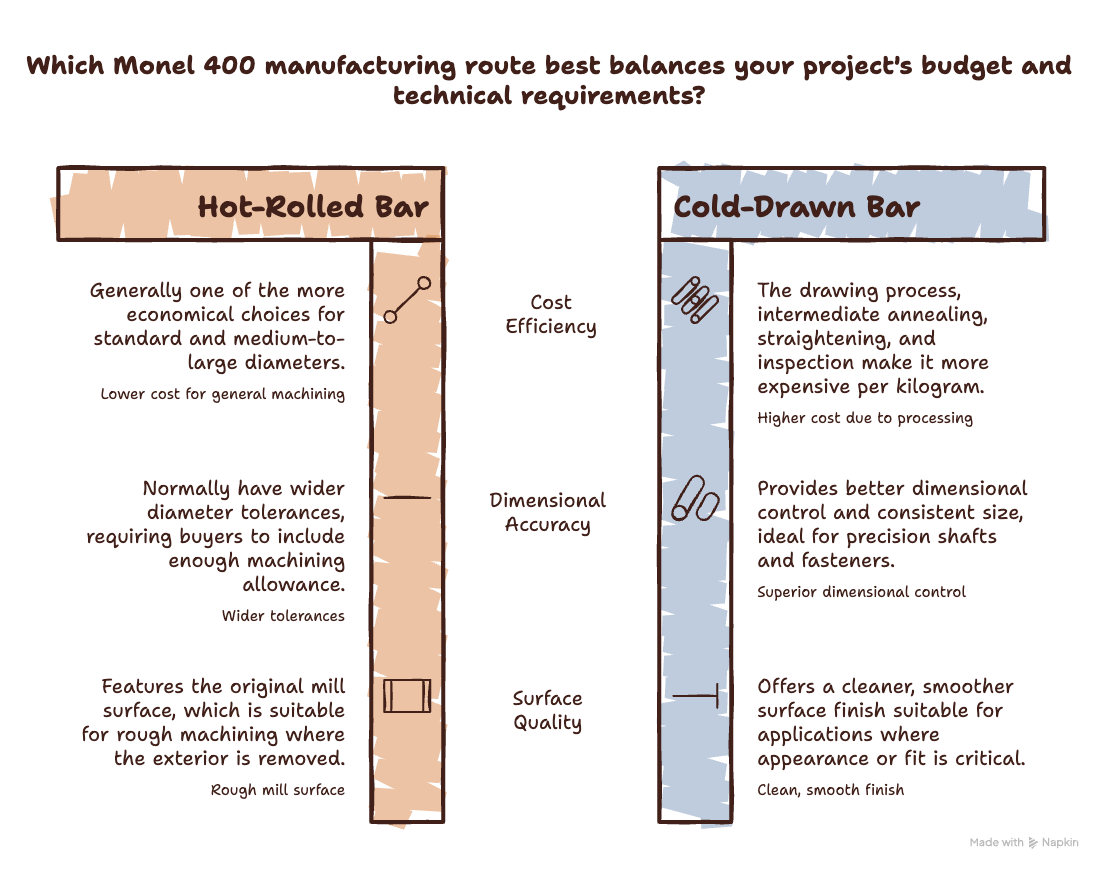
Hot-rolled bar is generally one of the more economical choices for standard and medium-to-large diameters. It is suitable for rough machining where the buyer can remove the original mill surface and machine the material to the final dimension.
Hot-rolled bars normally have wider diameter tolerances than ground or cold-drawn products. Buyers should include enough machining allowance when purchasing hot-rolled material.
Forged Monel 400 Bar
Forged bars are common for larger diameters, heavy components, and machining blanks. Forging can improve section availability and permit production of dimensions that are not practical by ordinary rolling.
Forged bar prices are normally higher because of heating, forging operations, dimensional allowance, surface scale, heat treatment, straightening, testing, and lower production efficiency for custom quantities.
Cold-Drawn Monel 400 Bar
Cold-drawn bars provide better dimensional control, a cleaner surface, and increased strength from cold work. They are commonly selected for smaller diameters, fastener stock, precision shafts, and machined components requiring more consistent size.
The drawing process, intermediate annealing, straightening, inspection, and lower production speed normally make cold-drawn bar more expensive per kilogram than standard hot-rolled bar.
Precision-Ground Monel 400 Bar
Precision-ground bars have controlled diameter tolerance, improved roundness, smoother surface, and better straightness. They reduce the amount of machining required by the customer but carry a higher material price because of centerless grinding, inspection, and lower material yield.
| Round Bar Condition | Relative Price | Typical Application |
|---|---|---|
| Hot rolled | Lower | General machining blanks and larger standard diameters. |
| Forged | Medium to high | Large shafts, heavy components, and custom machining stock. |
| Cold drawn | Medium to high | Small shafts, fastener stock, and controlled-diameter parts. |
| Peeled or turned | Higher than black bar | Machining stock requiring removal of the original mill surface. |
| Precision ground | High | Precision shafts, valve stems, pins, and close-tolerance components. |
ASTM B164 and Bar Pricing
ASTM B164 is a common specification for nickel-copper alloy rod, bar, and wire. If ASTM B164 compliance, certified mechanical properties, specific temper, or additional testing is required, the quotation may be higher than for basic commercial bar.
Monel 400 Plate and Sheet Price
Monel 400 plate and sheet are used for tanks, pressure components, heat exchangers, marine structures, evaporators, pickling equipment, chemical vessels, cladding, trays, and fabricated corrosion-resistant components. Their prices depend on thickness, width, length, flatness, rolling condition, surface finish, cutting, and applicable specification.
Monel 400 Plate Price
Standard plate normally costs less per kilogram than very thin precision sheet because thick plate requires fewer rolling reductions. However, extra-wide, extra-long, very thick, or specially tested plate may be expensive because of limited mill availability.
Custom-cut plates include additional cost for sawing, waterjet cutting, plasma cutting where technically suitable, machining, nesting loss, edge preparation, and inspection. Irregular shapes may create more scrap than rectangular cuts.
Monel 400 Sheet Price
Thin Monel 400 sheet usually requires cold rolling, controlled annealing, flatness correction, surface finishing, and careful packaging. As sheet thickness decreases, the number of production operations may increase, raising the price per kilogram.
Bright, polished, protective-film, or scratch-sensitive sheets cost more than standard mill-finish material. Small quantities cut from full sheets may also carry a higher unit price because the supplier must recover handling and offcut costs.
ASTM B127 Plate, Sheet, and Strip
ASTM B127 is a common specification for Monel 400 plate, sheet, and strip. Material ordered to this standard may require specified chemistry, mechanical properties, condition, dimensions, and testing. Buyers should identify whether they need hot-rolled plate, cold-rolled sheet, annealed material, or another defined condition.
| Flat Product Requirement | Effect on Price | Reason |
|---|---|---|
| Standard stock plate | More economical | Limited additional processing is required. |
| Thin cold-rolled sheet | Higher per kilogram | More rolling passes and tighter thickness control are required. |
| Extra-wide plate | Higher | Mill availability and production yield may be limited. |
| Precision flatness | Higher | Additional leveling and inspection may be needed. |
| Polished surface | Higher | Grinding, polishing, cleaning, and protective packaging add cost. |
| Custom-cut shape | Higher effective cost | Cutting time, programming, scrap, and edge finishing must be included. |
Monel 400 Pipe and Tube Price
Monel 400 pipe and tube are commonly used in marine systems, heat exchangers, chemical-processing equipment, brine heaters, acid handling, offshore installations, and hydrocarbon-processing systems. Pipe and tube prices can be significantly higher than bar or plate because tubular products require additional manufacturing and testing.
Seamless Monel 400 Pipe and Tube
Seamless tubular products may require extrusion, piercing, cold drawing, annealing, pickling, straightening, dimensional inspection, and nondestructive testing. The cost rises when the tube has a small diameter, thin wall, long length, or tight ovality and wall-thickness tolerances.
Welded Monel 400 Pipe and Tube
Welded pipe and tube are manufactured from plate or strip. The cost depends on input material, forming, welding, heat treatment, weld inspection, dimensional control, and final testing. Welded construction may be more economical for larger diameters and certain quantities, provided it is accepted by the design standard.
Testing Cost for Tubular Products
Tube orders may require hydrostatic testing, pneumatic testing, eddy-current testing, ultrasonic testing, flattening tests, flaring tests, leak tests, or weld radiography. These requirements add both direct inspection cost and production time.
| Pipe or Tube Factor | Price Effect | Buyer Note |
|---|---|---|
| Seamless construction | Usually higher | Selected for demanding pressure, corrosion, or reliability requirements. |
| Welded construction | Potentially more economical | Must be accepted by the design and purchasing specification. |
| Thin wall | Higher | More difficult forming, drawing, and dimensional control may be required. |
| Special outside diameter | Higher or subject to MOQ | Nonstandard tooling or a dedicated production campaign may be needed. |
| Long fixed length | Higher logistics cost | Production yield, straightness, packaging, and freight become more difficult. |
| Additional NDT | Higher | Testing equipment, inspection time, and documentation add cost. |
Relevant Pipe and Tube Specifications
ASTM B165 is commonly referenced for seamless Monel 400 pipe and tube. ASTM B725 and ASTM B730 may be relevant for welded nickel-copper pipe and tube products. The exact standard should be stated in the inquiry because pressure class, dimensions, inspection, and acceptance requirements affect price.
Monel 400 Wire, Strip, and Forging Price
Monel 400 Wire Price
Monel 400 wire is used for mesh, springs with suitable condition, fasteners, welding-related applications, marine components, electrical parts, and specialty fabrication. Wire price depends on diameter, coil weight, temper, surface, straightness, and whether it is supplied in coils or straight cut lengths.
Fine wire normally costs more per kilogram because it requires more drawing passes, intermediate annealing, tighter diameter control, and careful coil handling. Straightened and cut wire also includes straightening, cutting, counting, and packaging costs.
Monel 400 Strip Price
Strip is produced by cold rolling and slitting. Price depends on thickness, width, coil weight, edge condition, flatness, surface finish, and temper. Narrow strip with tight width tolerance can be expensive because slitting creates edge scrap and requires additional inspection.
Monel 400 Forging Price
Monel 400 forgings may include rings, discs, blocks, shafts, flanges, fittings, and custom shapes. Forging prices are normally calculated from the required finished dimensions, starting billet weight, forging ratio, machining allowance, heat treatment, testing, and production quantity.
The price per kilogram of a rough forging may not represent the effective cost of the final component. A finished part weighing 50 kg may require a starting billet weighing substantially more. The customer may pay for material that becomes scale, flash, test samples, machining chips, and process scrap.
| Product | Main Price Drivers | Common Buying Risk |
|---|---|---|
| Fine wire | Drawing passes, diameter tolerance, coil quality, annealing | Comparing coarse-wire prices with fine-wire requirements. |
| Narrow strip | Slitting loss, width tolerance, edge quality, temper | Ignoring minimum coil weight or slitting MOQ. |
| Forged ring | Starting weight, OD, ID, height, forging ratio, UT | Comparing finished weight with input material weight. |
| Custom block | Billet availability, forging, heat treatment, machining allowance | Failing to specify the final machining drawing. |
How Size, Thickness, Diameter, and Tolerance Affect Price
Standard stock dimensions generally provide the best balance of price and delivery time. Special sizes may require new rolling, forging, drawing, tube tooling, or extensive machining. The price impact depends not only on whether the dimension is large or small, but also on how efficiently it can be manufactured.
Small Diameters
Small bar and wire diameters may require cold drawing and multiple reductions. This increases processing cost. Small seamless tubes with thin walls are also difficult to produce and inspect, resulting in higher prices.
Large Diameters
Large Monel 400 bars may require forging rather than rolling. Forged bars need heating, deformation, surface conditioning, heat treatment, straightening, and ultrasonic testing when specified. Their effective cost can be much higher than common rolled diameters.
Thin Sheet and Strip
Thin products require additional cold rolling and thickness control. Very thin strip may also need precision slitting, edge treatment, protective interleaving, and special coil packaging.
Tight Dimensional Tolerances
Tight tolerance reduces manufacturing yield. A supplier may need to select oversized stock and remove material by turning or grinding. More inspection points and possible rework also increase cost.
| Dimensional Requirement | Relative Price Effect | Recommended Approach |
|---|---|---|
| Standard stock diameter | Lower | Use stock size with machining allowance where possible. |
| Nonstandard diameter | Higher | Ask whether a nearby standard size can be machined. |
| Very thin sheet | Higher per kilogram | Confirm whether strip or coil supply is more economical. |
| Extra-thick plate | Higher | Check plate availability against a forged block alternative. |
| Precision-ground bar | Higher | Compare reduced customer machining time with the material premium. |
| Custom fixed length | Additional cutting cost | Provide length tolerance and acceptable saw marks. |
Hot Rolled, Cold Drawn, Forged, and Annealed Price Differences
The manufacturing and delivery condition of Monel 400 affects price because each condition requires a different number of production steps. Monel 400 cannot be age hardened, but its strength and hardness can be increased through cold work.
Hot-Rolled Material
Hot-rolled bar and plate are generally economical for machining and fabrication. Their surface may contain scale, and dimensional tolerances are wider than those of cold-finished products. They are appropriate when the customer will perform substantial machining or surface removal.
Cold-Drawn Material
Cold-drawn bar, rod, wire, and tube provide better dimensions and increased strength. The process adds drawing, lubrication, intermediate annealing where needed, straightening, and inspection. The resulting price is normally higher.
Forged Material
Forging is used for large sections and custom shapes. The supplier must consider starting stock, furnace time, press or hammer operations, scale loss, machining allowance, testing, and low-volume setup costs.
Annealed Material
Annealing improves ductility and reduces hardness after cold work. The price includes furnace time, atmosphere control, cooling, descaling, pickling, and inspection. Annealed material may still be more economical overall if it improves forming or machining performance for the customer.
| Condition | Typical Price Level | Main Advantage |
|---|---|---|
| Hot rolled | Lower | Economical for general fabrication and machining stock. |
| Annealed | Low to medium | Improved ductility and formability. |
| Cold drawn | Medium to high | Better size control and higher cold-worked strength. |
| Forged | Medium to high | Available in large sections and custom shapes. |
| Peeled or turned | Higher | Cleaner surface and controlled machining stock. |
| Precision ground | High | Tight tolerance, smooth surface, and improved straightness. |
Quantity, MOQ, Stock Availability, and Lead Time Impact
Small-Quantity Orders
Small orders normally have a higher price per kilogram because suppliers must recover the cost of cutting, handling, inspection, certification, packaging, export documents, and inventory disruption. A two-kilogram order can require nearly the same administrative work as a much larger order.
Large-Quantity Orders
Larger orders may receive better unit pricing because the supplier can purchase directly from a mill, optimize production, reduce handling per kilogram, and use full sheets, bars, or coils efficiently. The advantage depends on whether the requested product is a standard mill item.
Minimum Order Quantity
Standard stock material may be available in small quantities. Custom rolling, tube production, wire drawing, strip slitting, and forging usually require a minimum order quantity or minimum production charge.
Even when a supplier accepts less than the production MOQ, the buyer may effectively pay for the complete production minimum. For this reason, asking for a nearby stock size can be more economical than ordering a special dimension.
Stock Availability
Stock material can normally be delivered faster after cutting, inspection, and packaging. However, Monel 400 is not stocked as widely as stainless steel. Large diameters, unusual wall thicknesses, extra-wide plates, and precision strip may require new production.
Lead Time
Lead time may include mill production, heat treatment, cold drawing, forging, machining, testing, third-party inspection, packaging, export documentation, and transportation. Urgent requirements can increase the total cost if air freight, priority processing, or premium stock sourcing is necessary.
| Order Situation | Price Impact | Lead-Time Impact |
|---|---|---|
| Small stock order | Higher unit price | Short if material and certificates are available. |
| Full stock length or sheet | Usually more economical | Shorter because less cutting is required. |
| Large standard order | Better unit price may be available | Depends on stock and mill scheduling. |
| Custom production | Higher setup and MOQ cost | Longer because manufacturing is required. |
| Urgent air shipment | Higher total landed cost | Shorter transportation time. |
| Third-party inspection | Additional inspection cost | Extra scheduling and document-review time. |
Testing, Certification, Cutting, and Machining Cost
Testing and processing can create a significant difference between the raw material price and the final quotation. These costs should be included before the order is placed.
Material Test Certificate
A standard material test certificate should identify the grade, heat number, chemical composition, product form, dimensions, condition, applicable standard, and mechanical properties when required. Buyers should confirm whether the quotation includes an EN 10204 3.1 certificate or another specified document type.
Positive Material Identification
PMI testing helps confirm that the delivered material matches the required nickel-copper alloy. It is useful when suppliers handle multiple nickel alloys that may have a similar appearance.
Mechanical Testing
Tensile testing, yield strength, elongation, hardness, flattening, flaring, and other tests may be required by the product standard or customer specification. Additional test samples and laboratory work increase the quotation.
Nondestructive Testing
Ultrasonic testing may be required for large bars, forgings, and thick plates. Eddy-current testing may be required for tubes. Dye-penetrant testing, radiography, hydrostatic testing, and other inspection methods may also be specified.
Cutting Cost
Cutting cost depends on section size, quantity, cutting method, tolerance, and material hardness. The quotation may also include saw loss and unusable remnants. A large number of short pieces often costs more to process than a few long lengths.
Machining Cost
Monel 400 work-hardens during machining. It generally requires rigid equipment, sharp tools, suitable cutting parameters, and effective cooling. Tool wear and machining time can be higher than for carbon steel or common stainless steel.
When buying finished parts, customers should provide a complete drawing showing dimensions, tolerances, threads, surface roughness, inspection requirements, and quantities. A price per kilogram is not sufficient for machined products.
| Additional Requirement | Cost Effect | Information Needed |
|---|---|---|
| EN 10204 3.1 MTC | Usually included or subject to supplier policy | Required document type and language. |
| PMI report | Additional | Number of pieces or percentage to be tested. |
| Ultrasonic testing | Additional | Acceptance standard and test class. |
| Third-party inspection | Additional | Inspection company, scope, witness points, and report format. |
| Cut-to-length service | Additional | Length, tolerance, quantity, and end condition. |
| CNC machining | Quoted by drawing | Drawing, tolerances, surface roughness, and inspection plan. |
Monel 400 Price Compared with Monel K-500 and Inconel 625
Monel 400 is frequently compared with Monel K-500 and Inconel 625. These materials overlap in some applications, but they have different compositions, mechanical properties, heat treatments, corrosion behavior, availability, and price structures.
Monel 400 vs Monel K-500 Price
Monel K-500 contains aluminum and titanium and can be age hardened. It provides substantially higher strength and hardness than Monel 400 while retaining broadly similar nickel-copper corrosion resistance.
Monel K-500 is normally more expensive because its composition is more complex, its production volume may be lower, and it requires solution treatment and age hardening to develop final properties. Mechanical testing and hardness control may also be more demanding.
Monel 400 is generally the more economical choice when corrosion resistance, toughness, fabrication, and moderate strength are sufficient. Monel K-500 is selected when the component requires higher strength, fatigue resistance, or hardness.
Monel 400 vs Inconel 625 Price
Inconel 625 is a nickel-chromium-molybdenum-niobium alloy. It provides strong resistance to chloride pitting, crevice corrosion, seawater, and many aggressive chemical environments. Its molybdenum and niobium content also provides high solid-solution strength.
Inconel 625 may cost more than Monel 400 when molybdenum, niobium, certification, and production costs are high. However, there is no universal price ranking. Product form, quantity, origin, size, and stock availability can cause a Monel 400 quotation to be higher than a particular Inconel 625 offer.
Material selection should not be based on price alone. Monel 400 can be a strong choice for hydrofluoric acid under suitable conditions, reducing environments, alkalis, seawater, and marine components. Inconel 625 is often selected for severe chloride exposure, offshore equipment, chemical processing, and applications requiring greater strength.
| Material | Main Alloy System | General Price Position | Primary Selection Reason |
|---|---|---|---|
| Monel 400 | Nickel-Copper | Baseline for comparison | Marine corrosion resistance, reducing environments, alkalis, toughness, and fabrication. |
| Monel K-500 | Nickel-Copper-Aluminum-Titanium | Usually higher than Monel 400 | Higher strength and hardness with broadly similar corrosion resistance. |
| Inconel 625 | Nickel-Chromium-Molybdenum-Niobium | Often similar to or higher than Monel 400 | Severe chloride corrosion resistance, high strength, and broad chemical resistance. |
Which Material Offers Better Value?
The material offering the lowest purchase price is not always the lowest-cost solution over the equipment life. If a lower-priced alloy corrodes, cracks, loses strength, or requires frequent replacement, the maintenance and shutdown cost can exceed the initial material saving.
Engineers should compare operating medium, concentration, temperature, flow velocity, mechanical load, expected life, fabrication method, inspection requirements, and replacement difficulty before selecting Monel 400, Monel K-500, or Inconel 625.
How to Get an Accurate Monel 400 Quotation
An accurate quotation requires more information than the words “Monel 400 price.” The supplier must know the exact material, product form, standard, dimensions, quantity, condition, tolerance, testing, processing, and destination.
Information Required for Quotation
| Inquiry Item | Example | Why It Matters |
|---|---|---|
| Grade | Monel 400 / Alloy 400 / UNS N04400 / W.Nr. 2.4360 | Confirms the correct nickel-copper alloy. |
| Product form | Round bar, plate, sheet, pipe, tube, wire, strip, forging | Determines the production process and applicable standard. |
| Standard | ASTM B164, ASTM B127, ASTM B165, ASTM B725, ASTM B730 | Defines technical, testing, and acceptance requirements. |
| Size | Diameter, thickness, width, length, OD, wall thickness, ID | Determines stock availability and manufacturing route. |
| Quantity | Kilograms, pieces, meters, sheets, coils, or total order weight | Affects price per kilogram, MOQ, and lead time. |
| Condition | Hot rolled, annealed, cold drawn, forged, stress relieved, ground | Affects mechanical properties, tolerance, and cost. |
| Surface finish | Black, pickled, peeled, polished, bright, ground | Determines additional processing requirements. |
| Tolerance | Standard mill tolerance, h7 diameter, special flatness, fixed length | Tight tolerances require extra finishing and inspection. |
| Testing | MTC, PMI, tensile test, hardness, UT, eddy current, third-party inspection | Testing cost must be included before the final quotation. |
| Application | Marine shaft, heat exchanger, acid piping, valve stem, pump component | Helps confirm whether Monel 400 is technically suitable. |
| Delivery destination | Country, postal code, seaport, airport, or factory address | Required for packing, freight, insurance, and trade-term calculation. |
| Trade term | EXW, FOB, CIF, CFR, DAP, or DDP | Determines which logistics and import costs are included. |
Example of a Complete Monel 400 Inquiry
A professional inquiry may read: “Please quote Monel 400 round bar, UNS N04400, ASTM B164, diameter 50 mm, length 3000 mm, annealed and peeled surface, quantity 1,000 kg, with EN 10204 3.1 MTC, PMI report, and ultrasonic testing, cut into fixed lengths and packed for sea freight to Hamburg, Germany.”
This information allows the supplier to check stock, confirm the standard, calculate material utilization, include cutting and testing costs, select packaging, and provide a realistic lead time.
Quotation Validity
Because nickel, copper, currency exchange rates, freight, and alloy surcharges can change, Monel 400 quotations often have a limited validity period. Buyers should confirm whether the price is fixed after purchase-order acceptance and whether any alloy surcharge remains adjustable.
How to Compare Monel 400 Supplier Quotations
Two quotations should be compared line by line. A lower price may exclude testing, certificate, cutting, packaging, or freight. It may also apply to a different product condition or standard.
| Comparison Point | What to Check | Common Difference Between Offers |
|---|---|---|
| Grade | UNS N04400 and heat-number traceability | Commercial material versus fully certified material. |
| Standard | ASTM, ASME, AMS, EN, DIN, or customer specification | Different testing and mechanical-property requirements. |
| Condition | Annealed, hot rolled, cold drawn, forged, or ground | Different strength, tolerance, and processing cost. |
| Size tolerance | Mill tolerance or precision finished tolerance | Significant difference in machining and finishing cost. |
| Inspection | MTC, PMI, UT, mechanical testing, third-party inspection | May be included, optional, or excluded. |
| Quantity basis | Net ordered weight or actual shipping weight | Cutting loss and excess mill tolerance may affect invoiced weight. |
| Delivery term | EXW, FOB, CIF, DAP, or DDP | Freight, insurance, duty, and local delivery may differ. |
| Lead time | Ready stock, production stock, or mill production | A low price may come with a much longer delivery period. |
Check Whether the Material Is Genuine Monel 400
Nickel alloys can look similar. Buyers should request clear grade marking, heat number, material test certificate, and PMI testing when appropriate. A very low price may indicate that the offer does not include the specified certification, condition, or alloy grade.
Check the Total Landed Cost
The total landed cost can include raw material, cutting, machining, testing, packing, inland transport, export handling, sea or air freight, insurance, customs duty, tax, bank charges, and local delivery. Comparing ex-works price with a delivered price can lead to an incorrect purchasing decision.
Monel 400 Packaging and Export Cost
Packaging requirements depend on product form, surface finish, length, weight, transportation method, and customer handling equipment. Export packing should protect the material from impact, bending, scratching, contamination, moisture, and material mix-up.
| Product Form | Common Packaging | Main Protection Requirement |
|---|---|---|
| Round bar | Bundles, waterproof wrapping, wooden cases, skids | Prevent bending, surface damage, and loss of identification. |
| Plate and sheet | Waterproof paper, protective film, wooden pallets, edge guards | Protect flatness, surfaces, and plate edges. |
| Pipe and tube | Bundles, end caps, separators, wooden cases | Protect tube ends, straightness, and internal cleanliness. |
| Wire and strip | Coils, spools, moisture protection, inner-core support | Prevent coil collapse, edge damage, and contamination. |
| Forgings and machined parts | Individual wrapping, separators, custom wooden cases | Protect machined surfaces, threads, dimensions, and traceability. |
Heavy wooden cases, seaworthy packaging, fumigation-compliant wooden materials, special lifting points, moisture barriers, and individual part protection increase cost. These requirements should be included in the original inquiry when the customer needs a delivered quotation.
Monel 400 Price Related Questions
How much is Monel 400 per kg?
Standard commercial Monel 400 bar, plate, and sheet are often discussed in a broad reference range of approximately USD 30 to USD 60 per kg. Seamless tubes, thin strip, precision wire, certified forgings, tight-tolerance bars, small quantities, and machined parts may be higher. The final price depends on nickel and copper markets, product form, size, quantity, condition, testing, stock availability, and delivery terms.
Why is Monel 400 so expensive?
Monel 400 is expensive because it contains at least about 63% nickel and approximately 28% to 34% copper. It also requires specialized melting, rolling, forging, tube production, testing, inventory, and machining. Small production volumes, rapid work hardening during machining, certification requirements, and limited stock sizes can further increase the final cost.
Is Monel 400 cheaper than Monel K-500?
Monel 400 is usually cheaper than Monel K-500 when product form, size, quantity, and certification are comparable. Monel K-500 contains aluminum and titanium and requires controlled heat treatment to develop higher strength and hardness. However, actual quotations can vary with stock availability, dimensions, testing, origin, and order quantity, so both materials should be quoted using the same commercial conditions.


 English
  Korean
  Japanese
  Arabic
  Spanish
  German
  Portuguese
  French
  Russian
  Italian