

Rene 41 material properties are mainly defined by high-temperature strength, precipitation hardening response, oxidation resistance, creep resistance, stress-rupture performance, and nickel-based superalloy stability. Rene 41, also known as R-41, UNS N07041, W.Nr. 2.4973, HAYNES R-41, or UDIMET R41, is a nickel-chromium-cobalt-molybdenum superalloy designed for severely stressed high-temperature service. It is widely used in aircraft engine parts, turbine components, combustion chamber hardware, afterburner parts, fasteners, rings, structural hardware, and other components that must maintain strength at elevated temperature. This article explains what Rene 41 material is, its grade identification, chemical composition, tensile strength, yield strength, hardness, oxidation resistance, corrosion resistance, creep resistance, heat treatment, physical properties, fabrication behavior, welding and machining properties, applications, and comparison with Inconel 718, Waspaloy, and Nimonic alloys.
What Is Rene 41 Material?
Rene 41 is a precipitation-hardenable nickel-based superalloy developed for high-strength service at elevated temperatures. It belongs to the nickel-chromium alloy family, but it also contains significant cobalt, molybdenum, titanium, and aluminum. These elements give Rene 41 its high strength, creep resistance, oxidation resistance, and age-hardening capability.
The main answer to the title is clear: Rene 41 material properties are strongest in high-temperature mechanical performance. It offers high tensile strength, high yield strength, good oxidation resistance, good stress-rupture strength, and useful corrosion resistance in hot gas environments. However, it is also more difficult to form, weld, and machine than many general nickel alloys. Therefore, Rene 41 should be selected when the application really needs its high-temperature strength, not simply because it is a nickel alloy.
Material Type
Rene 41 is an age-hardening nickel superalloy. Its strength is developed by solution annealing followed by aging treatment. During aging, strengthening precipitates form in the nickel matrix, giving the alloy much higher strength than ordinary solid-solution nickel alloys.
Why Rene 41 Is Used
Rene 41 is used where stainless steel, Inconel 600, Inconel 625, or even Inconel 718 may not provide enough high-temperature strength or stress-rupture performance. It is especially suitable for aircraft engine and gas turbine components exposed to high temperature, mechanical load, oxidation, and hot combustion gases.
Rene 41 UNS N07041 / W.Nr. 2.4973 Grade Identification
Rene 41 may appear under several names in drawings, specifications, quotations, and material certificates. Correct grade identification is important because Rene 41 is often compared with other high-temperature alloys such as Inconel 718, Waspaloy, Nimonic 90, and Nimonic 263.
| Name / Designation | Meaning | Procurement Note |
| Rene 41 | Common commercial name | Widely used in aerospace and high-temperature alloy markets. |
| R-41 | Short commercial name | Often used in datasheets and supplier inventory lists. |
| UNS N07041 | Unified Numbering System designation | Important for international material identification and certificates. |
| W.Nr. 2.4973 | European / German material reference | May appear in European drawings and cross-reference tables. |
| HAYNES R-41 | Commercial alloy name | Used in high-temperature alloy datasheets and product references. |
| UDIMET R41 | Commercial alloy name | Often used in material technical bulletins and aerospace references. |
Why Grade Identification Matters
Rene 41 should not be replaced by another nickel alloy based only on similar temperature ratings. Inconel 718, Waspaloy, Nimonic 90, and Nimonic 263 are all high-performance nickel alloys, but their chemistry, heat treatment, creep strength, weldability, machinability, and approved specifications are different. If a drawing specifies UNS N07041 or AMS 5712 / AMS 5713, the supplier should provide Rene 41 material that meets the required condition and standard.
Rene 41 Chemical Composition
The chemical composition of Rene 41 is the foundation of its material properties. Nickel forms the base matrix. Chromium improves oxidation and hot corrosion resistance. Cobalt and molybdenum improve high-temperature strength. Titanium and aluminum support precipitation hardening. Boron and carbon affect grain boundary behavior and creep performance.
| Element | Typical Range | Function in Rene 41 |
| Nickel (Ni) | Balance | Provides the base matrix, high-temperature stability, and corrosion resistance. |
| Chromium (Cr) | 18.00% – 20.00% | Improves oxidation resistance and resistance to hot combustion gases. |
| Cobalt (Co) | 10.00% – 12.00% | Improves high-temperature strength and phase stability. |
| Molybdenum (Mo) | 9.00% – 10.50% | Provides solid-solution strengthening and improves elevated-temperature strength. |
| Titanium (Ti) | 3.00% – 3.30% | Works with aluminum to form strengthening precipitates during aging. |
| Aluminum (Al) | 1.40% – 1.80% | Supports gamma-prime precipitation hardening and oxidation resistance. |
| Iron (Fe) | Max. 5.00% | Controlled element in the alloy system. |
| Carbon (C) | Max. 0.12% | Supports carbide formation and grain boundary behavior. |
| Boron (B) | 0.003% – 0.010% | Improves grain boundary strength and stress-rupture performance. |
| Manganese (Mn) | Max. 0.10% | Controlled minor element. |
| Silicon (Si) | Max. 0.20% – 0.50% | Controlled to maintain alloy cleanliness and processing quality. |
How the Composition Controls Properties
Rene 41 gets its high-temperature strength from a combination of solid-solution strengthening and precipitation hardening. Molybdenum and cobalt strengthen the nickel matrix. Titanium and aluminum form gamma-prime strengthening phases after aging. Chromium supports oxidation resistance, while boron and carbon help improve grain boundary strength under long-term elevated-temperature stress.
Composition Must Match the Certificate
For Rene 41 material, chemical composition should always be verified by the material test certificate. Small variations in titanium, aluminum, boron, carbon, and molybdenum can influence heat treatment response, creep behavior, ductility, weldability, and final mechanical properties.
Key Material Properties of Rene 41
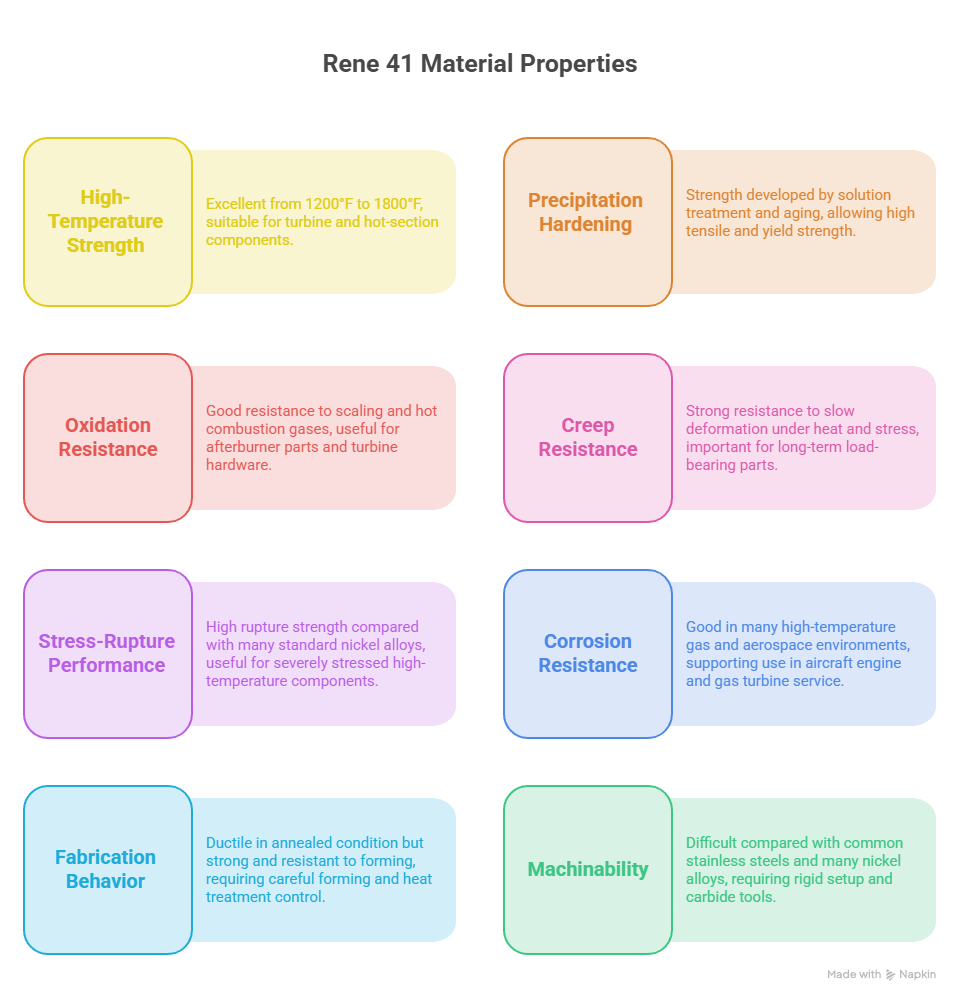
The key material properties of Rene 41 include high room-temperature strength, excellent elevated-temperature strength, good oxidation resistance, useful corrosion resistance, strong creep resistance, stress-rupture strength, and age-hardening capability. These properties make the alloy suitable for severe aerospace and gas turbine applications.
| Property | Rene 41 Performance | Practical Meaning |
| High-temperature strength | Excellent from about 1200°F to 1800°F depending on condition and design. | Suitable for turbine and hot-section components. |
| Precipitation hardening | Strength is developed by solution treatment and aging. | Allows high tensile and yield strength after proper heat treatment. |
| Oxidation resistance | Good resistance to scaling and hot combustion gases. | Useful for afterburner parts, liners, and turbine hardware. |
| Creep resistance | Strong resistance to slow deformation under heat and stress. | Important for long-term high-temperature load-bearing parts. |
| Stress-rupture performance | High rupture strength compared with many standard nickel alloys. | Useful for severely stressed high-temperature components. |
| Corrosion resistance | Good in many high-temperature gas and aerospace environments. | Supports use in aircraft engine and gas turbine service. |
| Fabrication behavior | Ductile in annealed condition but strong and resistant to forming. | Requires careful forming and heat treatment control. |
| Machinability | Difficult compared with common stainless steels and many nickel alloys. | Requires rigid setup, carbide tools, and controlled machining practice. |
Most Important Property
The most important Rene 41 material property is high strength at elevated temperature. This is the main reason the alloy is selected for hot-section aerospace and gas turbine components rather than ordinary industrial parts.
High-Temperature Strength of Rene 41
Rene 41 is designed for high-temperature strength. It can maintain useful mechanical strength in the approximate 1200°F to 1800°F range, depending on heat treatment, section size, stress level, exposure time, and design requirement. This makes it different from many corrosion-focused nickel alloys that may resist corrosion but cannot provide the same high-temperature load-bearing capability.
Why Rene 41 Maintains Strength at High Temperature
The high-temperature strength of Rene 41 comes from its precipitation-hardened nickel matrix. Titanium and aluminum form gamma-prime strengthening precipitates. Molybdenum and cobalt strengthen the matrix. Boron and carbon help grain boundary strength. Together, these features allow the alloy to resist deformation under heat and load.
High-Temperature Strength Is Heat Treatment Dependent
Rene 41 mechanical properties are not fixed for all conditions. The solution treatment temperature and aging cycle strongly affect room-temperature strength, elevated-temperature strength, ductility, and stress-rupture performance. Higher solution treatment temperatures may improve ductility and stress-rupture strength, while lower solution treatment temperatures may produce higher tensile strength at certain temperatures.
Rene 41 Tensile Strength and Yield Strength
Rene 41 tensile strength and yield strength vary by product form, heat treatment, testing temperature, and specification. In solution annealed condition, the alloy has good ductility and formability compared with its aged condition. After aging, strength increases significantly, but ductility and fabrication behavior may become more limited.
Typical Tensile Property Reference
| Condition / Temperature | 0.2% Yield Strength | Ultimate Tensile Strength | Elongation |
| Solution annealed sheet, room temperature | About 581 MPa | About 1021 MPa | About 44.7% |
| Solution annealed plate, room temperature | About 696 MPa | About 1344 MPa | About 38.8% |
| Age hardened, room temperature | About 805 MPa to above 1000 MPa depending on heat treatment | About 1230 MPa to above 1400 MPa depending on heat treatment | Lower than annealed condition |
| Age hardened, 1200°F / 649°C | High retained yield strength | High retained tensile strength | Useful elevated-temperature ductility |
| Age hardened, 1600°F / 871°C | Reduced but still useful strength | Reduced but still useful strength | Material remains suitable for selected hot-section design |
How to Use Tensile Data
The values above should be used as reference data only. Actual procurement should follow the required standard, heat treatment condition, product form, thickness, diameter, and material test certificate. Aerospace and turbine applications usually require specific AMS or customer specifications rather than general catalog values.
Rene 41 Hardness and Age-Hardened Properties
Rene 41 hardness depends strongly on heat treatment. In solution annealed condition, the alloy is softer and more ductile. After precipitation hardening, hardness increases and the alloy develops the high strength needed for severe service.
Solution Annealed Hardness
Solution annealed Rene 41 may show hardness around Rockwell B high range for sheet or around Rockwell C low range for heavier plate, depending on product form and cooling rate. Large sections may not cool as rapidly as thin sections, so hardness and microstructure can vary.
Age-Hardened Hardness
After aging treatment, Rene 41 can reach approximately Rockwell C 40 to 45 in many reference conditions. This higher hardness is related to the precipitation of strengthening phases. The increased hardness supports high strength but also affects machining and forming behavior.
| Condition | Typical Hardness Behavior | Practical Meaning |
| Solution annealed | Lower hardness, better ductility | Better for forming, welding preparation, and some machining operations. |
| Partially aged | Intermediate hardness | May be useful for selected machining and processing routes. |
| Fully aged | Higher hardness, often around HRC 40-45 | Provides high strength but makes machining more difficult. |
Hardness Is Not the Only Acceptance Item
Hardness can help verify heat treatment condition, but it should not replace tensile testing, yield strength verification, stress-rupture testing, or specification compliance when these are required by the project. For critical parts, hardness should be treated as one inspection item among several.
Rene 41 Oxidation Resistance
Rene 41 has good oxidation resistance at elevated temperatures. Chromium is the main element supporting oxide scale formation, while aluminum also contributes to oxidation behavior. This makes Rene 41 suitable for hot gas environments, jet engine parts, afterburner components, combustion chamber liners, and turbine hardware.
Oxidation in Hot Gas Environments
In turbine and aerospace service, components are exposed to high-temperature combustion gases. Rene 41 resists oxidation and scaling better than many ordinary steels and standard heat-resistant alloys. This helps preserve section thickness and reduces surface degradation during high-temperature exposure.
Oxidation Resistance and Strength Work Together
Oxidation resistance alone is not enough for hot-section components. A material must also resist stress, creep, and fatigue. Rene 41 is valuable because it combines oxidation resistance with high-temperature mechanical strength. This is why it is used in severely stressed high-temperature applications rather than only as a heat shield material.
Rene 41 Corrosion Resistance
Rene 41 provides good corrosion resistance in many high-temperature and aerospace environments. It is especially known for resistance to hot combustion gases and oxidation-related attack. However, it should not be treated as a universal corrosion alloy for all chemical environments.
High-Temperature Corrosion Resistance
In aircraft engines and gas turbines, corrosion often involves hot gases, oxidation, fuel impurities, and thermal cycling. Rene 41 provides useful resistance in these conditions, especially when combined with its high strength.
Not a Substitute for Chemical Corrosion Alloys
If the main application is severe acid corrosion, chloride pitting, seawater corrosion, or chemical processing at moderate temperature, other alloys may be more suitable. For example, Hastelloy C-276, Alloy 625, Alloy 400, or other corrosion-focused nickel alloys may be better depending on the environment. Rene 41 is primarily a high-temperature strength alloy, not a general acid-corrosion alloy.
| Environment | Rene 41 Suitability | Selection Note |
| Jet engine combustion gases | Good suitability | One of the important service areas for Rene 41. |
| High-temperature oxidizing gases | Good suitability | Chromium and aluminum support oxidation resistance. |
| Severely stressed hot-section parts | Strong suitability | High strength and stress-rupture performance are important. |
| Strong acid chemical processing | Requires careful review | Corrosion-focused alloys may be more suitable. |
| Seawater service | Not normally the first choice | Alloy 625 or Alloy 400 may be reviewed depending on conditions. |
Rene 41 Creep Resistance and Stress-Rupture Performance
Creep resistance and stress-rupture performance are among the most important Rene 41 material properties. Creep is slow deformation under long-term exposure to high temperature and stress. Stress rupture describes failure after sustained stress at elevated temperature. Rene 41 is designed to resist these failure modes better than many standard nickel alloys.
Why Creep Resistance Matters
In turbine wheels, hot fasteners, engine structures, afterburner components, and high-temperature rings, deformation can cause clearance loss, vibration, cracking, leakage, or catastrophic failure. Rene 41 helps reduce these risks by maintaining high strength and resisting deformation under thermal load.
1000-Hour Rupture Strength
Reference data for precipitation-hardened Rene 41 shows strong rupture strength across elevated temperatures. As temperature increases, rupture strength decreases, but Rene 41 still offers useful performance in severe high-temperature service. This is one reason the alloy is selected for parts that must survive long exposure under heat and stress.
| Temperature | Typical 1000-Hour Rupture Strength Reference | Design Meaning |
| 1200°F / 649°C | About 102 ksi / 705 MPa | Strong long-term load resistance at elevated temperature. |
| 1300°F / 704°C | About 80 ksi / 550 MPa | Useful for hot-section components under sustained stress. |
| 1400°F / 760°C | About 50 ksi / 345 MPa | Stress-rupture design becomes increasingly important. |
| 1500°F / 816°C | About 29 ksi / 200 MPa | Material still useful, but design stress must be reduced. |
| 1600°F / 871°C | About 17 ksi / 117 MPa | Long-term high-temperature service requires careful engineering review. |
| 1700°F / 927°C | About 11 ksi / 76 MPa | Used only where design limits and service life support the selection. |
Stress-Rupture Data Must Be Used Carefully
Stress-rupture values depend on heat treatment, product form, grain size, section size, temperature, atmosphere, and test method. For real parts, engineers should use approved design data and project specifications rather than only general reference values.
Rene 41 Heat Treatment and Aging Conditions
Heat treatment is critical for Rene 41 material properties. The alloy is normally solution annealed and then age hardened to develop its final strength. The selected heat treatment controls tensile strength, ductility, creep resistance, stress-rupture performance, hardness, and fabrication behavior.
Solution Annealing
Solution annealing is used to create a suitable microstructure before aging. Common solution treatment ranges are around 1950°F to 2150°F, depending on the required property balance, section size, and specification. Rapid cooling or water quenching may be used to obtain suitable properties.
Aging Treatment
After solution treatment, Rene 41 is aged to precipitate strengthening phases. A common aging practice is around 1400°F / 760°C for 16 hours followed by air cooling, though other commercial age-hardening treatments may be used depending on the required specification and final application.
Heat Treatment Effect on Properties
Different solution temperatures create different property balances. Higher solution treatment temperatures may improve room-temperature ductility and stress-rupture performance. Lower solution temperatures may improve tensile strength up to certain elevated temperatures. This is why the correct heat treatment should be selected according to service requirement rather than using one fixed process for every part.
| Heat Treatment Stage | Typical Purpose | Effect on Rene 41 Properties |
| Solution annealing | Prepares microstructure before aging | Improves ductility, resets structure, and supports later strengthening. |
| Rapid cooling / quenching | Controls precipitation and hardness | Helps achieve suitable aging response. |
| Age hardening | Develops final strength | Increases tensile strength, yield strength, and hardness. |
| Post-weld heat treatment | Restores properties after welding | Usually involves solution treatment followed by aging. |
Rene 41 Physical Properties: Density, Melting Range, and Thermal Expansion
Physical properties are important for design, weight calculation, thermal expansion control, heat transfer evaluation, and high-temperature engineering. Rene 41 has high density compared with steels and many nonferrous alloys, but this is expected for nickel-based superalloys.
| Physical Property | Typical Reference Value | Design Meaning |
| Density | About 8.25 g/cm³ | Used for weight calculation of bar, plate, sheet, forgings, and machined parts. |
| Density | About 0.298 lb/in³ | Useful for imperial engineering and aerospace weight estimates. |
| Melting range | About 1232°C – 1391°C | Useful for thermal processing and welding reference. |
| Thermal conductivity | About 9.0 W/m·°C near room temperature reference | Lower than many steels and pure metals, typical of superalloys. |
| Specific heat | About 435 J/kg·K to 452 J/kg·°C in reference data | Useful for thermal calculations and heat treatment planning. |
| Mean coefficient of thermal expansion | About 13.5 µm/m·°C from room temperature to 538°C | Important for assemblies exposed to heating and cooling. |
Thermal Expansion Considerations
Rene 41 expands as temperature increases. Its thermal expansion must be considered when it is assembled with stainless steel, titanium, ceramic parts, or other nickel alloys. In aerospace and turbine hardware, thermal expansion mismatch can affect clearance, bolt load, stress distribution, and part life.
Rene 41 Fabrication, Welding, and Machining Properties
Rene 41 can be fabricated, but it requires more careful processing than many common nickel alloys. It is strong, precipitation hardenable, and sensitive to certain thermal and deformation conditions. Good processing control is important to avoid cracking, distortion, poor ductility, or excessive tool wear.
Forming Properties
In the annealed condition, Rene 41 is ductile and can be formed with proper equipment. However, it is stronger and more resistant to forming than many stainless steels and some nickel alloys. Heavy forming should be planned carefully, and intermediate annealing may be required.
Cold Working
Rene 41 work hardens rapidly. Cold work can increase strength but also increases the risk of strain-age cracking if the material is later heated through the aging temperature range. For this reason, cold working and subsequent heat treatment must be carefully controlled.
Welding Properties
Rene 41 is weldable with proper procedures, but it is more difficult than many common nickel alloys. Because it is precipitation strengthened, post-weld heat treatment is usually needed to develop suitable properties. It can be susceptible to strain-age cracking, so joint design, pre-weld condition, heating rate, filler selection, restraint control, and post-weld heat treatment must be reviewed carefully.
Machining Properties
Rene 41 is difficult to machine. Tungsten carbide tools, rigid setups, controlled cutting speeds, suitable feed rates, and good coolant practices are commonly recommended. Machining may sometimes be easier or produce better finishes in partially aged or fully treated conditions, depending on the operation and final heat treatment route.
| Processing Item | Rene 41 Behavior | Practical Recommendation |
| Forming | Ductile in annealed condition but strong and resistant to forming | Use proper equipment and consider intermediate annealing. |
| Cold working | Rapid work hardening | Avoid small uncontrolled sizing passes before aging. |
| Welding | Possible but sensitive to strain-age cracking | Use qualified welding procedure and post-weld heat treatment. |
| Machining | Difficult due to high strength and work hardening | Use carbide tools, rigid setup, and controlled parameters. |
| Heat treatment after machining | May affect surface and dimensions | Protective atmosphere may be useful for finish-machined parts. |
Rene 41 Applications Based on Material Properties
Rene 41 applications are directly connected to its material properties. It is not usually chosen for ordinary corrosion resistance, low cost, or simple machining. It is selected when a component must work under high temperature, high stress, oxidation, and long-term load.
Aerospace Engine Components
Rene 41 is used in aircraft engine components such as turbine parts, afterburner parts, combustion chamber hardware, nozzle components, structural hardware, and hot-section fasteners. These parts require high-temperature strength and oxidation resistance.
Gas Turbine Components
Gas turbines require materials that can resist hot gases, thermal cycling, stress, and creep. Rene 41 can be used where its high stress-rupture strength and elevated-temperature mechanical properties provide a design advantage.
High-Temperature Fasteners
Fasteners exposed to high temperature must retain strength and resist relaxation. Rene 41 may be selected for bolts, screws, studs, and other fastening components in aerospace and high-temperature machinery.
Hot Structural Hardware
Rene 41 can be used for rings, brackets, supports, casings, liners, and structural parts that experience heat and mechanical stress. In these applications, both strength and oxidation resistance are important.
| Application | Required Property | Why Rene 41 Fits |
| Afterburner parts | Oxidation resistance and high-temperature strength | Resists hot gas exposure and mechanical loading. |
| Turbine hardware | Creep resistance and stress-rupture strength | Maintains strength under sustained high-temperature stress. |
| Combustion chamber liners | Hot gas resistance and oxidation resistance | Performs in aggressive high-temperature combustion environments. |
| High-temperature fasteners | Strength retention and relaxation resistance | Useful where fastener load must be maintained at temperature. |
| Structural aerospace hardware | Strength, fatigue resistance, and heat resistance | Supports critical hot-section and airframe-related applications. |
Rene 41 vs Inconel 718, Waspaloy, and Nimonic Alloys
Rene 41 is often compared with Inconel 718, Waspaloy, and Nimonic alloys because they are all nickel-based high-performance materials. However, they are not direct replacements for each other. Selection depends on temperature, strength requirement, stress-rupture life, oxidation resistance, fabrication, weldability, availability, cost, and approved specifications.
Rene 41 vs Inconel 718
Inconel 718 is widely used because it offers high strength, good corrosion resistance, good weldability, and broad availability. Rene 41 is usually selected for more severe elevated-temperature strength and hot-section performance. Inconel 718 is often easier to source and process, while Rene 41 may provide stronger high-temperature capability in selected applications.
Rene 41 vs Waspaloy
Waspaloy is another high-strength nickel superalloy used for turbine discs, rings, shafts, and engine parts. It offers excellent high-temperature strength and creep resistance. Rene 41 and Waspaloy may overlap in certain hot-section applications, but exact substitution should follow engineering approval and specification requirements.
Rene 41 vs Nimonic Alloys
Nimonic 80A, Nimonic 90, and Nimonic 263 are also nickel-based high-temperature alloys. Nimonic 80A is often used for fasteners, exhaust valves, and springs. Nimonic 90 contains cobalt and is used for high-temperature strength. Nimonic 263 offers strong fabrication and weldability balance. Rene 41 is generally selected when very high strength and stress-rupture performance are needed in severe service.
| Material | Main Strength | Compared with Rene 41 | Typical Selection Logic |
| Rene 41 | Very high elevated-temperature strength and oxidation resistance | Original material for severe hot-section strength applications | Choose when high-temperature strength and stress-rupture performance are critical. |
| Inconel 718 | High strength, corrosion resistance, weldability, availability | Usually easier to process and source, but may have lower capability in severe hot-section service | Choose for high-strength aerospace, oilfield, and fastener applications with good availability. |
| Waspaloy | High creep strength and turbine service capability | Possible alternative only after technical review | Choose for turbine discs, shafts, and high-stress engine parts. |
| Nimonic 80A | Age-hardened strength and oxidation resistance | Generally less severe than Rene 41 in high-temperature strength applications | Choose for high-temperature fasteners, springs, and exhaust valves. |
| Nimonic 263 | High-temperature strength with good fabrication behavior | May be easier for welded fabrications but not a direct equivalent | Choose for fabricated hot-section components requiring weldability. |
How to Specify Rene 41 Material Properties in a Purchase Order
Because Rene 41 properties depend strongly on product form and heat treatment, a purchase order should be specific. A vague inquiry such as “Rene 41 material” is not enough for accurate quotation or quality control.
Important Inquiry Details
| Inquiry Item | Example Information | Why It Matters |
| Grade | Rene 41 / R-41 / UNS N07041 / W.Nr. 2.4973 | Confirms the correct alloy. |
| Product form | Bar, sheet, plate, strip, wire, forging, fastener stock | Different forms have different standards and properties. |
| Standard | AMS 5545, AMS 5712, AMS 5713, customer drawing | Controls chemical, mechanical, and inspection requirements. |
| Size | Diameter, thickness, width, length, OD, ID, machining allowance | Affects production route, price, and testing. |
| Heat treatment | Solution annealed, aged, solution treated and aged, custom condition | Directly affects strength, hardness, and ductility. |
| Mechanical properties | Tensile strength, yield strength, elongation, hardness, rupture test if required | Needed for critical high-temperature components. |
| Testing | MTC, PMI, tensile test, hardness, UT, grain size, third-party inspection | Ensures quality and traceability. |
| Application | Turbine part, fastener, afterburner part, combustion liner, ring, structural hardware | Helps supplier confirm suitable material condition. |
Why Application Information Helps
Rene 41 is used in critical high-temperature applications. If the supplier knows the application, they can better confirm whether the requested heat treatment, surface condition, testing, and product form are suitable. This reduces the risk of buying material that matches the grade name but not the final performance requirement.
Quality Inspection for Rene 41 Material Properties
For Rene 41 material, inspection should verify grade, composition, dimensions, heat treatment condition, mechanical properties, and traceability. Since the alloy is used in demanding aerospace and turbine applications, quality documents are especially important.
Common Inspection Items
| Inspection Item | Purpose | When It Is Needed |
| Chemical analysis | Confirms UNS N07041 composition | All professional Rene 41 orders. |
| Material test certificate | Shows heat number, grade, chemistry, size, standard, and condition | Recommended for all industrial and export orders. |
| PMI test | Prevents material mix-up | Useful before shipment or fabrication. |
| Tensile test | Verifies tensile strength, yield strength, and elongation | Required for mechanical-property-controlled orders. |
| Hardness test | Checks heat treatment response and strength condition | Important for aged material and fastener stock. |
| Stress-rupture test | Verifies long-term elevated-temperature strength | Used for critical turbine and aerospace specifications. |
| Ultrasonic testing | Checks internal defects in bars, billets, plates, and forgings | Important for large sections and critical parts. |
| Dimension inspection | Checks diameter, thickness, width, length, straightness, and tolerance | Important for machining and assembly. |
| Surface inspection | Checks cracks, scratches, scale, pits, and surface defects | Important for sheet, plate, bar, and machined blanks. |
| Third-party inspection | Provides independent verification | Used for high-value export and critical engineering projects. |
MTC and Heat Number Traceability
The material test certificate should match the delivered material. Heat number, grade, size, condition, test results, and package marking should be traceable. For aerospace and turbine-related parts, traceability is not optional; it is a core quality requirement.
Rene 41 Material Properties Related Questions
What are the main properties of Rene 41?
Rene 41 has high tensile strength, high yield strength, excellent elevated-temperature strength, good oxidation resistance, useful corrosion resistance, strong creep resistance, and strong stress-rupture performance. Its properties are developed by solution annealing and aging heat treatment, making it suitable for severely stressed high-temperature aerospace and turbine components.
What is Rene 41 used for?
Rene 41 is used for aircraft engine components, turbine hardware, afterburner parts, combustion chamber liners, nozzle components, high-temperature fasteners, wheels, rings, casings, and structural hardware. These applications use Rene 41 because it can maintain high strength and oxidation resistance at elevated temperatures.
Is Rene 41 better than Inconel 718?
Rene 41 can be better than Inconel 718 for more severe high-temperature strength and stress-rupture applications, especially in hot-section aerospace service. Inconel 718 is usually easier to source, easier to weld, more widely used, and more practical for many high-strength applications. The better choice depends on operating temperature, load, corrosion environment, fabrication method, approved specification, price, and lead time.


 English
  Korean
  Japanese
  Arabic
  Spanish
  German
  Portuguese
  French
  Russian
  Italian