

Inconel 690 price depends on nickel and chromium market costs, product form, size, tolerance, heat treatment, surface finish, inspection requirements, order quantity, and delivery schedule. As a high-chromium nickel alloy, Inconel 690 is usually more expensive than standard stainless steel and many common nickel alloys, but it is selected when oxidation resistance, corrosion resistance, and long-term reliability are more important than the lowest material cost. For buyers comparing Inconel 690 bar, sheet, plate, pipe, tube, wire, or strip, the most useful approach is to understand the price structure first, then request a quotation based on exact specifications.
What Is Inconel 690 Alloy
Inconel 690 is a nickel-chromium alloy known by the UNS designation N06690. It is designed for excellent resistance to high-temperature oxidation, stress corrosion cracking, and many aggressive chemical environments. Compared with Inconel 600, Inconel 690 contains higher chromium, which improves its resistance to oxidizing media and high-temperature corrosion.
This alloy is widely used in nuclear power equipment, heat exchangers, steam generator tubing, furnace components, chemical processing equipment, thermal treatment systems, and high-temperature industrial parts. Because it contains a high percentage of nickel and chromium, the raw material cost is naturally higher than ordinary stainless steel. The final price also rises when the product requires tight tolerance, certified testing, precision machining, or special surface treatment.
Inconel 690 Price Overview
Inconel 690 is not priced like a simple commodity metal. The base value is influenced by nickel and chromium prices, but the finished product price includes melting, rolling, forging, drawing, heat treatment, testing, cutting, machining, certification, and logistics. This is why two suppliers may quote very different prices for the same alloy grade if the product form and technical requirements are different.
For general reference, Inconel 690 finished products are commonly quoted much higher than raw nickel value because the alloy requires controlled production and specialized processing. Bar stock is usually more cost-effective than thin precision strip or seamless tube. Plate and sheet pricing depends heavily on thickness and surface condition. Pipe and tube prices can be much higher when seamless production, tight dimensional tolerance, or inspection documentation is required.
Inconel 690 Price Per Kg Reference
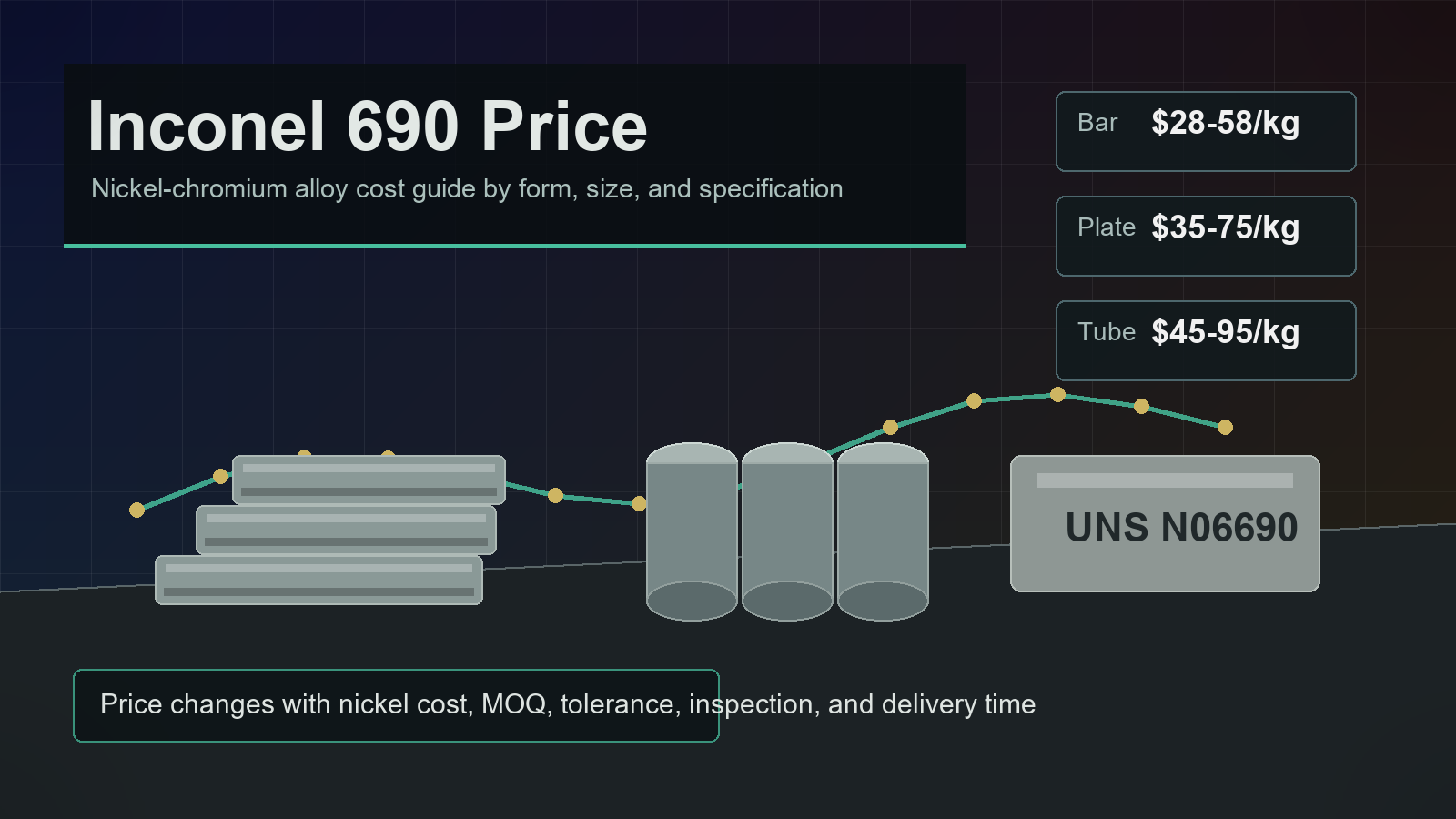
The price per kilogram of Inconel 690 can vary widely by market, country, supplier, specification, and order size. For common commercial supply, buyers may see rough reference ranges from about USD 28 to USD 95 per kg for many finished forms. Special tubing, small-lot precision wire, nuclear-grade material, or fully certified custom production can exceed this range.
| Inconel 690 Form | Typical Reference Price Range | Price Notes |
|---|---|---|
| Inconel 690 bar | USD 28-58 per kg | Depends on diameter, length, forged or rolled condition, and tolerance. |
| Inconel 690 sheet | USD 35-75 per kg | Thin sheet and tight flatness may increase cost. |
| Inconel 690 plate | USD 35-80 per kg | Thick plate, cut-to-size service, and testing affect price. |
| Inconel 690 pipe | USD 45-95 per kg | Seamless pipe usually costs more than welded pipe. |
| Inconel 690 tube | USD 50-120 per kg | Precision tube, small OD tube, and strict testing can be much higher. |
| Inconel 690 wire | USD 45-110 per kg | Fine diameter, spring temper, and small coils increase unit price. |
| Inconel 690 strip | USD 40-100 per kg | Thin precision strip has higher processing cost. |
These ranges are for general purchasing reference only. The actual Inconel 690 price should always be confirmed by quotation because raw material prices, stock level, production route, and project requirements can change quickly.
Main Factors Affecting Inconel 690 Price
The final price of Inconel 690 is affected by both metal value and manufacturing complexity. A simple large-diameter bar from stock may be relatively economical, while a small-batch precision seamless tube with full inspection can cost several times more per kilogram. Buyers should not compare price by alloy grade alone. The product form, specification, and certification level must be compared together.
Material Grade and Standard
Inconel 690 may be supplied according to different standards or customer specifications. Material produced with stricter chemical control, mechanical property requirements, corrosion testing, or nuclear-related documentation will usually cost more than standard commercial-grade material.
Product Form
Bar, plate, sheet, pipe, tube, wire, strip, forging, and machined parts all have different production costs. Tube and wire often require more processing steps than bar or plate. Precision strip may require repeated cold rolling, annealing, and surface control.
Order Quantity
Small orders usually have a higher unit price because the supplier must cover cutting, handling, inspection, packing, and administrative costs. Larger orders can reduce the price per kilogram, especially if the material can be produced in one batch.
Stock or Custom Production
Stock material is often cheaper and faster if the required size is available. Custom production can be more expensive because it may require melting, rolling, forging, drawing, machining, or special heat treatment.
Nickel, Chromium, and Raw Material Cost Impact
Nickel is one of the largest cost drivers for Inconel 690 because the alloy contains a high nickel content. Chromium is also important because Inconel 690 has a high chromium level compared with many other nickel alloys. When nickel or chromium prices rise, Inconel 690 suppliers often adjust quotations, especially for new production orders.
Raw material price does not move alone. Energy costs, alloy surcharge, scrap availability, mill capacity, transportation, currency exchange, and demand from power generation, aerospace, chemical processing, and energy industries can all influence the final quote. For long-term projects, some buyers request price validity terms because nickel alloy prices may change before the order is confirmed.
| Cost Driver | How It Affects Price |
|---|---|
| Nickel price | Directly affects base alloy cost because Inconel 690 is nickel-rich. |
| Chromium cost | Important because high chromium content improves oxidation resistance. |
| Energy cost | Affects melting, forging, rolling, annealing, and heat treatment. |
| Scrap and remelt availability | Can influence mill cost and lead time. |
| Currency exchange | Important for international purchasing and imported stock. |
Inconel 690 Bar Price
Inconel 690 bar is commonly supplied as round bar, square bar, flat bar, forged bar, or peeled and polished bar. Bar price is usually influenced by diameter, length, tolerance, surface condition, and whether the bar is hot rolled, forged, solution annealed, turned, ground, or polished.
Large-diameter forged bar may cost more due to forging and heat treatment. Small-diameter precision bar may also be expensive because of additional straightening, grinding, and tolerance control. If the buyer only needs rough machining stock, a hot rolled or forged bar may be more economical. If the bar will be used directly in precision equipment, ground or polished bar may reduce later machining time.
Inconel 690 Sheet and Plate Price
Inconel 690 sheet and plate prices depend mainly on thickness, width, length, surface finish, flatness, and cutting requirements. Thin sheet can be expensive per kilogram because cold rolling and surface control require more processing. Thick plate may have a high total order value because of weight, even if the price per kilogram is lower than precision thin sheet.
Cut-to-size plate may include extra cutting fees, especially for waterjet cutting, plasma cutting, laser cutting, or machining. If the project requires exact plate size, edge preparation, flatness control, or ultrasonic testing, these should be stated clearly in the inquiry.
Inconel 690 Pipe and Tube Price
Inconel 690 pipe and tube are often more expensive than bar and plate because production is more complex. Seamless tube requires piercing, extrusion, cold drawing, annealing, straightening, pickling, and testing. Welded tube may be more economical in some sizes, but the final choice depends on pressure, corrosion environment, code requirements, and application.
Tube price increases when the outside diameter is small, wall thickness is thin, tolerance is tight, or inspection requirements are strict. Heat exchanger tubes, nuclear-related tubes, and high-purity process tubes usually need more documentation and testing, which raises the final cost.
| Pipe or Tube Requirement | Price Impact |
|---|---|
| Seamless construction | Usually higher than welded product. |
| Small outside diameter | Higher processing difficulty and higher unit price. |
| Thin wall thickness | Requires better dimensional control. |
| Hydrostatic or eddy current testing | Adds inspection cost. |
| Full material traceability | Increases documentation and quality control cost. |
Inconel 690 Wire and Strip Price
Inconel 690 wire is used for welding, mesh, springs, fasteners, heating equipment, and special industrial parts. Wire price depends on diameter, coil weight, temper, surface finish, and packaging. Fine wire usually costs more per kilogram because drawing and handling are more difficult.
Inconel 690 strip is often used for stamped parts, seals, gaskets, clips, electrical components, and high-temperature assemblies. Strip price depends on thickness, width, hardness, edge condition, surface finish, and coil size. Precision strip with narrow width, thin gauge, and tight tolerance usually has a higher processing cost than standard strip.
How Size, Thickness, Diameter, and Tolerance Affect Cost
Size is one of the most practical reasons for price differences. A standard size available from stock may be quoted quickly and economically. A non-standard size may require custom production or additional machining from a larger size, which increases waste and cost.
For bar and rod, diameter tolerance affects price. For sheet and plate, thickness tolerance and flatness affect price. For pipe and tube, outside diameter, inside diameter, wall thickness, ovality, and straightness affect price. For wire and strip, small dimensional changes can require different tooling or extra drawing and rolling steps.
Standard Size vs Special Size
Standard stock sizes usually have better availability and lower cost. Special sizes may require minimum production quantity, longer lead time, and higher setup cost.
Tight Tolerance
Tight tolerance is useful when the material will be assembled directly or needs less machining. However, tighter tolerance usually means more processing, inspection, and scrap risk, so the price increases.
Cutting Loss
If the buyer requests exact cut lengths or custom plate sizes, the supplier may include cutting loss in the quotation. For expensive nickel alloys, cutting yield can noticeably affect price.
Hot Rolled, Cold Rolled, Forged, and Precision Machined Price Differences
The production route has a strong effect on Inconel 690 cost. Hot rolled material is often used for general industrial stock. Cold rolled material offers better dimensional accuracy and surface finish but costs more. Forged material is selected for larger sections, high-strength parts, or components requiring improved internal structure. Precision machined parts include additional labor, tooling, CNC time, and inspection.
| Production Route | Typical Cost Level | Common Use |
|---|---|---|
| Hot rolled | Lower to medium | General bar, plate, and rough machining stock. |
| Cold rolled | Medium to high | Sheet, strip, and precision material. |
| Forged | Medium to high | Large bars, rings, discs, and heavy-duty components. |
| Precision machined | High | Finished parts requiring CNC machining and inspection. |
Heat Treatment, Surface Finish, and Inspection Cost Factors
Inconel 690 is often supplied in solution annealed condition, but the exact heat treatment requirement depends on the final application. Heat treatment cost includes furnace operation, temperature control, atmosphere control, batch handling, and sometimes additional testing. If the project requires specific mechanical properties or corrosion resistance, heat treatment records may be requested.
Surface finish also changes price. Pickled surfaces are common for industrial use. Polished, ground, bright annealed, or precision cleaned surfaces require more processing. For chemical, nuclear, or high-purity applications, surface cleanliness may be as important as dimensional accuracy.
Inspection requirements can also add cost. Common documents include mill test certificate, chemical composition report, mechanical test report, ultrasonic test, PMI test, hardness test, hydrostatic test, eddy current test, dimensional report, and third-party inspection.
Inconel 690 Price Compared with Inconel 600, 625, and 718
Inconel 690 is often compared with Inconel 600, Inconel 625, and Inconel 718 because all are nickel-based alloys, but their price and performance are different. Inconel 600 is usually more economical than 690 in many forms, but 690 provides higher chromium content and better oxidation resistance in many environments. Inconel 625 is valued for strength and corrosion resistance, especially because of molybdenum and niobium additions. Inconel 718 is a precipitation-hardened alloy used when high strength is required.
| Alloy | General Price Level | Main Advantage | Common Buying Reason |
|---|---|---|---|
| Inconel 600 | Usually lower than 690 | Good high-temperature and corrosion resistance. | General nickel alloy service with lower cost. |
| Inconel 690 | Medium to high | High chromium, strong oxidation and stress corrosion resistance. | Chemical, thermal, and nuclear-related environments. |
| Inconel 625 | Often similar or higher | Excellent corrosion resistance and good strength. | Marine, chemical, aerospace, and severe corrosion service. |
| Inconel 718 | High | High strength after precipitation hardening. | Aerospace, turbines, fasteners, and high-load parts. |
Stock Availability, MOQ, Lead Time, and Shipping Impact on Price
Stock availability can make a major difference in price and delivery time. If a supplier has Inconel 690 bar, plate, or tube in stock, the buyer may receive a faster and more competitive quote. If the required size is not available, the supplier may need to produce it from mill order, which can require a minimum order quantity and longer lead time.
MOQ depends on product form. Bar and plate may be available in small cut pieces from stock. Wire, strip, seamless tube, or special forgings may require larger minimum quantity. Lead time can range from a few days for stock material to several weeks or months for custom mill production.
Shipping also affects total cost. Nickel alloys are dense and heavy, so freight cost can be significant for large bars, plates, and pipes. International orders may include export packing, customs documents, import duties, taxes, and insurance.
How to Get an Accurate Inconel 690 Quotation
To get an accurate Inconel 690 quotation, buyers should provide complete technical information rather than asking only for a general price per kilogram. A clear inquiry helps suppliers check stock, calculate weight, confirm production feasibility, and quote the right inspection level.
| Information to Provide | Example |
|---|---|
| Material grade | Inconel 690, Alloy 690, UNS N06690. |
| Product form | Bar, sheet, plate, pipe, tube, wire, strip, forging, machined part. |
| Size | Diameter, thickness, width, length, OD, ID, wall thickness. |
| Quantity | Total kilograms, pieces, meters, coils, or plates. |
| Standard | ASTM, ASME, customer drawing, or project specification. |
| Surface condition | Pickled, polished, ground, bright, machined, or cleaned. |
| Inspection | MTC, PMI, UT, hydro test, eddy current test, third-party inspection. |
| Delivery requirement | Destination, deadline, packing method, and shipping terms. |
A good quotation should clearly show material grade, specification, size, quantity, unit price, total price, lead time, payment terms, price validity, packaging, and included documents. If the quotation is for a critical project, buyers should also confirm whether the material is from stock or new production, whether certificates are available before shipment, and whether third-party inspection is accepted.
Inconel 690 Price Related Questions
How much does Inconel 690 cost per kg?
Inconel 690 commonly ranges from about USD 28 to USD 95 per kg for many standard finished products, depending on product form, size, tolerance, quantity, and inspection requirements. Precision tube, fine wire, special strip, nuclear-grade material, or custom machined parts may cost more. The best way to confirm the real price is to request a quotation with exact dimensions and quantity.
Why is Inconel 690 more expensive than stainless steel?
Inconel 690 is more expensive than stainless steel because it contains a high percentage of nickel and chromium, and it requires more specialized melting, forming, heat treatment, and inspection. It is used when standard stainless steel cannot provide enough oxidation resistance, corrosion resistance, or long-term performance in demanding environments.
Is Inconel 690 more expensive than Inconel 600?
In many cases, Inconel 690 is more expensive than Inconel 600 because it has higher chromium content and is often used for more demanding corrosion and high-temperature applications. However, the final price comparison depends on size, product form, stock availability, order quantity, and certification requirements.


 English
  Korean
  Japanese
  Arabic
  Spanish
  German
  Portuguese
  French
  Russian
  Italian