

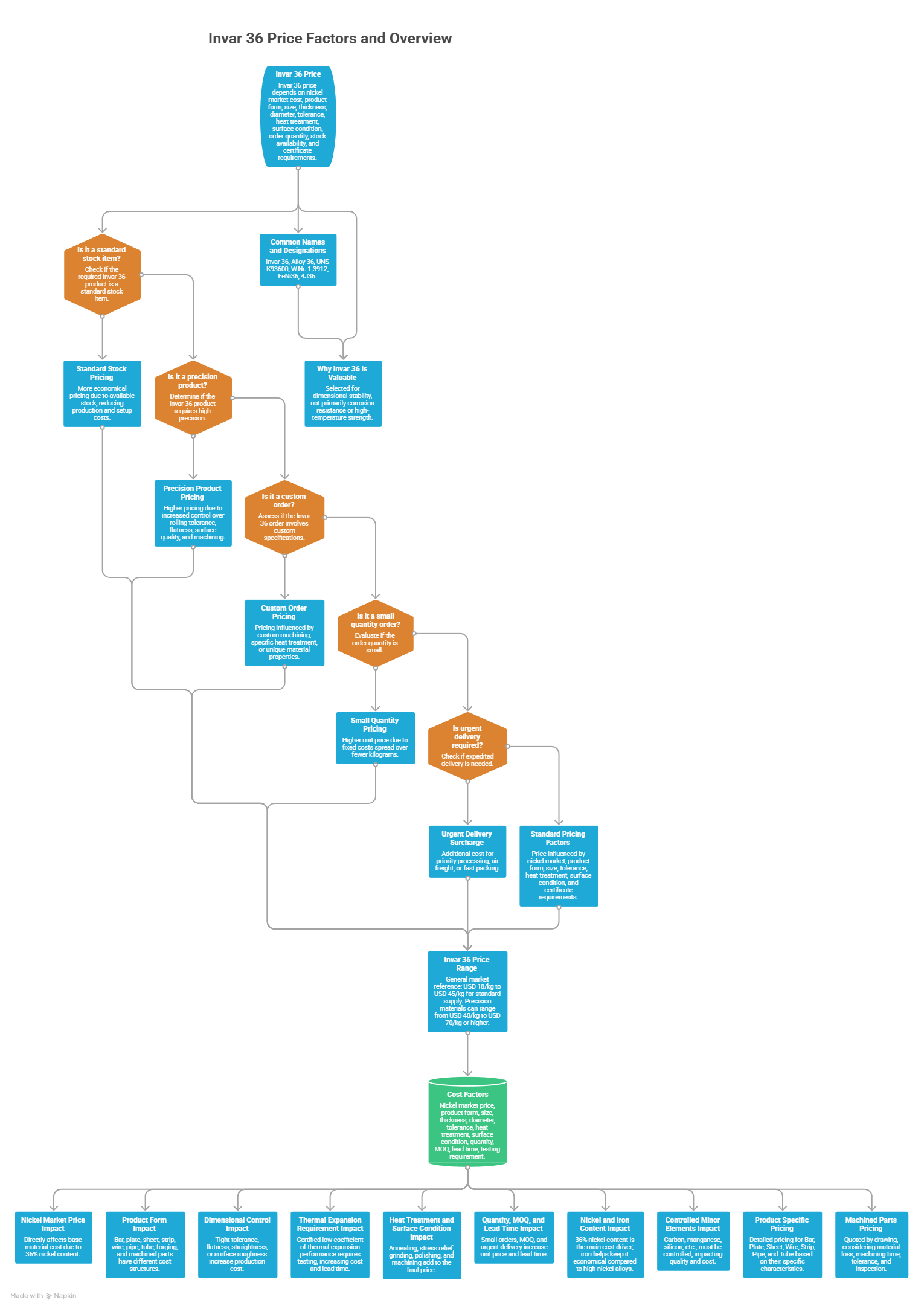
Invar 36 price depends on nickel market cost, product form, size, thickness, diameter, tolerance, heat treatment, surface condition, order quantity, stock availability, and certificate requirements. Invar 36, also known as Alloy 36, UNS K93600, K93601, K93603, W.Nr. 1.3912, FeNi36, and 4J36, is a nickel-iron low-expansion alloy containing about 36% nickel. It is widely used where dimensional stability is more important than ordinary strength, such as aerospace composite tooling, precision instruments, measuring devices, cryogenic equipment, glass sealing parts, optical components, molds, gauges, and low-expansion structural parts. In general market reference, standard Invar 36 price per kg may commonly appear around USD 18/kg to USD 45/kg, while precision sheet, tight-tolerance bar, small quantities, special heat treatment, certified aerospace material, or urgent delivery can be higher. This article explains what Invar 36 alloy is, Invar 36 price overview, price per kg reference, main cost factors, nickel and iron content impact, bar price, plate and sheet price, wire and strip price, pipe and tube price, size and tolerance influence, heat treatment and surface cost, MOQ and lead time, comparison with Kovar, Super Invar, and nickel alloys, and how to get an accurate Invar 36 quotation from a supplier.
What Is Invar 36 Alloy?
Invar 36 is a nickel-iron controlled expansion alloy containing approximately 36% nickel and the balance mainly iron. Its most important property is very low thermal expansion over normal atmospheric temperature ranges. This means Invar 36 can maintain stable dimensions when temperature changes, which is why it is used in precision tooling, measuring systems, aerospace molds, scientific instruments, cryogenic equipment, and optical structures.
Unlike many nickel alloys that are selected mainly for corrosion resistance or high-temperature strength, Invar 36 is selected mainly for dimensional stability. Buyers do not usually choose Invar 36 because it is the strongest or most corrosion-resistant alloy. They choose it because it expands much less than carbon steel, stainless steel, aluminum, or many general engineering alloys.
Common Names and Designations
| Name / Designation | Description | Procurement Meaning |
|---|---|---|
| Invar 36 | Common commercial name | Most widely used market name. |
| Alloy 36 | Alternative commercial name | Often used by nickel alloy suppliers. |
| UNS K93600 | UNS designation | Important for international material identification. |
| UNS K93601 / K93603 | Related UNS references | May appear in different specifications or product references. |
| W.Nr. 1.3912 | German material number | Common in European drawings and technical documents. |
| FeNi36 | Iron-nickel designation | Describes the iron-nickel alloy system. |
| 4J36 | Chinese precision alloy designation | Often used in Asian material supply and procurement. |
Why Invar 36 Is Valuable
The value of Invar 36 is not only in its nickel content. The alloy must also be controlled carefully to achieve low thermal expansion. Chemical composition, melting quality, heat treatment, grain structure, cold work, and stress relief can all influence final dimensional stability. This is why precision Invar 36 material may cost more than ordinary nickel-iron alloy products.
Invar 36 Price Overview
Invar 36 price is normally quoted by kilogram, piece, meter, sheet, plate, bar length, coil, or custom-machined part. For raw material comparison, price per kg is the most common reference. However, Invar 36 price is not fixed. It changes with nickel price, stock condition, product form, tolerance, order quantity, surface finish, and testing requirement.
General Price Position
Invar 36 is usually more expensive than carbon steel, stainless steel, and many standard iron-based alloys because it contains about 36% nickel and requires controlled production. However, it is often less expensive than high-nickel corrosion-resistant alloys such as Inconel 625, Hastelloy C-276, or some cobalt-containing superalloys.
Why Invar 36 Prices Vary Widely
Two suppliers may quote very different prices for Invar 36 because they may not be quoting the same product condition. One offer may be for standard hot rolled bar from stock. Another may be for precision ground bar with low-expansion certificate, tight tolerance, stress relief, ultrasonic testing, and custom cutting. These are not the same cost level.
| Price Situation | Typical Price Behavior | Reason |
|---|---|---|
| Standard stock plate or bar | More economical | Available stock reduces production and setup cost. |
| Precision sheet or strip | Higher | Rolling tolerance, flatness, and surface quality require more control. |
| Ground or machined bar | Higher | Extra machining and tolerance control increase processing cost. |
| Small quantity order | Higher unit price | Cutting, packing, documents, and handling cost are spread over fewer kilograms. |
| Custom heat treatment | Higher | Stress relief, annealing, and dimensional stability requirements add cost. |
| Certified precision material | Higher | Low-expansion testing, full traceability, and strict documentation may be required. |
Invar 36 Price Per Kg Reference
For general market reference, Invar 36 price per kg may commonly appear around USD 18/kg to USD 45/kg for standard commercial supply. Some standard plate or bar offers may be lower when stock is available and order quantity is larger. Precision cold-rolled sheet, special wire, close-tolerance strip, stress-relieved material, low-expansion-certified material, or small custom orders may be quoted at USD 40/kg to USD 70/kg or higher.
These values are only reference ranges for budget discussion. They should not be treated as final quotations. Actual Invar 36 price must be calculated according to current nickel cost, exact size, product form, tolerance, quantity, certificate requirement, and delivery condition.
| Invar 36 Product | General Reference Price Range | Price Comment |
|---|---|---|
| Invar 36 Bar | About USD 20 – 45/kg | Diameter, surface finish, tolerance, and cutting length affect price. |
| Invar 36 Plate | About USD 22 – 50/kg | Thickness, width, length, flatness, cutting, and stock availability affect cost. |
| Invar 36 Sheet | About USD 28 – 60/kg | Thin sheet, cold rolling, flatness, and surface finish may increase price. |
| Invar 36 Strip | About USD 35 – 70/kg | Slitting, width tolerance, coil condition, and edge control affect price. |
| Invar 36 Wire | About USD 30 – 70/kg | Wire drawing, diameter tolerance, coil weight, and temper affect cost. |
| Invar 36 Pipe / Tube | Quoted case by case | OD, wall thickness, seamless or welded type, and testing strongly affect price. |
| Invar 36 Machined Parts | Quoted by drawing | Material loss, CNC machining time, tolerance, and inspection must be calculated. |
Why Price Per Kg Is Only a Reference
Invar 36 is often used for precision parts. For this reason, total cost is not only the raw material price per kg. If the buyer needs low CTE control, stress relief, flatness control, precision machining, surface grinding, or inspection reports, the final cost may be much higher than a simple material price.
Main Factors Affecting Invar 36 Price
The main factors affecting Invar 36 price include nickel market price, product form, size, thickness, diameter, tolerance, heat treatment, surface condition, quantity, MOQ, lead time, testing requirement, and whether the material is standard stock or custom production.
Raw Material Cost
Nickel is the most important raw material cost factor. Since Invar 36 contains about 36% nickel, nickel price movement has a direct influence on quotation. Iron is cheaper than nickel, but the alloy still requires controlled melting and composition management.
Product Form
Bar, plate, sheet, strip, wire, pipe, tube, forging, and machined parts all have different cost structures. A standard plate may be relatively economical, while precision strip or fine wire may be more expensive due to additional processing.
Dimensional Control
Many Invar 36 applications require dimensional stability and precision. Tight thickness tolerance, diameter tolerance, flatness, straightness, or surface roughness can increase production cost.
Thermal Expansion Requirement
Some buyers only need standard Invar 36 composition. Others require certified low coefficient of thermal expansion performance. If low-expansion testing is required, the cost and lead time may increase.
| Cost Factor | How It Affects Price | Buyer Suggestion |
|---|---|---|
| Nickel price | Directly affects base material cost. | Confirm quotation validity period. |
| Product form | Sheet, bar, plate, wire, strip, and tube have different production routes. | Provide exact product form in the inquiry. |
| Size | Special sizes may require custom production or cutting. | Use standard stock dimensions when possible. |
| Tolerance | Tighter tolerance requires rolling, grinding, machining, or inspection. | Specify only the tolerance truly required by the application. |
| Heat treatment | Stress relief or annealing adds furnace cost and time. | State dimensional stability requirements clearly. |
| Surface condition | Ground, polished, pickled, or machined surfaces increase cost. | Choose the surface according to final processing needs. |
| Testing | CTE test, mechanical test, PMI, UT, or third-party inspection adds cost. | List required tests before quotation. |
| Quantity | Small orders usually have higher unit price. | Combine sizes or increase quantity if practical. |
| Lead time | Urgent delivery may require stock sourcing or priority processing. | Confirm delivery schedule early. |
Nickel and Iron Content Impact on Invar 36 Cost
Invar 36 is mainly an iron-nickel alloy. The approximate 36% nickel content gives the alloy its low-expansion character, while iron forms the balance of the structure. The price is therefore strongly connected with nickel cost, but the material value also comes from controlled chemistry and low-expansion performance.
Nickel Content Impact
Nickel is much more expensive than iron, so the 36% nickel content is the main reason Invar 36 costs more than ordinary steel. When nickel market prices increase, Invar 36 quotations may rise quickly. Suppliers may also shorten quotation validity when nickel prices fluctuate sharply.
Iron Content Impact
Iron is the balance element and helps keep Invar 36 more economical than many high-nickel corrosion-resistant alloys. This is one reason Invar 36 may be cheaper than alloys such as Inconel 625 or Hastelloy C-276, even though it still contains a significant amount of nickel.
Controlled Minor Elements
Carbon, manganese, silicon, sulfur, phosphorus, chromium, cobalt, and other elements must be controlled within specification limits. For precision low-expansion applications, chemistry control is important because small variations can influence thermal expansion behavior and dimensional stability.
| Element | Role in Invar 36 | Price Impact |
|---|---|---|
| Nickel | Creates the low-expansion nickel-iron structure. | Very high impact because it is the main cost element. |
| Iron | Balance element in the alloy. | Lower cost than nickel, helps reduce total alloy price. |
| Carbon | Controlled to maintain stable properties. | Low direct cost impact but important for quality. |
| Manganese and Silicon | Controlled minor elements. | Small cost impact, but must meet specification limits. |
| Cobalt | Usually controlled as a limited element. | Can affect low-expansion performance and cost if tightly controlled. |
Invar 36 Bar Price
Invar 36 bar price depends on diameter, length, surface finish, straightness, tolerance, cutting method, and whether the bar is hot rolled, forged, peeled, turned, polished, or centerless ground. Bar is commonly used for shafts, rods, gauges, molds, supports, optical parts, and precision machined components.
Hot Rolled or Forged Bar
Hot rolled or forged Invar 36 bar is usually more economical than precision ground bar. It is suitable when the buyer will machine the material after delivery. Larger diameter bars may need forging, which can increase cost and lead time.
Peeled and Ground Bar
Peeled and ground Invar 36 bar costs more because additional surface processing is required. These conditions are often used when the buyer needs better surface quality, tighter diameter tolerance, or reduced machining time.
Stress-Relieved Bar
Some precision applications require stress-relieved Invar 36 bar to improve dimensional stability after machining. Stress relief adds heat treatment cost but may reduce distortion risk during final machining or service.
| Invar 36 Bar Type | Relative Price Level | Common Use |
|---|---|---|
| Hot rolled black bar | Lower | General machining blanks and structural parts. |
| Forged bar | Medium to high | Large diameter bars and heavy machined components. |
| Peeled bar | Medium to high | Better surface quality and controlled diameter. |
| Ground bar | High | Precision shafts, rods, gauges, and machined parts. |
| Stress-relieved bar | Higher | Precision parts requiring dimensional stability. |
| Cut-to-length bar | Depends on quantity | Reduces customer cutting work but adds cutting cost. |
Invar 36 Plate and Sheet Price
Invar 36 plate and sheet are widely used for aerospace composite tooling, molds, precision plates, support structures, optical platforms, cryogenic equipment, and low-expansion fixtures. Price depends on thickness, width, length, flatness, surface condition, cutting size, and whether the material is hot rolled, cold rolled, annealed, or stress relieved.
Invar 36 Plate Price
Invar 36 plate price is usually affected by thickness and plate size. Thick plates may require more rolling, heat treatment, cutting, and inspection. If the buyer needs large flat plates for aerospace tooling, flatness and stress relief can become major cost factors.
Invar 36 Sheet Price
Invar 36 sheet price is affected by cold rolling, thickness tolerance, surface finish, and flatness. Thin sheet may cost more per kg than thick plate because more processing is required to control thickness and surface quality.
Cut Plate and Custom Sheet Cost
Custom cutting can increase cost, especially for small pieces, complex shapes, or tight cutting tolerance. Cutting methods may include shearing, sawing, waterjet cutting, laser cutting, or CNC machining depending on thickness and edge requirements.
| Plate / Sheet Type | Main Cost Factors | Buyer Note |
|---|---|---|
| Hot rolled plate | Thickness, width, length, surface, stock size | Suitable for molds, tooling plates, and machined parts. |
| Cold rolled sheet | Thickness tolerance, flatness, surface quality | Often higher per kg due to additional rolling control. |
| Stress-relieved plate | Heat treatment and dimensional stability control | Useful for precision tooling and large machined plates. |
| Custom cut plate | Cutting method, nesting loss, edge quality | Provide drawings for accurate quotation. |
| Precision flat plate | Flatness inspection, grinding, machining | Higher cost but better for precision assemblies. |
Invar 36 Wire and Strip Price
Invar 36 wire and strip are used for precision components, glass-to-metal sealing, thermostatic elements, springs, measurement systems, electronic parts, and special low-expansion assemblies. Wire and strip can be more expensive per kg than standard plate or bar because they require additional drawing, rolling, slitting, and coil control.
Invar 36 Wire Price
Invar 36 wire price depends on diameter, coil weight, temper, surface finish, straightness, and tolerance. Fine wire is usually more expensive because wire drawing requires more processing passes and tighter quality control.
Invar 36 Strip Price
Invar 36 strip price depends on thickness, width, coil size, edge condition, surface finish, and tolerance. Narrow strip with tight width tolerance can be more expensive because slitting loss and edge quality control increase production cost.
Temper and Surface Condition
Wire and strip may be supplied annealed, hard, half-hard, or according to special temper requirements. Temper control and surface finish can affect both price and lead time.
| Product | Relative Price Level | Main Cost Drivers |
|---|---|---|
| Large diameter wire | Medium | Wire drawing, diameter tolerance, coil packaging. |
| Fine wire | High | Multiple drawing passes and strict tolerance control. |
| Standard strip | Medium to high | Rolling, slitting, annealing, and coil control. |
| Narrow precision strip | High | Slitting loss, width tolerance, edge quality. |
| Special temper strip | Higher | Additional rolling or heat treatment may be needed. |
Invar 36 Pipe and Tube Price
Invar 36 pipe and tube price is usually quoted case by case because tubular products involve more variables than plate or bar. Outer diameter, wall thickness, length, seamless or welded construction, tolerance, straightness, heat treatment, and inspection requirements all affect price.
Seamless Invar 36 Tube
Seamless Invar 36 tube may cost more because the production route is more complex. It may require hot working, cold drawing, annealing, straightening, and dimensional inspection. Seamless tube is often selected when wall integrity, pressure resistance, or high precision is required.
Welded Invar 36 Tube
Welded Invar 36 tube may be more economical if the application accepts welded construction. It is commonly considered for low-expansion structures, cryogenic transfer systems, precision assemblies, and custom tubular components. Welding method and weld inspection should be confirmed before ordering.
Tube Testing and Inspection
Pipe and tube orders may require dimensional inspection, surface inspection, hydrostatic testing, eddy current testing, flattening test, flaring test, or weld inspection. These requirements can increase cost and lead time.
| Pipe / Tube Factor | Cost Impact | Buyer Suggestion |
|---|---|---|
| Outer diameter | Special OD may increase cost. | Use standard OD if possible. |
| Wall thickness | Thin wall and thick wall may both require special control. | Provide exact tolerance and application details. |
| Seamless tube | Usually higher. | Suitable for demanding service and precision needs. |
| Welded tube | Can be more economical. | Confirm whether welded construction is acceptable. |
| Tube testing | Raises cost. | List all required tests before quotation. |
How Size, Thickness, Diameter, and Tolerance Affect Price
Size, thickness, diameter, and tolerance have a direct impact on Invar 36 price. Standard stock sizes are usually more economical. Special sizes, very tight tolerances, large plates, thin strips, fine wires, and precision ground bars require extra processing and inspection.
Standard Size vs Custom Size
Standard stock sizes reduce cost because the material is already available or easier to produce. Custom sizes may require cutting, machining, rolling, forging, or new production. If the final part can be machined from a standard size, the buyer may reduce cost and shorten lead time.
Thickness Impact
For sheet and plate, thickness affects rolling difficulty, flatness, cutting, and heat treatment. Thin sheets may require cold rolling and careful handling. Thick plates may need stress relief and machining allowance if used for precision tooling.
Diameter Impact
For bars and tubes, diameter strongly affects availability. Common diameters are easier to source. Large forged bar or special small-diameter precision rod may require production and higher MOQ.
Tolerance Impact
Tight tolerance increases cost because it requires additional finishing such as grinding, peeling, cold drawing, machining, or precision rolling. If a loose tolerance is acceptable for rough machining stock, buyers should avoid requesting unnecessary precision.
| Requirement | Price Effect | Practical Example |
|---|---|---|
| Common stock size | Lower | Standard plate, sheet, or bar size. |
| Custom cut size | Medium | Cut-to-size plate or cut bar length. |
| Special production size | Higher | Non-standard tube, large forged bar, very thin strip. |
| Standard tolerance | Lower | Mill tolerance material for later machining. |
| Tight tolerance | Higher | Ground bar, precision strip, cold drawn tube. |
| Precision flatness | Higher | Tooling plate or optical structure plate. |
Heat Treatment and Surface Condition Impact on Cost
Heat treatment and surface condition are important cost factors for Invar 36 because many applications require dimensional stability. Stress relief, annealing, controlled cooling, pickling, grinding, polishing, and machining can all affect final price.
Annealed Condition
Annealed Invar 36 is commonly supplied when the buyer needs good formability or stable material condition. Annealing can reduce internal stress and improve workability, but it adds furnace processing cost.
Stress-Relieved Condition
Stress relief is important for precision machined parts, aerospace tooling, optical structures, and large plates. It helps reduce deformation during machining and service. Stress-relieved material usually costs more than standard mill condition, but it may reduce later machining problems.
Cold Worked Condition
Cold worked Invar 36 may be used for strip, wire, and precision parts. Cold working changes strength, hardness, and dimensional behavior. If a specific temper is required, it should be clearly stated in the order.
Surface Finish Options
| Surface Condition | Relative Cost | Common Product Form |
|---|---|---|
| Mill finish | Lower | Plate, sheet, bar, strip. |
| Pickled / descaled | Medium | Sheet, plate, tube, strip. |
| Peeled | Medium to high | Round bar and rod. |
| Ground | High | Precision bar, tooling plate, machined blanks. |
| Polished | High | Sheet, strip, plate, decorative or clean-surface parts. |
| Machined | Highest | Custom components and near-finished parts. |
Quantity, MOQ, and Lead Time Impact on Invar 36 Price
Quantity, minimum order quantity, and lead time have a strong impact on Invar 36 price. A small urgent order from stock may have a higher unit price, while a larger planned order may allow better price per kg. However, large orders may require production time if stock is not enough.
Small Quantity Orders
Small quantities are common for repair, sample production, laboratory use, prototype tooling, or precision parts. The unit price may be higher because cutting, packing, documentation, and handling costs are fixed even if the quantity is small.
Large Quantity Orders
Large orders may reduce unit cost if production can be arranged efficiently. For plates, sheets, bars, and strips, larger orders may also reduce cutting loss and improve raw material planning. However, if the grade and size are not in stock, lead time may become longer.
MOQ for Special Products
Wire, strip, tube, and special-size materials may have minimum production quantities. If the buyer needs a small quantity of non-stock material, the supplier may suggest a standard size or available stock substitute.
Urgent Delivery
Urgent delivery can increase cost because the supplier may need priority cutting, air freight, fast packing, or stock sourcing from multiple warehouses. For planned projects, early inquiry usually helps reduce price and avoid limited material options.
| Order Situation | Price Effect | Lead Time Effect |
|---|---|---|
| Small stock order | Higher unit price | Faster if material is available. |
| Large stock order | Better unit price possible | Depends on inventory quantity. |
| Custom production | Higher setup cost | Longer lead time. |
| Below MOQ order | May be expensive or unavailable | Supplier may recommend stock material. |
| Urgent export order | May increase total cost | Fast freight and priority processing may be needed. |
Invar 36 Price Compared with Kovar, Super Invar, and Nickel Alloys
Invar 36 is often compared with Kovar, Super Invar, and other nickel alloys because they are all used in precision, controlled expansion, or high-performance engineering applications. However, their price and function are different.
Invar 36 vs Kovar Price
Kovar is a controlled expansion alloy commonly used for glass-to-metal and ceramic-to-metal sealing. It contains nickel, cobalt, and iron. Because cobalt is expensive and sealing performance requirements can be strict, Kovar may cost more than standard Invar 36 in many cases. If the application only needs low expansion and not glass sealing compatibility, Invar 36 may be more economical.
Invar 36 vs Super Invar Price
Super Invar, often associated with Fe-Ni-Co low-expansion alloys, is used where even lower thermal expansion is required. Because of tighter composition control and cobalt content, Super Invar is usually more expensive than Invar 36. It should be chosen only when the application truly needs lower expansion than standard Invar 36 can provide.
Invar 36 vs General Nickel Alloys
Compared with corrosion-resistant nickel alloys such as Inconel 600, Inconel 625, or Hastelloy C-276, Invar 36 has a different purpose. Invar 36 is selected for low thermal expansion, not for maximum corrosion resistance or high-temperature strength. Its price may be lower than some high-nickel corrosion alloys, but it should not be used as a substitute when the main requirement is strong acid corrosion resistance or high-temperature oxidation resistance.
| Material | Main Purpose | General Price Position | Best Use |
|---|---|---|---|
| Invar 36 | Low thermal expansion and dimensional stability | Medium among special alloys | Tooling, gauges, precision structures, cryogenic parts. |
| Kovar | Controlled expansion for glass and ceramic sealing | Usually higher than standard Invar 36 | Glass-to-metal seals, electronic packages, vacuum devices. |
| Super Invar | Very low thermal expansion | Higher than Invar 36 | Ultra-precision instruments and optical structures. |
| Inconel 600 | Corrosion and heat resistance | Depends on market and product form | Chemical processing and high-temperature equipment. |
| Inconel 625 | High corrosion resistance and strength | Usually higher than Invar 36 | Marine, chemical, oil and gas, severe corrosion service. |
| Hastelloy C-276 | Severe corrosion resistance | Usually much higher | Strong acid and chemical corrosion environments. |
How to Get an Accurate Invar 36 Quotation from a Supplier
To get an accurate Invar 36 quotation, buyers should provide complete technical information. A simple inquiry such as “Invar 36 price” or “Invar 36 price per kg” is not enough for a reliable offer because the supplier still needs to know product form, size, tolerance, quantity, surface condition, heat treatment, standard, and testing requirements.
Information Needed for Quotation
| Inquiry Item | Example Information | Why It Matters |
|---|---|---|
| Grade | Invar 36 / Alloy 36 / UNS K93600 / 1.3912 / 4J36 | Confirms the exact material. |
| Product form | Bar, plate, sheet, strip, wire, pipe, tube, machined part | Different product forms have different price structures. |
| Size | Diameter, thickness, width, length, wall thickness | Determines stock availability and processing cost. |
| Quantity | Kg, pieces, meters, sheets, coils | Affects unit price, MOQ, and lead time. |
| Standard | ASTM F1684, AMS, MIL, EN, DIN, customer drawing | Controls chemical, mechanical, and inspection requirements. |
| Heat treatment | Annealed, stress relieved, cold worked, custom condition | Affects dimensional stability and cost. |
| Surface condition | Mill finish, pickled, polished, peeled, ground, machined | Surface processing changes price and lead time. |
| Tolerance | Standard tolerance or precision tolerance | Tight tolerance may require extra finishing. |
| Testing | MTC, PMI, CTE test, tensile test, hardness, UT, third-party inspection | Inspection costs must be included in quotation. |
| Application | Aerospace tooling, cryogenic tank, precision instrument, optical structure | Helps supplier recommend suitable condition. |
| Delivery destination | Country, port, courier address, freight term | Needed for packing, export documents, and freight cost. |
Example of a Clear Invar 36 Inquiry
A clear inquiry may read: “Please quote Invar 36 plate, UNS K93600 / W.Nr. 1.3912, thickness 20 mm, width 1000 mm, length 2000 mm, stress relieved, mill finish, quantity 500 kg, with MTC and CTE test report, delivery to Germany.” This type of inquiry allows the supplier to check stock, calculate cutting loss, confirm testing cost, and provide a more accurate quotation.
Why Application Information Helps
Invar 36 is used in many precision fields. If the material is for aerospace composite tooling, the supplier may recommend stress-relieved plate and flatness control. If it is for cryogenic service, toughness and certificate requirements may be important. If it is for precision instruments, CTE testing and machining stability may matter more than standard mechanical strength.
Quality and Certificate Notes for Invar 36 Supply
For Invar 36 procurement, quality documents are important because buyers often need the material for precision applications. A low price is not useful if the material cannot meet the required coefficient of thermal expansion, chemical composition, dimensional tolerance, or traceability requirement.
Common Quality Documents
| Document / Test | Purpose | When It Is Needed |
|---|---|---|
| Material Test Certificate | Shows grade, heat number, chemistry, size, and condition. | Recommended for all Invar 36 orders. |
| PMI Test | Confirms alloy identity before shipment. | Useful for preventing material mix-up. |
| CTE Test Report | Confirms coefficient of thermal expansion performance. | Important for precision tooling and instruments. |
| Dimension Report | Confirms thickness, diameter, width, length, or wall thickness. | Important for precision orders. |
| Mechanical Test | Checks tensile strength, yield strength, and elongation if required. | Needed when specified by standard or customer. |
| Ultrasonic Testing | Checks internal defects in thick plate, bar, or forging. | Useful for critical machined parts. |
| Surface Inspection | Checks cracks, pits, scratches, scale, and edge quality. | Important for sheet, plate, strip, tube, and polished products. |
| Third-Party Inspection | Provides independent verification. | Used for export projects and critical applications. |
Certificate Requirements Affect Price
If the buyer requires only a standard material certificate, the cost may be relatively simple. If the buyer requires CTE testing, mechanical testing, ultrasonic testing, or third-party inspection, the supplier must include laboratory cost, sample preparation, inspection time, and documentation work in the quotation.
Invar 36 Packaging and Export Cost
For international supply, packaging and export handling also affect total cost. Invar 36 is often supplied as high-value precision material, so packing should protect the surface, edges, dimensions, and identification marks during transportation.
Common Packaging Methods
Bars are usually bundled and protected with plastic film, anti-rust paper, wooden boxes, or wooden pallets. Plates and sheets may be packed with waterproof paper, edge protection, steel strips, and wooden pallets. Wire and strip are packed in coils or spools with moisture protection. Precision machined parts may require individual protection and custom packaging.
Export Documents
Export documents may include commercial invoice, packing list, material test certificate, certificate of origin if required, third-party inspection report if requested, and shipping documents. If the buyer needs special marking, heat number traceability, or customer label, this should be confirmed before shipment.
Invar 36 Price Related Questions
How much is Invar 36 per kg?
Invar 36 price per kg commonly appears around USD 18/kg to USD 45/kg for standard commercial stock, while precision sheet, strip, wire, ground bar, stress-relieved plate, CTE-tested material, small quantities, and urgent orders can be higher. The final price depends on size, product form, tolerance, quantity, heat treatment, surface condition, certificate, and current nickel price.
Why is Invar 36 expensive?
Invar 36 is expensive because it contains about 36% nickel and requires controlled production to achieve low thermal expansion. For precision applications, additional costs may come from stress relief, flatness control, tight tolerance, CTE testing, surface grinding, certification, and small-batch processing.
Is Invar 36 cheaper than Kovar?
In many cases, standard Invar 36 is cheaper than Kovar because Kovar contains cobalt and is often used for strict glass-to-metal or ceramic-to-metal sealing applications. However, precision Invar 36 with tight tolerance, stress relief, or CTE testing may still be expensive. The final comparison depends on product form, specification, size, and certificate requirements.


 English
  Korean
  Japanese
  Arabic
  Spanish
  German
  Portuguese
  French
  Russian
  Italian