

Invar steel rods are widely used in applications where dimensional stability is more important than ordinary strength, corrosion resistance, or low material cost. Although buyers often search for “Invar steel rods,” the material is not conventional carbon steel. It is a nickel-iron controlled expansion alloy, most commonly Invar 36, containing about 36% nickel and balance iron. Reliable Invar steel rods suppliers should understand low thermal expansion performance, UNS K93600 grade identification, chemical composition control, mechanical properties, diameter tolerance, straightness, surface finish, heat treatment, machining stability, certification, and small batch supply requirements. This article explains Invar steel rods for low thermal expansion applications, common grades supplied by manufacturers, Invar 36 rods, chemical composition, low expansion performance, mechanical properties, available sizes, cold drawn, hot rolled and precision ground rod options, heat treatment, surface requirements, applications, quality inspection, custom cutting, price factors, lead time, and how to choose reliable Invar steel rods suppliers.
Invar Steel Rods for Low Thermal Expansion Applications
Invar steel rods are selected when a component must keep its dimensions stable during temperature changes. In many engineering applications, ordinary steel, stainless steel, aluminum, brass, or general nickel alloys expand too much when the temperature changes. Invar rods solve this problem by offering very low thermal expansion around room temperature and in controlled temperature ranges.
The main function of Invar steel rods is not to provide the highest tensile strength or the strongest corrosion resistance. Their main value is dimensional stability. This makes Invar rods useful for aerospace tooling, optical systems, molds, measuring equipment, scientific instruments, precision shafts, cryogenic assemblies, and fixtures where small dimensional changes can cause alignment errors or product failure.
Why Buyers Search for Invar Steel Rods
Many buyers use the term “Invar steel rods” because the material looks like steel rod in product form and contains iron as the base balance element. However, technically, Invar 36 is a nickel-iron alloy rather than ordinary steel. Good suppliers should explain this clearly so buyers do not compare Invar rod price directly with carbon steel or stainless steel rod price.
Typical Low Expansion Use Cases
| Application Area | Why Invar Rods Are Used | Common Rod Requirement |
|---|---|---|
| Aerospace tooling | Low expansion helps maintain mold accuracy during curing and temperature cycling. | Stress-relieved rods, machined blanks, controlled straightness. |
| Optical systems | Stable dimensions help maintain lens, mirror, and frame alignment. | Precision ground rods, tight tolerance, clean surface. |
| Precision instruments | Low expansion reduces measurement drift caused by temperature changes. | Small diameter rods, cold drawn rods, CTE certificate if required. |
| Molds and fixtures | Dimensional stability reduces distortion during production and inspection. | Large diameter rods, machined stock, stress-relieved condition. |
| Cryogenic equipment | Invar retains good dimensional behavior at low temperatures. | Certified material, stable chemistry, suitable heat treatment. |
Common Invar Steel Rod Grades Supplied by Manufacturers
Invar steel rods can refer to different low-expansion nickel-iron alloys, but the most common grade is Invar 36. Other related controlled expansion alloys may include Super Invar, Kovar, Invar 42, Alloy 42, and other Fe-Ni or Fe-Ni-Co grades. A reliable supplier should help buyers identify whether they need low thermal expansion, glass sealing expansion, ultra-low expansion, or another controlled expansion function.
Main Grades in Controlled Expansion Rod Supply
| Grade | Common Designation | Main Feature | Typical Rod Application |
|---|---|---|---|
| Invar 36 | UNS K93600 / W.Nr. 1.3912 / FeNi36 / 4J36 | Very low thermal expansion around room temperature. | Tooling, optical frames, measuring rods, precision parts. |
| Super Invar | Fe-Ni-Co low expansion alloy | Lower thermal expansion than standard Invar 36 in selected ranges. | Ultra-precision instruments, optical supports, laboratory equipment. |
| Kovar | UNS K94610 / FeNiCo alloy | Controlled expansion for glass-to-metal and ceramic-to-metal sealing. | Electronic packages, vacuum devices, sealing pins. |
| Alloy 42 | UNS K94100 / FeNi42 | Controlled expansion alloy with higher nickel content than Invar 36. | Electronic parts, lead frames, glass sealing applications. |
Why Grade Confirmation Matters
Different controlled expansion alloys are not automatically interchangeable. Invar 36 is mainly selected for low thermal expansion. Kovar is selected when expansion must match glass or ceramic. Super Invar is selected when even lower expansion is required within a narrower temperature range. If a drawing requires UNS K93600, the supplier should not replace it with Kovar or Alloy 42 unless the buyer approves the substitution.
Invar 36 Steel Rods and UNS K93600 Grade Identification
Invar 36 steel rods are most commonly supplied under UNS K93600. The grade may also be listed as Alloy 36, FeNi36, W.Nr. 1.3912, Ni36, or 4J36. These names are often used in different regions, standards, drawings, and supplier documents.
Common Identification Names
| Identification | Meaning | Where It May Appear |
|---|---|---|
| Invar 36 | Common commercial name | Supplier quotations, websites, buyer inquiries. |
| Alloy 36 | Alternative commercial name | Nickel alloy product catalogs and datasheets. |
| UNS K93600 | Unified Numbering System designation | International procurement and material certificates. |
| W.Nr. 1.3912 | German material number | European drawings and specifications. |
| FeNi36 | Iron-nickel alloy designation | Technical documents and European material references. |
| 4J36 | Chinese precision alloy designation | Asian supply chain and local specifications. |
Supplier Responsibility for Grade Identification
A professional Invar steel rods supplier should confirm the exact grade before quoting. If the buyer sends only “Invar rods,” the supplier should ask whether the requirement is Invar 36 / UNS K93600 or another controlled expansion grade. This avoids supplying a material that looks similar but does not meet the required thermal expansion behavior.
Chemical Composition of Invar Steel Rods
The chemical composition of Invar steel rods must be controlled because low thermal expansion performance depends strongly on the balance of nickel, iron, carbon, manganese, silicon, cobalt, and other minor elements. For Invar 36 rods, the typical nickel content is about 35% to 37%, with iron as the balance.
Typical Chemical Composition of Invar 36 Rods
| Element | Typical Range | Function in Invar Steel Rods |
|---|---|---|
| Nickel (Ni) | 35.00% – 37.00% | Creates the low thermal expansion nickel-iron structure. |
| Iron (Fe) | Balance | Forms the main matrix with nickel. |
| Carbon (C) | Max. 0.05% | Controlled to maintain stable expansion and processing behavior. |
| Manganese (Mn) | Max. 0.60% | Controlled minor element affecting processing and cleanliness. |
| Silicon (Si) | Max. 0.40% | Controlled to maintain alloy quality. |
| Cobalt (Co) | Max. 0.50% | Usually limited because cobalt can affect expansion behavior. |
| Chromium (Cr) | Max. 0.25% | Controlled residual element. |
| Sulfur (S) | Max. 0.015% | Kept low to improve material quality and workability. |
| Phosphorus (P) | Max. 0.015% | Controlled impurity. |
Why Composition Control Is Important
Invar steel rods are often used for precision parts, so chemical composition is not just a basic certificate item. If nickel content, cobalt content, carbon level, or impurity levels are not properly controlled, the coefficient of thermal expansion, machining stability, and dimensional performance can be affected. For precision applications, buyers should request a material test certificate and, when necessary, a CTE test report.
Low Thermal Expansion Performance of Invar Steel Rods
The main reason to use Invar steel rods is low thermal expansion. Invar 36 has a thermal expansion rate much lower than ordinary carbon steel, stainless steel, aluminum, copper, and many nickel alloys around room temperature. This makes the material valuable in assemblies where temperature variation can cause misalignment or dimensional error.
What Low Thermal Expansion Means
When temperature changes, most metals expand or contract. In precision assemblies, even a small dimensional change can affect alignment, measurement accuracy, sealing, optical position, or mold geometry. Invar rods reduce this problem because their coefficient of thermal expansion is very low in the useful temperature range.
Temperature Range Considerations
Invar 36 is especially useful around normal atmospheric temperatures and can also perform well at cryogenic temperatures. However, buyers should not assume that the expansion rate remains equally low at every temperature. The selected temperature range should be confirmed before procurement, especially for aerospace, optical, cryogenic, and scientific equipment.
When CTE Testing Is Needed
For general rods used as machining stock, a standard material certificate may be enough. For precision tooling, optical systems, satellite structures, metrology equipment, or high-value molds, buyers may request coefficient of thermal expansion testing. CTE testing increases cost and lead time, but it provides stronger confidence in dimensional performance.
| Application Requirement | Why Low Expansion Matters | Recommended Supplier Check |
|---|---|---|
| Precision measuring rods | Reduces measurement error caused by temperature variation. | CTE certificate, straightness control, ground surface. |
| Aerospace composite tooling | Helps mold dimensions remain stable during heating and cooling. | Stress relief, plate or rod traceability, machining allowance. |
| Optical structures | Maintains alignment of lenses, mirrors, and frames. | Precision ground rods, low internal stress, tight tolerance. |
| Cryogenic assemblies | Reduces dimensional mismatch at low temperature. | Material certificate, service temperature review. |
Mechanical Properties of Invar Steel Rods
Invar steel rods provide moderate mechanical strength and good toughness, especially at low temperatures. However, they are not normally selected as high-strength structural rods. Their main function is dimensional stability. Mechanical properties depend on product form, diameter, cold work, annealing condition, heat treatment, and testing standard.
Typical Mechanical Property Reference
| Property | Typical Reference for Invar 36 | Buyer Note |
|---|---|---|
| Density | About 8.1 g/cm³ | Useful for weight calculation of rods and machined parts. |
| Melting Range | About 1430°C | Important for manufacturing and welding reference. |
| Tensile Strength | Moderate, varies by condition | Cold drawn rods can have higher strength than annealed rods. |
| Yield Strength | Varies with cold work and heat treatment | Should be confirmed when load-bearing design is required. |
| Elongation | Good in annealed condition | Important for forming and machining behavior. |
| Hardness | Depends on cold work and annealing condition | Specify hardness requirement if needed. |
| CTE Performance | Very low around room temperature | The key property for most Invar rod applications. |
Annealed vs Cold Drawn Mechanical Behavior
Annealed Invar rods generally provide better ductility and lower internal stress. Cold drawn rods usually provide better dimensional accuracy, smoother surface, and higher strength, but cold working can affect expansion behavior. For precision applications, the supplier should help select a suitable condition based on machining and service requirements.
Available Invar Steel Rod Sizes and Diameter Range
Invar steel rods can be supplied in different diameters, lengths, and surface conditions. Common diameters may range from small precision rods to large forged bars, depending on stock and production capability. Exact availability depends on supplier inventory, mill production schedule, and customer tolerance requirements.
Common Rod Size Information
| Rod Type | Common Diameter Range | Typical Length | Common Use |
|---|---|---|---|
| Small precision rod | 1 mm – 10 mm | Coil, straight length, or cut length | Instrument parts, pins, small shafts, precision assemblies. |
| Cold drawn rod | 3 mm – 50 mm | 1000 mm – 3000 mm or custom | Machined rods, measuring components, precision supports. |
| Hot rolled round bar | 10 mm – 150 mm | 2000 mm – 6000 mm or custom | Machining blanks, structural low-expansion parts. |
| Forged bar | Above 80 mm, depending on production | Cut length or forged billet | Large molds, heavy machined parts, tooling blanks. |
| Precision ground rod | 2 mm – 80 mm | Custom cut length | Precision shafts, optical supports, gauges, guide rods. |
How to Confirm Available Size
When asking suppliers for Invar rods, buyers should provide diameter, length, tolerance, quantity, surface finish, and delivery condition. If the requested size is not in stock, the supplier may recommend the nearest available diameter with machining allowance. This can reduce cost and shorten lead time.
Cold Drawn, Hot Rolled, and Precision Ground Invar Rod Options
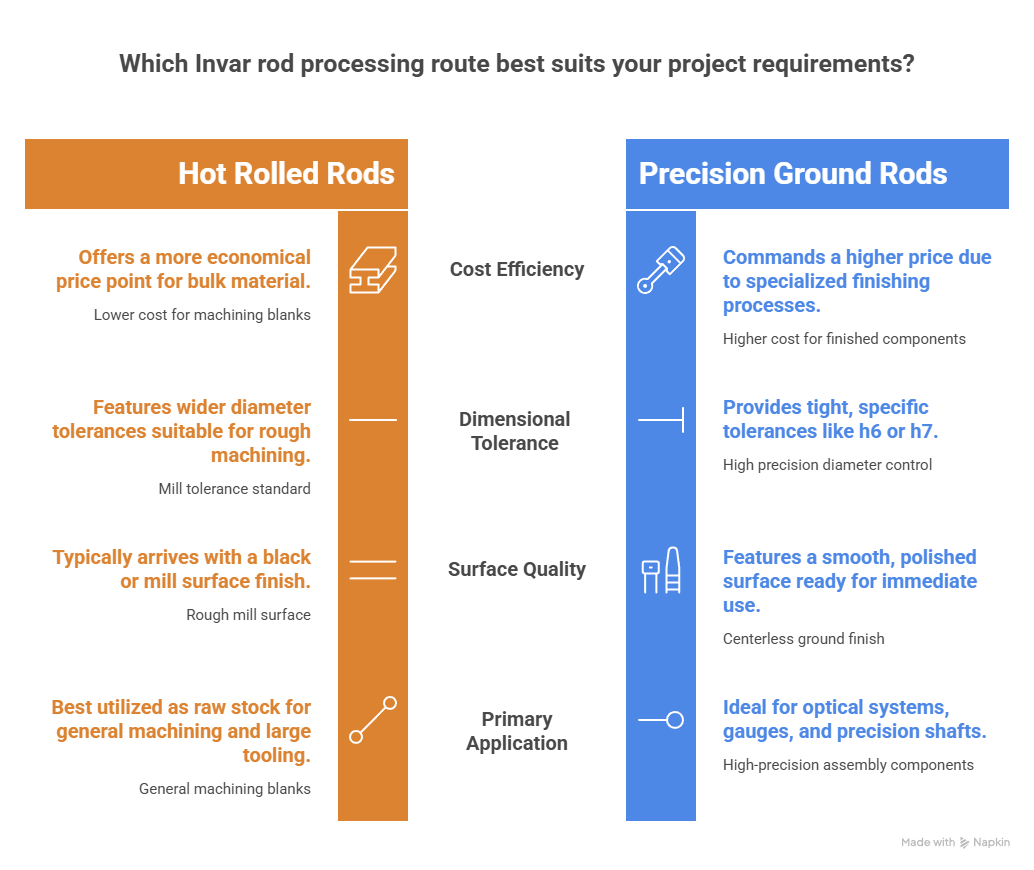
Invar rods are available in different processing routes, including hot rolled, forged, cold drawn, peeled, turned, and precision ground. The right option depends on final machining, tolerance, surface requirement, dimensional stability, and budget.
Hot Rolled Invar Rods
Hot rolled Invar rods are usually more economical and suitable for machining blanks. They may have a black or mill surface and wider diameter tolerance. This option is practical when the buyer will machine the rod to final dimensions.
Cold Drawn Invar Rods
Cold drawn rods offer better dimensional control and surface quality than hot rolled rods. They are useful for small to medium diameters and applications requiring better straightness or machining preparation. However, cold drawing introduces work hardening and internal stress, so stress relief may be needed for precision applications.
Precision Ground Invar Rods
Precision ground Invar rods are used when tight diameter tolerance, smooth surface, and good straightness are required. They cost more than hot rolled or cold drawn rods but can reduce machining time for precision components.
| Rod Option | Main Advantage | Cost Level | Best Use |
|---|---|---|---|
| Hot rolled rod | Economical and available in larger sizes. | Lower | General machining blanks and tooling stock. |
| Forged rod | Suitable for large diameters and heavy sections. | Medium to high | Large molds, heavy precision components, custom billets. |
| Cold drawn rod | Better tolerance and surface than hot rolled rod. | Medium | Small shafts, pins, precision machining stock. |
| Peeled / turned rod | Removes surface defects and improves diameter consistency. | Medium to high | Machined components and controlled surface applications. |
| Precision ground rod | Tight tolerance, smooth surface, improved straightness. | High | Optical parts, measuring rods, precision shafts, gauges. |
Heat Treatment and Annealed Condition for Invar Steel Rods
Heat treatment is important for Invar steel rods because it affects internal stress, dimensional stability, machinability, and low-expansion behavior. Common delivery conditions include annealed, stress relieved, cold worked, hot rolled, and custom heat-treated conditions.
Annealed Condition
Annealed Invar rods are used when the buyer needs better ductility, lower hardness, and improved machining stability. Annealing can reduce internal stress and improve uniformity. For precision parts, annealed or stress-relieved material is often preferred before final machining.
Stress-Relieved Condition
Stress relief is commonly requested for precision rods, tooling parts, molds, and optical structures. Invar can move or distort during machining if internal stress is high. Stress-relieved rods help reduce this risk, especially when the final component has tight dimensional requirements.
Cold Worked Condition
Cold drawn or cold worked rods can provide better strength and tighter dimensions, but cold work may influence thermal expansion behavior. If the final application requires certified low expansion, the supplier should confirm whether the cold worked condition is acceptable or whether additional heat treatment is needed.
| Condition | Main Purpose | Typical Application |
|---|---|---|
| Hot rolled | Economical stock for machining. | Rough machining blanks and large rods. |
| Annealed | Improves ductility and reduces hardness. | Precision machining and forming applications. |
| Stress relieved | Reduces distortion during machining or service. | Aerospace tooling, optical supports, precision molds. |
| Cold drawn | Improves size control and strength. | Small rods, pins, guide rods, precision parts. |
| Custom heat treated | Meets special CTE or dimensional stability requirements. | High-precision or customer-specific projects. |
Surface Finish, Straightness, and Tolerance Requirements
Surface finish, straightness, and tolerance are important when buying Invar steel rods. Many Invar rods are used in precision assemblies, so dimensional requirements may be stricter than ordinary steel rod supply.
Surface Finish Options
Common surface conditions include black hot rolled surface, peeled surface, turned surface, polished surface, and centerless ground surface. Mill finish is more economical, while precision ground surface is more expensive but provides better tolerance and appearance.
Straightness Requirements
Straightness is important for long rods, optical supports, measuring rods, shafts, and guide components. If straightness is critical, the buyer should provide a numerical straightness tolerance instead of only requesting “good straightness.”
Diameter Tolerance
Diameter tolerance affects machining cost and final assembly. For rough machining stock, standard tolerance may be enough. For precision rods, buyers may need h6, h7, h8, or custom tolerances depending on the application. Tighter tolerance increases processing cost.
| Requirement | Standard Option | Precision Option | Cost Impact |
|---|---|---|---|
| Surface | Hot rolled or peeled | Ground or polished | Precision surface increases cost. |
| Diameter tolerance | Mill tolerance | h6, h7, h8, or custom tolerance | Tighter tolerance requires grinding or drawing. |
| Straightness | General commercial straightness | Controlled straightness per meter | Extra straightening and inspection may be required. |
| Length | Random length or stock length | Cut-to-length with tight tolerance | Cutting and inspection add cost. |
| Surface roughness | Not specified | Ra requirement specified by drawing | Grinding or polishing may be required. |
Invar Steel Rods for Aerospace, Optical, Mold, and Precision Instruments
Invar steel rods are used across many industries where thermal expansion control is critical. The most common applications include aerospace tooling, optical systems, molds, precision instruments, cryogenic equipment, electronic devices, and scientific equipment.
Aerospace Applications
In aerospace tooling, Invar rods and related Invar materials are used for composite molds, assembly fixtures, measuring equipment, and dimensionally stable supports. The low expansion of Invar helps maintain mold geometry during heating and cooling cycles.
Optical and Laser Systems
Optical assemblies require stable alignment. Invar rods are used in lens mounts, mirror supports, laser equipment, optical frames, and precision positioning structures. For these applications, precision ground rods and stress-relieved material may be required.
Mold and Tooling Applications
Invar rods can be machined into mold supports, guide parts, tooling frames, and fixtures. For large molds, the supplier should consider internal stress, machining allowance, and heat treatment condition because distortion can affect final tooling accuracy.
Precision Instruments
Invar rods are used for measuring devices, gauges, scientific instruments, reference rods, and calibration equipment. These applications may require CTE testing, tight tolerance, stable heat treatment, and clean surface finish.
| Industry | Typical Invar Rod Parts | Key Requirement |
|---|---|---|
| Aerospace | Composite tooling supports, fixture rods, mold components | Low expansion, stress relief, traceability. |
| Optical | Lens supports, mirror frames, optical rods, laser mounts | Precision ground surface and dimensional stability. |
| Mold manufacturing | Guide rods, mold support rods, machined tooling blanks | Machining stability and low distortion. |
| Precision instruments | Measuring rods, gauges, reference components | CTE control, straightness, tight tolerance. |
| Cryogenic equipment | Low-temperature supports and structural parts | Dimensional stability and toughness at low temperature. |
Quality Inspection and Material Certification from Invar Rod Suppliers
Reliable Invar rod suppliers should provide clear quality inspection and material certification. Since Invar rods are often used for precision applications, buyers should not only check the price. They should also check whether the supplier can provide proper grade verification, chemical analysis, dimensional inspection, straightness control, CTE testing, and traceability.
Common Inspection Items
| Inspection Item | Purpose | When It Is Needed |
|---|---|---|
| Chemical composition test | Confirms Invar 36 / UNS K93600 chemistry. | All professional Invar rod orders. |
| PMI test | Prevents material mix-up before shipment. | Useful for export and multi-grade orders. |
| CTE test | Confirms low thermal expansion behavior. | Precision tooling, optical, aerospace, and metrology applications. |
| Mechanical test | Checks tensile strength, yield strength, and elongation. | Required when specified by standard or drawing. |
| Hardness test | Confirms condition and work-hardening level. | Cold drawn, ground, or machined rods. |
| Dimensional inspection | Checks diameter, length, tolerance, and straightness. | Precision rods and cut-to-length orders. |
| Surface inspection | Checks cracks, pits, scratches, scale, and machining marks. | Ground, polished, and precision rods. |
| Ultrasonic testing | Checks internal defects in large rods or forged bars. | Large diameter rods and critical machined parts. |
| Third-party inspection | Provides independent verification. | Export projects and high-value precision orders. |
Material Test Certificate Requirements
A complete material test certificate should show grade, heat number, chemical composition, product size, delivery condition, applicable standard, and mechanical properties if required. For precision projects, the buyer may also require CTE data, heat treatment record, dimension report, or third-party inspection documents.
Custom Cutting, Machining, and Small Batch Supply Capability
Many buyers do not need full-length rods. They need cut pieces, machining blanks, trial quantities, sample rods, or small batch supply for prototypes. A capable Invar steel rods supplier should support cutting, grinding, machining allowance, and flexible quantity when possible.
Custom Cutting
Cut-to-length service helps buyers reduce handling and preparation work. For example, a buyer may request 20 mm diameter Invar rods cut into 200 mm pieces for precision components. Cutting loss, saw blade width, length tolerance, and end-face quality should be included in the quotation.
Machining Support
Invar rods can be machined into shafts, pins, spacers, supports, rings, threaded rods, and custom parts. Since Invar can be sensitive to internal stress and dimensional change, machining should be planned carefully. Stress relief may be recommended before or after rough machining for high-precision parts.
Small Batch Supply
Small batch supply is important for research, prototype development, repair, and custom engineering. However, small orders usually have higher unit prices because cutting, packing, testing, and document costs are spread over fewer kilograms. Shanghai NC Metal Materials Co., Ltd. can support supplier-style inquiries by matching grade, size, condition, certificate, and processing requirements before quotation.
| Custom Service | What Buyers Should Provide | Cost Consideration |
|---|---|---|
| Cut-to-length rods | Diameter, length, quantity, length tolerance | Cutting cost and material loss should be included. |
| Precision ground rods | Diameter tolerance, surface roughness, straightness | Grinding increases cost but reduces customer machining. |
| Machined blanks | Drawing, tolerance, machining allowance, heat treatment | CNC time and inspection cost must be calculated. |
| Small batch supply | Exact quantity and required delivery time | Unit price may be higher than bulk orders. |
| Prototype parts | Application, drawing, final inspection needs | Engineering review and special packing may be needed. |
Invar Steel Rods Price Factors and Lead Time
Invar steel rods price depends on nickel price, rod diameter, tolerance, surface finish, heat treatment, quantity, certificate requirements, and lead time. Standard hot rolled rods are usually more economical than precision ground rods. Small diameter cold drawn rods may be more expensive than larger standard stock rods because of drawing and tolerance control.
Main Price Factors
| Price Factor | How It Affects Cost | Buyer Suggestion |
|---|---|---|
| Nickel price | Invar 36 contains about 36% nickel, so nickel market changes affect cost. | Confirm quotation validity before ordering. |
| Rod diameter | Special or large diameters may require production or forging. | Use standard stock diameters when possible. |
| Surface finish | Peeled, turned, polished, or ground rods cost more than mill finish rods. | Choose precision finish only when needed. |
| Tolerance | Tight tolerance requires cold drawing, grinding, or extra inspection. | Provide realistic tolerance based on final use. |
| Heat treatment | Annealing or stress relief adds furnace cost and time. | Specify dimensional stability requirements clearly. |
| CTE testing | Low-expansion verification adds laboratory cost. | Request only when the project needs certified expansion data. |
| Quantity | Small orders usually have higher unit price. | Combine sizes or increase quantity if practical. |
| Lead time | Urgent orders may require stock sourcing or priority processing. | Confirm stock and schedule early. |
Lead Time Logic
If the required Invar rod size is in stock, delivery can be faster after cutting, inspection, packing, and documentation. If the size requires cold drawing, forging, grinding, stress relief, or special testing, lead time will be longer. For precision or aerospace-related projects, buyers should leave enough time for certificate preparation and inspection.
How to Choose Reliable Invar Steel Rods Suppliers
Choosing reliable Invar steel rods suppliers is not only about comparing the lowest price. Buyers should check whether the supplier understands controlled expansion alloys, can confirm grade identity, provide suitable rod condition, support precision tolerance, offer testing and certification, and communicate clearly about lead time and processing limitations.
Supplier Selection Checklist
| Supplier Checkpoint | What to Confirm | Why It Matters |
|---|---|---|
| Grade knowledge | Invar 36 / UNS K93600 / 1.3912 / 4J36 identification | Prevents wrong controlled expansion alloy supply. |
| Product capability | Hot rolled, cold drawn, forged, peeled, ground rods | Ensures the supplier can match the required rod condition. |
| Size availability | Diameter range, stock length, custom cutting | Affects quotation speed and lead time. |
| Tolerance support | Diameter tolerance, straightness, surface roughness | Important for precision machining and assembly. |
| Heat treatment control | Annealed, stress relieved, or custom condition | Improves dimensional stability for precision parts. |
| Testing support | MTC, PMI, CTE test, mechanical test, UT, third-party inspection | Supports technical verification and project approval. |
| Small batch supply | Prototype, sample, repair, and cut pieces | Useful for non-standard engineering projects. |
| Export experience | Packing, documents, marking, international shipment | Reduces delivery and customs problems. |
Questions Buyers Should Ask Before Ordering
Before ordering, buyers should ask whether the rods are in stock or newly produced, what standard they meet, whether the material has heat number traceability, what surface finish is available, whether straightness can be controlled, whether CTE testing is available, and whether the supplier can cut or grind rods to the required length and tolerance.
Why Very Low Prices Need Careful Checking
Very low prices may not include the required grade, certificate, heat treatment, surface finish, or testing. For Invar rods, wrong material or unstable expansion behavior can cause more loss than a small price difference. Buyers should compare quotations based on the same grade, diameter, condition, tolerance, certificate, and delivery term.
How to Send a Clear Inquiry for Invar Steel Rods
A clear inquiry helps suppliers quote faster and more accurately. Buyers should provide grade, diameter, length, quantity, tolerance, surface finish, heat treatment condition, testing requirement, standard, application, and delivery destination.
Inquiry Information Table
| Inquiry Item | Example Information | Reason |
|---|---|---|
| Grade | Invar 36 / UNS K93600 / W.Nr. 1.3912 / 4J36 | Confirms the exact alloy. |
| Rod diameter | 10 mm, 20 mm, 50 mm, or custom size | Determines stock availability and production route. |
| Length | Random length, 1000 mm, 3000 mm, cut pieces | Affects cutting cost and packing. |
| Quantity | Kg, pieces, meters, or total length | Affects unit price and MOQ. |
| Surface finish | Hot rolled, peeled, turned, polished, ground | Changes tolerance and cost. |
| Tolerance | Standard tolerance, h7, custom tolerance | Determines whether grinding or drawing is needed. |
| Condition | Annealed, stress relieved, cold drawn, custom heat treated | Affects dimensional stability and machining. |
| Testing | MTC, PMI, CTE test, tensile test, UT, third-party inspection | Ensures quality and project compliance. |
| Application | Aerospace tooling, optical frame, mold, instrument, cryogenic equipment | Helps the supplier recommend suitable material condition. |
| Delivery destination | Country, port, courier address, freight term | Needed for packing, shipping, and export documents. |
Example of a Professional Inquiry
A complete inquiry may read: “Please quote Invar 36 rods, UNS K93600 / W.Nr. 1.3912, diameter 20 mm, length 1000 mm, precision ground surface, h7 tolerance, stress relieved condition, quantity 50 pieces, with MTC and CTE test report, used for optical support parts, delivery to Germany.” This kind of inquiry allows the supplier to check stock, processing route, certificate cost, and lead time more accurately.
Invar Steel Rods Suppliers Related Questions
What are Invar steel rods used for?
Invar steel rods are used for aerospace tooling, optical supports, measuring rods, precision instruments, molds, gauges, cryogenic components, scientific equipment, and low-expansion structures. They are selected because Invar 36 has very low thermal expansion and helps maintain dimensional stability when temperature changes.
Is Invar 36 the same as steel?
Invar 36 is not ordinary carbon steel. It is a nickel-iron controlled expansion alloy containing about 36% nickel and balance iron. Buyers often call it Invar steel rod because it is supplied in rod form and contains iron, but its main property is low thermal expansion, not the typical behavior of common steel.
How do I choose an Invar rod supplier?
Choose an Invar rod supplier by checking grade knowledge, UNS K93600 certification, available diameter range, rod surface options, straightness and tolerance capability, annealing or stress-relief support, CTE testing availability, material traceability, custom cutting capability, and export experience. A reliable supplier should ask about the application before recommending the final rod condition.


 English
  Korean
  Japanese
  Arabic
  Spanish
  German
  Portuguese
  French
  Russian
  Italian