

Reliable Invar steel rods suppliers should be able to confirm the alloy grade, available diameters, delivery condition, dimensional tolerances, and material traceability before accepting an order. Most buyers searching for Invar rods need Invar 36, an iron-nickel alloy widely used where low thermal expansion helps maintain dimensional stability. However, stock availability, processing history, certification, and testing requirements can vary considerably between suppliers. Whether you are purchasing rods for precision instruments, tooling, measuring equipment, or machined components, the best source is one that can document compliance with your requirements and deliver material in a condition suitable for the next manufacturing step.
What Are Invar Steel Rods?
Invar steel rods are solid lengths of an iron-nickel alloy known for its low coefficient of thermal expansion near room temperature. The material most commonly associated with the name is Invar 36, typically identified as UNS K93600. Its nominal nickel content is approximately 36%, with iron making up most of the balance.
Although buyers frequently use the phrase “Invar steel,” the more precise description is a low-expansion iron-nickel alloy. This distinction matters during purchasing because ordinary steel rods do not offer the same thermal expansion behavior. A purchase order that says only “steel rod” leaves too much room for misunderstanding.
The main reason to specify Invar is dimensional control as temperature changes. That does not mean the alloy has zero expansion under all conditions. Its expansion behavior depends on temperature, composition, condition, and processing history. For demanding applications, buyers should define the relevant temperature interval and any required expansion testing rather than relying on the alloy name alone.
How to Choose Invar Steel Rods Suppliers
Start by checking whether the supplier can provide the exact alloy and product condition your project requires. Then evaluate dimensional capability, documentation, inventory, processing services, and delivery commitments. Price becomes meaningful once these requirements match across quotations.
| Selection factor | What a buyer should confirm | Why it matters |
|---|---|---|
| Alloy identification | Invar 36, UNS K93600, or the exact specified alternative | Different low-expansion alloys are not automatically interchangeable. |
| Product specification | Applicable standard, revision, and customer requirements | Defines the acceptance basis for the supplied material. |
| Dimensions | Diameter, length, tolerance, straightness, and machining allowance | Affects usability, machining time, and material yield. |
| Delivery condition | As-rolled, annealed, cold-finished, ground, or another agreed condition | Influences machining and dimensional stability. |
| Traceability | Heat identification linked to the rods and material documents | Supports receiving inspection and quality records. |
| Thermal requirements | Specified expansion limits, temperature range, and test method when required | Connects material acceptance to the intended operating conditions. |
| Availability | Physical stock, quantity, location, and processing schedule | Helps distinguish an immediate shipment from a sourcing estimate. |
| Commercial terms | Price basis, minimum order, processing charges, and freight | Allows a fair comparison of the total purchase cost. |
Which Invar Grade Should You Request?
Invar 36 for Common Low-Expansion Applications
Invar 36 is often the starting point for buyers who need low expansion around ambient temperatures. Suppliers may list it under several descriptions, including Invar 36 rod, Alloy 36 round bar, and UNS K93600 bar. These descriptions can help locate stock, but the final order should identify the exact specification and acceptance requirements.
A commonly referenced material standard is ASTM F1684, which covers iron-nickel and iron-nickel-cobalt alloys for low thermal expansion applications. Buyers should verify that the relevant alloy, product form, condition, and current project requirements are covered before using it as the purchasing basis. Other contractual specifications may apply to particular industries or components.
Other Low-Expansion Alloys
Some suppliers also offer Super Invar, Alloy 42, or other controlled-expansion materials. These grades have different compositions and expansion characteristics. A supplier may suggest one when the requested stock is unavailable, but substitution requires a technical review.
For example, a material selected to match the expansion of glass or ceramic may not be the best choice for a precision fixture designed around Invar 36. Confirm the operating temperature, joining method, mechanical demands, and thermal requirements before approving an alternative.
Why a Trade Name Is Not Enough
Commercial names are useful for searching supplier catalogs, but they do not replace a complete purchasing description. Include the recognized alloy designation, product standard where applicable, delivery condition, dimensions, and any additional test requirements.
If a drawing uses a legacy designation, ask the responsible engineer to confirm the intended modern designation. A supplier’s proposed equivalence should be supported by the relevant technical documentation.
Invar Rods, Round Bars and Precision-Ground Stock
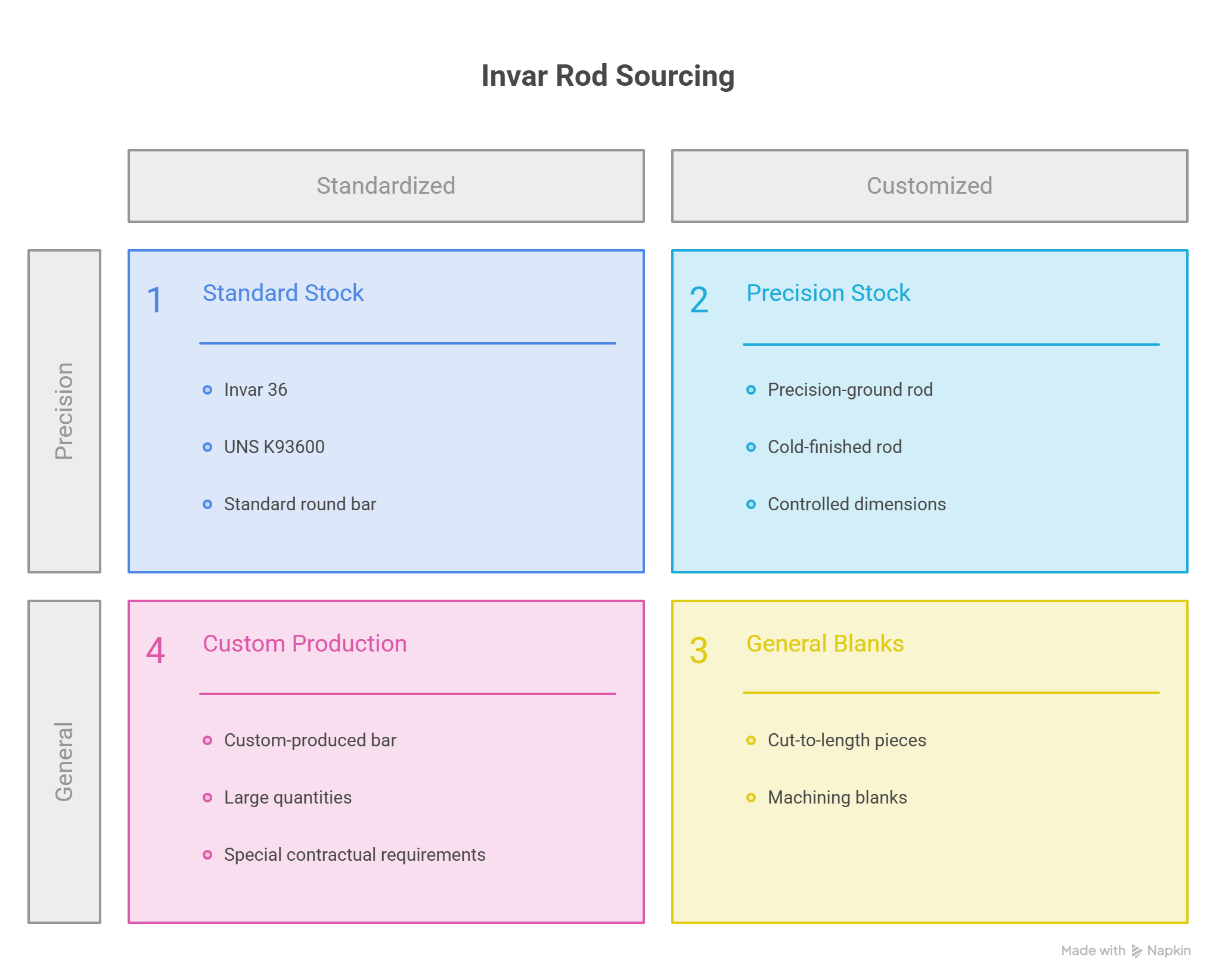
Suppliers do not always use “rod” and “round bar” in exactly the same way. Some use rod for smaller diameters and bar for larger stock, while others use the terms interchangeably. State the required diameter and condition instead of assuming the product name defines the size or finish.
| Supply form | Typical purchasing purpose | Details to discuss |
|---|---|---|
| Standard round bar | General machining of shafts, spacers, supports, and instrument parts | Diameter tolerance, surface condition, and machining allowance |
| Cold-finished rod | Applications requiring controlled dimensions before further machining | Finishing route, straightness, condition, and residual-stress considerations |
| Precision-ground rod | Components needing a defined outside diameter or improved surface finish | Diameter tolerance, roundness, straightness, and roughness |
| Cut-to-length pieces | Machining blanks and small production batches | Length tolerance, cut allowance, end condition, and piece identification |
| Custom-produced bar | Unusual sizes, large quantities, or special contractual requirements | Minimum quantity, production schedule, testing, and inspection scope |
Precision-ground stock can reduce some downstream machining, but grinding alone does not establish thermal stability. If dimensional stability is central to the application, discuss the complete processing and inspection requirements with the material supplier and the component manufacturer.
Key Dimensions to Include in Your Inquiry
Diameter and Diameter Tolerance
Specify both the nominal diameter and the permitted variation. A nominal size without a tolerance may be quoted as standard commercial stock, which may not suit a close-fitting component or an automated machining process.
If you intend to machine the outside surface, allow enough material for cleanup. The allowance should account for the supplied surface condition, dimensional variation, straightness, and workholding requirements.
Length and Cutting Allowance
Distinguish between full-length bars, random lengths, and individual cut pieces. When ordering blanks, clarify whether the stated length includes the material needed for facing operations.
A finished component length is usually not the same as the required saw-cut blank length. Providing a drawing or clearly stated blank dimensions helps prevent unusable short pieces.
Straightness, Roundness and Surface Finish
These characteristics can affect machining and assembly even when the diameter is acceptable. Long, slender rods may need a straightness requirement, while parts used directly as sliding or locating elements may require controlled roundness and surface finish.
Avoid relying solely on descriptions such as “smooth” or “precision quality.” Where a characteristic matters, define a measurable acceptance criterion and agree on the inspection method.
Why Material Condition Matters for Invar Rods
Invar is purchased for dimensional behavior, so processing history deserves attention. Forming, machining, and thermal processing can influence residual stress and subsequent dimensional movement. The required delivery condition should be chosen with the component’s manufacturing sequence in mind.
Annealed Material
Annealed material may be requested to meet a particular specification or support a planned machining process. However, the word “annealed” alone does not describe every relevant treatment detail or guarantee the stability of a finished component.
If the project requires a defined condition, reference the applicable standard or approved process requirements. Ask the supplier which processing records are available when documentation is necessary.
Cold-Worked Material
Cold finishing can change dimensions and mechanical properties, but it can also introduce or redistribute residual stresses. Buyers should confirm whether the supplied condition is compatible with the final component requirements.
Do not assume that a rod with a close diameter tolerance will remain unchanged after substantial material removal. For demanding precision work, the manufacturing plan may need intermediate stability checks and an approved treatment sequence.
Machining and Final Stability
A material certificate establishes compliance with the ordered material requirements; it does not guarantee every dimensional characteristic of a subsequently machined part. Finished-part stability depends on the component design, material removal, processing sequence, and service conditions.
For tight-tolerance assemblies, coordinate purchasing with engineering and machining teams before placing the order. Their input can determine whether you need standard bar, a particular condition, extra machining allowance, or additional testing.
Certificates and Testing to Request
Material Test Report
A material test report should identify the supplied material and include the results required by the applicable specification and purchase order. Review the heat or lot identification, reported chemistry, required properties, and stated conformity.
Confirm that the certificate covers the actual rods being delivered. If the supplier cuts a larger bar into multiple pieces, ask how the identity of those pieces remains linked to the original report.
Thermal Expansion Testing
When thermal expansion is an acceptance requirement, define it clearly. The test method, temperature interval, specimen requirements, and acceptance limits should be agreed upon before the order is placed.
A typical catalog value is not automatically a measured result for the supplied heat. Ask whether the quoted documentation includes actual thermal expansion test data or only a statement of grade compliance.
Positive Material Identification
Positive material identification can support grade verification, depending on the equipment and procedure used. It does not by itself establish the thermal expansion behavior of a rod or replace every test required by a material specification.
If identification testing is required, specify the method, coverage, reporting, and acceptance basis. The supplier can then confirm the cost and schedule before processing begins.
Additional Inspection
Some orders require dimensional reports, surface inspection, ultrasonic examination, or independent inspection. These requirements should come from the drawing, applicable standard, or project quality plan.
Define the inspection scope and acceptance criteria rather than requesting “full testing,” which can mean different things to different suppliers.
Where to Buy Invar Steel Rods
Common sourcing options include specialty alloy stockholders, precision metal distributors, mills, and suppliers that combine material sourcing with processing. The appropriate choice depends on order volume, size availability, schedule, and documentation requirements.
| Supplier type | Potential advantage | Points to verify |
|---|---|---|
| Specialty alloy stockholder | May hold several diameters and offer small quantities | Actual inventory, condition, certificates, and cutting charges |
| Precision metal distributor | May offer ground rods and close dimensional tolerances | Finish, dimensional inspection, processing route, and traceability |
| Mill or primary producer | May suit larger quantities or custom production requirements | Minimum order, production schedule, available sizes, and test scope |
| Machining and material supplier | May deliver prepared blanks or components | Drawing control, inspection responsibility, and material documentation |
| International trading supplier | May locate material across several sources | Original producer, certificate authenticity, stock location, and shipping terms |
Online directories and marketplaces can help identify potential sources, but a listing does not confirm current stock or technical compliance. Request a written quotation and supporting documents before treating a catalog entry as a qualified supply option.
Domestic vs. Overseas Invar Suppliers
Domestic Purchasing
A domestic supplier may offer shorter shipping routes, simpler communication, and easier handling of small repeat orders. Local stock can also be useful when a workshop needs a replacement blank quickly.
However, a local business may still source material internationally. Ask where the quoted rods are physically located and whether they are ready for dispatch.
Overseas Purchasing
An overseas source may provide a wider size range or a competitive quotation for larger orders. Compare the full landed cost, including freight, insurance, duties where applicable, inspection, and any extra packaging.
Agree on delivery terms, document requirements, payment milestones, and the procedure for handling nonconforming material. Returning a small order internationally can cost more than expected, making clear acceptance requirements particularly valuable.
Country of Origin and Customer Restrictions
Some projects specify an approved manufacturer, country of origin, or source qualification requirement. Include those restrictions in the initial inquiry.
A distributor’s location is not the same as the material’s country of origin. If origin documentation is required, identify the acceptable evidence before ordering.
What Affects Invar Rod Prices?
Invar rod prices vary with nickel market conditions, stock availability, bar size, quantity, delivery condition, processing, and documentation. There is no single dependable price that applies to every diameter, destination, and order scope.
Diameter and Production Availability
Standard stocked diameters may be easier to source than unusual sizes. A special diameter can require additional processing, a larger starting bar, or a production order with a minimum quantity.
Large and small diameters can each present different supply constraints. Ask suppliers which dimensions are available before assuming a particular size will be economical.
Order Quantity and Minimum Charges
Small orders may carry cutting, packing, or minimum invoice charges. These fixed costs can make the price per kilogram appear high even when the material cost is reasonable.
Larger orders may improve purchasing efficiency, but they can also exceed current inventory and trigger a longer production lead time. Compare both price and delivery availability.
Precision Processing
Grinding, machining, close-tolerance cutting, and special inspection add work to the supply scope. The extra purchase cost may be justified if it reduces machining time or scrap at your facility.
Compare prepared-stock quotations against the complete cost of buying larger raw bar and processing it yourself. Include setup, tooling, inspection, material loss, and production time.
Documentation and Special Testing
Additional thermal expansion testing, independent inspection, or detailed inspection records can affect both cost and schedule. Ask suppliers to separate optional services from the base material price where practical.
Specify necessary testing accurately. A vague request can produce inconsistent quotations or leave a required inspection outside the agreed scope.
How to Compare Invar Rod Quotations
Create a comparison using the same technical requirements for every supplier. Check that each offer covers the same alloy, condition, dimensions, quantity, and documentation before evaluating the total price.
| Quotation item | What to check |
|---|---|
| Alloy designation | The quoted grade matches the inquiry and drawing. |
| Material specification | The correct standard and revision are identified. |
| Dimensions and condition | Diameter, length, tolerance, finish, and delivery condition match. |
| Quantity basis | The number of pieces, total weight, and billing method are clear. |
| Processing | Cutting, grinding, marking, and inspection are included where required. |
| Documentation | Certificate content, traceability, and extra test reports are confirmed. |
| Delivery commitment | Stock status and dispatch timing are stated clearly. |
| Total cost | Freight, packaging, minimum charges, and exclusions are accounted for. |
If one quotation is substantially cheaper, ask what differs. The reason may be a different condition, fewer documents, a longer delivery time, or a different dimensional scope. Clarifying the difference is more useful than assuming either quotation is directly comparable.
Using Weight to Check an Invar Rod Quotation
Estimated weight can help buyers review freight charges and compare offers priced by mass. For a solid round rod, weight can be estimated from its cross-sectional area, length, and material density.
Using a nominal density of approximately 8,050 kg/m³, the estimated weight in kilograms is:
Weight ≈ π ÷ 4 × diameter² × length × 8,050, with diameter and length expressed in meters.
For a rod measuring 25 mm in diameter and 1 meter long, the estimated weight is approximately 3.95 kg. This is a planning estimate; actual weight can vary with dimensions, permitted tolerances, and the material’s density.
Ask whether billing is based on theoretical weight, actual shipped weight, or price per piece. For cut orders, clarify whether you are paying for cutting losses or a minimum parent-bar quantity.
Typical Applications for Invar Rods
Precision Instruments and Measuring Equipment
Invar rods may be used in supports, reference elements, and other instrument components where thermal expansion affects alignment or measurement. Suitability depends on the temperature range, mechanical design, and permitted dimensional change.
For these applications, the required expansion behavior may be more important than nominal strength. Purchasing documents should reflect the property the design actually relies on.
Tooling and Fixtures
Low-expansion tooling can help control dimensional differences during thermal changes. Invar stock may be machined into locating features, supports, spacers, or other tooling components.
The finished tool’s performance also depends on geometry, joints, temperature distribution, and processing. Material selection and fabrication planning should be considered together.
Optical and Positioning Assemblies
Some optical and positioning systems use low-expansion materials to help maintain relative component positions. Rods can serve as machined members or starting stock for precision parts.
Designers should also consider stiffness, mass, thermal conductivity, magnetic behavior, and environmental exposure. Low expansion is one material characteristic within the overall design.
Temperature-Sensitive Industrial Components
Invar may be considered for specialized industrial components where temperature changes cause unacceptable dimensional movement in conventional materials. Before purchasing, confirm that the operating temperature range is appropriate for the specified grade.
Do not assume Invar provides the same expansion advantage at every temperature. Use relevant material data and any required testing for the actual service interval.
Machining Considerations to Discuss Before Buying
Invar machining benefits from a process suited to the alloy and component geometry. Workholding, tool selection, heat generation, and the sequence of material removal can influence the result.
From a purchasing perspective, the useful questions are practical: How much machining allowance is needed? Is the incoming bar straight enough? Will the supplied condition suit the machining plan? Does the finished part require an approved stabilization process or additional inspection?
- Confirm the minimum starting diameter with the machining team.
- Include enough length for facing and workholding.
- Specify surface defects or dimensional limits that would affect yield.
- Keep heat identification associated with blanks throughout production.
- Agree on the required material condition before placing the order.
- Coordinate any special processing with the finished-part requirements.
For very small or long components, confirm whether precision-ground stock offers a practical benefit. For heavily machined components, discuss whether buying closer-to-size stock could reduce waste without compromising the production plan.
How to Write an Invar Rod Request for Quotation
A complete inquiry reduces repeated questions and helps suppliers quote the intended material. Use the following structure and replace the placeholders with project requirements.
| RFQ field | Information to include |
|---|---|
| Material | Invar 36 / UNS K93600, or the exact required grade |
| Product | Solid round rod or round bar |
| Specification | Applicable material standard and revision |
| Dimensions | Diameter × length, including tolerances and allowances |
| Quantity | Number of pieces and any permitted quantity variation |
| Condition | Required delivery condition and finish |
| Thermal requirements | Expansion limits, temperature interval, and test requirements if applicable |
| Documents | Material report, heat traceability, and inspection records |
| Processing | Cutting, grinding, marking, or other preparation |
| Delivery | Destination, required arrival date, and preferred delivery terms |
A straightforward inquiry might read: “Please quote Invar 36 solid round bar, UNS K93600, to the attached specification. Required dimensions, quantity, condition, tolerances, and documentation are listed in the attachment. Please confirm stock location, dispatch lead time, processing charges, and delivery terms. Any proposed deviation requires written approval.”
Where the inquiry includes drawings, identify the current revision. Ask the supplier to list exceptions explicitly rather than assuming an unqualified quotation covers every attachment.
Receiving Inspection and Storage
Check the Shipment Against the Order
On arrival, compare the quantity, dimensions, labels, and delivery condition with the purchase order. Review the material documents and confirm that heat identification matches the supplied rods or agreed packaging records.
Record any damage, missing pieces, or document discrepancies before releasing material to production. Resolving an issue is easier while the original labels and packaging are available.
Preserve Material Identification
When bars are cut into blanks, transfer identification using an approved method that preserves the link to the material report. Keep different heats or grades separated where mix-ups could occur.
If individual-piece identification is required, specify it before delivery. Bundle-level identification may not satisfy a process in which pieces are separated immediately.
Protect Surfaces and Straightness
Store rods so that handling and support do not introduce damage or unacceptable bending. Precision-ground surfaces may need additional protection against scratches and contamination.
Invar should not be assumed to have the corrosion resistance of stainless steel. Use storage and handling practices appropriate to the alloy, surface condition, and intended application.
Common Buying Mistakes
Ordering “Invar” Without a Grade
The name alone may not fully define what the supplier should provide. Include the alloy designation and applicable specification so that alternatives are not accepted unintentionally.
Assuming Low Expansion Means Zero Expansion
Invar expands with temperature, and its behavior changes across temperature ranges. Define the relevant interval and required performance where thermal movement is critical.
Confusing Dimensional Precision With Stability
A ground rod can have an accurate diameter while still requiring careful processing for a demanding finished component. Incoming geometry and long-term dimensional behavior are related purchasing concerns, but they are not the same property.
Requesting Certificates After Delivery
Special documentation and testing may be difficult or costly to arrange after material has been cut or shipped. Include them in the original inquiry and order.
Comparing Material Prices Without Freight or Processing
A low price per kilogram can become less attractive after cutting, inspection, packing, and shipping charges are added. Compare the full delivered scope.
Accepting Substitutions Without Review
Another iron-nickel alloy may have a different thermal expansion profile or processing requirement. Obtain technical approval before changing the grade, condition, or specification.
Related Questions
Where can I buy Invar rods?
You can buy Invar rods from specialty alloy stockholders, precision metal distributors, and mills. Search for the required grade, such as Invar 36 or UNS K93600, then confirm diameter, length, condition, certificates, physical stock, and delivery timing. For a small order, a stockholder offering cut lengths may be practical; larger or unusual requirements may suit a mill-supported order.
Is Invar 36 the same as steel?
Invar 36 is an iron-nickel alloy with approximately 36% nickel, commonly purchased for its low thermal expansion near room temperature. Although it is often called Invar steel, it differs substantially from ordinary carbon steel in composition and behavior. Use the exact alloy designation when ordering.
How much do Invar rods cost?
The price depends on diameter, length, quantity, condition, availability, processing, certification, and shipping destination. A current supplier quotation is needed for a reliable figure. Compare offers using the same specification and include cutting, testing, packaging, and freight when assessing the total cost.


 English
 Korean
 Japanese
 Arabic
 Spanish
 German
 Portuguese
 French
 Russian
 Italian