

Nickel 200 suppliers provide commercially pure nickel in forms such as sheet, plate, round bar, pipe, tube, strip, wire, and forging stock. Choosing a suitable source starts with confirming the exact grade, product specification, dimensions, delivery condition, and required certificates. Nickel 200, identified as UNS N02200, is valued for its resistance to many corrosive environments, good thermal and electrical conductivity, and useful fabrication properties. However, a supplier’s ability to meet your order depends on more than listing the alloy in a catalog. Actual stock, processing capability, traceability, testing, and delivery commitments determine whether the material will suit your project and arrive ready for production.
What Is Nickel 200?
Nickel 200 is a wrought, commercially pure nickel grade with a minimum nickel content of approximately 99%, with cobalt commonly included in the specification’s nickel accounting. It is generally identified by UNS N02200. Unlike nickel-based alloys designed around substantial additions of chromium, molybdenum, or copper, Nickel 200 consists predominantly of nickel with controlled amounts of other elements.
The material is used where its combination of corrosion resistance, conductivity, ductility, and mechanical properties is useful. Applications include certain chemical-processing equipment, alkaline service components, electrical parts, and fabricated industrial products. Its suitability depends on the actual environment, including temperature, concentration, contaminants, aeration, flow, and mechanical stress.
Nickel 200 is not interchangeable with every product described as pure nickel. Powder, plating anodes, battery materials, electroformed nickel, and wrought industrial stock can have different specifications and purchasing requirements. When sourcing material for a component, identify the wrought grade and product form explicitly.
Where Can You Buy Nickel 200?
Common sources include specialty alloy stockholders, metal service centers, nickel alloy distributors, tube and pipe specialists, and mills. Some businesses carry finished stock in several sizes; others procure material after receiving an order.
For a small order of standard bar or sheet, a stockholder offering cut pieces may be practical. Large quantities, unusual dimensions, or special contractual requirements may require a mill-supported order. If the purchase includes finished fittings or machined components, choose a supplier that can document both the material and the relevant manufacturing requirements.
| Supplier type | Potential benefit | What to verify |
|---|---|---|
| Specialty alloy stockholder | Access to stocked sizes and smaller quantities | Physical inventory, certificates, cutting services, and minimum charges |
| Metal service center | Sheet and plate preparation, cutting, and consolidated orders | Grade availability, processing limits, dimensional tolerances, and traceability |
| Pipe and tube specialist | Product-specific knowledge and access to piping sizes | Manufacturing route, applicable standard, wall thickness, and testing |
| Mill or primary producer | Production orders and larger-volume requirements | Minimum quantity, size range, production schedule, and inspection scope |
| Material and machining supplier | Prepared blanks or components from a single source | Drawing control, inspection records, material identity, and processing responsibility |
A website listing is a starting point for an inquiry. It does not establish that your exact size is in stock or that the offered material complies with your project specification. Obtain written confirmation before placing an order.
Nickel 200 vs. Nickel 201
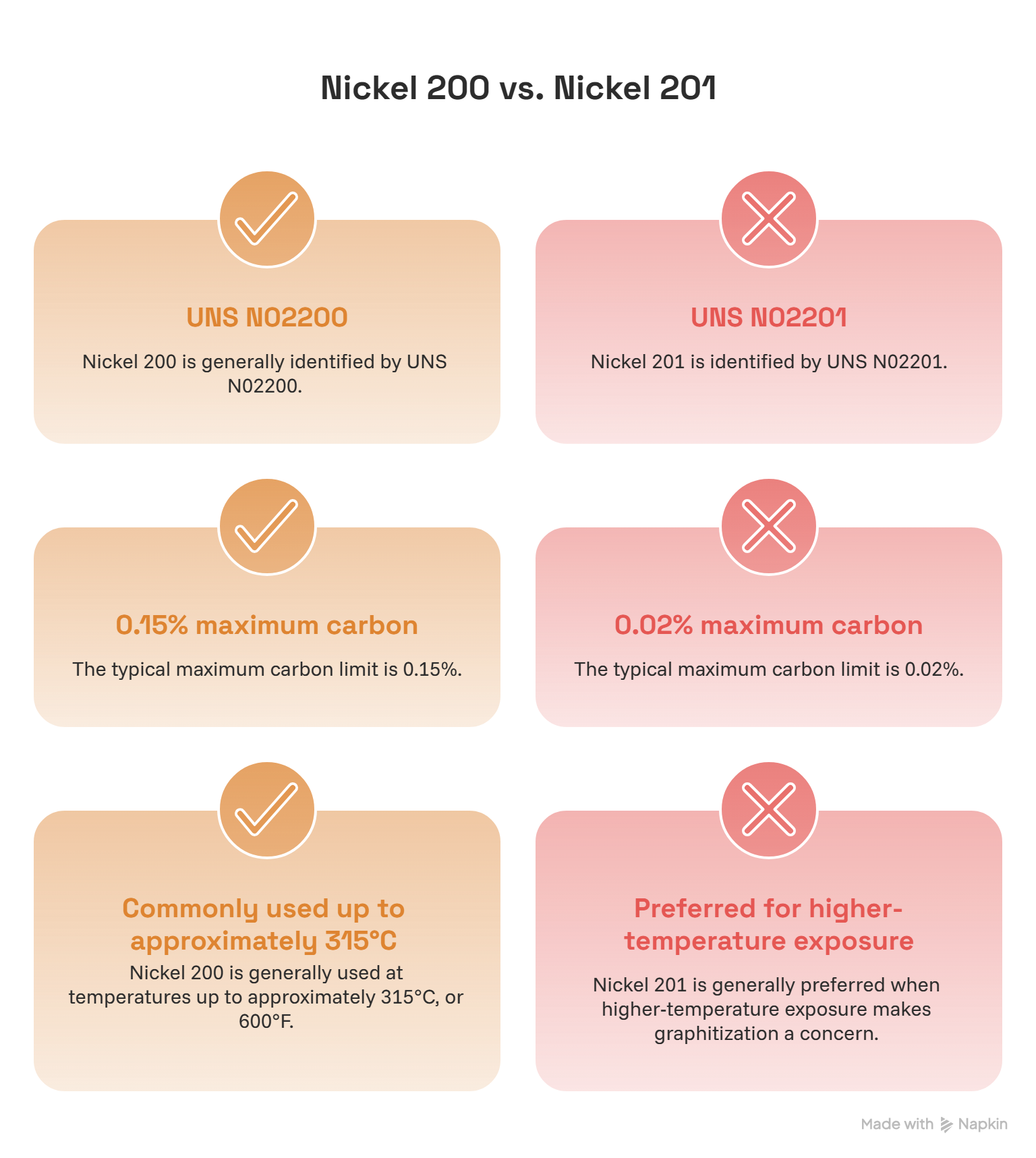
One of the most important purchasing distinctions is between Nickel 200 and Nickel 201. Nickel 201, UNS N02201, is the lower-carbon grade. The grades are closely related, but the difference in carbon limits matters when selecting material for elevated-temperature service.
Nickel 200 is generally used at temperatures up to approximately 315°C, or 600°F. At higher temperatures, extended exposure can make its carbon content a concern because of graphitization and associated loss of ductility. Nickel 201 is generally preferred when this mechanism is relevant. Final selection also depends on the environment, design code, product specification, and mechanical requirements.
| Characteristic | Nickel 200 | Nickel 201 |
|---|---|---|
| UNS designation | N02200 | N02201 |
| General description | Commercially pure wrought nickel | Lower-carbon commercially pure wrought nickel |
| Typical maximum carbon limit | 0.15% | 0.02% |
| Temperature selection | Commonly used up to approximately 315°C | Generally preferred for higher-temperature exposure where graphitization is a concern |
| Purchasing requirement | Specify grade, form, condition, and governing standard | Specify grade, form, condition, and governing standard |
These carbon limits are commonly specified values; the applicable standard and its revision remain the contractual reference. If a supplier offers dual-certified Nickel 200/201, review the certificate to confirm compliance with both grades and the required product standard. Dual certification should be supported by the reported results and applicable requirements.
Nickel 200 Products Available from Suppliers
Sheet and Plate
Nickel 200 sheet and plate are used as starting material for fabricated equipment, covers, linings, vessels, and machined components. Availability depends on thickness, width, length, condition, and surface requirements.
Include flatness and thickness tolerance where they affect fabrication or machining. For cut blanks, define whether the requested dimensions are finished sizes or stock sizes that include cutting and machining allowance.
Round Bar and Rod
Round bar and rod can be machined into shafts, pins, fittings, spacers, and other components. Suppliers may offer hot-worked, cold-finished, or ground stock, subject to size and specification.
Confirm diameter tolerance, length, straightness, surface condition, and delivery condition. The terms “rod” and “bar” are not used consistently by every supplier, so dimensions should always be stated explicitly.
Pipe
Nickel 200 pipe may be supplied for chemical-process lines and other fluid-handling applications. Buyers need to specify nominal pipe size, schedule or wall thickness, length, end preparation, manufacturing route, and applicable standard.
Check that the quotation identifies pipe rather than tube when the design uses nominal pipe sizes. A similar outside diameter does not automatically establish equivalent dimensions or specification compliance.
Tube
Tube inquiries usually require outside diameter, wall thickness, length, tolerances, and intended product specification. Applications may include heat-transfer equipment, instrumentation, and specialized process systems.
Where a project requires particular nondestructive examination, pressure testing, or dimensional inspection, include the method and acceptance basis in the inquiry.
Strip and Wire
Strip and wire can serve electrical, forming, and specialized manufacturing applications. Purchasing requirements may include thickness or diameter, width, temper, coil size, edge condition, and surface finish.
For automated manufacturing, coil presentation and consistent dimensions can be as important as grade compliance. Discuss the equipment’s requirements before accepting an alternative package size or delivery condition.
Forging Stock and Finished Components
Suppliers may offer stock for forging or source finished flanges, fittings, and machined parts. These orders require a clear distinction between raw material compliance and finished-product compliance.
A material certificate for the starting stock does not, by itself, establish that a finished fitting satisfies the required dimensional, manufacturing, pressure-rating, or inspection standard. Define both sets of requirements where applicable.
Common Specifications for Nickel 200
The appropriate specification depends on the product form. A supplier should identify the standard being quoted rather than describing all Nickel 200 products under one generic reference.
| Product form | Common ASTM reference | Purchasing notes |
|---|---|---|
| Plate, sheet, and strip | ASTM B162 | Confirm grade, dimensions, condition, and required supplementary provisions. |
| Rod and bar | ASTM B160 | Confirm size, condition, tolerances, and mechanical requirements. |
| Seamless pipe and tube | ASTM B161 | Specify product dimensions, manufacturing requirements, and applicable testing. |
| Welded pipe | ASTM B725 | Verify dimensional scope, grade, and required examination. |
| Welded tube | ASTM B730 | Confirm tube dimensions, condition, and test requirements. |
| Forgings | ASTM B564 | Confirm that the specified grade, product, and contractual requirements are covered. |
Use the standard edition required by the project and verify its scope. Pressure equipment may require corresponding ASME specifications or other code provisions. A supplier’s quotation should address those requirements explicitly when they form part of the order.
How to Evaluate Nickel 200 Suppliers
Confirm Grade and Specification Compliance
Ask the supplier to identify Nickel 200 as UNS N02200 and state the product specification. Review any proposed deviations from the inquiry, including changes to condition, dimensions, testing, or documentation.
If a supplier offers an alternative grade, obtain technical approval before proceeding. Stock availability is a commercial consideration; it does not establish material equivalence.
Check Actual Inventory
Ask whether the quoted quantity is physically available in the correct form, size, and condition. A supplier may advertise a broad range while holding only selected dimensions.
Confirm stock location and whether the delivery estimate includes warehouse transfers, cutting, testing, document preparation, and packing. For urgent purchases, request a specific expected dispatch date.
Review Material Traceability
The delivered material should remain linked to its heat identification and required documents. This becomes especially important when a service center cuts plate, divides bar, or repackages tube.
Specify whether identification is required on every piece, each bundle, or an accompanying schedule. The correct approach depends on how your facility receives, stores, and processes the material.
Assess Processing Capability
Cutting, grinding, machining, and other preparation can improve production efficiency when the supplier has suitable equipment and inspection procedures. Confirm tolerances, surface requirements, allowances, and marking before ordering processed material.
For components supplied to a drawing, identify the current revision and agree on inspection responsibility. A quotation should clearly separate any exceptions from the accepted scope.
Evaluate Commercial Reliability
Clear communication about availability, payment terms, quotation validity, and delivery is a useful indicator of how an order will be handled. Ask how the supplier manages shortages, schedule changes, and nonconforming shipments.
For repeat procurement, consider consistency of documentation and delivery as well as the initial price. A source that reliably supplies usable material can reduce administrative work and production interruptions.
Material Certificates and Inspection
Material Test Reports
A material test report should identify the supplied grade, relevant heat or lot, applicable specification, and results required by the order. Review chemistry and mechanical data where applicable, along with any required supplementary tests.
If the project specifies a particular inspection-document type, such as EN 10204 Type 3.1, state it in the inquiry. Do not assume that every document described informally as a “certificate” contains the required information.
Positive Material Identification
Positive material identification can support checks for material mix-ups, depending on the method and equipment used. However, common handheld X-ray fluorescence instruments generally do not measure carbon, so an XRF check alone cannot establish the carbon distinction between Nickel 200 and Nickel 201.
Where grade acceptance depends on carbon content, use the required chemical analysis and documentation. Define the identification method and reporting scope if additional testing is part of the order.
Dimensional Inspection
Dimensions should be verified against the specified tolerances, particularly for precision bar, cut blanks, and thin-wall tube. Agree on the inspection scope when a formal report is required.
Visual descriptions such as “good finish” or “precision quality” are difficult to enforce. State measurable requirements for roughness, straightness, flatness, or other characteristics when they affect use.
Additional Testing
Depending on the specification and application, an order may require ultrasonic examination, pressure testing, other nondestructive testing, or independent inspection. Define the test method, coverage, acceptance criteria, and reporting requirements.
Requirements are easier to schedule before the material is cut or shipped. Late additions can create delays or require work to be repeated.
What Affects Nickel 200 Prices?
Nickel 200 prices vary with nickel market conditions, manufacturing costs, dimensions, quantity, stock availability, delivery condition, and processing requirements. There is no single price per kilogram that applies to every product and order.
Product Form and Size
Plate, bar, pipe, and tube have different production routes and supply conditions. An unusual thickness or diameter may require special sourcing, while a standard stocked size may be available with fewer preparation steps.
A quote for raw stock is also different from a quote for precision-ground bar or prepared machining blanks. Compare the product actually being delivered.
Quantity and Minimum Charges
Small orders can carry minimum invoice, cutting, or packing charges. These costs may noticeably increase the effective price per kilogram.
A larger order may improve pricing but exceed current stock. Ask whether the quotation is based on warehouse inventory or a production order, since this affects delivery.
Certification and Processing
Additional inspection, special certificates, close tolerances, and machining add work to the supply scope. Request separate pricing for optional services where that helps compare alternatives.
Prepared material may still be economical if it reduces workshop labor, scrap, or setup time. Consider the total manufacturing cost rather than material weight alone.
Shipping and Import Costs
Freight, packaging, insurance, customs charges where applicable, and delivery terms affect landed cost. Heavy plate and long bars can have handling requirements that differ from small parcels of cut pieces.
Compare quotations using equivalent delivery terms. Confirm who arranges transport, who handles import clearance, and which charges remain outside the quoted amount.
How to Compare Supplier Quotations
Issue the same technical inquiry to each supplier and ask for exceptions to be listed clearly. Once the scope matches, compare total cost, dispatch timing, and the quality of the supporting information.
| Comparison item | What to check |
|---|---|
| Grade | Nickel 200 / UNS N02200, with any dual certification documented |
| Specification | Correct product standard, revision, and project requirements |
| Dimensions | Same size, tolerance, length, and machining allowance |
| Condition | Same delivery condition and surface requirements |
| Quantity | Same piece count, length, or weight basis |
| Documents | Required certificates, traceability, and inspection records included |
| Processing | Cutting, machining, testing, and marking included where required |
| Schedule | Confirmed availability and realistic dispatch date |
| Delivered cost | Material, preparation, packaging, freight, and exclusions accounted for |
If an offer is substantially cheaper, ask which requirements differ. A price gap may come from a different stock condition, fewer documents, a longer schedule, or excluded processing. Clarifying the cause makes the comparison more useful.
How to Request a Nickel 200 Quote
A complete request for quotation should describe the material and the order sufficiently for the supplier to confirm compliance and availability. Attach drawings or project specifications where dimensions or acceptance requirements cannot be explained clearly in a short inquiry.
- Material designation: Nickel 200 / UNS N02200.
- Product form: sheet, plate, bar, pipe, tube, strip, wire, or another defined product.
- Applicable standard and required revision.
- Dimensions, tolerances, and any machining or cutting allowance.
- Quantity and acceptable delivery split, if applicable.
- Delivery condition and surface requirements.
- Required certificates, traceability, testing, and inspection.
- Cutting, machining, marking, or special packaging.
- Destination, required arrival date, and delivery terms.
- Any approved-source, origin, or substitution restrictions.
A practical inquiry might read: “Please quote Nickel 200, UNS N02200, in the product form and dimensions listed below, to the specified material standard. Include the required material test report and heat traceability. Please confirm stock location, processing charges, dispatch lead time, delivery terms, and any deviations from our requirements.”
For recurring demand, provide a realistic forecast and ask about scheduled releases. Agree on stock reservation, price validity, and release obligations before treating forecast material as committed inventory.
Applications That Influence Material Selection
Caustic and Alkaline Service
Nickel 200 is often considered for caustic service because commercially pure nickel can provide useful resistance in suitable alkaline environments. Selection must account for concentration, temperature, impurities, and the mechanical requirements of the equipment.
A supplier should not make a universal corrosion guarantee from the phrase “caustic service.” Provide the relevant design information to the responsible materials engineer and purchase against the resulting specification.
Chemical Processing
Nickel 200 can be useful in selected chemical environments, but corrosion resistance varies widely with the medium and operating conditions. Oxidizing conditions, contaminants, and changes in concentration can alter performance.
Identify the actual process conditions rather than assuming all nickel products suit all chemical equipment. Grade selection should precede supplier comparison.
Electrical Components
Nickel 200’s conductivity and fabrication properties can be useful in electrical products. Purchasing requirements may emphasize surface condition, dimensions, temper, or forming performance as well as chemistry.
If the material will be joined, plated, stamped, or formed, discuss those manufacturing needs when defining the delivery condition.
Fabricated and Machined Parts
Bar, sheet, and plate may be used to produce custom components. The supplied material should suit the planned forming, welding, or machining sequence.
For critical parts, separate raw-material acceptance from finished-component inspection. Both may be necessary, and each should have a clear contractual basis.
Nickel 200 Fabrication Considerations
Machining
Nickel 200 is ductile and can work-harden during machining. Tool selection, cutting conditions, workholding, and a consistent process can influence productivity and surface quality.
From a purchasing standpoint, confirm stock allowance, straightness, and condition with the machining team. Closer-to-size stock may reduce waste, but it must still provide enough material for cleanup and setup.
Forming
Forming requirements can influence the requested temper or delivery condition. Sheet intended for substantial forming may need different preparation from material purchased for a machined flat part.
Provide relevant forming requirements to engineering and specify the resulting material condition in the order.
Welding
Nickel 200 can be welded using suitable procedures, filler selection, and cleanliness controls. The appropriate approach depends on the joint, product form, service conditions, and applicable code.
If a supplier is delivering welded assemblies, define welding qualifications, inspection, and documentation as part of the finished-product scope. Raw stock certification alone does not cover those requirements.
Domestic and International Sourcing
A domestic stockholder may simplify small orders and shorten transport time when the material is physically available nearby. An overseas source may offer a wider size range or different commercial terms, particularly for larger orders.
Compare actual stock location, total delivered cost, certificates, and the process for handling discrepancies. A distributor’s business address does not establish the material’s origin or warehouse location.
When a project requires a particular manufacturer or country of origin, include that requirement before quotation. Ask for the specified supporting evidence rather than assuming a supplier’s location satisfies it.
Receiving and Storing Nickel 200
Verify Material and Documents on Arrival
Check quantities, dimensions, condition, labels, and packaging against the purchase order. Confirm that heat identification matches the material report and any accompanying identification schedule.
Resolve missing documents or discrepancies before releasing material into production. Original packaging and labels often make investigation easier.
Preserve Traceability After Cutting
When stock is divided into smaller pieces, maintain the link between each piece or controlled batch and its material documentation. Use the identification method required by your quality procedures.
Keep Nickel 200 and Nickel 201 segregated where a mix-up could affect compliance. Similar appearance is not a reliable basis for identifying the grade.
Protect the Surface
Store material in a way that prevents handling damage and contamination relevant to the intended application. Precision surfaces, thin sheet, and prepared tube ends may need additional protection.
Use packaging and handling methods suited to the product. Requirements for raw plate differ from those for clean, prepared components ready for assembly.
Common Purchasing Mistakes
Ordering by the Name “Pure Nickel” Alone
Specify Nickel 200, UNS N02200, and the appropriate product standard. A broad purity description may not define the wrought grade or manufacturing requirements.
Overlooking the Nickel 200 and Nickel 201 Distinction
Carbon limits and service temperature matter. Confirm the selected grade before ordering, and review documentation when dual-certified stock is proposed.
Assuming Catalog Stock Is Ready to Ship
Request confirmation of the exact size, quantity, condition, and physical location. Include processing and documentation time in the delivery assessment.
Requesting Special Tests After Shipment
State inspection and certification requirements before purchase. Some checks become harder once stock has been cut, processed, or separated from its original identification.
Comparing Incomplete Prices
Check cutting, testing, packing, freight, and minimum charges. A quotation should make its inclusions and exclusions clear.
Accepting a Grade Change Without Approval
Another nickel alloy may have different corrosion behavior, conductivity, mechanical properties, or code status. Obtain the required technical approval before accepting a substitution.
Related Questions
Where can I buy Nickel 200?
You can buy Nickel 200 from specialty alloy stockholders, metal service centers, nickel alloy distributors, and mills. The best source depends on product form, quantity, dimensions, certificates, and delivery needs. Confirm actual stock and specification compliance before ordering.
What is the difference between Nickel 200 and 201?
Nickel 201 has a lower carbon limit than Nickel 200. Nickel 200 is generally used up to approximately 315°C, while Nickel 201 is generally preferred for higher-temperature exposure where graphitization is a concern. Select the grade according to the service conditions, applicable specification, and design requirements.
How much does Nickel 200 cost?
The price depends on product form, dimensions, quantity, condition, availability, certification, processing, and delivery location. Request current quotations using the same technical requirements, then compare total delivered cost, including preparation and freight.


 English
 Korean
 Japanese
 Arabic
 Spanish
 German
 Portuguese
 French
 Russian
 Italian