

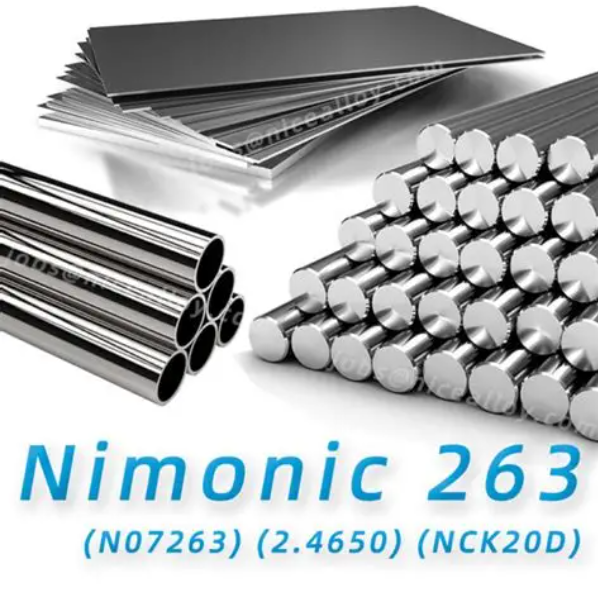
Nimonic 263 equivalent is a common search term used by engineers, buyers, and material planners who need to match Nimonic 263 with UNS, DIN, W.Nr., AMS, BS, EN, or other commercial alloy names. Nimonic 263 is also known as Alloy C-263, UNS N07263, W.Nr. 2.4650, NiCo20Cr20MoTi, Nicrofer 5120 CoTi, and sometimes Haynes 263 in commercial material references. It is a precipitation-hardenable nickel-cobalt-chromium-molybdenum alloy designed for high-temperature strength, creep resistance, oxidation resistance, weldability, and good fabrication performance. This article explains what Nimonic 263 alloy is, its equivalent grades, UNS N07263 equivalent, W.Nr. 2.4650 equivalent, BS HR10 and AMS specification equivalents, chemical composition comparison, mechanical properties, high-temperature strength, oxidation and corrosion resistance, comparison with Nimonic 80A, Inconel 718, and Waspaloy, and how to choose a suitable equivalent material for bar, plate, sheet, and forging procurement.
What Is Nimonic 263 Alloy?
Nimonic 263 is an age-hardenable nickel-cobalt-chromium-molybdenum superalloy developed for high-temperature service. It was originally designed to provide good sheet fabrication performance, improved ductility in welded assemblies, and strong creep performance compared with older high-temperature nickel alloys.
The alloy is widely used in gas turbines, aircraft engine components, combustion chambers, exhaust systems, rings, casings, fabricated sheet structures, high-temperature fasteners, and other parts requiring strength and oxidation resistance at elevated temperature.
Material Character of Nimonic 263
Nimonic 263 is strengthened by two main mechanisms. Cobalt and molybdenum provide solid-solution strengthening, while titanium and aluminum form gamma prime precipitates during aging. This combination gives the alloy a useful balance of strength, ductility, weldability, and high-temperature stability.
Why Buyers Search for Nimonic 263 Equivalent
Buyers often search for Nimonic 263 equivalent because different drawings, countries, and suppliers may use different names for the same or closely related material. One drawing may call for Nimonic 263, another may specify UNS N07263, another may list W.Nr. 2.4650, and an aerospace purchase order may require AMS 5872 or AMS 5886. Understanding these equivalents helps avoid material mismatch during procurement.
Nimonic 263 Equivalent Grades Overview
The most important Nimonic 263 equivalents are designation equivalents, not always performance substitutes. In other words, UNS N07263, W.Nr. 2.4650, Alloy C-263, and NiCo20Cr20MoTi refer to the same alloy family. Materials such as Nimonic 80A, Inconel 718, and Waspaloy are not direct equivalents; they are alternative high-temperature alloys that may be considered only after engineering review.
| Equivalent Name / Designation | Type | Meaning for Procurement |
|---|---|---|
| Nimonic 263 | Trade name | Common commercial name for the alloy. |
| Alloy C-263 | Commercial alloy name | Frequently used by suppliers for the same alloy family. |
| UNS N07263 | UNS designation | Important for international material identification. |
| W.Nr. 2.4650 | German material number | Common in European drawings and DIN/EN references. |
| NiCo20Cr20MoTi | EN-style designation | Describes the nickel-cobalt-chromium-molybdenum-titanium alloy system. |
| Nicrofer 5120 CoTi | Commercial designation | Often used by VDM-related material references. |
| Haynes 263 / Alloy 263 | Commercial reference | May appear in market listings; confirm chemistry and standard before ordering. |
| BS HR10 | British aerospace specification | Commonly associated with bar, billet, forging, and related parts. |
| BS HR206 | British aerospace specification | Commonly associated with sheet, plate, and strip forms. |
| AMS 5872 | Aerospace material specification | Commonly used for sheet, plate, and strip. |
| AMS 5886 | Aerospace material specification | Commonly used for rod and bar. |
Important Note About “Equivalent”
For procurement, “equivalent” must be understood carefully. A designation equivalent means the same alloy is identified under another naming system. A substitute alloy means another material may perform similarly in some conditions but is not automatically interchangeable. For critical components, the required standard and customer approval should always control the final material choice.
Nimonic 263 UNS N07263 Equivalent
UNS N07263 is the Unified Numbering System designation for Nimonic 263. When a drawing or purchase order states UNS N07263, the buyer is generally referring to the same nickel-cobalt-chromium-molybdenum alloy family as Nimonic 263 or Alloy C-263.
Why UNS N07263 Matters
The UNS number is useful because trade names can vary between suppliers. One supplier may write Nimonic 263, another may write Alloy C-263, and another may use Nicrofer 5120 CoTi. The UNS number helps identify the alloy more clearly in international trade and engineering documents.
Procurement Tip for UNS N07263
If the purchase order uses UNS N07263, buyers should still specify the product form, standard, heat treatment condition, size, tolerance, testing requirement, and certificate requirement. The UNS number identifies the alloy, but it does not by itself define every delivery requirement.
Nimonic 263 W.Nr. 2.4650 Equivalent
W.Nr. 2.4650 is the German material number equivalent for Nimonic 263. It is often used in European drawings, DIN-related documents, and international material cross-reference tables.
W.Nr. 2.4650 and EN Designation
The EN-style designation commonly associated with this alloy is NiCo20Cr20MoTi. This name reflects the main alloy system: nickel base, cobalt around 20%, chromium around 20%, molybdenum addition, and titanium for precipitation strengthening.
When to Use W.Nr. 2.4650 in Inquiry
If a European customer sends a drawing with 2.4650, the supplier should match it with Alloy C-263 / UNS N07263 / Nimonic 263. However, before quoting, the supplier should confirm whether the requirement is for bar, sheet, plate, wire, tube, or forging, because different product forms may follow different standards.
Nimonic 263 BS HR10 and AMS Specification Equivalents
Nimonic 263 is often used in aerospace and turbine applications, so BS and AMS specifications are important. These specifications are not simply names; they define technical requirements such as product form, heat treatment, testing, surface condition, and acceptance rules.
BS HR10 Equivalent
BS HR10 is commonly used for Nimonic 263 bar, billet, forgings, and parts. If a drawing requires BS HR10, buyers should not replace it with only “commercial Nimonic 263” unless the end user accepts the change. The supplier must confirm that the material can meet the required BS HR10 condition and test requirements.
AMS 5872 Equivalent
AMS 5872 is commonly associated with Nimonic 263 sheet, plate, and strip. It is especially important for aerospace sheet fabrications, combustion components, welded structures, and high-temperature sheet-metal parts.
AMS 5886 Equivalent
AMS 5886 is commonly associated with Nimonic 263 rod and bar. Buyers looking for Nimonic 263 bar equivalent should pay attention to this specification when aerospace or high-performance engineering requirements are involved.
| Specification | Common Product Form | Procurement Meaning |
|---|---|---|
| BS HR10 | Bar, billet, forgings, parts | Often used for aerospace and high-temperature forged or machined components. |
| BS HR206 | Plate, sheet, strip | Used for flat products and fabricated high-temperature sheet structures. |
| AMS 5872 | Sheet, plate, strip | Common aerospace specification for flat products. |
| AMS 5886 | Rod, bar | Common aerospace specification for bar and rod supply. |
| DIN 17752 | Rod and bar | European material standard reference for bar products. |
| DIN 17750 | Plate, sheet, strip | European material standard reference for flat products. |
| DIN 17751 | Pipe and tube | European material standard reference for tubular products. |
Chemical Composition Comparison of Nimonic 263 Equivalents
For true designation equivalents of Nimonic 263, the chemical composition should fall within the same controlled range required by the applicable standard. The following table shows a typical composition range for Nimonic 263 / Alloy C-263 / UNS N07263 / W.Nr. 2.4650. Actual values should be confirmed by the material test certificate.
| Element | Typical Range | Function in Nimonic 263 |
|---|---|---|
| Nickel (Ni) | Balance | Provides base matrix, high-temperature stability, and corrosion resistance. |
| Cobalt (Co) | 19.00% – 21.00% | Improves high-temperature strength and supports gamma prime stability. |
| Chromium (Cr) | 19.00% – 21.00% | Improves oxidation resistance and high-temperature corrosion resistance. |
| Molybdenum (Mo) | 5.60% – 6.10% | Provides solid-solution strengthening and improves elevated-temperature strength. |
| Titanium (Ti) | 1.90% – 2.40% | Forms strengthening precipitates during aging. |
| Aluminum (Al) | 0.30% – 0.60% | Works with titanium in precipitation strengthening. |
| Aluminum + Titanium | 2.40% – 2.80% | Controls precipitation-hardening response. |
| Carbon (C) | 0.04% – 0.08% | Affects carbide formation and high-temperature performance. |
| Iron (Fe) | Max. 0.70% | Controlled residual element. |
| Manganese (Mn) | Max. 0.60% | Controlled minor element. |
| Silicon (Si) | Max. 0.40% | Controlled to maintain alloy quality. |
| Copper (Cu) | Max. 0.20% | Limited residual element. |
| Boron (B) | Max. 0.005% | Supports grain boundary behavior and creep performance. |
| Sulfur (S) | Max. 0.007% | Kept low to reduce hot cracking and improve workability. |
| Phosphorus (P) | Max. 0.015% | Controlled impurity. |
Why Composition Must Match the Standard
Nimonic 263 gets its performance from a controlled balance of cobalt, chromium, molybdenum, titanium, aluminum, and nickel. If cobalt or molybdenum is too low, high-temperature strength may be affected. If titanium and aluminum are not controlled correctly, aging response and mechanical strength can change. This is why a proper MTC is necessary when buying Nimonic 263 equivalent materials.
Nickel, Cobalt, Chromium, and Molybdenum Content Comparison
The most important elements in Nimonic 263 are nickel, cobalt, chromium, and molybdenum. These elements explain why Nimonic 263 is often selected for gas turbine components and high-temperature welded structures.
Nickel Base
Nickel gives Nimonic 263 its basic high-temperature stability and corrosion resistance. It also provides a suitable matrix for precipitation hardening after solution treatment and aging.
Cobalt Around 20%
Cobalt is one of the key differences between Nimonic 263 and some lower-cost nickel alloys. It improves high-temperature strength and supports the stability of strengthening phases. Because cobalt is expensive, it also has a clear effect on Nimonic 263 price.
Chromium Around 20%
Chromium supports oxidation resistance and high-temperature corrosion resistance. This is important for combustion chambers, exhaust systems, turbine casings, and other parts exposed to hot gases.
Molybdenum Around 6%
Molybdenum improves solid-solution strengthening and contributes to elevated-temperature strength. It helps Nimonic 263 maintain mechanical performance under heat and stress.
| Element Group | Nimonic 263 Role | Effect on Equivalent Selection |
|---|---|---|
| Nickel | Base matrix and thermal stability | Any true equivalent must remain nickel-based. |
| Cobalt | High-temperature strength and phase stability | Low-cobalt alternatives are not direct equivalents. |
| Chromium | Oxidation and hot corrosion resistance | Important for gas turbine and combustion applications. |
| Molybdenum | Solid-solution strengthening | Important for creep and elevated-temperature strength. |
| Titanium + Aluminum | Age-hardening response | Controls final strength after heat treatment. |
Mechanical Properties of Nimonic 263 and Equivalent Alloys
The mechanical properties of Nimonic 263 depend on product form, section thickness, heat treatment condition, testing temperature, and specification. Sheet, plate, bar, and forging products may have different acceptance requirements. In general, Nimonic 263 offers good tensile strength, good ductility, excellent elevated-temperature strength, and strong creep performance after proper heat treatment.
Typical Mechanical Property Considerations
| Property | Nimonic 263 General Performance | Buyer Note |
|---|---|---|
| Density | About 8.4 g/cm³ | Useful for weight calculation and component design. |
| Room-temperature strength | Good in solution-treated and aged condition | Final value depends on product standard and heat treatment. |
| Elevated-temperature strength | Excellent for gas turbine and hot-section applications | Confirm design temperature and stress requirement. |
| Creep resistance | Strong compared with many fabrication-friendly nickel alloys | Important for long-term high-temperature load. |
| Ductility | Good, especially for welded and fabricated structures | One reason 263 is often preferred over harder-to-fabricate alloys. |
| Weldability | Good with suitable procedures | Matching filler and clean surface preparation are important. |
Why Mechanical Values Should Not Be Copied Blindly
Mechanical values from one product form should not be copied directly to another. A thin sheet, thick plate, forged bar, and machined forging may not have the same mechanical performance. For procurement, the supplier should quote according to the required standard and provide actual test results where required.
High-Temperature Strength Comparison
Nimonic 263 is designed for high-temperature strength and creep resistance. It performs especially well in applications that require a balance of strength, ductility, fabrication performance, and oxidation resistance.
Nimonic 263 High-Temperature Strength
Nimonic 263 is commonly recommended for service temperatures up to about 850°C in high-temperature applications, with oxidation resistance often referenced up to about 1000°C. It is especially useful where the material must keep strength while also allowing welding or forming.
Comparison with Other High-Temperature Alloys
| Alloy | High-Temperature Strength | Fabrication Behavior | Selection Note |
|---|---|---|---|
| Nimonic 263 | Excellent strength and creep resistance up to high service temperatures | Good weldability and fabrication performance | Balanced choice for welded high-temperature structures. |
| Nimonic 80A | Good high-temperature strength | Less favorable than 263 for some welded structures | Often used for fasteners, turbine parts, and exhaust valves. |
| Inconel 718 | Very strong up to moderate high-temperature ranges | Widely available and commonly machined | Good for high-strength parts, but not a direct equivalent to 263. |
| Waspaloy | Very high strength and creep resistance | More difficult to form and weld than 263 | Used for severe turbine applications where fabrication difficulty is acceptable. |
Oxidation and Corrosion Resistance Comparison
Nimonic 263 has good oxidation resistance and high-temperature corrosion resistance because of its nickel-chromium base. Chromium helps form a protective oxide layer, while nickel supports stability in hot gas and corrosive environments.
Oxidation Resistance of Nimonic 263
Nimonic 263 offers excellent resistance to oxidation and scaling at high temperature. This makes it suitable for combustion chambers, gas turbine rings, exhaust cones, hot gas ducts, and fabricated high-temperature sheet components.
Corrosion Resistance of Nimonic 263
Nimonic 263 provides good resistance in many high-temperature corrosive environments. However, it is not selected primarily as a chemical corrosion alloy like Hastelloy C-276 or C-22. If the main problem is strong acid corrosion at moderate temperature, a corrosion-focused alloy may be more suitable.
Comparison with Equivalent and Alternative Alloys
| Material | Oxidation Resistance | Corrosion Resistance | Best Fit |
|---|---|---|---|
| Nimonic 263 / UNS N07263 | Excellent at high temperature | Good in many hot gas environments | Gas turbines, combustion parts, welded structures. |
| Nimonic 80A | Good | Good general high-temperature resistance | Fasteners, springs, exhaust valves. |
| Inconel 718 | Good, but usually selected more for strength and corrosion balance | Good general corrosion resistance | Fasteners, shafts, oil and gas, aerospace hardware. |
| Waspaloy | Good to excellent | Good high-temperature corrosion resistance | Turbine discs, rings, and severe high-temperature components. |
Nimonic 263 vs Nimonic 80A
Nimonic 263 and Nimonic 80A are both nickel-based high-temperature alloys, but they are used for different reasons. Nimonic 80A is a nickel-chromium alloy strengthened by titanium and aluminum. Nimonic 263 contains significant cobalt and molybdenum additions, giving it stronger creep resistance and better performance in many welded fabricated structures.
Why Nimonic 263 Was Developed
Nimonic 263 was developed to provide improved ductility in welded assemblies compared with Nimonic 80A, while maintaining useful proof stress and creep strength. This makes it attractive for sheet fabrication, gas turbine structures, rings, casings, and welded hot-section parts.
| Comparison Item | Nimonic 263 | Nimonic 80A |
|---|---|---|
| Main alloy system | Ni-Co-Cr-Mo-Ti-Al | Ni-Cr-Ti-Al |
| Cobalt content | High, around 20% | Normally much lower |
| Molybdenum content | About 5.6% – 6.1% | Not a main strengthening element |
| Welded structures | Better suited for many welded high-temperature assemblies | Useful alloy but less favorable for some welded fabrications. |
| Common applications | Combustion chambers, rings, casings, fabricated parts | Bolts, turbine parts, exhaust valves, springs |
| Cost level | Usually higher due to cobalt and molybdenum | Usually lower than 263 in many supply situations |
Which One Should You Choose?
Choose Nimonic 263 when welded fabrication, hot-section sheet structures, creep strength, and ductility are important. Choose Nimonic 80A when the part is a fastener, spring, exhaust valve, or high-temperature component where the 80A specification is already approved and welding ductility is less critical.
Nimonic 263 vs Inconel 718
Inconel 718 is a very widely used precipitation-hardenable nickel alloy. It is known for high strength, good corrosion resistance, good availability, and broad aerospace and industrial use. However, Inconel 718 is not a direct equivalent to Nimonic 263 because its composition and strengthening system are different.
Main Difference Between Nimonic 263 and Inconel 718
Nimonic 263 is a nickel-cobalt-chromium-molybdenum alloy with titanium and aluminum precipitation strengthening. Inconel 718 is a nickel-chromium-iron alloy strengthened mainly by niobium-containing precipitates with titanium and aluminum additions. Their service temperature range, aging behavior, welding response, and design data are different.
| Comparison Item | Nimonic 263 | Inconel 718 |
|---|---|---|
| UNS designation | UNS N07263 | UNS N07718 |
| Main strengthening system | Gamma prime from Ti and Al, plus Co and Mo strengthening | Gamma double prime / gamma prime system with Nb, Ti, and Al |
| Cobalt content | High | Usually not a major alloying element |
| Fabricated hot-section parts | Strong choice for welded high-temperature structures | More common for forged, machined, and fastener applications |
| Availability | More specialized | Usually easier to source globally |
| Equivalent status | Original material | Alternative only after engineering approval |
Can Inconel 718 Replace Nimonic 263?
Inconel 718 should not be treated as a direct replacement for Nimonic 263. It may be considered in some projects if the design temperature, strength requirement, corrosion environment, welding requirement, and customer approval allow it. For drawings that specifically require Nimonic 263, UNS N07263, AMS 5872, or AMS 5886, substitution should be approved by engineering or the end user.
Nimonic 263 vs Waspaloy
Waspaloy is another nickel-based superalloy used for high-temperature turbine parts. It is known for very strong elevated-temperature strength and creep resistance. However, Waspaloy is generally more difficult to form and weld than Nimonic 263, which is one reason 263 is often selected for fabricated and welded structures.
Performance Difference
Waspaloy may be preferred when very high strength and creep resistance are required in severe turbine applications. Nimonic 263 may be preferred when the design needs a better balance of high-temperature strength, weldability, ductility, and fabrication performance.
| Comparison Item | Nimonic 263 | Waspaloy |
|---|---|---|
| Main advantage | Balanced strength, ductility, weldability, and fabrication | Very high high-temperature strength and creep performance |
| Fabrication | Easier to form and weld in many cases | More difficult fabrication and welding control |
| Common product forms | Sheet, plate, bar, forging, wire, tube | Bar, forging, rings, discs, turbine components |
| Typical applications | Combustion chambers, rings, casings, sheet fabrications | Turbine discs, shafts, rings, high-stress engine parts |
| Equivalent status | Original material | Possible alternative only after engineering review |
When Waspaloy May Be Considered
Waspaloy may be considered when the part requires very high creep strength and the manufacturing route can handle its processing difficulty. If the part is welded, formed, or fabricated from sheet, Nimonic 263 may be more practical.
How to Choose a Suitable Nimonic 263 Equivalent Material
Choosing a suitable Nimonic 263 equivalent depends on whether the buyer needs a true equivalent designation or an engineering substitute. If the drawing states Nimonic 263, UNS N07263, W.Nr. 2.4650, or Alloy C-263, the correct choice is normally the same alloy under the proper standard. If the buyer wants a substitute, the decision must be based on temperature, stress, atmosphere, fabrication, welding, cost, and approval requirements.
Choose a True Equivalent When
Choose a true Nimonic 263 equivalent when the project requires strict compliance with original drawings, aerospace specifications, customer approvals, turbine parts, or safety-critical service. In this case, names such as UNS N07263, W.Nr. 2.4650, AMS 5872, AMS 5886, BS HR10, or BS HR206 should be followed exactly.
Consider an Alternative Alloy When
An alternative alloy may be considered only when the project allows substitution. For example, Inconel 718 may be easier to source for certain machined high-strength parts, Nimonic 80A may be suitable for some fastener or spring applications, and Waspaloy may be considered for very high-strength turbine applications. However, none of these should be used as direct replacements without technical review.
| Selection Question | Recommended Approach | Reason |
|---|---|---|
| Does the drawing specify UNS N07263? | Use Nimonic 263 / Alloy C-263 | This is the direct designation equivalent. |
| Does the drawing specify W.Nr. 2.4650? | Use Nimonic 263 / Alloy C-263 | 2.4650 is the material number equivalent. |
| Does the order specify AMS 5872? | Use approved flat product material | AMS 5872 usually applies to sheet, plate, and strip. |
| Does the order specify AMS 5886? | Use approved rod or bar material | AMS 5886 usually applies to rod and bar. |
| Is welding or forming important? | Nimonic 263 is often a strong choice | It has good fabrication and welded-structure performance. |
| Is lower cost the main concern? | Review Nimonic 80A, Inconel 718, or other alloys carefully | Lower cost may involve performance trade-offs. |
| Is severe creep strength required? | Compare Nimonic 263 with Waspaloy or other superalloys | Application temperature and stress level decide the best alloy. |
Procurement Notes for Nimonic 263 Equivalent Bar, Plate, Sheet, and Forging
When buying Nimonic 263 equivalent material, the product form is just as important as the alloy name. Bar, plate, sheet, strip, wire, tube, and forgings may follow different standards and have different heat treatment and inspection requirements.
Nimonic 263 Bar Equivalent
For bar and rod supply, common references include UNS N07263, W.Nr. 2.4650, BS HR10, AMS 5886, and DIN 17752. Bar may be supplied as rolled bar, forged bar, drawn bar, machined bar, peeled bar, ground bar, polished bar, or cut-to-length bar. Buyers should confirm diameter, length, tolerance, surface condition, heat treatment, straightness, and ultrasonic testing requirements.
Nimonic 263 Plate and Sheet Equivalent
For plate, sheet, and strip, common references include AMS 5872, BS HR206, DIN 17750, UNS N07263, and W.Nr. 2.4650. Flat products are often used for combustion chambers, exhaust cones, casings, rings, ducts, and welded high-temperature structures. Buyers should confirm thickness, width, length, flatness, surface finish, annealing condition, and whether the material will be formed or welded.
Nimonic 263 Forging Equivalent
Nimonic 263 forgings may be supplied as rings, blocks, discs, billets, or near-net-shape forged parts. For forging procurement, buyers should provide drawings, forging ratio if required, machining allowance, heat treatment, ultrasonic testing, grain size requirement, mechanical testing, and end-use condition.
Nimonic 263 Wire and Filler Wire
Nimonic 263 wire can be supplied for welding filler, springs, mesh, or special high-temperature components. Welding filler should match the base alloy where required. Buyers should confirm diameter, coil condition, temper, surface, and applicable welding specification.
| Product Form | Common Equivalent Reference | Key Procurement Details |
|---|---|---|
| Bar / Rod | UNS N07263, 2.4650, AMS 5886, BS HR10 | Diameter, tolerance, surface, heat treatment, UT, MTC. |
| Sheet / Plate | UNS N07263, 2.4650, AMS 5872, BS HR206 | Thickness, width, length, flatness, surface, forming requirement. |
| Strip | AMS 5872, BS HR206, DIN 17750 | Thickness, width, coil ID, temper, edge condition. |
| Forging | BS HR10, DIN 17754, customer drawing | Drawing, forging ratio, machining allowance, UT, heat treatment. |
| Tube / Pipe | BS HR404, DIN 17751, customer specification | OD, wall thickness, length, straightness, pressure or non-pressure use. |
| Wire | DIN 17753, filler wire specification, customer requirement | Diameter, coil type, temper, welding or spring application. |
Heat Treatment and Delivery Condition of Nimonic 263 Equivalents
Nimonic 263 is normally supplied in a solution-treated or high-temperature annealed condition, and it can be age-hardened before service depending on the product form and application. The typical heat treatment route includes solution treatment followed by aging.
Typical Heat Treatment Logic
For many bar and forged products, a typical treatment may include solution treatment around 1150°C followed by rapid cooling, then aging around 800°C followed by air cooling. For sheet products, solution treatment time is usually shorter because of lower section thickness. Exact temperature and time should follow the required standard and product form.
Why Heat Treatment Matters
Heat treatment controls the balance between tensile strength, creep strength, and ductility. Incorrect heat treatment may reduce high-temperature performance, cause poor ductility, or create problems during welding and forming. For critical projects, the heat treatment condition should be written clearly on the purchase order.
| Condition | Main Purpose | Common Use |
|---|---|---|
| Solution treated / annealed | Improves ductility and prepares for fabrication or aging | Sheet, plate, bar, forging, formed parts. |
| Solution treated and aged | Develops high-temperature strength | Final parts requiring strength and creep resistance. |
| High-temperature annealed | Provides suitable structure for service | Mill product supply and fabrication stock. |
| Custom heat treatment | Meets drawing or customer specification | Aerospace, turbine, and critical engineering components. |
Quality Inspection for Nimonic 263 Equivalent Materials
For Nimonic 263 equivalent materials, inspection should confirm both alloy identity and product compliance. A material can have the correct trade name but still fail to meet the required standard, heat treatment condition, or mechanical property requirement.
Common Inspection Items
| Inspection Item | Purpose | When It Is Important |
|---|---|---|
| Chemical analysis | Confirms UNS N07263 composition | All orders. |
| Mechanical testing | Checks tensile strength, yield strength, and elongation | AMS, BS, aerospace, and high-performance orders. |
| Hardness testing | Verifies condition and processing consistency | Bars, forgings, machined parts, and aged material. |
| PMI testing | Prevents material mix-up | Before shipment or before fabrication. |
| Ultrasonic testing | Checks internal defects | Large bars, forgings, billets, and critical parts. |
| Dimension inspection | Confirms size and tolerance | Bar, plate, sheet, tube, and forging supply. |
| Surface inspection | Checks cracks, scale, scratches, and defects | Fabrication and precision machining stock. |
| Third-party inspection | Provides independent verification | Export projects and critical engineering orders. |
MTC Must Match the Material
The material test certificate should show grade, heat number, standard, product form, size, heat treatment condition, chemical composition, and mechanical properties when required. The heat number on the MTC should match the marking on the delivered material.
Supplier Checklist for Nimonic 263 Equivalent Procurement
Before placing an order for Nimonic 263 equivalent material, buyers should provide complete technical information. This reduces the risk of receiving a material that matches the name but not the actual engineering requirement.
| Inquiry Item | Example | Why It Matters |
|---|---|---|
| Grade name | Nimonic 263 / Alloy C-263 / UNS N07263 / 2.4650 | Confirms the correct alloy family. |
| Required standard | AMS 5872, AMS 5886, BS HR10, BS HR206 | Controls product form and acceptance rules. |
| Product form | Bar, plate, sheet, forging, wire, tube | Different forms may follow different specifications. |
| Size | Diameter, thickness, width, length, wall thickness | Affects stock availability and production route. |
| Condition | Annealed, solution treated, aged, custom condition | Directly affects mechanical properties. |
| Surface finish | Black, pickled, peeled, ground, polished, machined | Affects cost, tolerance, and application suitability. |
| Testing | MTC, PMI, tensile test, hardness, UT, third-party inspection | Ensures compliance and traceability. |
| Application | Gas turbine, exhaust system, combustion chamber, ring, casing | Helps supplier confirm suitable material condition. |
Nimonic 263 Equivalent Related Questions
What is the equivalent of Nimonic 263?
The main equivalents of Nimonic 263 are Alloy C-263, UNS N07263, W.Nr. 2.4650, NiCo20Cr20MoTi, and Nicrofer 5120 CoTi. In specification terms, AMS 5872 is commonly used for sheet, plate, and strip, while AMS 5886 is commonly used for rod and bar. BS HR10 and BS HR206 may also appear in aerospace and high-temperature material requirements.
Is Nimonic 263 the same as Inconel 718?
No, Nimonic 263 is not the same as Inconel 718. Nimonic 263 is a nickel-cobalt-chromium-molybdenum alloy with titanium and aluminum strengthening, while Inconel 718 is a nickel-chromium-iron alloy strengthened mainly by niobium-containing precipitates. Inconel 718 may be considered as an alternative in some designs, but it is not a direct equivalent to Nimonic 263.
What is Nimonic 263 used for?
Nimonic 263 is used for gas turbine parts, combustion chambers, exhaust cones, rings, casings, hot gas ducts, fabricated sheet structures, high-temperature fasteners, and other components requiring high-temperature strength, oxidation resistance, creep resistance, weldability, and good fabrication performance.


 English
  Korean
  Japanese
  Arabic
  Spanish
  German
  Portuguese
  French
  Russian
  Italian