

Nimonic price per kg is not a fixed number because Nimonic alloys include several nickel-based high-temperature grades, such as Nimonic 75, Nimonic 80A, Nimonic 90, and Nimonic 263. Each grade has different nickel, chromium, cobalt, titanium, aluminum, molybdenum, and carbon content, so the material cost, processing cost, heat treatment cost, and stock availability can vary significantly. In general market discussion, standard Nimonic alloy products may be quoted from about USD 30/kg to more than USD 80/kg, while special sizes, small quantities, aerospace-grade certificates, strict tolerances, forged bars, precision wire, or heat-treated material can be higher. This article explains what Nimonic alloy is, common Nimonic grades and their price differences, Nimonic 75 price per kg, Nimonic 80A price per kg, Nimonic 90 price per kg, Nimonic 263 price per kg, product form price differences, cost factors, comparison with Inconel and Hastelloy alloys, and how to get an accurate Nimonic quotation from a supplier.
What Is Nimonic Alloy?
Nimonic alloy is a family of nickel-based high-temperature superalloys designed for strength, oxidation resistance, creep resistance, and corrosion resistance at elevated temperatures. These alloys are commonly used in gas turbines, exhaust systems, high-temperature fasteners, springs, furnace parts, aerospace components, petrochemical equipment, and thermal processing applications.
Most Nimonic grades are based on nickel and chromium, with additional elements such as titanium, aluminum, cobalt, molybdenum, carbon, iron, and other controlled elements. Some grades are mainly used for oxidation resistance and medium strength, while others are precipitation-hardenable and selected for high-temperature strength and creep resistance.
Why Nimonic Price Per Kg Is Different from Ordinary Nickel Alloy Price
Nimonic alloys are not general-purpose nickel alloys. Many grades require stricter melting control, heat treatment, mechanical testing, and product traceability. The alloying elements are also expensive, especially nickel and cobalt. For grades such as Nimonic 80A, Nimonic 90, and Nimonic 263, the final price can be higher because these materials often require more controlled production and are used in more demanding applications.
Main Nimonic Product Forms
Nimonic alloy can be supplied as bar, rod, round bar, forged bar, plate, sheet, strip, wire, pipe, tube, forging, ring, fastener blank, and custom-machined part. The same grade may have different price per kg depending on product form. For example, Nimonic wire or precision ground bar may cost more per kg than standard hot rolled bar because the processing cost is higher.
Common Nimonic Grades and Their Price Differences
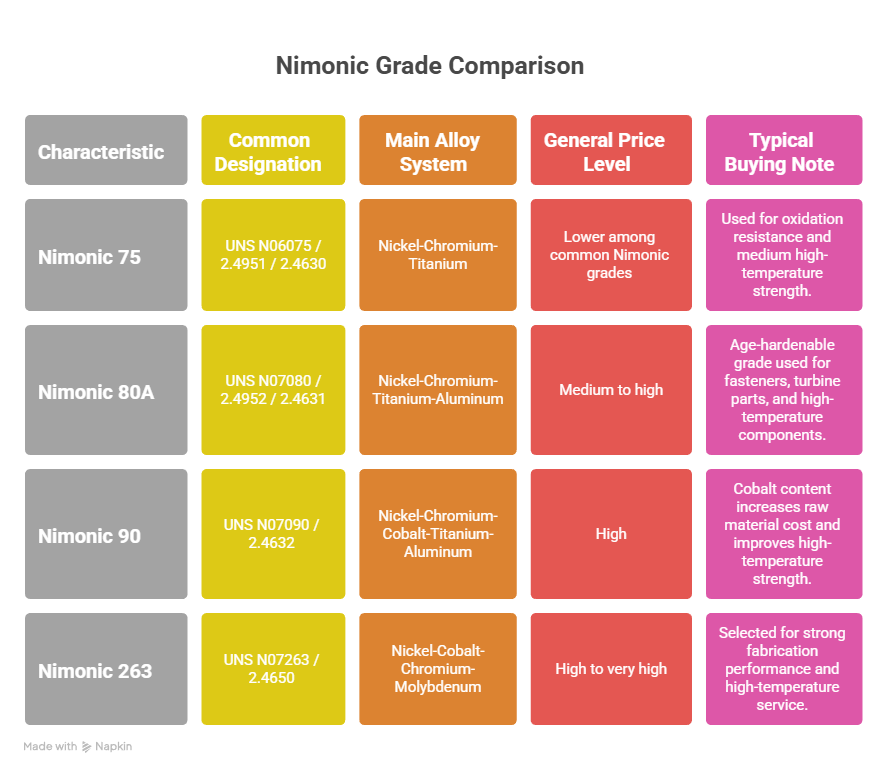
Different Nimonic grades have different price levels because their chemical composition, heat treatment method, mechanical properties, and supply difficulty are not the same. Nimonic 75 is usually more economical than age-hardenable grades because it is a nickel-chromium alloy with relatively simpler chemistry. Nimonic 80A and Nimonic 90 are usually more expensive because they contain titanium and aluminum for precipitation hardening, and Nimonic 90 also contains cobalt. Nimonic 263 is usually a higher-cost alloy because it contains cobalt and molybdenum and is used for demanding high-temperature applications.
| Nimonic Grade | Common Designation | Main Alloy System | General Price Level | Typical Buying Note |
|---|---|---|---|---|
| Nimonic 75 | UNS N06075 / 2.4951 / 2.4630 | Nickel-Chromium-Titanium | Lower among common Nimonic grades | Used for oxidation resistance and medium high-temperature strength. |
| Nimonic 80A | UNS N07080 / 2.4952 / 2.4631 | Nickel-Chromium-Titanium-Aluminum | Medium to high | Age-hardenable grade used for fasteners, turbine parts, and high-temperature components. |
| Nimonic 90 | UNS N07090 / 2.4632 | Nickel-Chromium-Cobalt-Titanium-Aluminum | High | Cobalt content increases raw material cost and improves high-temperature strength. |
| Nimonic 263 | UNS N07263 / 2.4650 | Nickel-Cobalt-Chromium-Molybdenum | High to very high | Selected for strong fabrication performance and high-temperature service. |
Simple Price Logic
For a buyer, the easiest way to understand Nimonic price difference is to look at alloy complexity. More cobalt, molybdenum, titanium, aluminum, stricter heat treatment, and stricter testing usually mean higher price. A standard Nimonic 75 sheet may be much cheaper than a small batch of Nimonic 263 forged bar with ultrasonic testing and third-party inspection.
Nimonic Price Per Kg: General Market Reference
Nimonic price per kg changes with raw material cost, supplier stock, country of origin, order quantity, product form, and certificate requirement. Public online prices can only be used as a rough reference. They are not final factory quotations because they may not include cutting, heat treatment, inspection, packing, export documents, freight, bank charges, or updated raw material surcharges.
| Nimonic Grade | General Reference Price Range | Common Product Form | Important Note |
|---|---|---|---|
| Nimonic 75 | About USD 25 – 45/kg for common commercial supply | Sheet, plate, bar, strip, wire | Price may be lower for large stock orders and higher for certified small orders. |
| Nimonic 80A | About USD 30 – 55/kg for common commercial supply | Bar, wire, sheet, plate, fastener material | Heat treatment and mechanical testing can increase price. |
| Nimonic 90 | About USD 35 – 65/kg for common commercial supply | Bar, sheet, wire, forgings | Cobalt content and high-temperature performance requirements affect cost. |
| Nimonic 263 | About USD 45 – 90/kg for common commercial supply | Plate, sheet, bar, forgings, wire | Higher alloying content, availability, and certification level may increase cost. |
| Special Nimonic parts | Quoted case by case | Machined parts, rings, fasteners, custom forgings | Final price depends on drawing, machining, tolerance, testing, and lead time. |
These price ranges are only reference values for website content and buyer understanding. Real quotations should be confirmed according to current nickel, cobalt, chromium, and molybdenum prices, as well as actual stock and production conditions.
Why Online Prices Can Be Misleading
Many online listings use low starting prices to attract inquiries. The listed price may apply only to a specific size, large quantity, old stock, simple product form, or non-critical commercial condition. When a buyer asks for AMS, ASTM, EN, MTC, ultrasonic testing, heat treatment, or precision tolerance, the final price may be different.
Main Factors Affecting Nimonic Price Per Kg
The price of Nimonic alloy is mainly affected by raw material cost, grade, product form, size, quantity, tolerance, heat treatment, testing requirements, surface condition, and delivery time. Buyers should not compare Nimonic price only by grade name. Two offers for “Nimonic 80A bar” may look very different because one is black hot rolled bar and the other is precision ground, aged, tested, and cut-to-length material.
Grade and Chemical Composition
Grade is the first factor. Nimonic 75 is usually less expensive than Nimonic 80A, Nimonic 90, or Nimonic 263 because it has a simpler alloy system. Nimonic 90 and Nimonic 263 can be more expensive because they contain cobalt, and Nimonic 263 also contains molybdenum.
Product Form
Bar, plate, sheet, wire, pipe, tube, and forging all have different processing routes. Wire drawing, precision grinding, forging, heat treatment, and machining add cost. For the same grade, small diameter wire or close-tolerance ground bar may have a higher price per kg than standard plate or hot rolled bar.
Order Quantity
Small orders usually have higher unit prices because of minimum production charges, cutting loss, certificate cost, packing cost, and handling cost. Larger orders may have better unit prices, but they may require longer production time if the material is not in stock.
Inspection and Certification
Material test certificate, chemical analysis, tensile test, hardness test, ultrasonic testing, PMI testing, third-party inspection, and special traceability can all increase cost. For aerospace, turbine, and pressure equipment applications, these requirements are often necessary.
| Cost Factor | How It Affects Nimonic Price | Buyer Suggestion |
|---|---|---|
| Raw material market | Nickel, cobalt, chromium, titanium, and molybdenum prices change frequently. | Confirm quotation validity before placing an order. |
| Grade | Higher alloy content usually means higher cost. | Choose the grade according to service temperature and load. |
| Product form | Wire, ground bar, forgings, and custom parts usually cost more. | Use standard form when possible to reduce cost. |
| Size and tolerance | Tight tolerance and special dimensions add processing cost. | Provide clear drawings and realistic tolerances. |
| Heat treatment | Solution treatment, aging, or special condition increases cost and time. | State the exact delivery condition in the inquiry. |
| Testing | Mechanical testing, UT, PMI, and third-party inspection add cost. | List required tests before quotation. |
| Lead time | Urgent orders may require stock sourcing or faster processing. | Confirm delivery schedule early. |
Nickel, Cobalt, Chromium, and Titanium Content Impact on Price
Nimonic alloys are expensive mainly because they contain high-value alloying elements. Nickel is the base element. Chromium improves oxidation and corrosion resistance. Titanium and aluminum allow some grades to be precipitation hardened. Cobalt and molybdenum improve high-temperature strength but also raise raw material cost.
Nickel Cost Impact
Nickel is the largest cost base for most Nimonic alloys. When nickel price rises, Nimonic alloy price usually follows. Because Nimonic alloys often contain more than 50% nickel, raw material fluctuation can directly affect quotation.
Cobalt Cost Impact
Cobalt has a strong impact on Nimonic 90 and Nimonic 263 price. Cobalt improves high-temperature strength and creep resistance, but it is expensive and its market price can fluctuate sharply. This is one reason Nimonic 90 and Nimonic 263 are generally higher-priced than Nimonic 75.
Chromium Cost Impact
Chromium improves oxidation resistance and high-temperature corrosion resistance. Its cost impact is smaller than nickel or cobalt in many cases, but it still affects total alloy cost, especially for nickel-chromium high-temperature materials.
Titanium and Aluminum Cost Impact
Titanium and aluminum are important for precipitation-hardenable Nimonic grades such as Nimonic 80A and Nimonic 90. These elements help create high-temperature strength after aging treatment. Their cost impact is not only from raw material value, but also from the need for controlled melting and heat treatment.
| Element | Role in Nimonic Alloy | Price Impact |
|---|---|---|
| Nickel | Base matrix for high-temperature strength and corrosion resistance | Very high impact because it is the main element. |
| Cobalt | Improves high-temperature strength and creep resistance | Strong impact, especially in Nimonic 90 and 263. |
| Chromium | Improves oxidation and corrosion resistance | Moderate impact. |
| Titanium | Supports precipitation hardening | Moderate impact, but important for heat-treated grades. |
| Aluminum | Supports precipitation hardening and oxidation resistance | Moderate impact and important for performance control. |
| Molybdenum | Improves strength and high-temperature performance | High impact in grades that contain it, such as Nimonic 263. |
Nimonic 75 Price Per Kg
Nimonic 75 is usually one of the more economical Nimonic grades. It is a nickel-chromium alloy with controlled titanium and carbon additions. It is commonly used for sheet-metal fabrications, gas turbine components, furnace parts, heat treatment fixtures, and applications requiring oxidation resistance and medium strength at high temperature.
Reference Price of Nimonic 75
For general commercial supply, Nimonic 75 price per kg may commonly appear around USD 25 – 45/kg, depending on size, product form, quantity, origin, and certificate requirement. Some public supplier pages may show lower or higher reference prices, but actual factory quotation must be confirmed according to real stock and production condition.
Why Nimonic 75 Is Usually More Economical
Nimonic 75 does not contain high cobalt like Nimonic 90 or Nimonic 263. Its composition is relatively simpler, so the raw material cost is often lower. It is a good option when the buyer needs oxidation resistance and medium high-temperature strength rather than maximum creep strength.
Common Nimonic 75 Product Forms
| Product Form | Typical Price Level | Reason |
|---|---|---|
| Nimonic 75 Sheet | Medium | Common product form for fabricated high-temperature parts. |
| Nimonic 75 Plate | Medium to high | Thicker plate may require more rolling and cutting cost. |
| Nimonic 75 Bar | Medium | Price depends on diameter, surface, and tolerance. |
| Nimonic 75 Wire | Medium to high | Wire drawing and coil control add processing cost. |
Nimonic 80A Price Per Kg
Nimonic 80A is an age-hardenable nickel-chromium alloy strengthened by titanium and aluminum. It is widely used for high-temperature bolts, exhaust valves, turbine parts, fasteners, springs, and components requiring higher strength than Nimonic 75.
Reference Price of Nimonic 80A
Nimonic 80A price per kg is usually higher than Nimonic 75 because it is precipitation hardenable and requires more controlled chemistry and heat treatment. For general commercial supply, a common reference range may be about USD 30 – 55/kg. Precision bar, aged condition, wire, fastener stock, or special certificates may increase the price.
Why Heat Treatment Affects Nimonic 80A Price
Nimonic 80A often needs solution treatment and aging to obtain required mechanical properties. If the buyer requires a specific aged condition, tensile strength, yield strength, hardness, or stress-rupture performance, the supplier must include heat treatment and testing costs in the quotation.
Common Uses That Affect Price
When Nimonic 80A is used for high-temperature fasteners, bar quality becomes important. Buyers may request peeled bar, ground bar, straightness control, ultrasonic testing, mechanical testing, or special marking. These requirements increase cost compared with standard commercial bar.
| Nimonic 80A Requirement | Price Impact | Reason |
|---|---|---|
| Annealed bar | Lower to medium | Suitable for further machining or heat treatment. |
| Solution treated and aged bar | Higher | Additional heat treatment and testing may be required. |
| Precision ground bar | Higher | Tighter tolerance and surface processing increase cost. |
| Fastener-quality material | Higher | May require stricter mechanical properties and traceability. |
Nimonic 90 Price Per Kg
Nimonic 90 is a precipitation-hardenable nickel-chromium-cobalt alloy. It is known for high stress-rupture strength, creep resistance, and high-temperature performance. It is used for turbine blades, turbine discs, hot-working tools, high-temperature springs, rings, and aerospace-related components.
Reference Price of Nimonic 90
Nimonic 90 price per kg is commonly higher than Nimonic 75 and often higher than Nimonic 80A because it contains cobalt and is used in more demanding applications. A general commercial reference range may be about USD 35 – 65/kg, while special aerospace-grade material, forged bar, or certified heat-treated stock can be higher.
Why Nimonic 90 Costs More
The cobalt content is one of the main reasons. Cobalt improves high-temperature strength and creep resistance, but it increases raw material cost. Nimonic 90 is also frequently used in critical applications, which means buyers may need more testing, better traceability, and stricter material control.
When Nimonic 90 Is Worth the Higher Price
Nimonic 90 is worth considering when the part must resist high-temperature stress and creep deformation. If the application only needs oxidation resistance with moderate strength, Nimonic 75 or Inconel 601 may be more economical. If the part needs high stress-rupture strength, Nimonic 90 can justify its higher price.
| Application | Why Nimonic 90 Is Used | Cost Note |
|---|---|---|
| Turbine blades | High-temperature strength and creep resistance | Requires strict material quality and certification. |
| Turbine discs | Stress-rupture strength | Forging and testing can increase cost. |
| High-temperature springs | Strength retention under heat | Wire condition and temper affect price. |
| Hot-working tools | Strength and oxidation resistance | Bar size and heat treatment affect cost. |
Nimonic 263 Price Per Kg
Nimonic 263 is a nickel-cobalt-chromium-molybdenum alloy with good fabrication characteristics and strong high-temperature performance after aging. It is often used for gas turbine components, combustion systems, fabricated sheet parts, rings, casings, ducting, and other hot-section applications.
Reference Price of Nimonic 263
Nimonic 263 price per kg is usually among the higher Nimonic grades because it contains cobalt and molybdenum and is often required for demanding high-temperature applications. A general commercial reference range may be about USD 45 – 90/kg. For large forgings, aerospace-grade materials, special plate sizes, or strict testing requirements, the price may be higher.
Why Nimonic 263 Has a Higher Price Level
Nimonic 263 contains high-value alloying elements and is often used where weldability, forming, ductility, and aged strength must be balanced. The production route may involve controlled melting, rolling, forging, solution treatment, aging, and mechanical testing. These steps increase the final cost compared with simpler nickel-chromium alloys.
When to Choose Nimonic 263
Nimonic 263 is selected when the part needs high-temperature strength but also requires good fabrication or welding characteristics. If a project involves complex fabricated parts, hot gas ducts, combustion components, or turbine structures, Nimonic 263 may be more suitable than some harder-to-fabricate high-strength alloys.
| Nimonic 263 Product | Typical Price Level | Reason |
|---|---|---|
| Sheet | High | Used for fabricated hot-section parts and may require strict flatness. |
| Plate | High to very high | Thick plate and special sizes require more controlled production. |
| Bar | High | Diameter, tolerance, surface condition, and heat treatment affect price. |
| Forgings | Very high | Forging ratio, testing, and machining allowance add cost. |
Nimonic Bar, Plate, Sheet, Wire, and Pipe Price Differences
The product form has a major influence on Nimonic price per kg. Buyers sometimes compare only grade names, but a Nimonic 80A wire price and a Nimonic 80A bar price may be very different because the manufacturing process is different.
Nimonic Bar Price
Nimonic bar price depends on diameter, length, surface condition, tolerance, straightness, heat treatment, and testing. Hot rolled or forged black bar is usually cheaper than peeled, polished, or centerless ground bar. Fastener-quality bar may require tighter control and higher price.
Nimonic Plate Price
Nimonic plate price depends on thickness, width, length, flatness, cutting requirement, surface condition, and stock availability. Thick plate may require more production time and may be more expensive if the grade is not commonly stocked.
Nimonic Sheet Price
Nimonic sheet is often used in fabricated high-temperature parts. Thin sheet may require cold rolling, annealing, pickling, and careful surface inspection. Sheet price per kg can be higher when thickness tolerance or surface quality is strict.
Nimonic Wire Price
Nimonic wire can be expensive because wire drawing, coil control, surface finish, diameter tolerance, and temper control require additional processing. Wire used for springs or fasteners may require specific mechanical properties.
Nimonic Pipe and Tube Price
Nimonic pipe and tube price depends on whether the tube is seamless or welded, wall thickness, diameter, length, surface finish, testing, and dimensional tolerance. Small quantity tube orders may be expensive if special production is required.
| Product Form | Relative Price Level | Main Cost Drivers |
|---|---|---|
| Bar / Rod | Medium to high | Diameter, surface, tolerance, heat treatment, UT testing. |
| Plate | Medium to very high | Thickness, size, cutting, flatness, availability. |
| Sheet | Medium to high | Thickness tolerance, surface quality, annealing, pickling. |
| Wire | High | Drawing, diameter tolerance, temper, coil condition. |
| Pipe / Tube | High | Seamless or welded process, wall thickness, testing, dimensional control. |
| Forging | High to very high | Forging ratio, heat treatment, machining allowance, UT inspection. |
How Size, Quantity, and Tolerance Affect Nimonic Cost
Size, quantity, and tolerance can change Nimonic cost significantly. A standard stock size is usually easier and cheaper to supply. A special diameter, non-standard thickness, close tolerance, or small batch order may increase the price per kg.
Size Impact
Large diameter bars, thick plates, thin precision sheets, and small diameter wires may all require special processing. If the size is not in stock, production lead time and cost may increase. Buyers can sometimes reduce cost by using a nearby stock size and machining it to the final dimension.
Quantity Impact
Small quantities often have higher unit costs because fixed costs are spread over fewer kilograms. These fixed costs include material preparation, cutting, testing, documentation, packing, and export handling. Larger quantities may reduce price per kg, but only if raw material and production capacity are available.
Tolerance Impact
Tight tolerances increase production cost. For example, a black forged bar with rough tolerance is cheaper than a centerless ground bar with tight diameter tolerance. If the final part will be heavily machined, buyers may not need expensive precision ground material.
| Requirement | Cost Impact | Practical Suggestion |
|---|---|---|
| Standard stock size | Lower | Use stock dimensions when possible. |
| Special size | Higher | Confirm MOQ and production time early. |
| Small quantity | Higher unit price | Combine sizes or increase order quantity if practical. |
| Large quantity | Better unit price possible | Ask for production schedule and batch delivery options. |
| Tight tolerance | Higher | Use only where function requires it. |
| Precision surface | Higher | Specify peeled, polished, or ground only when necessary. |
Heat Treatment and Delivery Condition Impact on Price
Heat treatment is an important cost factor for many Nimonic grades. Some grades are supplied annealed, while others may require solution treatment, aging, or precipitation hardening to achieve required mechanical properties. Heat treatment affects not only price but also delivery time and testing requirements.
Annealed Condition
Annealed material is often easier to form and machine. For sheet, plate, and some bar products, annealed condition may be selected when the buyer will continue fabrication after delivery. Annealed material may be more economical than fully aged material if final heat treatment is done by the customer.
Solution Treated Condition
Solution treatment is used for certain age-hardenable grades. It prepares the microstructure for later aging and can improve workability before final strengthening. If the order requires certified solution treatment, furnace control and testing costs may be included.
Aged or Precipitation-Hardened Condition
Aged Nimonic material has higher strength but usually costs more because of additional heat treatment time, furnace cost, and mechanical testing. For Nimonic 80A and Nimonic 90, aged condition is common when the final part requires high strength at elevated temperature.
Delivery Condition Must Be Clear
When requesting a quotation, buyers should avoid only writing “Nimonic bar price.” It is better to specify “Nimonic 80A round bar, solution treated and aged, peeled surface, with MTC and tensile test.” Clear delivery conditions help the supplier quote correctly.
| Condition | Price Impact | Suitable Use |
|---|---|---|
| Annealed | Lower to medium | Further forming, machining, or fabrication. |
| Solution treated | Medium | Preparation for aging or controlled delivery condition. |
| Solution treated and aged | Higher | High-strength finished or near-finished parts. |
| Cold worked | Higher | Wire, springs, and strength-controlled components. |
| Custom heat treatment | Higher | Aerospace, turbine, or customer-specific applications. |
Nimonic Price Compared with Inconel and Hastelloy Alloys
Nimonic alloys are often compared with Inconel and Hastelloy alloys because all three groups are nickel-based materials. However, the price difference depends on grade and application. Nimonic is often used for high-temperature strength and creep resistance. Inconel grades may focus on high-temperature oxidation, corrosion resistance, or precipitation strength. Hastelloy grades usually focus more on corrosion resistance in aggressive chemical environments.
Nimonic vs Inconel Price
Some Inconel grades, such as Inconel 600 and Inconel 601, may be more economical and easier to source than Nimonic 90 or Nimonic 263. Inconel 718 may be similar or higher depending on standard, heat treatment, and aerospace certification. If the buyer needs high-temperature fasteners or turbine-related parts, Nimonic 80A or Nimonic 90 may be preferred over general Inconel grades.
Nimonic vs Hastelloy Price
Hastelloy alloys such as C-276, C-22, and X can be expensive because they contain nickel, molybdenum, chromium, cobalt, or tungsten depending on grade. Hastelloy is usually selected for corrosion resistance or high-temperature oxidation depending on grade. Nimonic is usually selected for high-temperature strength, creep resistance, and turbine service. The cheaper material is not always the better choice because service failure can cost much more than material savings.
Selection Should Follow Application, Not Price Alone
If the application involves hot gas, creep, turbine service, and high-temperature load, Nimonic may be more suitable. If the application involves strong acid corrosion, Hastelloy may be better. If the application requires general oxidation resistance and easier availability, Inconel 601 or Inconel 600 may be more practical.
| Alloy Family | Main Strength | Typical Price Position | Best Use |
|---|---|---|---|
| Nimonic | High-temperature strength, creep resistance, oxidation resistance | Medium-high to very high | Turbine parts, hot fasteners, springs, exhaust systems. |
| Inconel | Oxidation resistance, corrosion resistance, high-temperature performance | Medium to high depending on grade | Furnace parts, chemical equipment, fasteners, aerospace parts. |
| Hastelloy | Strong corrosion resistance or high-temperature oxidation depending on grade | High to very high | Chemical processing, acid environments, severe corrosion service. |
How to Get an Accurate Nimonic Quotation from a Supplier
To get an accurate Nimonic quotation, buyers should provide complete technical information. A vague inquiry such as “Nimonic price per kg” is not enough because the supplier cannot know the grade, size, condition, quantity, and testing requirements.
Information Needed for Quotation
| Inquiry Item | Example | Why It Matters |
|---|---|---|
| Grade | Nimonic 75, 80A, 90, 263 | Different grades have different alloy cost and standards. |
| Product form | Bar, plate, sheet, wire, pipe, forging | Processing route affects price. |
| Size | Diameter, thickness, width, length, wall thickness | Determines stock availability and production cost. |
| Quantity | Kg, pieces, meters, coils, sheets | Affects unit price and MOQ. |
| Standard | ASTM, AMS, BS, EN, DIN, customer drawing | Controls chemical and mechanical requirements. |
| Heat treatment | Annealed, solution treated, aged, custom condition | Directly affects mechanical properties and cost. |
| Surface condition | Black, peeled, polished, ground, pickled | Surface processing affects price and lead time. |
| Testing | MTC, PMI, tensile test, hardness, UT, third-party inspection | Inspection cost must be included in quotation. |
| Delivery destination | Country, port, courier address, freight term | Needed for freight and export cost calculation. |
Example of a Clear Nimonic Inquiry
A clear inquiry may read: “Please quote Nimonic 80A round bar, diameter 25 mm, length 3000 mm, solution treated and aged, peeled surface, quantity 200 kg, with MTC and tensile test, delivery to Germany.” This type of inquiry allows the supplier to check material stock, processing cost, certificate requirement, packing, and freight more accurately.
Why Supplier Communication Matters
A reliable supplier should ask about application, standard, condition, size, and testing before giving a final price. If a supplier gives a very low price without confirming these details, buyers should check whether the material is correct, whether certification is included, and whether the quoted price applies to the required condition.
Supplier Notes for Nimonic Price Per Kg
For Nimonic alloy supply, price and technical condition should be discussed together. A lower price may not be useful if the material cannot meet the required heat treatment condition, mechanical properties, or inspection standard. Buyers should compare quotations based on the same grade, size, product form, condition, certificate, and delivery term.
Check Material Certificate
The material test certificate should show grade, heat number, chemical composition, product size, delivery condition, standard, and mechanical properties if required. For critical applications, buyers may also request PMI testing, ultrasonic testing, or third-party inspection.
Check Stock and Lead Time
Some Nimonic sizes are not always available in stock. If the project is urgent, ask the supplier whether the material is ready stock, semi-finished stock, or new production. Stock material may ship faster, but the available condition and size must match the project.
Check Total Cost, Not Only Price Per Kg
For export orders, the final cost includes material price, cutting, testing, packing, export documents, freight, insurance, and customs-related charges. A material price per kg may look attractive, but the total landed cost can be different after all charges are included.
Nimonic Price Per Kg Related Questions
What is the price of Nimonic per kg?
Nimonic price per kg usually ranges from about USD 30/kg to more than USD 80/kg depending on grade, product form, size, quantity, heat treatment, testing, and market conditions. Nimonic 75 is often more economical, while Nimonic 90 and Nimonic 263 are usually higher because of cobalt, molybdenum, and stricter high-temperature performance requirements.
Why is Nimonic 80A expensive?
Nimonic 80A is expensive because it is a precipitation-hardenable nickel-chromium alloy strengthened by titanium and aluminum. It often requires controlled melting, heat treatment, mechanical testing, and traceability. If the material is supplied as aged bar, precision wire, fastener stock, or certified aerospace-grade material, the price per kg can be higher.
Which Nimonic grade is cheapest?
Among common grades, Nimonic 75 is usually one of the more economical Nimonic alloys because it has a simpler nickel-chromium composition and does not contain high cobalt like Nimonic 90 or Nimonic 263. However, the final price still depends on product form, size, quantity, surface condition, certificate, and stock availability.


 English
  Korean
  Japanese
  Arabic
  Spanish
  German
  Portuguese
  French
  Russian
  Italian