

Nimonic 90 round bar price is one of the most sensitive pricing topics in the nickel-based superalloy market. Unlike commodity metals, Nimonic 90 is heavily influenced by aerospace certification requirements, heat treatment condition, processing route, and delivery urgency. Buyers searching this keyword are typically in the RFQ (Request for Quotation) stage, meaning they are already comparing suppliers, specifications, and lead times rather than just looking for general information. Because of this, pricing is rarely standardized and can vary significantly even for the same nominal specification.
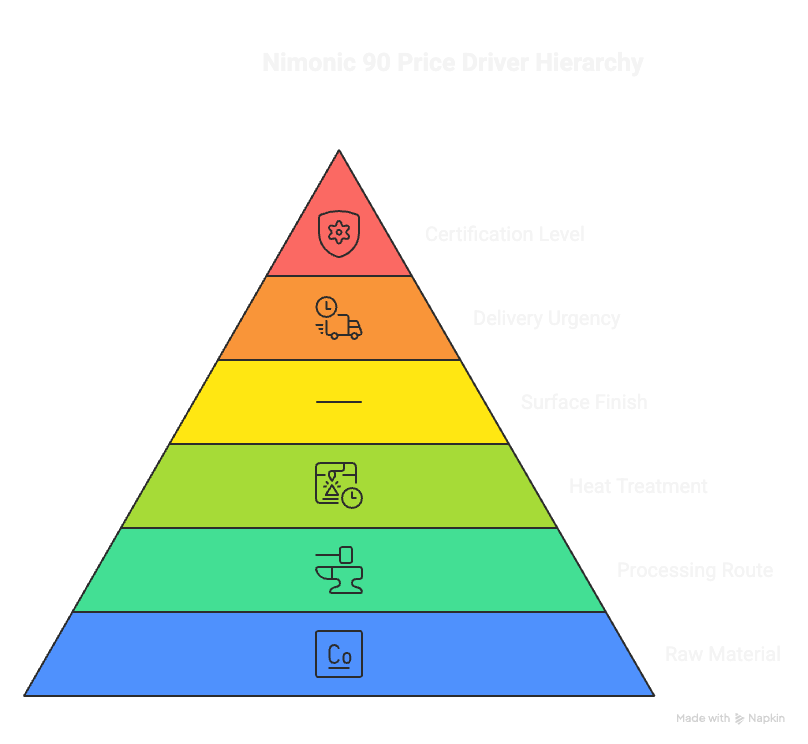
Aerospace Certification Is the Biggest Price Driver for Nimonic 90 Round Bar
The presence of aerospace certification such as AMS standards is often the single largest factor influencing Nimonic 90 price. Certified material requires full traceability, controlled melting routes (VIM/VAR), strict chemical composition verification, and detailed mechanical testing reports.
| Certification Level | Price Impact |
|---|---|
| Industrial Grade | Base level |
| ASTM / EN Certified | +20% to +50% |
| AMS Aerospace Grade | +80% to +200% |
In many real-world cases, certification cost can exceed raw material cost impact.
Same Grade Can Differ 2–3x Depending on Diameter Range
Nimonic 90 round bar pricing is highly sensitive to diameter. Smaller diameters require more drawing passes and tighter dimensional control, while larger diameters involve heavier forging and longer machining cycles.
| Diameter Range | Relative Cost |
|---|---|
| <10 mm | Very High |
| 10–50 mm | Medium |
| >50 mm forged bar | High (forging dependent) |
Cobalt Content Makes Nimonic 90 More Sensitive to Raw Material Fluctuation
Nimonic 90 contains cobalt as a key strengthening element. Cobalt is a high-volatility strategic metal, and its market price changes can directly influence alloy pricing. When cobalt rises, Nimonic 90 often increases faster than nickel-only alloys.
Forged Bar and Rolled Bar Are Priced in Completely Different Tiers
Processing route significantly affects cost. Rolled bar is generally more economical, while forged bar requires additional heating cycles, press operations, and machining allowance.
| Product Type | Price Level |
|---|---|
| Hot Rolled Bar | Lower |
| Cold Drawn Bar | Higher |
| Forged Bar | Highest |
Small MOQ Orders Usually Break Standard Price Logic
Low-volume orders (for example 1–50 kg) are usually priced far higher per kilogram because fixed production costs, cutting losses, and handling charges are distributed over a smaller weight base. This is why MOQ is a critical pricing variable in quotations.
Heat Treatment Condition Can Change Cost More Than Alloy Composition
Nimonic 90 requires controlled heat treatment to achieve its final mechanical properties. Solution treatment and aging processes increase furnace time and energy consumption. In some cases, heat treatment adds more cost than alloying element variation.
Stock Material vs Production Material Has Separate Pricing Systems
Stock material pricing includes inventory holding cost, storage risk, and immediate availability premium. Production pricing is lower but depends on lead time and batch scheduling.
Cutting Tolerance Requirement Directly Increases Unit Price
Tighter dimensional tolerances require additional machining, grinding, and inspection. This increases scrap rate and production time, especially for aerospace-grade bars.
Testing Requirements (UT / PMI / AMS) Are Often Hidden Cost Factors
Non-destructive testing (UT), Positive Material Identification (PMI), and full aerospace documentation packages can significantly increase total cost. Many low initial quotes exclude these services.
Fast Delivery Requests Usually Push Price Higher Than Material Itself
Expedited production schedules often require priority furnace allocation or stock reservation. In urgent cases, logistics (air freight) can cost more than material processing differences.
Bright Surface Finish Costs Significantly More Than Black Bar Condition
| Surface Condition | Price Impact |
|---|---|
| Black Hot Rolled | Lowest |
| Turned / Peeled | Medium |
| Bright Drawn | Highest |
Bright bars require multiple finishing passes and stricter surface quality control.
Export Compliance Adds Extra Cost in EU/US Supply Chains
Export markets such as Europe and the United States require stricter documentation, traceability, and compliance checks, which increase final landed cost.
China Pricing Is Lower but Depends Heavily on Certification Level
Chinese suppliers often offer competitive base pricing, but cost increases significantly when aerospace certification, third-party inspection, or strict AMS compliance is required.
Buyers Often Compare Nimonic 90 With Inconel 718, Not Other Nimonic Grades
In procurement decisions, Nimonic 90 is frequently compared with Inconel 718 due to similar high-temperature applications. However, Inconel 718 generally offers higher strength, while Nimonic 90 performs well in oxidation resistance environments.
Price Negotiation Is Usually Driven by Lead Time, Not Raw Material Cost
In real transactions, delivery time flexibility often has more impact on final pricing than fluctuations in nickel or cobalt markets.
Most Searches for This Keyword Are RFQ-Stage Buyers
Users searching “Nimonic 90 round bar price” are typically ready to purchase or request quotations. Their focus is usually on supplier comparison, availability, certification, and delivery terms rather than basic material education.
Frequently Asked Questions About Nimonic 90 Round Bar Price
Why is Nimonic 90 more expensive than other nickel alloys?
Because it contains cobalt and requires aerospace-level processing and testing in many applications.
What is the main factor affecting Nimonic 90 price?
Certification level (especially AMS), followed by diameter and heat treatment condition.
Is forged Nimonic 90 always better than rolled bar?
Forged bar has better mechanical properties, but it is not always required depending on application and cost target.


 English
  Korean
  Japanese
  Arabic
  Spanish
  German
  Portuguese
  French
  Russian
  Italian